The question of when the phrase Men’s Human Rights Movement was first coined continues to crop up in conversations in the manosphere and beyond, with conflicting claims. So this post is designed to set the record straight.
It’s worth stating that the shorter phrase human rights has been in use in relation to men’s issues for several decades, by a number of people, so the idea of thinking about the human rights of men is certainly nothing new nor original. However no one to my knowledge had coined the longer phrase Men’s Human Rights Movement until January 2013 when I raised it in an email exchange between Paul Elam and myself, as detailed here: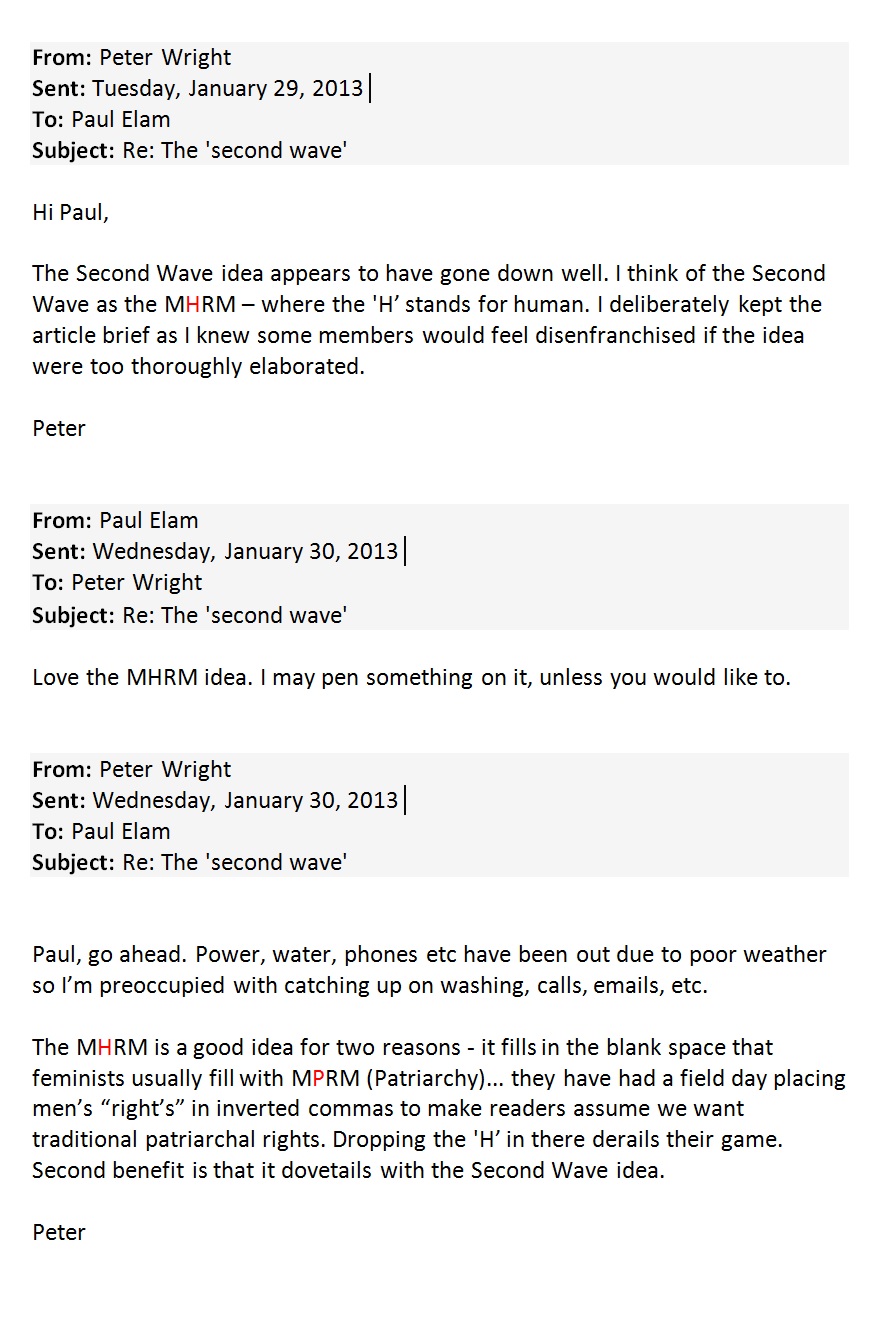 Following that email exchange, Paul Elam went ahead and wrote an article in which he made the following official announcement:
“From this day forward, it is the editorial policy of AVFM to refer to the movement of which we are a part as the Men’s Human Rights Movement, or MHRM.”
[Paul Elam, Entering a New ERA]
As you can see from the date stamps, Paul’s article was published within 24 hours of our above email exchange, and was followed by widespread discussion across the manosphere regarding the pros and cons of the new phrase. The rest as they say is history, and the phrase Men’s Human Rights Movement is now used widely.
With the dated email exchange above, and the inaugural MHRM articles which first promoted the MHRM phrase, the history of the phrase is clarified. While I wouldn’t necessarily be surprised to learn that someone used the phrase before this time, a search of the internet revealed nothing with earlier dates.
As an aside, those who like and use the MHRM phrase might like to check out the following free-use human rights logo. The symbol, which is part bird and part hand (see directly below), is internationally recognized and can be used on blogs and printed materials promote human rights status of many men’s issues.
The Men’s Human Rights Movement (MHRM): A Philosophical Overview
MHRM stands for the Men’s Human Rights Movement (sometimes referred to as MHRA for Men’s Human Rights Advocacy). It is a specific strand of men’s rights advocacy within the broader manosphere. It was framed as a “second wave” of the men’s rights movement, emphasizing human-rights goals and language over earlier approaches.
It is distinct from other manosphere factions (Red Pill communities, pickup artists/Game, MGTOW, or incel spaces), with differences in tone, organization, and core assumptions: MHRM stresses cultural narrative change and human-rights framing rather than purely individual self-help, dating strategies, or fatalistic acceptance of evolutionary psychology claims that often lack sufficient evidence.
Core Values and Principles
Opposition to gynocentrism and male disposability.
Gynocentrism is defined as a dominant or exclusive cultural or practical focus on women, which can originate from either feminist or traditional sources. Male disposability is the expectation that men sacrifice life, health, deference or resources for women, or the community by rote expectation. A central goal of MHRM is to challenge and change the cultural narratives that support this demand. The movement specifically rejects the view, common elsewhere in the manosphere, that extreme female prioritization is an inevitable, hardwired evolutionary feature of human nature. Instead, it treats modern gynocentrism as a historically cultivated and culturally exaggerated pattern—with roots in courtly love traditions and in later developments after the rise of the Industrial era—that can be challenged and changed.
Supports equality of opportunity, rights, choices, and treatment under the law.
This means formal equality: equal protection, the presumption of innocence, and merit-based treatment, not guaranteed equal outcomes. It includes critiques of perceived biases in family courts (custody, alimony, and child support), criminal sentencing, education, health funding, and selective service. Specific positions have even included calls for parallel reproductive choice for men (for example, the ability to opt out of parental financial obligations in a timeframe comparable to women’s abortion window), mandatory paternity testing on demand, and opposition to sex-based affirmative action. None of these concerns are considered essential to the MHRA orientation, but serve as examples of a human rights focus regarding men.
Individual liberty, autonomy, and personal responsibility.
MHRM advocates a greater range of choices for men, including the freedom to reject traditional provider or protector roles, or marriage, without social penalty. It opposes state interference in private consensual adult relationships. There is a strong emphasis on personal accountability, responsibility, and judging people by individual merit rather than group identity. The movement rejects enforced gender roles of any kind—traditional or otherwise—while leaving voluntary choices to individuals.
Cultural narrative change as primary methods.
Advocates prioritize “changing the cultural narrative” (through discourse, media, and exposing perceived double standards and misandry) over direct lobbying or seeking special government programs for men. Laws are assumed to eventually follow cultural shifts. The movement is described as non-partisan and views mainstream left and right options as generally gynocentric; it is neutral on religion.
Human rights framing.
The “human” in MHRM is intentional—to stress that men and boys are human beings entitled to the same consideration as others (not emotionless utilities or disposable assets), and to counter hyperbolic characterizations of the older, ‘first wave’ of the men’s movement as seeking regressive control over women. It draws on broader liberal values of liberty, justice, individualism, and meritocracy, while arguing that these have been unevenly applied by sex.
In essence, MHRM’s self-described values center on anti-gynocentrism (both cultural and evolutionary theories), formal equality under the law, individual liberty and responsibility for men, cultural critique, and a rejection of both enforced traditionalism and gendered double standards—all positioned as a human-rights-oriented alternative within men’s advocacy.