The Spirit of Chivalry – Westminster Hall Exhibition (1845)

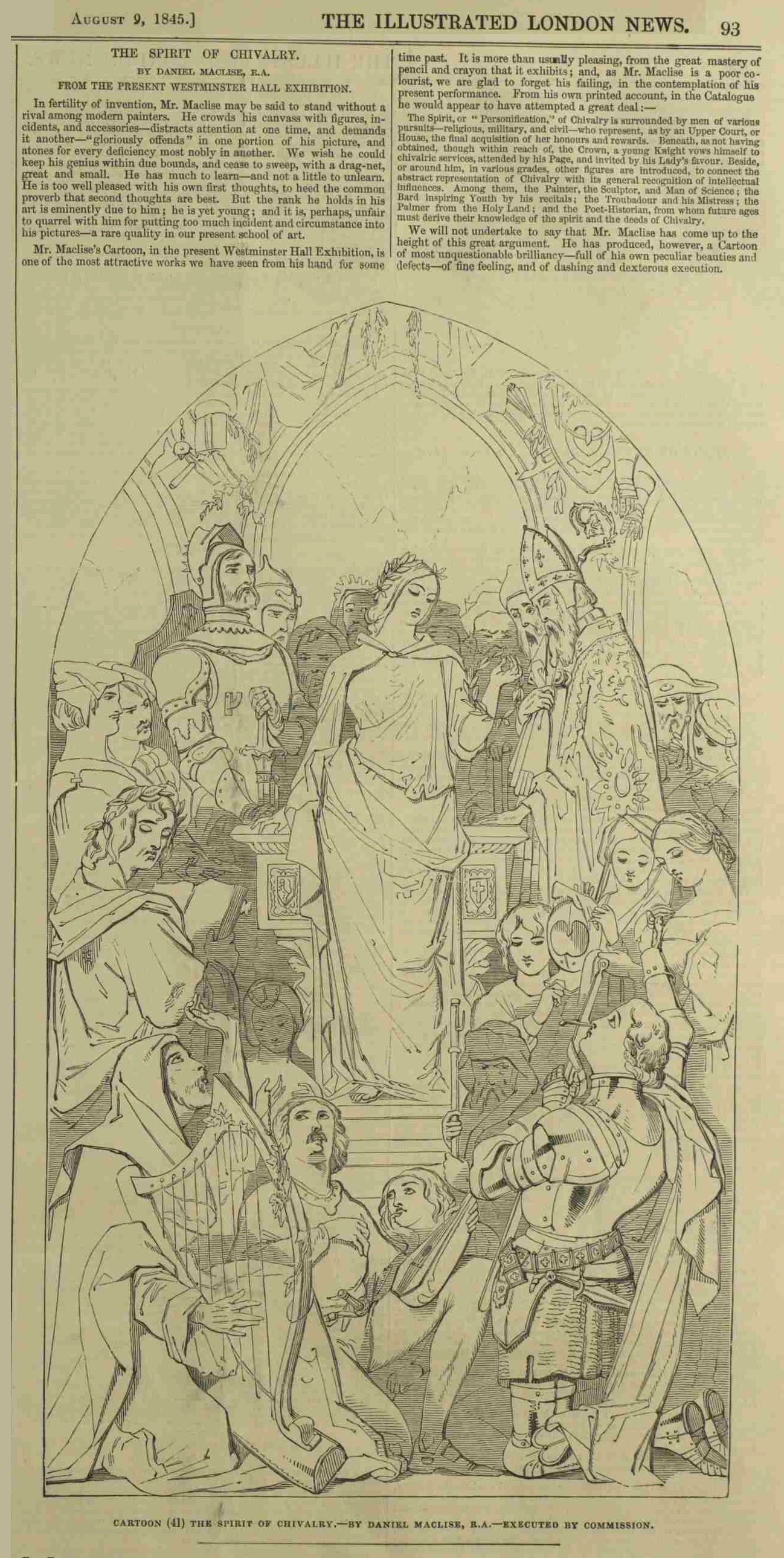
The following graphic depicting the spirit of chivalry was exhibited in Westminster Hall, London, in August 1845. The author of this image describes the scene as follows:
The spirit, or “personification” of Chivalry is surrounded by men of various pursuits — religious, military, and civil — who represent, as by an Upper Court, or House, the final acquisition of her honours and rewards. Beneath, as not having obtained, though within reach of the Crown, a young Knight vows himself to chivalric services, attended by his Page, and invited by his Lady’s favour. Beside, or around him, in various grades, other figures are introduced to connect the abstract representation of Chivalry with its general recognition of intellectual influences. Among them the Painter, the Sculptor, the Man of Science; the Bard inspiring Youth by his recitals; the Troubadour and his Mistress; the Palmer from the Holy Land; and the Poet-Historian, from whom future ages must derive their knowledge of the spirit and the deeds of Chivalry.

American Chivalry (Article – originally published in 1846)

The following article, describing American culture as an epicenter of exaggerated gynocentric chivalry, was published in The London Sun, Wed 11th November, 1846.

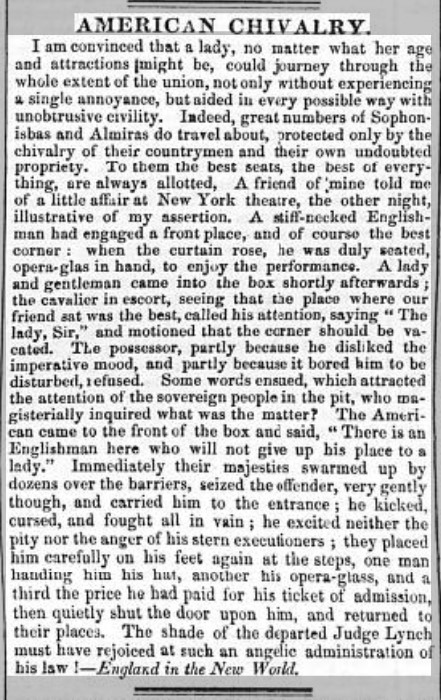
I am convinced that a lady, no matter what her age and attractions might be, could journey through the whole extent of the union, not only without experiencing a single annoyance, but aided in every possible way with unobtrusive civility. Indeed a great number of Saphonisbas and Almiras do travel about, protected only by the chivalry of their countrymen and their own undoubted propriety.

To them the best seats, the best of everything, are always allotted. A friend of mine told me of a little affair at New York Theatre, the other night, illustrative of my assertion. A stiff-necked Englishman had engaged a front place, and of course the best corner: when the curtain rose, he was duly seated, opera-glass in hand, to enjoy the performance. A lady and a gentleman came into the box shortly afterwards; the cavalier in escort, seeing that the place where our friend sat was the best, calling his attention, saying “The lady, sir,” and motioned that the corner should be vacated. The possessor, partly because he disliked the imperative mood, and partly because it bored him to be disturbed, refused. Some words ensued, which attracted the attention of the sovereign people in the pit, who magisterially enquired what was the matter?

The American came to the front of the box and said, “There is an Englishman here who will not give up his place to a lady.” Immediately their majesties swarmed up by dozens over the barriers, seized the offender, very gently though, and carried him to the entrance; he kicked, cursed, and fought all in vain: he excited neither the pity nor the anger of his stern executioners; they placed him carefully on his feet again at the steps, one man handing him his hat, another his opera glass, and a third the price he had paid for his ticket of admission, then quickly shut the door upon him, and returned to their places. The shade of the departed Judge Lynch must have rejoiced at such an angelic administration of his law! – England in the New World.


C.S. Lewis: The Feudalisation of Love

The whole attitude of courtly love has been rightly described as ‘a feudalisation of love’. ~ C.S. Lewis

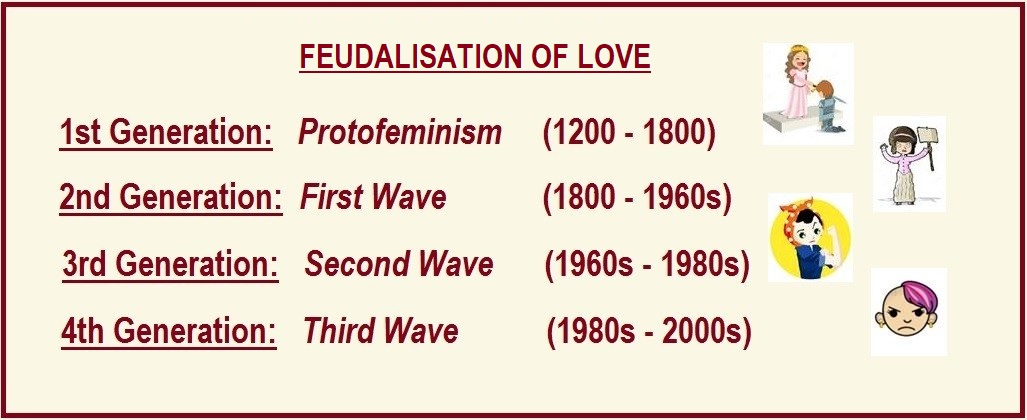
Both liberal-feminism and traditional conservatism can be viewed as two heads of the same Hydra. What common purpose do these rival ideologies actually share? C.S. Lewis captured it perfectly in his phrase “the feudalisation of love.”
 
According to C.S. Lewis, the “feudalisation of love” refers to the medieval innovation in which the feudal contract between lord and vassal was repurposed as a model for relations between men and women. Noblewomen cast themselves in the role of lord (midons in the poetry — etymologically “my lord”), with the man as her vassal. This dynamic is still vividly symbolised today in the iconic image of a man kneeling on one knee to propose, offering his service and devotion.
 
This ambitious social engineering project proved wildly successful. Through centuries of cultural diffusion, the model spread across borders and now governs the vast majority of interactions between men and women globally — such has been its extraordinary power to colonise. Today we simply call it “romantic love.”
 

Lewis states that in comparison with the revolution generated by the feudalisation of love, the Renaissance amounts to a mere ripple on the surface of literature. It forms the internal rationale of post-industrial societies, along with the subsequent waves of feminism which embraced this concept with fervor, applying its principles more aggressively with each iteration of the movement.

.

C.S. Lewis dates the rise of this “feudalisation of love” quite precisely: it appeared suddenly at the end of the eleventh century in France. What began as an elitist fad among the troubadours rapidly spread to the courts of Europe. From there it filtered downward, eventually permeating the imagination of all social classes. Its success was so complete that today the feudalised model is widely regarded as “timeless” and “natural” — a sacrosanct pillar of gender relations now accepted by laypeople and academics alike.
 
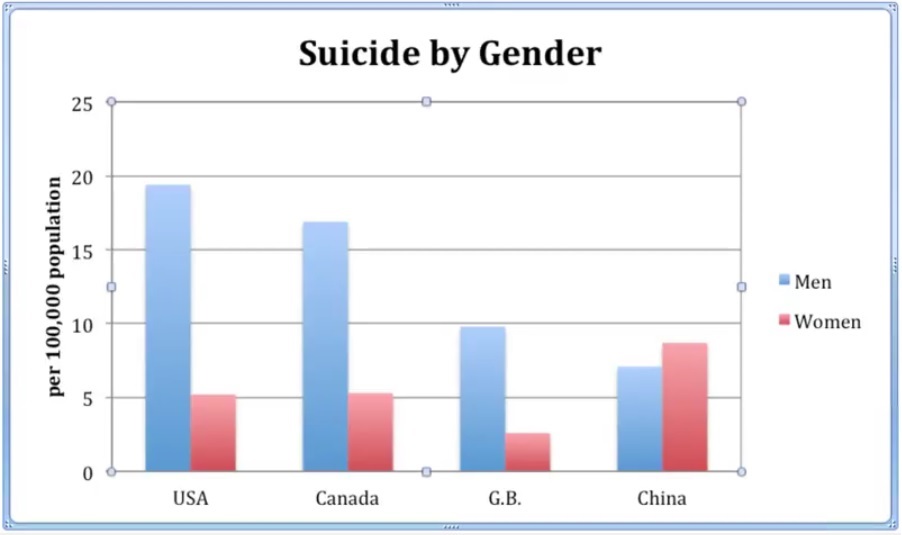
The feudalisation of love is founded on one central principle: male service to women. This arrangement produces systemic poor treatment of males and lies at the root of the many destructive outcomes addressed by men’s advocates. Chief among them is male suicide. Yet even family members, friends, and academics who have lost loved ones to suicide remain reluctant to name the true cause: the gynocentrism and misandry embedded in the feudalisation of love itself.
 
The only major exception occurs in rural China, where female suicide rates have historically exceeded male rates — precisely the region where women have traditionally held lower social value than men. Notably, China is also the country where the feudalisation of love never fully took root. Mao explicitly suppressed it during the Cultural Revolution, denouncing romantic love as a bourgeois and disintegrative cultural product.
 

.

Outside certain parts of Asia, most cultures today are decidedly gynocentric, placing disproportionate value on women’s identities, needs, and wants. While many factors contribute to male suicide, the devaluation of men’s sense-of-self is central. If we dismantled the feudalisation of love and its attendant gynocentrism, the majority of these suicides would theoretically not occur. Men would be buoyed by the one essential ingredient they currently lack: social value. This requires a full-throated rejection of gynocentrism and a deliberate, society-wide revalorisation of men and boys.
 

Those who adhere to the feudalisation of love script in their relationships, please don’t be surprised when it begins to hurt or when tragedy hits. In order to regain your sense of value you will need to divest yourself of it and, in the long run, find alternative models to live by.

__________________________


Gynocentrism: The Real Gender Cult

By Vernon Meigs

In light of the trend of transgender mania and woke and politically correct culture, those on the conservative traditionalist side are keen on throwing around terms like “gender cult.” This gender cult they speak of is that of gender subjectivism, denial of organic attributes of sex, and divorcing the metaphysical and behavioral aspects of sex from the biological real-world component – what progressives would like to call sex assigned at birth.

It’s not that they’re necessarily wrong here, calling this a gender cult. It is; albeit a specialized reactionary one that professes to rebel against gender norms. Ironically enough transgender identity relies on stereotyped ideas about gender to then say they are defying it.

What I want to address is the idiocy of those who claim to be fighting this gender cult, namely the hypocrisy of calling it a gender cult when they as neotraditionalists are likely to indulge and take for granted a gender cult of their own, one which is more massive and has a bigger, more longstanding history than even feminism itself.

Gynocentrism and gyneolatry contain qualities in every way attributable to an actual gender cult. The fact that it actually gave way to feminism, which in turn gave way to political transgender ideology, is evident but conveniently ignored too often by these conservatives. They don’t want to address it because, as practitioners of the gynocentric gender cult, they either are dependent on it to keep the approval of the women in their immediate lives as well as from the public, or suffer from a serious normalized case of Stockholm Syndrome.

Anyway, to the heart of the subject of this article: The gender cult that the traditional conservative promotes and refuses to denounce.

Men are expected to die in wars while the royal class of women are subject to protection by these men. That is a gender cult.

Men are expected, from the point of courtship til well after the divorce, to financially and in effect materially provide for womankind. That is a gender cult.

Men are expected at one day old to have a crucial component of their genitalia ripped off, despite the risk of infection, physical complications that follow, and death, as well as guaranteed psychological trauma manifesting itself at varying degrees later in life — apparently for the sake of anywhere from Sandra Bullock’s, Oprah’s, and Kate Beckinsale’s facial creams to the depraved whims of women sexually attracted to broken manhood. That is a gender cult. Circumcision of baby boys is a gender cult.

Women are regarded as equivalent of nature, designated as the big choosers, and the men as vassals that must commit degrading acts of altruism to earn their attention, this despite the fact that men and women are both choosers and members of nature together. This one-sided attitude is a gender cult.

Families, in particular in North America, favor supporting daughters after adulthood, whereas men are generally kicked out of the house when they reach the age of 18, expected to fend for themselves because “a man should take care of himself” else he gets shamed as a dweller in his parents’ basement with no life. Women categorically reject men at the slightest hint of them receiving assistance in any such way in the dating market, for instance. I call that a gender cult.

To engage in romance a man must first place himself in a position of self-degradation of bending his knee in front of a woman and present her with a hunk of rock, which may or may not be a blood diamond, that he has spent a ridiculous amount of his fortune on. That’s the first edge. What is either a curt rejection and no further regard by the woman for the trouble the man went through or, if she did accept, then the wedding will be even more of a fortune lost on the man’s part and it will be again when the divorce follows, which happens at this point too often to not consider it an event to expect, and practically schedule. Either way, royal woman looks down at vassal man. That is the image of the man going down on his knee and proposing. That is a gender cult.

Violence against men, especially by women, is subject to laughter. The very act of entertaining the idea of violence against women, especially by men, is grounds for ostracism at best, violent retribution at worst. Self-defense is not tolerated even if the man is faced with a rabid crazed blade wielding unhinged psycho woman on a rampage. That is a gender cult.

Happy wife, happy life. If Momma ain’t happy, ain’t nobody happy. Placing women on status of maniacal ruler whose whims must be satisfied else the man’s existence is not justified. That is a gender cult.

To the traditional conservatives out there, and anyone who professes to ally with feminists and other misandrists just so they could own the trans gender cult — this discussion is for you. The gender cult which you profess to wage war on is but a fad compared to the grander gender cult that is gynocentrism that you take for granted and bask in.

I’ll close with something that I want you to get through to your head. Gynocentrism is a gender cult. It is the biggest such cult. Gyneolatry is woman-worshipping in this gender cult. Biogynocentrism is the means of rationalizing it with the alleged argument from biology and evolution in this gender cult. Male disposal is the end goal of this gender cult. Gynocentrism is a gender cult.
MGTOW aligns with an LGBTQIA category: Aromantic

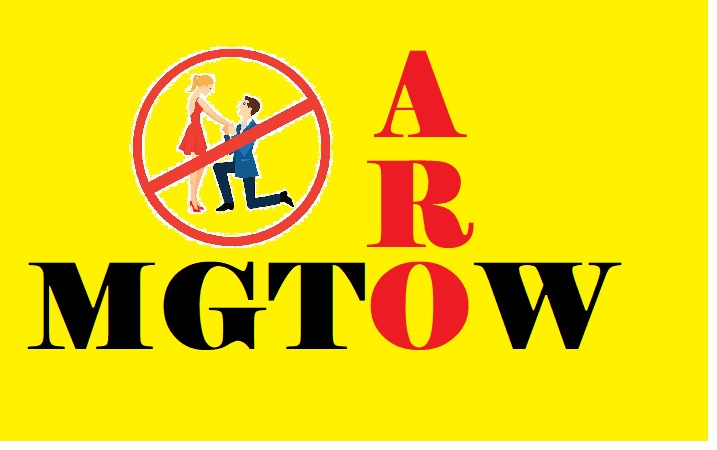
The headline is likely to provoke an emotional reaction from both the woke and the virulently anti-woke, but I stride forth with my flack jacket on in order to make a salient point: that far from being a fringe group of misogynistic terrorists who refuse to court the ladies, MGTOW is perfectly aligned with the LGBTQIA category ‘Aromantic’ – a term indicating a profound disinterest in romantic love.

When it comes to romantic love they simply don’t want it.

I was surprised to learn that the ‘A’ in LGBTQIA can mean either asexual or aromantic, as described in the following LGBTQIA Wiki Fandom definition:

Aromantic, often shortened to aro, describes people who do not experience romantic attraction. One of the meanings of the A in LGBTQIA+ is Aromantic.[1] Aromanticism may involve forms of attraction that are not necessarily romantic, or interests in relationships that are intimate in other ways. There is no singular experience of aromanticism.[3]

The aromantic spectrum, also known as “aro-spec”, ranges from aromantic to alloromantic, the latter referring to people who regularly and consistently experience romantic attraction.[1] People within the aromantic spectrum are part of a community that has much in common. They may use the label aromantic as a close fit for their experiences or use other labels that further describe them.

Men Going Their Own Way are unmoved by the fantasy of romantic love, viewing its latent BDSM overtones as a theatre of female dominatrixes and male subs, a model that has grown from a kind of sexual feudalism instituted by affluent ladies of the medieval era. MGTOW typically reject this model because it requires men to go down on a literal and proverbial knee before a woman. This qualifies MGTOW as Aromantic because, as stated on the LGBTQIA Wiki Fandom page, aromantic individuals “may choose to opt out of anything coded as romantic or feel discomfort with the idea of romantic relations.”


I should add, for the slow of mind, that MGTOW orientation is concerned with a wider array of issues than this. However, the romance problem forms a molten core around which many of their concerns for male self-determination revolve.

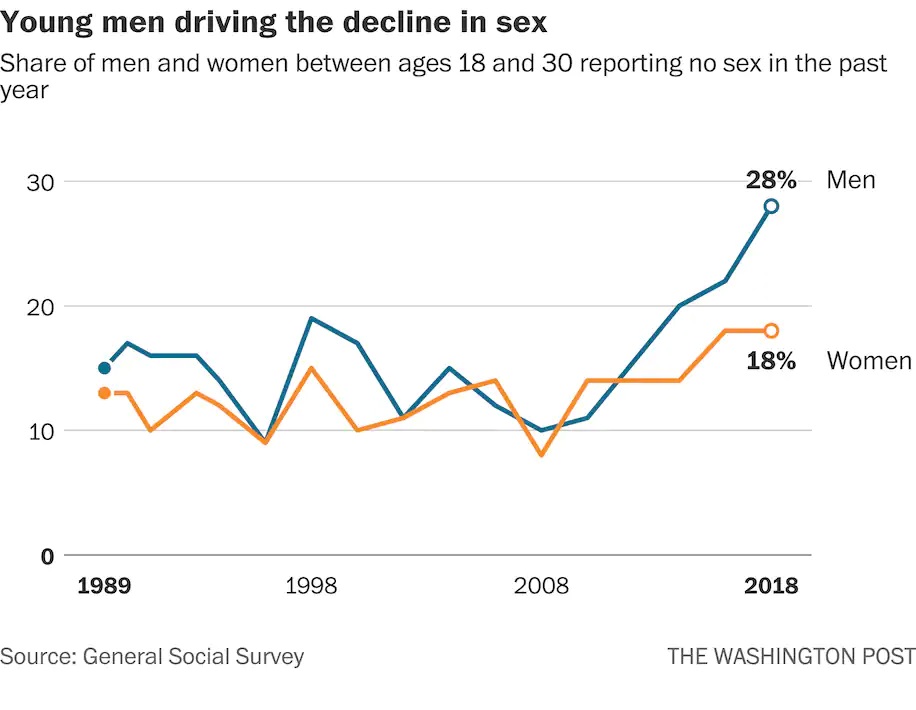
The result of ‘Men going their aromantic way’ is in some ways striking. These men have inaugurated an enduring sex strike, putting quietly into practice what women routinely threaten if they don’t get their own way – as we recently saw from Joy Behar who called for ‘sex strike’ after Supreme Court abortion law leak. As usual it seems men have beaten women to the punch:

As this graph demonstrates, young men are driving a decline in sex.  Perhaps more accurately they may be rejecting the pathological contamination of sexual intimacy with romantic love – aka, the idea that men need to demonstrate obeisance and servitude toward “romantic” partners before being “rewarded” with sex.

The sex slump is not sufficiently explained by labeling reluctant men as ‘involuntary celibates,’ because the yearly baseline for numbers of incels has blown out. A more plausible explanation is that men of the West are becoming increasingly aromantic – much as they did en masse in Japan with the rise of grass eaters. This is certainly true of the growing numbers of MGTOW, who may be interested in other kinds of sex and relationship (casual relationships, intimate friendships, non-romantic intimate partnerships, relationships of peers, etc) but who are no longer moved by the false fairy-tale of romance.

Far from being a fringe group that warrants deplatforming, men going their aromantic way deserve to be embraced as a speshul minority,  deserving of special rights and protections afforded to every other vulnerable demographic. Is it not true that MGTOW are bullied, harassed and treated with extreme bigotry? That should qualify them for special protections and considerations under the law. 

MGTOW probably won’t be entering a Pride float anytime soon, but in theory their cause is every bit as deserving under the umbrella of that one, powerful word – AROMANTIC.