The following 2025 study of ‘The Woman King’ reveals the growth of gynocentrism & gamma bias in modern cinematic productions: Aris, Q., & Syam, E. (2025). Gynocentrism: Female Superiority Propaganda in The Woman King. Rainbow: Journal of Literature, Linguistics and Culture Studies, 14(2), 191-198.
Month: March 2026
Manosphere Archetypes of Gynocentric Thinking
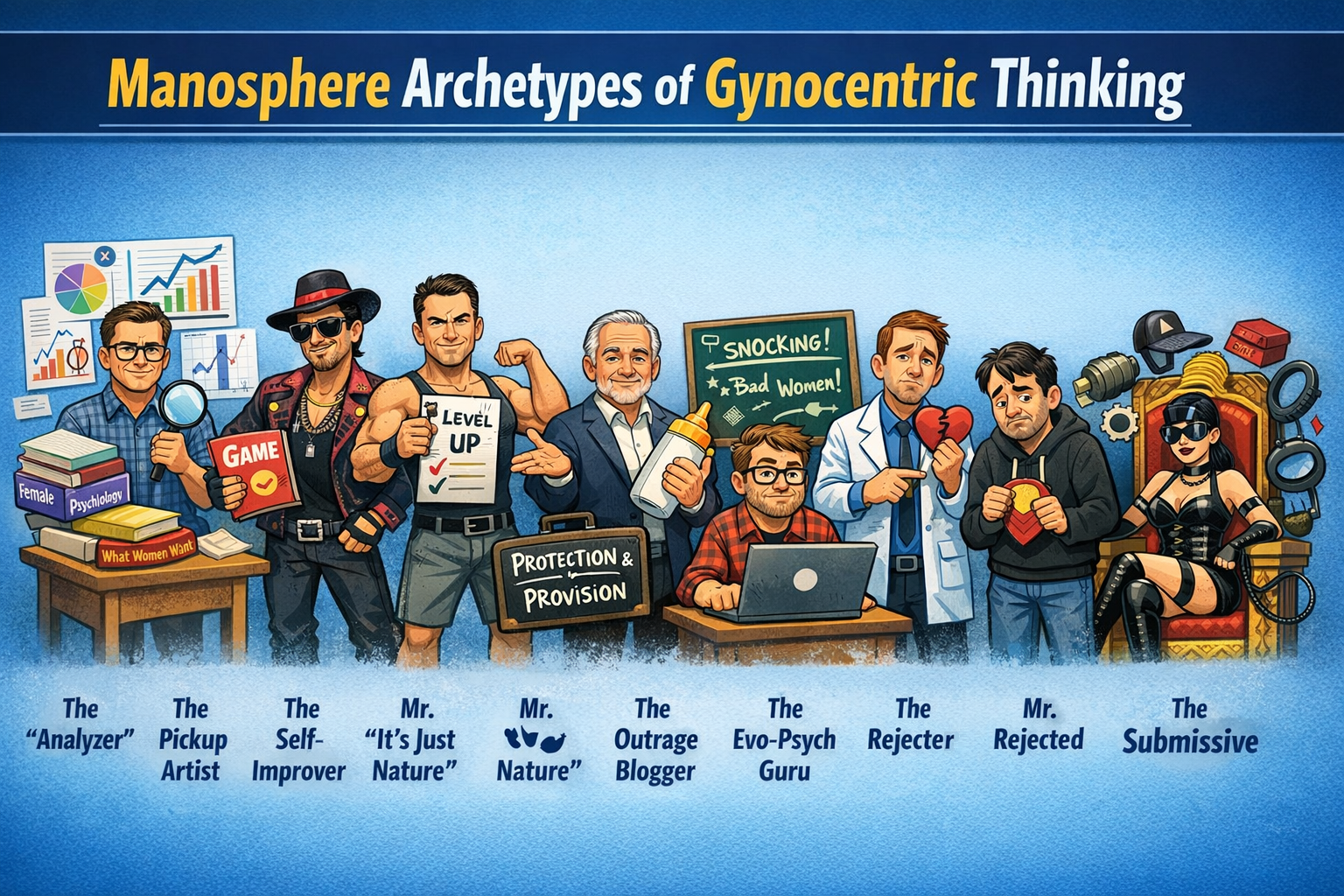
A recent poll conducted on X.com assessed the prevalence of gynocentric attitudes in the manosphere, which typically takes the form of one of these approaches:
1. Obsessing over what makes women tick.
2. Fixating on securing sex with women via “game.”
3. Self-improving primarily to attract or please women.
4. Excusing women from accountability as appealing to their “nature.”
5. Promoting a parent–child dynamic: women framed as childish dependents needing male protection, pampering, provision, and discipline.
6. Relentlessly cataloguing and broadcasting women’s worst behaviour.
7. Inventing evolutionary-psychology narratives about hypergamy, female vulnerability, female gatekeeping, or reproductive superiority.
8. Being consumed by either rejecting women, or being rejected by them.
9. Framing all male–female relations through a quasi-BDSM lens casting women as the dominatrix and ultimate gatekeeper of sex, validation, and the terms of the relationship.
10. Any combination of the above.
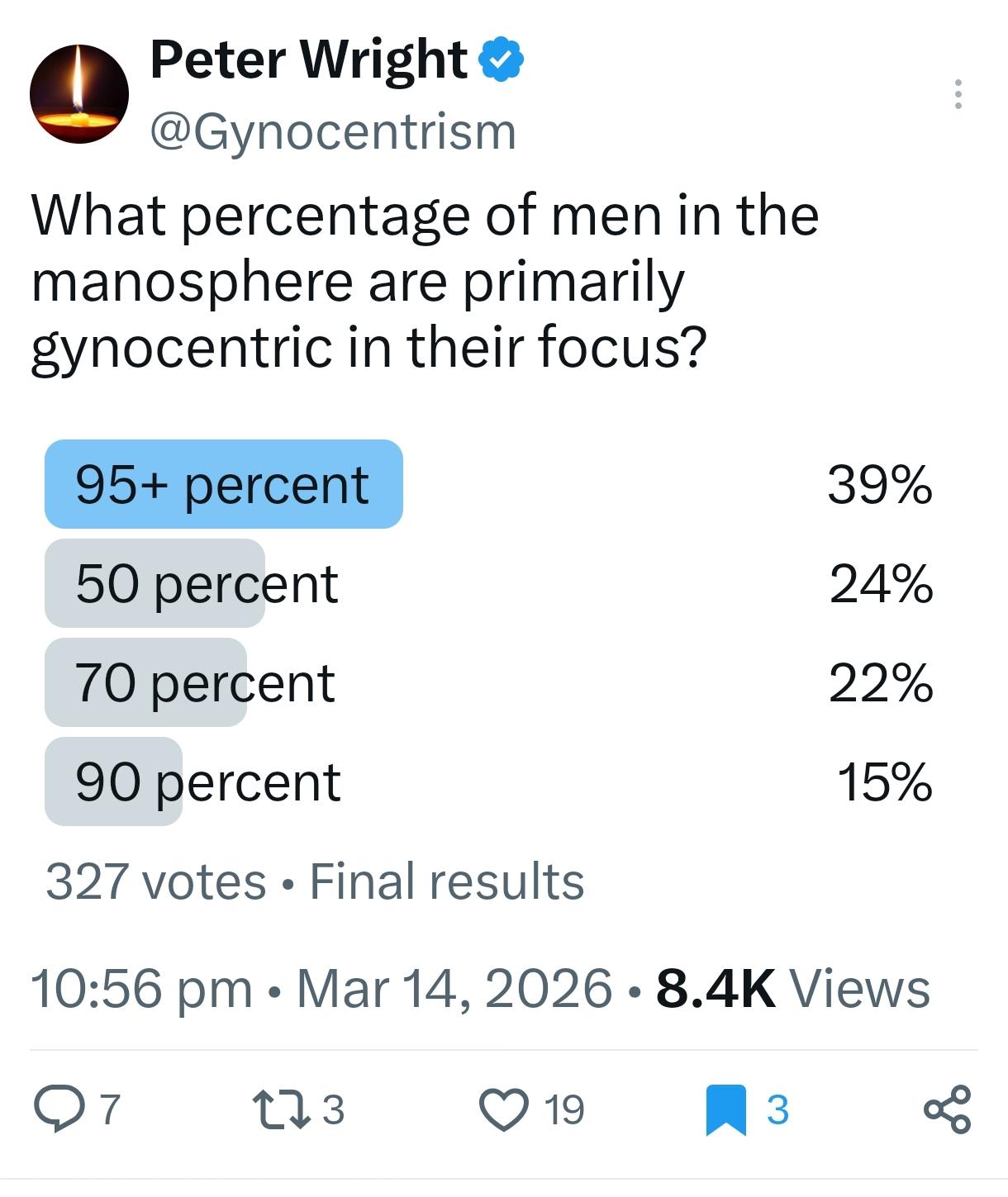
The poll asked this question, “What percentage of men in the manosphere are primarily gynocentric in their focus?”
RESULTS:
Romantic love promotes fertility collapse – Alan Macarlane (1986)
The following excerpt from Marriage and love in England : modes of reproduction, 1300-1840, by Alan Macfarlane, describes how romantic love leads to disintegration of the extended family and promotes lowered fertility among those who practice it.
Romantic Love
In contrast to most other recorded societies, it has been noted that Americans do ‘not merely build their households on the husband–wife relationship, but build their whole value system and morality on it’. Whereas in industrial Western societies the emotional relationship between man and wife is primary, it is not the pivot of social structure in the majority of societies.¹ As we have noted, the relationships that are most important are often those between parents and children, with the marital bond as a poor second. ‘In Eastern countries with their ancient civilization there exists even now comparatively little of that tenderness towards the woman which is the principal charm of our own family life,’ wrote Westermarck.²
The transition from a situation where the marital relationship is subordinated to others, to the prevalent Western view of it as the deepest and most enduring relationship of life, brings numerous consequences, changing the nature of marriage and women’s and men’s roles. One consequence is the demographic one. The substitution of the husband–wife relationship for wider kinship links and parent–child ties, decreases the pressure to have children. The couple are sufficient to each other: children become a luxury, not a necessity. Effective contraception makes it possible to choose whether to indulge in a few or many. Hence the strengthening of the husband–wife bond is part of that emotional and economic nucleation which certain demographers like Caldwell see as leading to a state of affairs propitious for the demographic transition to lowered fertility.³
¹ Bohannan, Social Anthropology, 99; Goode, World Revolution, 14, 89.
² Westermarck, Marriage, ii, 24ff; ii, 28.
³ Caldwell, ‘Restatement’, 354.
Androcentrism, Not Gynocentrism, Should Guide the Future of Men’s Health
*The article published first at the Nuzzo Newsletter Substack on April 28, 2023.
National and international organizations do not give explicit attention to men’s health in the same way that they do women’s health [1]. For example, the National Institutes of Health in the United States has an Office for Research on Women’s Health, but it does not have an office dedicated to the study of men’s health. In “Men’s health in the United States: a national health paradox,” I pointed out that such asymmetries in public health policy are perplexing given that boys and men experience various physical, psychological, and behavioral health issues at higher rates than girls and women, culminating in a life expectancy that is approximately five years shorter for males than females [1]. Below is a list of health issues that are more prevalent among boys and men than girls and women [1]:
· Amputations
· Amyotrophic lateral sclerosis (ALS)
· Antisocial personality disorder
· Attention-deficit hyperactivity disorder
· Autism spectrum disorder
· Cardiovascular disease and hypertension
· Color blindness
· Communication disorders
· Criminality and imprisonment
· Drownings
· Educational attainment
· Hearing loss
· Homelessness
· Motor vehicle deaths and accidents
· Muscular dystrophy
· Occupational deaths and accidents
· Problematic gambling
· Sleep-disordered breathing
· Spinal cord injuries
· Substance abuse
· Suicide
Given the above issues and their financial and non-financial impacts on society, academics and policy makers who are rationally-minded will not be able to deny the evidence much longer. Nevertheless, to the extent that men’s issues receive increased attention as a distinct area of public health concern in the future, the field of men’s health should be guided by basic principles that inform relevant initiatives and policies. Here, I propose that there are two fundamental philosophical approaches to guide thinking around men’s issues. They are the gynocentric approach and the androcentric approach. After defining and describing these two approaches, I argue that the androcentric approach, which sees men and their needs as ends in themselves, is the approach best-suited to guide future thinking around men’s issues.
Definitions
The adjective “gynocentric” is defined in the Merriam-Webster online dictionary as “dominated by or emphasizing feminine interests or a feminine point of view.” A gynocentric approach to men’s issues involves action on men’s issues in so far as those actions improve outcomes for women. This approach might also involve action on women’s issues or attempts to achieve “gender equality” which then incidentally improve outcomes for men. Female wellbeing is the primary outcome of concern of the gynocentric approach. Consequently, the gynocentric approach does not recognize male suffering independent of a greater concern for female suffering.
The adjective “androcentric” is defined in the Merriam-Webster online dictionary as “dominated by or emphasizing masculine interests or a masculine point of view.” An androcentric approach to men’s health views male wellbeing as an end in itself. Male wellbeing is the primary outcome of concern of the androcentric approach. Consequently, the androcentric approach recognizes the potential for male suffering independent of a concern for female suffering. Moreover, women’s health is not used as a mediator for improved men’s health with the androcentric approach. Instead, direct action is taken on men’s health. Importantly, the androcentric approach is not devoid of consideration of the impact of a man’s life on others. Instead, the androcentric approach sees that a man’s relationships with others (e.g., marriage) will be best for that man and for others when that man is in a state of good mental and physical health.
Contrasting the gynocentric and androcentric approaches
An example of the gynocentric approach to men’s health, recently presented in the health prevention literature, comes from the paper by King and Elliott [2] titled “Why gender equality is good for men’s health an why this matters now. ” The authors argued that “gender equality” is a causal path that, if acted upon, improves men’s health. They stated this action “matters now.” However, the question is: matters for whom?
According to King and Elliott [2], “gender equality does not sit at counterpoint to the interests of men,” and does not “place the interests of men and women at odd with one another.” They also stated there is “no evidence that men are disadvantaged or devalued by gender equality” [2]. However, a critique of the topics discussed by the authors reveal that their claims are questionable. For example, to reduce violence against women and girls, the authors mentioned “engaging men in tackling gender inequality” [2] – an approach also adopted by the United Nations [3]. However, because women’s health is the primary concern of a gynocentric approach, neither violence against men by men [4] nor violence perpetrated by women [4-6] were acknowledged by King and Elliott. Thus, the gynocentric approach does not acknowledge male victimization and therefore places a level of guilt upon men that is disproportionate to the data. An androcentric approach, on the other hand, would teach boys and men about concepts such as individual rights and the rule of law, and that perpetrating violence against others violates the rights of those individuals. Moreover, the androcentric approach would teach a man that a life of criminality and poor decision making significantly reduces his chances of living a healthy and prosperous life.
Paternal leave is another area where a gynocentric approach to men’s health is sometimes advocated [2]. In such instances, advocation for paternal leave stems from an interest in creating “gender equality” – e.g., reducing the mother’s unpaid work at home [2]. Thus, the mother’s, not the father’s, wellbeing is the primary outcome of concern. In contrast, an androcentric approach to paternal leave would outline explicitly the benefits to be gained by the father as a result of caring for and bonding with his newborn child.
A third example of how the gynocentric approach and “gender equality” can disadvantage or devalue men is the World Economic Forum’s Global Gender Gap Index [7]. The Global Gender Gap Index is a metric used by researchers and policy advocates to assess “gender equality.” The Index “rewards countries that reach the point where outcomes for women equal those for men, but it neither rewards nor penalizes cases in which women are outperforming men in particular indicators in some countries. Thus, a country that has higher enrolment for girls rather than boys in secondary school will score equal to a country where boys’ and girls’ enrolment is the same” [7]. Thus, the Global Gender Gap Index penalizes a country’s gender equality score only when girls and women, not boys and men, fall behind. Although the Index is not framed as a metric to monitor male wellbeing, it does claim to measure “gender equality,” and thus couldbe used explore the wellbeing of both sexes if its creators wanted it to. Unfortunately, the anti-male bias that is baked into the Global Gender Gap Index is pervasive within national and international organizations, including the United Nations [8].
Finally, the gynocentric approach to men’s health often is guided by abstract starting points such as “male privilege” and “toxic masculinity.” The androcentric approach rejects a priori assumptions that boys and men are born into the world and/or are socialized as “privileged” or “toxic.” In fact, assumptions of inherent “privilege” or “toxicity” preclude the possibility of recognizing male suffering or disadvantage.
Conclusion
In the coming years, men’s health is likely to receive increased attention within public health circles. Thus, discussion around the best way to think about men’s issues is warranted. Here, I have proposed that two general philosophical approaches to addressing men’s health exist: the gynocentric and androcentric. The gynocentric approach is characterized by an interest in men’s issues insofar as this interest improves outcomes for women. The gynocentric approach prioritises female over male wellbeing. The androcentric approach to men’s health sees men and their needs as ends in themselves. A man’s wellbeing is the primary outcome of concern of the androcentric approach. Because the androcentric approach recognizes the potential for male suffering independent of a concern for female suffering, it is the approach best-suited to guide thinking around men’s issues. An explicit declaration of this sort appears necessary, in part, because of the apparent inclination of the human mind, and consequently national and international organizations, to be less concerned about male than female suffering [8-10]. Such a declaration also appears necessary because there are feminist academics who claim to be interested in men’s health but whose philosophy is entirely gynocentric. Finally, just as an androcentric approach is recommended for men’s health; a gynocentric approach is recommended for women’s health. These two approaches, when directed at their respective sexes, are not at odds with one another. They are mutually supportive. They are intended to help individual men and women flourish and achieve their highest potential rather than sacrifice one sex to the other.
References
1. Nuzzo JL. Men’s health in the United States: a national health paradox. Aging Male. 2020;23(1):42-52.
2. King TL, Elliott K. Why gender equality is good for men’s health and why this matters now. Am J Prev Med. 2021;60(6):873-6.
3. Greig A, Flood M. Work with men and boys for gender equality: a review of field formation, the evidence based and future directions. New York, USA; 2020.
4. Thompson A, Tapp SN, U.S. Department of Justice. Crime victimization, 2021: U.S. Department of Justice; 2022.
5. Desmarais SL, Reeves KA, Nicholls TL, Telford RP, Fiebert MS. Prevalence of physical violence in intimate relationships, part 2: rates of male and female perpetration. Partner Abuse. 2012;3(2):170-98.
6. Fiebert MS. References examining assaults by women on their spouses or male partners: an updated annotated bibliography. Sex Cult. 2014;18:405-67.
7. World Economic Forum. Global gender gap report 2020. 2019.
8. Nuzzo JL. Bias against men’s issues within the United Nations and the World Health Organization: A content analysis. Psychreg J Psychol. 2020;4(3).
9. Osman SL. Predicting rape empathy based on victim, perpetrator, and participant gender, and history of sexual aggression. Sex Roles. 2011;64:605-11.
10. Seager M, Farrell M, Barry JA. The male gender empathy gap: time for psychology to take action. New Male Studies. 2016;5(2):6-16.
Subscribe to the The Nuzzo Letter