The Dowry Ethos: Rediscovering What True Reciprocity Requires

“Dowry ethos” is a conceptual term, primarily used in discussions of gender dynamics, marriage markets, and critiques of modern romantic expectations. It refers to an underlying cultural principle of reciprocal value exchange in relationships: both partners (or their families) are expected to bring commensurate material, practical, or economic contributions to the “relationship table,” rather than one side bearing the full burden of provision.

It is explicitly differentiated from the literal historical/anthropological practice of dowry (a transfer of money, goods, property, or assets from the bride’s family to the groom or couple at marriage). The ethos is a broader attitude or norm about fairness and contribution, not a specific custom involving payment from the bride’s side.

Historical Practices of Dowry

Historically, dowry was a widespread custom in many Eurasian societies, especially those with intensive agriculture, private property, and patrilineal/patrilocal systems (e.g., parts of Europe, India, ancient Rome, Greece, and elsewhere). Key features include:

1. The bride’s family provided assets to the groom, his family, or directly to the couple. This could include land, cash, household goods, livestock, clothing (trousseau), or other resources. It was also common for young women to work and save money toward their own dowry before marriage, and married women often continued working for wages in order to contribute to the conjugal fund.

2. Purposes varied by context:

  • To give the bride some economic security or inheritance portion (often controlled by the husband during marriage but reverting to her/children in cases of widowhood, divorce, or death).
  • To secure a husband of commensurate status who could adequately provide for her.
  • To equip the new household and support family formation.
  • In some views, it compensated for the bride’s lower direct contributions to subsistence (e.g., in plough-agriculture societies where men’s labor dominated) or acted as female competition for high-value mates.

3. It was often tied to social norms of masculine provision: the groom/family offered ongoing economic support and protection, while the dowry helped balance or secure the arrangement.

4. Practices evolved; in some places it declined with modernization, cash economies, or legal changes, while in others (e.g., parts of South Asia) it persists.

Anthropologists like Jack Goody linked dowry to diverging devolution (property passing to both sons and daughters) in certain agricultural societies, contrasting it with bridewealth in others. It wasn’t universally “paying to offload a daughter” — interpretations include it as a form of pre-mortem inheritance for women or a conjugal fund.

Feminist critics sometimes frame historical dowry as patriarchal (treating women as burdens requiring compensation), while defenders note it typically empowered women with direct material security or reflected mutual commitment to the marriage and family investment.

Dowry Ethos (as Differentiated Concept)

The “dowry ethos” strips away the specific historical mechanics (no actual transfer from bride’s family to groom is required) and focuses on the principle of balanced contribution and assortative pairing:

  • Women are expected to bring tangible value — material resources, practical skills/labor, fidelity, domestic contributions, or other assets — commensurate with what the man brings (resources, earning potential, provision, protection, status).
  • Pairing should occur between partners of roughly equal “market” or contributory value. A woman with limited material/practical input would traditionally pair with a man of similar (modest) standing, not demand a high-provider without offering reciprocity.
  • This ethos assumes relationships involve mutual investment and rejects one-sided entitlement. In traditional systems, it checked hypergamy (women seeking markedly higher-status men) by tying women’s options to what they (or their families) could offer in return.

In this framework, the ethos is “broadly understood” as a cultural expectation of fairness: “both partners should bring commensurate value… Under traditional systems, women were expected to contribute materially or through labor and fidelity.”

Key Differentiation and Modern Contrast

  • Historical dowry = A concrete, often one-directional transfer of assets (bride’s side -> groom/couple), embedded in specific legal, familial, and economic systems.
  • Dowry ethos = An abstract norm or attitude emphasizing reciprocity and matched value in mate selection and ongoing relationships. It doesn’t prescribe paying dowries today; it critiques situations where this balancing expectation has eroded.

Proponents argue that modern Western “romantic chivalry ethos” or unconditional “love” narratives have largely waived the contribution requirement for women. Men are still culturally (and often legally) expected to provide resources, protection, and emotional labor, while women’s hypergamous preferences face fewer checks. This creates asymmetry: women can pursue higher-value men without equivalent input, leading to entitled dynamics, provider burnout, or men feeling like “ATMs.”

The ethos is invoked to advocate for mutual standards — e.g., women demonstrating “something to the table” (career, skills, resources, low entitlement) rather than expecting provision based solely on romance, attractiveness, or traditional female roles without reciprocity.

In short: Historical dowry was a specific practice involving asset transfer; dowry ethos is the underlying idea of balanced, value-matched partnership that some argue has been selectively discarded in favor of female-favoring romantic ideals. The term highlights perceived imbalances in contemporary dating and marriage markets.

Romantic Love as a Dyadic Cultural Script

Academic definitions of romantic love portray it as a single, universal construct experienced identically by both sexes. This unitary framing is a serious misrepresentation. It erases the distinctly feudal dynamic that has always defined the tradition, bleaching its asymmetrical structure into a feel-good myth of mutual (read identical) behaviors, emotions and reciprocity.

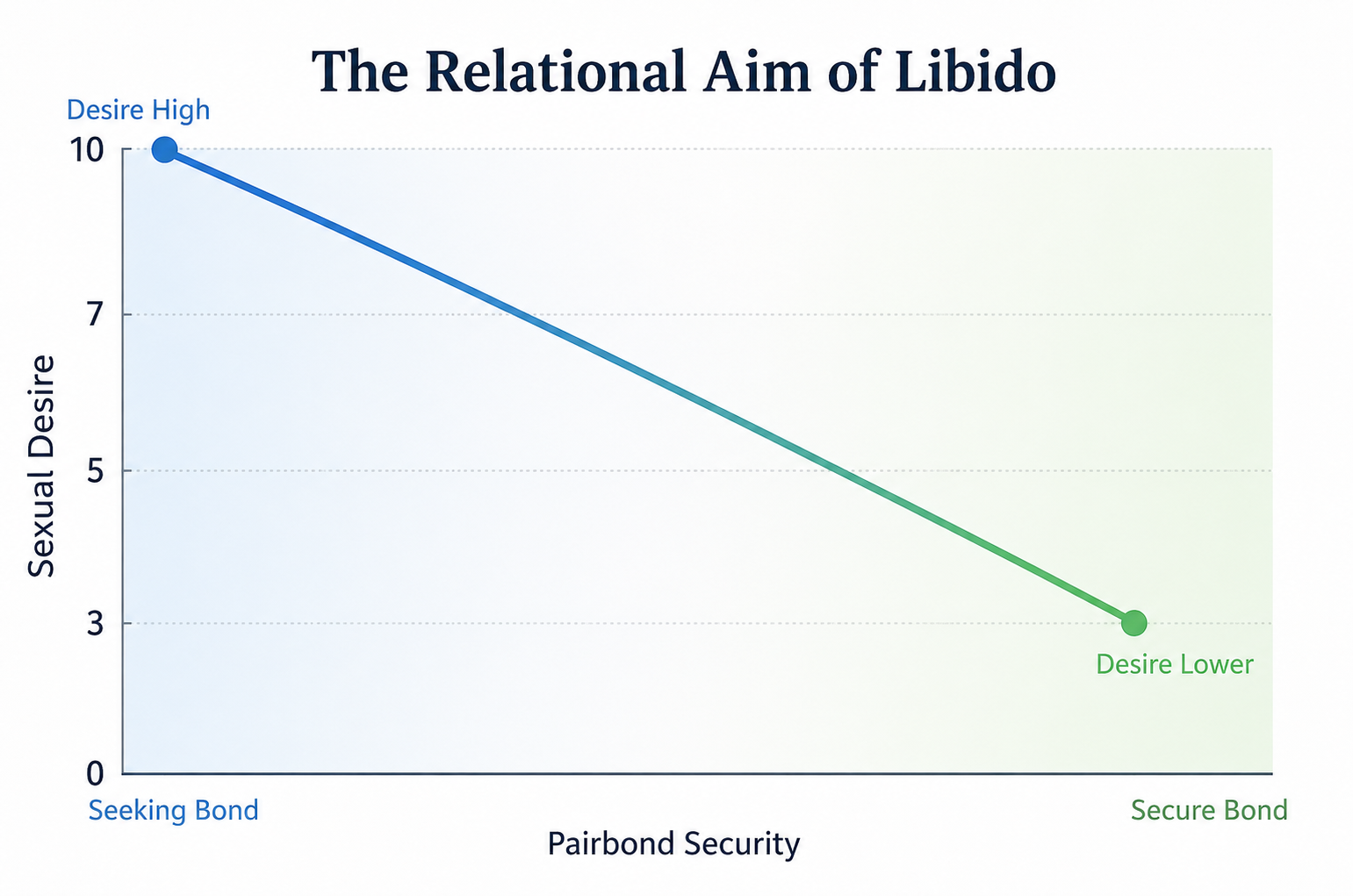
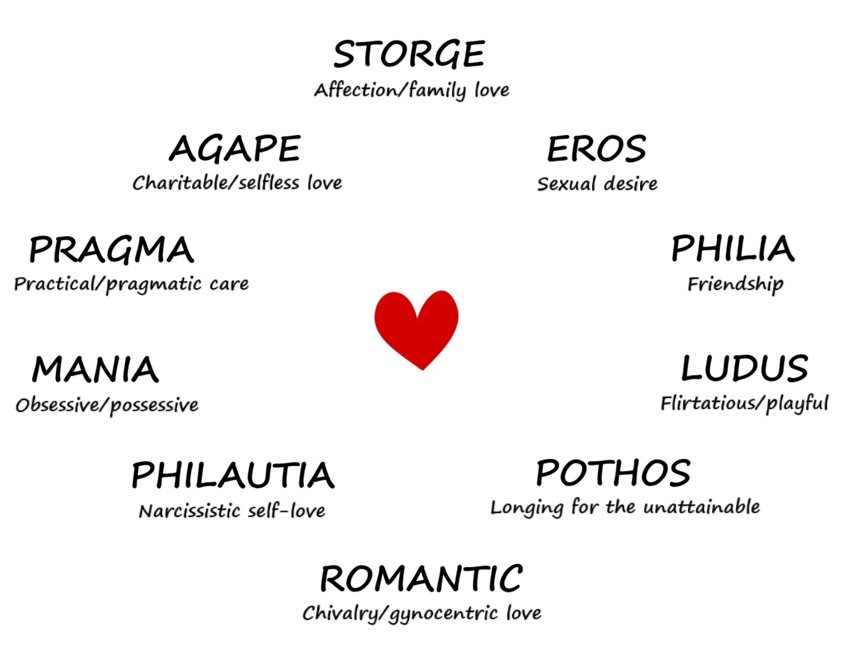
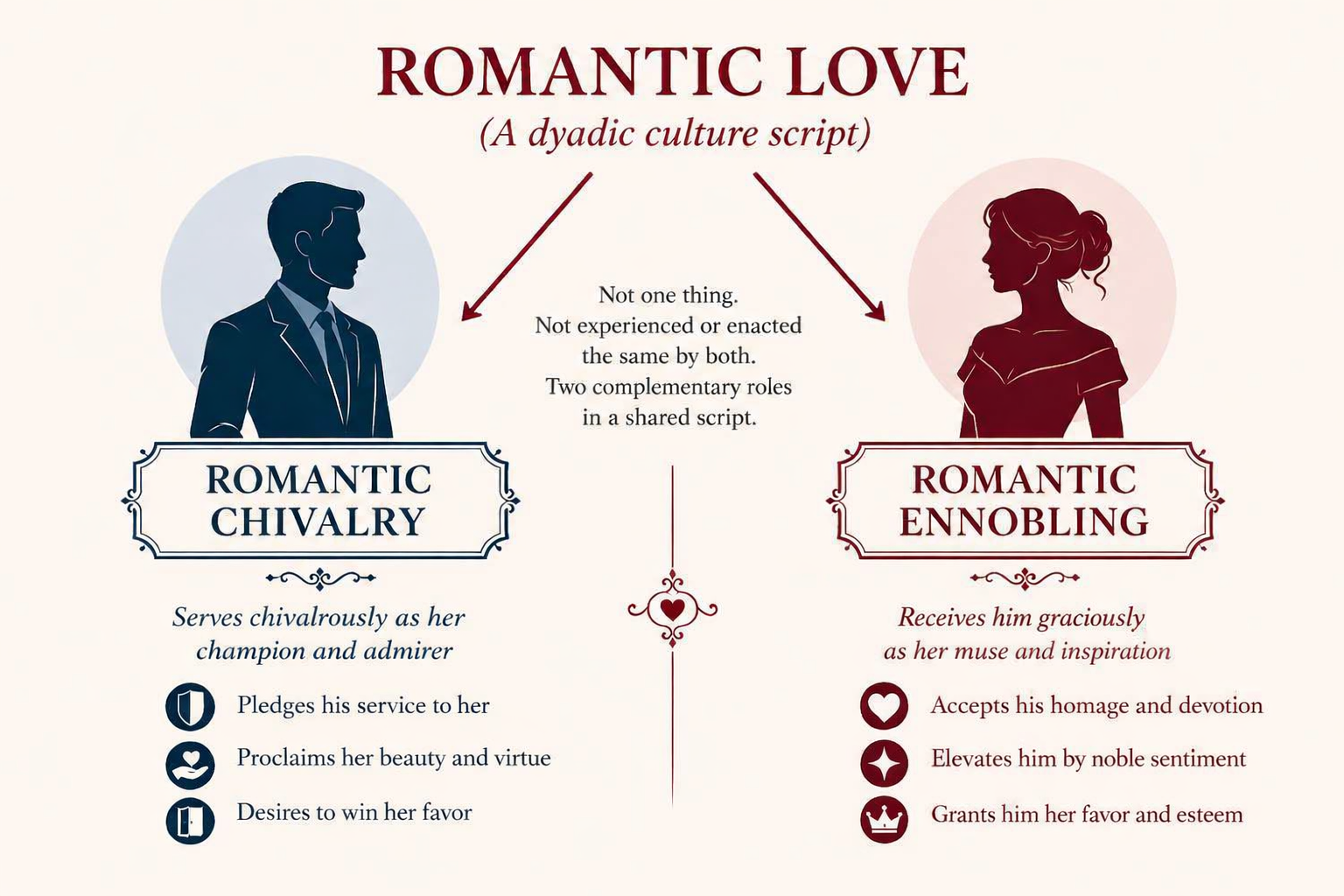
In reality, romantic love is a dyadic cultural script – a single overarching construct built from two distinct, complementary roles. Unlike other forms of love such as eros (sexual desire), agape (charity/compassion), storge (bonded/familial affection), companionate love (pairbonding), philia (friendship), and pragma (pragmatic, material gestures of care) — each of which operates as a single construct enacted similarly by either sex — romantic love requires not one, but two separate sets of roles, each governing the expectations, behaviors, and moral obligations of one sex.

On the male side stands romantic chivalry: the active performance of proving oneself by service, protection, provision, and devotional elevation of the woman. This is the vassal’s role – deferential, sacrificial, and oriented toward earning favour.

On the female side stands romantic ennobling: the active claiming and performance of elevated, aristocratic status within the romantic dyad. She embraces and reinforces her position as the “Dame” or “midons” (my lord) – the ennobled figure who receives devotion while occupying the superior, sovereign place in the hierarchy. This is the lordly role transposed into the feminine — a role that persists today in the widespread feminist emphasis on women’s “status,” “esteem,” “worth,” “dignity,” and “respect” in heterosexual relationships, terms once reserved exclusively for nobles.

These two roles are not symmetrical. They are deliberately complementary in the feudal sense: his chivalric service is meaningful only because she performs and expects ennoblement. Together they form the complete script that Western romantic love has inherited from medieval courtly tradition, where the lady was addressed with masculine titles of lordship precisely to signal her exalted position.

The ‘Freedom of Choice’ claim

Romantic love is built on the feudal template: the relationship of a servant to a pedestalized overlord. The much-touted “freedom of choice” in the romantic model therefore shrinks to two narrow options – a woman may choose her vassal, a man may choose his domina.

That is an extremely limited set of roles, and it looks a long way from genuine freedom of choice. Outside the romantic model, freedom of choice (what the Greeks called eleutheria) can draw on a far wider range of qualities in a prospective partner: emotional stability, willingness to contribute materially, balanced reciprocity, moral values, and so on.

Recognising romantic love as a dyadic construct rather than a unitary one restores analytical clarity. It explains why the experience, the expectations, and the moral economy differ so sharply between the sexes — a difference that the prevailing academic narrative works hard to obscure. Romantic love is not a gender-neutral emotion. It is a structured cultural system with two interlocking parts, each carrying its own distinct imperatives.


See also: Romantic Love vs. Sexual Urge: Ending the Evopsych Conflation

Romantic Love Was Never Eros

Since its invention in medieval Europe, the concept of romantic love has referred to a specific cultural template: a feudal-inspired dyad in which the man acts as a devoted servant (embodied in the rituals of chivalry) and the woman occupies the pedestal traditionally reserved for a feudal lord. This structural relationship, adapted from feudal society and applied to intimate bonds, became the defining framework for romantic love. It spread globally and remains symbolically potent today—for instance, in the common image of a man kneeling on one knee to propose marriage, an act that implies the same roles between men and women even when not literally performed.

This core template—the feudal structure itself—is what distinguishes romantic love from other forms of affection. Over time, however, it underwent category creep through its increasing association with two related but distinct elements:

1. The freedom to choose one’s love partner.
2. Sexual desire and activity.

The first of these, freedom of partner choice, is more apparent than real. In the romantic template, “freedom of choice” means only this: a woman may choose her vassal, a man may choose his lady. That is a choice of persons inside a fixed pair of roles. It confines free choice only to people willing to enact those roles, not to people free of them. Genuine choice can weigh many other things—stability, reciprocity, material contribution, character. Romance doesn’t facilitate that wider freedom; it imprisons choice inside a narrow feudal script.

The second association, sexual desire, was not inherent or necessary to the original model. Courtly love (amour courtois), the direct precursor to what we call romantic love, was frequently and even ideally Platonic in nature. Troubadour poetry and chivalric literature often celebrated an elevated, non-physical devotion in which the man’s service and the woman’s pedestal remained pure; consummation was neither required nor always desired. Sex sometimes occurred as an additional element, but its presence or absence did not define the romantic construct. This historical reality makes clear that sexual activity is merely an adjunct—something that may accompany the template but is not identical to it.

Because sexual desire is clearly an evolved human behavior, its frequent close proximity to the romantic template has encouraged academics and lay observers alike to interpret the entire phenomenon—including the cultural feudal template—as a biological universal rather than a historically specific construct. The result is a form of misplaced adaptationism: the assumption that because one component is innate, the whole package must be as well. The feudal template was smuggled in as an instinct: a medieval idea disguised as biology and conflated with it.

A Foundational Study and Its Limitations

A widely cited 1992 paper by William Jankowiak and Edward Fischer examined evidence of “romantic love” across 166 cultures and reported its presence in 147. They defined it as intense attraction involving idealization of the other “within an erotic context.” Their coding criteria then looked for generic features of passionate courtship and pair-bonding: personal anguish and longing, love songs or folklore, elopements based on affection, and ethnographers’ reports. Sexual passion (eros) was part of that mix. The feudal template was not. Missing from their construct was the man-as-vassal, woman-as-lord dynamic at the heart of European romantic love. Without that element, what they described aligns with broader passionate or early pair-bonding experiences, not with romantic love in its historically specific sense.

I put this objection to both authors in 2023. Jankowiak agreed that “romantic love” should be reserved for the Western European form that took shape from the twelfth century. Passionate love, he said, is another thing: “equivalent to pair-bond love,” an emotion that “arises naturally unless it is tightly controlled through social norms.” (W. Jankowiak, personal communication, June 2023)

Fischer wrote that he had not worked on the topic for a long time, but that the critique “seems valid”: the emotion may be widespread, “but you rightly argue that it may well not fit into the European feudal ideal,” and that “pairbonding love” is a better formulation. (E. Fischer, personal communication, June 2023)

Neither man withdrew the finding that passionate or pair-bond love is common across cultures. However, both agreed that what they had documented was not romantic love, and not the feudal mechanism that defines it.

Uncritical Reliance in Evolutionary Psychology

Despite these clarifications, the conflation stuck. Popular culture had already fused the feudal template with sexual passion and other evolved features of pair-bonding. Evolutionary psychologists and much of the manosphere then followed that usage and treated the package as an instinct.

Steve Stewart-Williams, in his otherwise insightful book The Ape That Understood the Universe, relies on Jankowiak and Fischer’s findings to reach that conclusion without fully addressing the missing feudal component. He writes:

“And why, as far as we can tell, is romantic love found in all cultures? That’s right; contrary to stubborn anthropological myth, people everywhere fall in love. One line of evidence for this claim comes from the anthropologists William Jankowiak and Edward Fischer, who scoured the anthropological research on 166 historically independent cultures, noting down any evidence of romantic love that they came across: romantic poetry, elopement, all the usual symptoms. Their conclusion? Romantic love was unambiguously present in around 89 percent of cultures…

The question all these findings raise is a straightforward one: If romantic love is an invention of Western culture, why is it found in every geographical region, historical period, and ethnic group? The simplest and most plausible answer is that romantic love is not an invention of Western culture. Instead, the idea that romantic love is an invention of Western culture is itself an invention of Western culture, and a rather implausible one at that. Human beings were falling in and out of love for hundreds of thousands of years before we ever had Hollywood blockbusters or knights in shining armor. We’re just that kind of animal – the kind that falls in love from time to time.”

This passage illustrates a category error. Stewart-Williams takes Jankowiak and Fischer’s bundle—sexual passion, longing, courtship intensity, pair-bonding—and treats that bundle as “romantic love.” Those features may well be old and widespread. They are not the feudal template: the man in service to an elevated beloved. That template is a medieval European invention that later spread. Folding it into an evolved courtship package, and giving the package the European name, treats a composite as a biological given.

That said, Stewart-Williams distinguishes the intense early phase of passion from later companionate attachment. As he notes, companionate love is “a less exhilarating form of love than romantic love, but in many ways, it’s more real.”

That is a real distinction between early and later stages of pairbonding, but it is not the one at issue. Early passion versus mature companionship still leaves the feudal template mixed with both eros and pair-bonding under one label: “romantic love.” Precise definitions still matter. Romantic love, properly understood as the feudal template adapted to intimate relations, is a cultural innovation with a clear historical origin—not a timeless biological given. Eros and pair-bonding are older. Using one word for all of them is the error.

Sloppy handling of these distinctions in academic work, even by otherwise capable researchers, perpetuates confusion and overgeneralization. Clearer categorization keeps the evolved foundations of attachment separate from later cultural inventions—including the romantic template, which is not an expression of those foundations but a maladaptive departure from them.

References

Jankowiak, W. R., & Fischer, E. F. (1992). A cross-cultural perspective on romantic love. Ethnology, 31(2), 149-155.

Stewart-Williams, S. (2018). The Ape That Understood the Universe: How the Mind and Culture Evolve. Cambridge University Press.

Gynocentrism: Discourses of Female Supremacy in The Woman King

The following 2025 study of ‘The Woman King’ reveals the growth of gynocentrism & gamma bias in modern cinematic productions: Aris, Q., & Syam, E. (2025). Gynocentrism: Female Superiority Propaganda in The Woman King. Rainbow: Journal of Literature, Linguistics and Culture Studies, 14(2), 191-198.

Romantic love promotes fertility collapse – Alan Macarlane (1986)

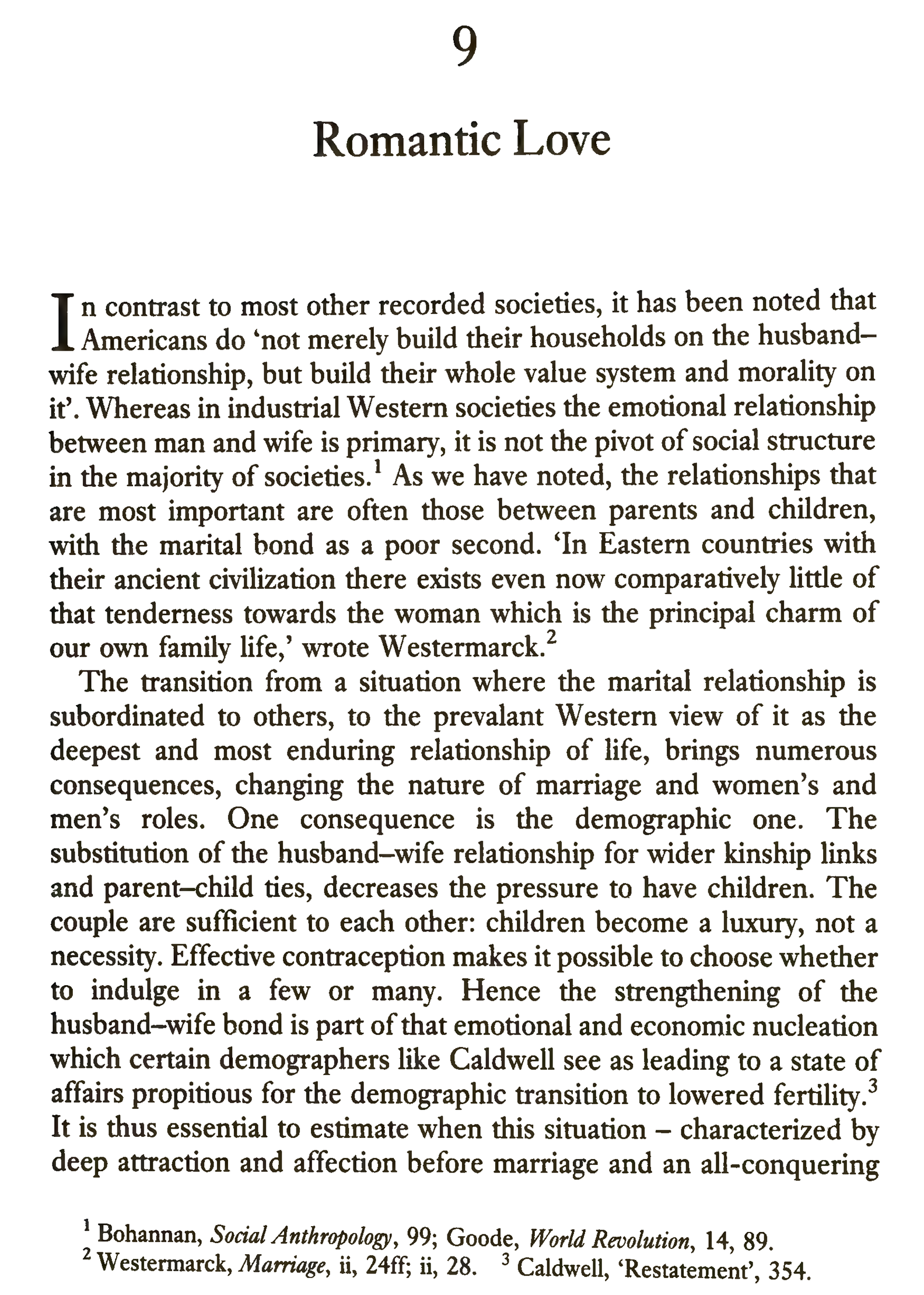
The following excerpt from Marriage and love in England : modes of reproduction, 1300-1840, by Alan Macfarlane, describes how romantic love leads to disintegration of the extended family and promotes lowered fertility among those who practice it. 

Romantic Love

In contrast to most other recorded societies, it has been noted that Americans do ‘not merely build their households on the husband–wife relationship, but build their whole value system and morality on it’. Whereas in industrial Western societies the emotional relationship between man and wife is primary, it is not the pivot of social structure in the majority of societies.¹ As we have noted, the relationships that are most important are often those between parents and children, with the marital bond as a poor second. ‘In Eastern countries with their ancient civilization there exists even now comparatively little of that tenderness towards the woman which is the principal charm of our own family life,’ wrote Westermarck.²

The transition from a situation where the marital relationship is subordinated to others, to the prevalent Western view of it as the deepest and most enduring relationship of life, brings numerous consequences, changing the nature of marriage and women’s and men’s roles. One consequence is the demographic one. The substitution of the husband–wife relationship for wider kinship links and parent–child ties, decreases the pressure to have children. The couple are sufficient to each other: children become a luxury, not a necessity. Effective contraception makes it possible to choose whether to indulge in a few or many. Hence the strengthening of the husband–wife bond is part of that emotional and economic nucleation which certain demographers like Caldwell see as leading to a state of affairs propitious for the demographic transition to lowered fertility.³ 

¹ Bohannan, Social Anthropology, 99; Goode, World Revolution, 14, 89.
² Westermarck, Marriage, ii, 24ff; ii, 28.
³ Caldwell, ‘Restatement’, 354.

Androcentrism, Not Gynocentrism, Should Guide the Future of Men’s Health

*The article published first at the Nuzzo Newsletter Substack on April 28, 2023.

National and international organizations do not give explicit attention to men’s health in the same way that they do women’s health [1]. For example, the National Institutes of Health in the United States has an Office for Research on Women’s Health, but it does not have an office dedicated to the study of men’s health. In “Men’s health in the United States: a national health paradox,” I pointed out that such asymmetries in public health policy are perplexing given that boys and men experience various physical, psychological, and behavioral health issues at higher rates than girls and women, culminating in a life expectancy that is approximately five years shorter for males than females [1]. Below is a list of health issues that are more prevalent among boys and men than girls and women [1]:

·      Amputations

·      Amyotrophic lateral sclerosis (ALS)

·      Antisocial personality disorder

·      Attention-deficit hyperactivity disorder

·      Autism spectrum disorder

·      Cardiovascular disease and hypertension

·      Color blindness

·      Communication disorders

·      Criminality and imprisonment

·      Drownings

·      Educational attainment

·      Hearing loss

·      Homelessness

·      Motor vehicle deaths and accidents

·      Muscular dystrophy

·      Occupational deaths and accidents

·      Problematic gambling

·      Sleep-disordered breathing

·      Spinal cord injuries

·      Substance abuse

·      Suicide

Given the above issues and their financial and non-financial impacts on society, academics and policy makers who are rationally-minded will not be able to deny the evidence much longer. Nevertheless, to the extent that men’s issues receive increased attention as a distinct area of public health concern in the future, the field of men’s health should be guided by basic principles that inform relevant initiatives and policies. Here, I propose that there are two fundamental philosophical approaches to guide thinking around men’s issues. They are the gynocentric approach and the androcentric approach. After defining and describing these two approaches, I argue that the androcentric approach, which sees men and their needs as ends in themselves, is the approach best-suited to guide future thinking around men’s issues.

Definitions

The adjective “gynocentric” is defined in the Merriam-Webster online dictionary as “dominated by or emphasizing feminine interests or a feminine point of view.” A gynocentric approach to men’s issues involves action on men’s issues in so far as those actions improve outcomes for women. This approach might also involve action on women’s issues or attempts to achieve “gender equality” which then incidentally improve outcomes for men. Female wellbeing is the primary outcome of concern of the gynocentric approach. Consequently, the gynocentric approach does not recognize male suffering independent of a greater concern for female suffering.

The adjective “androcentric” is defined in the Merriam-Webster online dictionary as “dominated by or emphasizing masculine interests or a masculine point of view.” An androcentric approach to men’s health views male wellbeing as an end in itself. Male wellbeing is the primary outcome of concern of the androcentric approach. Consequently, the androcentric approach recognizes the potential for male suffering independent of a concern for female suffering. Moreover, women’s health is not used as a mediator for improved men’s health with the androcentric approach. Instead, direct action is taken on men’s health. Importantly, the androcentric approach is not devoid of consideration of the impact of a man’s life on others. Instead, the androcentric approach sees that a man’s relationships with others (e.g., marriage) will be best for that man and for others when that man is in a state of good mental and physical health.

Contrasting the gynocentric and androcentric approaches

An example of the gynocentric approach to men’s health, recently presented in the health prevention literature, comes from the paper by King and Elliott [2] titled “Why gender equality is good for men’s health an why this matters now. ” The authors argued that “gender equality” is a causal path that, if acted upon, improves men’s health. They stated this action “matters now.” However, the question is: matters for whom?

According to King and Elliott [2], “gender equality does not sit at counterpoint to the interests of men,” and does not “place the interests of men and women at odd with one another.” They also stated there is “no evidence that men are disadvantaged or devalued by gender equality” [2]. However, a critique of the topics discussed by the authors reveal that their claims are questionable. For example, to reduce violence against women and girls, the authors mentioned “engaging men in tackling gender inequality” [2] – an approach also adopted by the United Nations [3]. However, because women’s health is the primary concern of a gynocentric approach, neither violence against men by men [4] nor violence perpetrated by women [4-6] were acknowledged by King and Elliott. Thus, the gynocentric approach does not acknowledge male victimization and therefore places a level of guilt upon men that is disproportionate to the data. An androcentric approach, on the other hand, would teach boys and men about concepts such as individual rights and the rule of law, and that perpetrating violence against others violates the rights of those individuals. Moreover, the androcentric approach would teach a man that a life of criminality and poor decision making significantly reduces his chances of living a healthy and prosperous life.

Paternal leave is another area where a gynocentric approach to men’s health is sometimes advocated [2]. In such instances, advocation for paternal leave stems from an interest in creating “gender equality” – e.g., reducing the mother’s unpaid work at home [2]. Thus, the mother’s, not the father’s, wellbeing is the primary outcome of concern. In contrast, an androcentric approach to paternal leave would outline explicitly the benefits to be gained by the father as a result of caring for and bonding with his newborn child.

A third example of how the gynocentric approach and “gender equality” can disadvantage or devalue men is the World Economic Forum’s Global Gender Gap Index [7]. The Global Gender Gap Index is a metric used by researchers and policy advocates to assess “gender equality.” The Index “rewards countries that reach the point where outcomes for women equal those for men, but it neither rewards nor penalizes cases in which women are outperforming men in particular indicators in some countries. Thus, a country that has higher enrolment for girls rather than boys in secondary school will score equal to a country where boys’ and girls’ enrolment is the same” [7]. Thus, the Global Gender Gap Index penalizes a country’s gender equality score only when girls and women, not boys and men, fall behind. Although the Index is not framed as a metric to monitor male wellbeing, it does claim to measure “gender equality,” and thus couldbe used explore the wellbeing of both sexes if its creators wanted it to. Unfortunately, the anti-male bias that is baked into the Global Gender Gap Index is pervasive within national and international organizations, including the United Nations [8].

Finally, the gynocentric approach to men’s health often is guided by abstract starting points such as “male privilege” and “toxic masculinity.” The androcentric approach rejects a priori assumptions that boys and men are born into the world and/or are socialized as “privileged” or “toxic.” In fact, assumptions of inherent “privilege” or “toxicity” preclude the possibility of recognizing male suffering or disadvantage.

Conclusion

In the coming years, men’s health is likely to receive increased attention within public health circles. Thus, discussion around the best way to think about men’s issues is warranted. Here, I have proposed that two general philosophical approaches to addressing men’s health exist: the gynocentric and androcentric. The gynocentric approach is characterized by an interest in men’s issues insofar as this interest improves outcomes for women. The gynocentric approach prioritises female over male wellbeing. The androcentric approach to men’s health sees men and their needs as ends in themselves. A man’s wellbeing is the primary outcome of concern of the androcentric approach. Because the androcentric approach recognizes the potential for male suffering independent of a concern for female suffering, it is the approach best-suited to guide thinking around men’s issues. An explicit declaration of this sort appears necessary, in part, because of the apparent inclination of the human mind, and consequently national and international organizations, to be less concerned about male than female suffering [8-10]. Such a declaration also appears necessary because there are feminist academics who claim to be interested in men’s health but whose philosophy is entirely gynocentric. Finally, just as an androcentric approach is recommended for men’s health; a gynocentric approach is recommended for women’s health. These two approaches, when directed at their respective sexes, are not at odds with one another. They are mutually supportive. They are intended to help individual men and women flourish and achieve their highest potential rather than sacrifice one sex to the other.

Share

References

1.      Nuzzo JL. Men’s health in the United States: a national health paradox. Aging Male. 2020;23(1):42-52.

2.      King TL, Elliott K. Why gender equality is good for men’s health and why this matters now. Am J Prev Med. 2021;60(6):873-6.

3.      Greig A, Flood M. Work with men and boys for gender equality: a review of field formation, the evidence based and future directions. New York, USA; 2020.

4.      Thompson A, Tapp SN, U.S. Department of Justice. Crime victimization, 2021: U.S. Department of Justice; 2022.

5.      Desmarais SL, Reeves KA, Nicholls TL, Telford RP, Fiebert MS. Prevalence of physical violence in intimate relationships, part 2: rates of male and female perpetration. Partner Abuse. 2012;3(2):170-98.

6.      Fiebert MS. References examining assaults by women on their spouses or male partners: an updated annotated bibliography. Sex Cult. 2014;18:405-67.

7.      World Economic Forum. Global gender gap report 2020. 2019.

8.      Nuzzo JL. Bias against men’s issues within the United Nations and the World Health Organization: A content analysis. Psychreg J Psychol. 2020;4(3).

9.      Osman SL. Predicting rape empathy based on victim, perpetrator, and participant gender, and history of sexual aggression. Sex Roles. 2011;64:605-11.

10.    Seager M, Farrell M, Barry JA. The male gender empathy gap: time for psychology to take action. New Male Studies. 2016;5(2):6-16.

Subscribe to the The Nuzzo Letter

The conflict of love and honor, by J. M. Ferrante

“The legend of Tristan and Isolde, posing the basic human conflict between an overpowering passion and the demands of morality and honor, offered a rich fund of material for medieval writers. They told the story in various forms for various reasons. Some condemned the love, others exalted it. For one, Tristan is a great hero, destroyed by a passion he cannot control; for another he is an artist inspired by a love that is mostly pain; for another, a knight caught between his love and loyalty to an unworthy king…

The conflict arises because Tristan’s love for Isolt is not just an ennobling inspiration, it is also a physical passion that demands fulfilment and destroys prudence. Love, which should guide the knight in the right direction, instead gets in his way. This presents a crucial paradox: without honor in the world a man cannot be a perfect lover, but without love a man is not a complete knight.

Why does this paradox exist? Because love between man and woman cannot be a purely spiritual phenomenon; there is always the danger of the physical impulse asserting itself and taking control. Then love, for all its ennobling powers, becomes an anti-social force. The only way out of the dilemma is death, so instead of a moral comedy, we have a romantic tragedy.”

Perceived Oppression Through Gynocentric Privilege Loss Theory

By Alex Sharpe

When a group is culturally centered and treated as morally primary, that position becomes invisible and is experienced as normal rather than privileged. Over time, this creates entitlement without conscious intent. When equality or accountability is introduced, it is perceived not as balance but as loss. Because loss is processed emotionally before it is processed rationally, the response is framed as harm. This harm is then moralized and expressed as oppression. In cultures where gynocentrism is the moral baseline, feminism functions not as a corrective to oppression, but as a narcissistic defense system that protects perceived entitlement by converting loss of special status into victimhood.

Gynocentrism, Narcissistic Injury, and the Illusion of Oppression

One of the most persistent claims in modern discourse is that women are systemically oppressed by men. This claim is treated as self-evident, morally unquestionable, and foundational to feminism. Yet when examined empirically, the claim repeatedly fails to hold up. Legal systems, social norms, education, healthcare, and public sympathy overwhelmingly favor women in most modern Western societies. This raises an obvious question. If men are not empirically oppressing women, why does feminism experience equality and accountability as oppression?

The answer does not lie in policy or statistics. It lies in psychology.

Gynocentrism is not an ideology in the way feminism is an ideology. It is a cultural orientation. It places women at the moral center of society, treats their needs as inherently more urgent, and frames their suffering as uniquely meaningful. Because this orientation is ambient and inherited, it is not experienced as privilege. It is experienced as reality itself. What is centered feels neutral. What is favored feels deserved.

When a group grows accustomed to being morally prioritized, that prioritization becomes part of identity. Expectations form around it. Deference is assumed. Protection is automatic. Accountability is softened or externalized. This is not because individuals are malicious, but because systems train perception long before conscious thought occurs.

When equality is introduced into such a system, it does not feel like fairness. It feels like loss. Psychological research consistently shows that human beings experience loss more intensely than gain. Loss triggers threat responses. Threat responses seek moral justification. The mind then reframes loss as harm, and harm as injustice.

This is where narcissistic pathology enters the picture.

Narcissism, at its core, is not vanity. It is entitlement fused with fragility. It is the inability to tolerate loss of special status without reframing oneself as a victim. When boundaries are enforced, they are perceived as abuse. When standards are applied evenly, they are perceived as punishment. When attention is shared, it is perceived as erasure.

Cultural gynocentrism creates the perfect conditions for this pathology to operate at scale. Because women are culturally framed as victims by default, any reduction in privilege can be interpreted as renewed oppression. Because men are framed as moral agents rather than moral patients, male suffering is minimized or ignored. Because the system already presumes male guilt and female innocence, evidence becomes secondary to narrative.

Feminism, in this context, functions less as a liberation movement and more as a psychological defense structure. It protects entitlement by moralizing discomfort. It converts equality into aggression. It reframes accountability as misogyny. It does not need to prove oppression empirically, because oppression is felt emotionally, and feeling is treated as proof.

This explains several otherwise puzzling features of feminist discourse. It explains why contradictory claims coexist without friction. It explains why data is dismissed as irrelevant or hostile. It explains why male suffering is either denied or reframed as deserved. Most importantly, it explains why any challenge to feminist narratives is met not with debate, but with moral outrage.

The outrage is not strategic. It is defensive.

When a system is built around moral asymmetry, symmetry feels violent. When one group has been protected from responsibility, responsibility feels cruel. When privilege has been mistaken for a right, losing it feels like theft.

This is why feminism often reacts to egalitarian arguments as though they are attacks. It is not responding to the content of the argument. It is responding to a perceived existential threat to status and identity. In that sense, feminism mirrors the very structures it claims to oppose. It maintains power not through force, but through moral framing. It preserves dominance not by argument, but by redefining resistance as harm.

Understanding this does not require hostility or moral condemnation. It requires clarity.

If gynocentrism is the cultural baseline, then feminism is not correcting oppression. It is protecting a centered position from being equalized. The resulting narrative of victimhood is not evidence of injustice. It is evidence of narcissistic injury triggered by the loss of unearned moral priority.

Once this mechanism is seen clearly, much of the modern gender debate stops being confusing. The contradictions resolve. The emotional intensity makes sense. The refusal to engage evidence becomes predictable.

What remains is not a mystery of power, but a problem of perception.

_________________________________________________

**This guest post submitted by Alex Sharpe, who goes by the moniker shadowclaw87 on X.com


International Men’s Day: R.S.V.P (published by Thomas Oaster – 1992)

International Men’s Day: R.S.V.P (1992 book published by Thomas Oaster).

JPG version below:

PDF version below: