Enterprise of the Green Shield with the White Lady

White Lady on Green Shield
The “Enterprise of the Green Shield with the White Lady” (Emprise de l’Escu vert à la Dame Blanche) was a chivalric order founded by Jean Le Maingre and twelve knights in 1399, committing themselves for the duration of five years. Inspired by the ideal of courtly love, the stated purpose of the order was to guard and defend the honor, estate, goods, reputation, fame and praise of all ladies, including widows. It was an undertaking that earned the praise of protofeminist Christine de Pizan.

Foundation

According to his Livre des faits, in 1399 Jean Le Maingre, tired of receiving complaints from ladies, maidens, and widows oppressed by powerful men bent on depriving them of the lands and honours, and finding no knight of squire willing to defend their just cause, out of compassion and charity founded an order of twelve knights sworn to carry “a shield of gold enamelled with green and a white lady inside” (une targe d’or esmaillé de verd & tout une dame blanche dedans). The twelve knights, after swearing this oath, affirmed a long letter explaining their purpose and disseminated it widely in France and beyond her borders.

The letter explained that any lady young or old finding herself the victim of injustice could petition one or more or the knights of the ‘Enterprise of the Green Shield with the White Lady’ for redress and that knight would respond promptly and leave whatever other task he was performing to fight the lady’s oppressor personally. The twelve knights promised not just this, however. They offered also to release any other knight from a vow requiring him to fight a duel before a judge. The letter was signed 11 April 1399 by Jean le Maingre, Charles d’Albret, Geffroi le Maingre, François d’Aubrecicourt, Jean de Lignères, Chambrillac, Castelbayac, Gaucourt, Chasteaumorant, Betas, Bonnebaut, Colleville, and Torsay.

Symbols

The emblem of the order was the shield of gold enamelled with green and a white lady inside. It seems reasonable to believe that the dame blanche represented the purity of women which the knights of the order were to protect; what the green background signified is not so clear. That white and green were sometimes associated together in connection with the observances of May is shown by an account, in Hall’s Chronicle, of a “maying” of Henry VIII of England, in which the company were clad in green on one occasion and in white on another. In Machyn’s Diary, too, there is mention of a white and green Maypole around which danced a company of men and women wearing “baldrykes” of white and green.

WRLogo_NO_CO.UK_The Order of the Green Shield with the White Lady bears a striking resemblance to the so-called “White Ribbon Campaigns” of today that require men, as was required of the medieval knights above, to pledge oaths to “Never to condone, or remain silent about violence towards women and girls” and especially to intervene when learning of any male behaving crassly toward a female. The continuity of chivalry in these two examples is worthy of study in itself.

Sources:

Lalande, Denis (1988). Jean II Le Meingre, dit Boucicaut (1366–1421): étude d’une biographie héroïque.
Marsh, George L. (1906) “Sources and Analogues of ‘The Flower and the Leaf’: Part I.” Modern Philology, pp. 153.
Riquer, Martín de (1967). Caballeros andantes españoles. Madrid: Editorial Espasa-Calpe.

[Study] Courtly Love Today: Romance and Socialization in Interpersonal Scripts

Despite attempts to dismiss courtly love as something that has never existed outside of male fantasy and medieval literature, the following excepts from a formal academic study show that tenets of courtly love were, and remain today, supported by real persons of both sexes. – PW

Abstract:

Summary.-This pilot study measured current acceptance of medieval rules of love operationalized in two scales adapted from an important 12th-century Latin treatise about courtly love. One item about a doctrine in the treatise was added to measure “perfect” love. Subjects were Hispanic and Caucasian students at a south-western Catholic university (45% men, 55% women). Scores on the scales of 11 Male Courtesy Norms did not significantly correlate with those for Rubin’s romantic love scale, but scores for 31 Action Norms did. There was general acceptance that women expect men to follow medieval rules of love concerning Male Courtesy. Some significant sex and ethnic differences were found, especially in regard to Action Norms. Results were interpreted to modify current understanding of courtly love by identifying men’s courtesy as a prerequisite for love. Demographic variables were interpreted as evidence of cultural scripts that program romantic experience to give women social and personal control of men.


Questions: Norms for Male Courtesy and Male-Female Action (Answered with agree/disagree)

1. As you would flee the plague, avoid being a scrooge (a mean-spirited man who amasses wealth); instead, embrace generosity.
2. To intensify the feelings of romantic tenderness, never go all the way.
3. Break up other lovers who follow the rules of love.
4. Be careful not to choose a lover you would be ashamed to marry.
5. Remember that lies spoil everything.
6. Let any number of associates help arrange your trysts (meetings between lovers).
7. To become a skilled lover in the world of romance, strive to obey all the commands of sophisticated women, who have mastered the social graces.
8. Don’t worry about social taboos when you give and receive love’s sweetnesses.
9. Don’t run others down.
10. Encourage others to leak information about love affairs.’
11. Be polite and courteous in all matters.
12. In practising the delightful exchanges of love, do not exceed your lover’s desires
13. Marriage is a good reason not to love someone else.
14. If you are nor madly devoted to someone, you aren’t able to love.
15. No one can really love two persons at the same time.
16. Love can sometimes remain on a plateau, neither increasing nor decreasing.
17. What a lover takes from a reluctant partner is enjoyable.
18. A male cannot love romantically unless he is at least a teenager.
19. After a lover’s death, some people may be able to develop a new close love relation within two years.
20. As long as they don’t do anything rash, no one -married or single- should be deprived of a tender relationship.
21. A person can love even though not valuing romantic love.
22. You can romantically love someone just to get money or prestige.
23. It is not appropriate for a man to love a woman he would be ashamed to marry.
24. A true lover desires to embrace tenderly others besides his (her) lover.
25. When made public, romantic love rarely endures.
26. Easy courtship is viewed as of little value: difficulty makes love prized.
27 As a rule, lover feel butterflies when their eyes meet.
28 A lover’s heart need not beat faster when the love partner shows up unexpectedly.
29. A new love need not put to flight an old one.
30. Good character alone does not make a man worthy of love.
31. If love diminishes, it quickly falters and rarely revives.
32. A real lover is continually solicitous toward his (her) lover.
33. The ability to love stems from ardent devotion to the other lover.
34. The desire to love increases from merely suspecting the partner of cheating.
35. A person tormented by love fantasies, sleeps and eats very little.
36. Every act of one lover need not end up in fantasizing about the other.
37. A true lover imagines nothing to be good except what will please the partner.
38. There’s no vacation from love.
39. A lover can never have enough tender exchanges.
40. The slightest premonition that something has gone wrong causes the lover to imagine the worst.
41. Someone who lives for sexual pleasure rather than romance has not yet learned how to love.
42. A true lover is not constantly, and without intermission, obsessed with fantasies focussed on the other.
43. Nothing forbids one woman from being loved by two men or one man by two women.

Today’s expectations

The current study shows that men and women agreed that women accept the norms for Male Courtesy… As Lafitte-Houssat (1966) and Kelly (1968) wrote, courtly love taught social and personal propriety to medieval men in erotic relationships. The current acceptance of a number of the norms for Male Courtesy indicates that today’s expectations of a potential male lover resemble these norms found in Marie of Champagne’s 1185 CE program as reported by Andreas Capellanus.

Courtly Love as a Vehicle For Feminine Control

By developing ways to handle the excess of men to women (Moller, 1958-59; Guttentag & Secord, 1983), medieval courtly love provided alternative behaviors besides violence to resolve conflict (Brody, 1969; Koenigsberg, 1967). By including norms that also can be related to courtesy, courtly love taught men a way to express tenderness rather than just erotic passion (Kelly, 1968), and legitimated a level of control for women in heterosexual relationships analogous to their increased domestic power in the 12th century (Lafitte-Houssat, 1966).

Although recognizing this new power, Lafitte-Houssat (1966) claimed 12th-century men only fictionalized women “as a feudal sovereign” (p. 22). Similarly, Duby (1983) considered courtly love an escapist male fantasy. Boone (1987) argued that the image of courtly love “maintained a hierarchy of male dominance” (p. 42). However, medieval courtly love also provided women a structure to contest for personal control. This empowerment gave society a way to structure the darker side of passionate love identified by Peele (1988) as addictive love. Without knowing how or in what context the norms developed, most men and women today agree with the courteous love proposed by Andreas Capellanus in 1185 CE.

Nevertheless, as the low acceptance of Item 7 by only 31% of men and 30% of women about obedience to women shows, the overt control of men which was a part of courtly love is generally not identified as part of the modern scenario. According to Koenigsberg (1967), Item 7 (male obedience to women) showed psychological growth in Western culture. Koenigsberg also pointed out that, despite the potential of psychological growth that could come from obedience to women, such courtly obedience was also a parody of submission, for the man’s “deference involves the maintenance of emotional distance” (p. 38). Rejection by modern youth of this obedience may be a refusal to accept either this emotional distancing or the passive role required in such distance.

The instrument needs refinement. For instance, the diction should be simplified and the negatives removed. Furthermore, Andrew’s original second commandment should be restored (as in “Respect for my lover should keep me from sleeping around”). Nevertheless, responses to the 43 items have raised intriguing questions.

Research is necessary to determine the possibility that women determine men’s cultivated behavior by establishing an image of themselves as sovereigns to control male fantasies, rather than being enthroned by male patriarchy. Incorporating the operative Courtesy Norms into current love scales could expand our view of the scripts which direct erotic fantasies and judgements about relationships. Finally, responses of other ethnic and Hispanic groups to selected items, especially about courtesy and obsessiveness, could be analyzed.


References:

BHODY, J. (1969) La princesse de Cleves and the myth of courtly love. University of Toronto Quarterly, 38, 105-135.
BOONE, J. A. (1987) Tradition counter tradition: love and the form of fiction. Chicago, IL:
Univer. of Chicago Press.
GUTENTAG, M., & SECORD, P. F. (1983) Too many women? The sex ratio question. Beverly Hills, CA: Sage.
KELLY, D. (1968) Courtly love in perspective: the hierarchy of love in Andreas Capellanus. Traditio, 24, 119-147
KOENIGSBERGR,. A. (1967) Culture and unconscious fantasy observations on courtly love.
Psychoanolytic Review, 54, 36-50.
LAFITTE-HOUSSAT, J. (1966) Troubadours et cours d’amours. [Troubadours and courts of love.] (3rd ed.) Paris: Presses Universitaires de France.
MOLLER, H. (1958-59) The social causation of the courtly love complex. Comparative Studies in Socieo and History, 1, 137-163.

_________________________________________
STUDY SOURCE : CONTRIBUTIONS TO PSYCHOHISTORY: XIII. COURTLY LOVE TODAY: ROMANCE AND SOCIALIZATION IN INTERPERSONAL SCRIPTS

Gaining Equal Rights for Men: Ratifying the E.R.A.

Ratifying the Equal Rights Amendment has long been discussed in men’s rights circles, but there was perhaps none more passionate about it than David Ault who actively lobbied for its ratification from the 1970s, and established the Equal Rights Amendment Project of Men’s Rights. The following article by David Ault was published in MEN Magazine in 1996, and in honour of his memory and work I’m pleased to republish it here. – PW

Article by David Ault
encourage-passage-equal-rights-amendment-200X200
The notion that men need equal rights with women is almost as politically incorrect today as it was in 1978, when I began actively working in Virginia for ratification of the Equal Rights Amendment to the U.S. Constitution. Even today, the ERA is often referred to as the “women’s rights amendment.” This limited interpretation is difficult to understand given its wording: Equality of rights under the law shall not be denied or abridged by the United States or any State on account of sex.

During the late 1970s and early 1980s, I distributed pamphlets that explained why women deserve to have equal rights with men. As Vice Chair of the Virginia Equal Rights Amendment Ratification Council, I often passed out our organization’s pamphlet entitled Women of Virginia, Rights You Are Denied.

We did not have a corresponding pamphlet Men of Virginia, Rights You Are Denied. In fact, men’s rights were so excluded from the ERA ratification process that, despite repeated requests by several knowledgeable men, no men were invited to testify on men’s equal rights issues before the U.S. Congressional hearings on ERA ratification.

Harris and Gallup polls informed us then that nearly 60 percent of all Americans favored ERA ratification. Although men were ignored as potential beneficiaries of a ratified ERA, younger men favored the ERA at nearly the same percentage as women. Many older men also supported it.

Despite this majority of women and men in its favor, the ten-year ratification period expired in June 1982 with only 35 of the required 38 states approving its ratification. I recall that some people blamed the ERA’s defeat on men who wanted to keep women “in their place” by denying women equal rights. Particularly targeted for blame were those male legislators from nonratifying states who voted against it.

Upon reflection, perhaps some men are to “blame” for the ERA’s failure to be ratified, but not for the reasons I heard in 1982. During that period of time, I was one of very few men who donated large amounts of their time and money to support ERA ratification. I also voted for political candidates by giving heavy weight to their stand on the ERA. At ERA meetings and workshops, I was often outnumbered by the women present by 10 or 20 to 1. My level of passion in support of the ERA was typical of many American women.

Although many American men supported ERA ratification, their support was more from their heads. Men often explained to me that they supported the ERA for their wife, sister, daughter, or mother. However, they did not donate significant time or money to support its ratification. Judging from the phone calls that I made polling households for ERA support, many men did not vote for pro-ERA candidates as a top priority.

I submit that it was not the men (and women) who opposed the ERA that defeated it. Instead, those men who are largely to “blame” are the majority of men who favored its ratification and yet failed to give it sufficient importance in their lives to see that it passed.

Winning men’s active support for the ERA may be easier today. During recent years, men’s consciousness about their own issues has been raised substantially and the momentum is upward. Men are growing aware of how the narrow gender-role conditioning they receive during society’s indoctrination of them to become protectors and providers negatively affects both their emotional and physical health. They learn that, on average, men not only live 7 years less than women, but men’s quality of life is reduced in trying to live up to this restrictive gender role.

Men are grieving, publicly and privately, for the loss of their fathers and their distance from their own children. They are learning how welfare rules and our father-negative “family” courts separate caring fathers from their children. They are dismayed by the contribution that fatherless families have tothe increase in homeless and runaway children, and toteenage suicide, academic failure, drug abuse, violence and unwed pregnancy.

At the same time that women have control over their parenthood through abortion or adoption, men’s reproductive rights are either ignored or condescendingly dismissed. Men lack the “right to choose” legal fatherhood, but have the responsibility of financial support. Further, men have no corresponding right to either custody or noncustodial access to their children.

Although outlawing female genital mutilation gets national media and Congressional attention, over 60% of American male babies still undergo medically unnecessary, involuntary, and painful infant circumcision.

Men realize that only they have the responsibility to register for selective service and may subsequently face the military draft. Further, as women gain the option of volunteering for combat positions, men are still assigned to combat.

Men see programs instituted to help women, while men’s similar concerns go unacknowledged and unfunded. Examples of neglected areas include male academic difficulties at all educational levels, lack of support for “men’s programs” in higher education, failure to acknowledge and support male victims of domestic violence, lack of affirmative action for men to enter predominately female professions, low levels of government support to homeless men, unequal privacy provisions in public restrooms and dressing rooms, failure to recognize and combat female modes of sexual harassment of men, and more stringent employee dress codes for men.

Men are hurting from 30 years of being the object of unwarranted blame, male-bashing, and negative sex-role stereotyping. As their consciousness increases, men will be more receptive to understanding both the harm done to them by continued pressure to conform to rigid role models and the legal injustices still visited upon them. Men will see how unjustified blame and their traditional stoic conditioning have combined to repress any remedy to their equality issues.

However, when men understand how gender-inclusive application of the ERA will benefit them, their pain, anger, and desire for justice will propel them into action to support ERA ratification. Together with women supporters, they will work to successfully win ERA passage in the U.S. Congress and by the necessary three-quarters of the states.

To make this happen, men’s equality issues must be included in the debate over ERA ratification. The first step within each state is to continue to research and document the areas where men are discriminated against by local, state and federal law. This includes not only laws written in a gender-biased way, but laws that, although gender-neutral in wording, result in bias against men in practice. Sometimes the remedy will not require changing the law; instead, changing public opinion will result in an equitable application of existing law. In other cases, the law will require modification or elimination.

The second step is to bring men’s equality issues and the ERA remedies to the attention of the public and our legislative bodies. Men might begin by asking each state legislature to memorialize the ERA again, as Washington State did in 1983. Memorialization means that the state legislature passes a resolution asking the U.S. Congress to pass the ERA and to send it out to the states for ratification. However, the reasons expressed this time by each state legislature for memorializing the ERA must include the need for men’s equal rights.

The third step is to secure an invitation for knowledgeable men to testify for the first time before the U.S. Congress when hearings are held again on the ERA. This will have three important benefits. First, it will help to bring the issue of discrimination against men before the entire country. Second, it will increase American men’s identification of ERA ratification with ending this discrimination. Third, it will create an official record of Congress’s intent to include equal rights for men in its justification for the ERA.

This Congressional record will be vital to men after the ERA is ratified, because judges often consider legislative intent in deciding how to apply the law to a specific case. After the Congress records its support for men’s rights, men will find it much easier to use the ERA to right legal injustices against them.

Finally, prepared with our research and buoyed by state and federal recognition of men’s need for the ERA, men must continue to educate the public and join with women in the ERA ratification process. With women and men working together for a gender-inclusive ERA, to quote Susan B. Anthony, “Failure is impossible.”

An ungallant society: The men’s rights movement of 1898

The following newspaper article ‘An Ungallant Society: The Men’s Rights Movement’ was published in 1898. – PW

***


The Women’s Rights movement has scored another great success. It has called forth a League for Men’s Rights to counteract it. This league, with the object of securing legal and moral protection to men against the encroachment of women, is in process of formation in London. Mr. William Austin, who resides at Blackheath, and is in a very large way of business in the City, is the founder, and he has received letters of sympathy and assurances of co-operation from, among others, two noblemen whose names during the past few years have been several times prominently before the public in cases that have attracted wide attention. Mr. Austin’s personal appearance is not in the least indicative of his deep seated misogyny. Indeed, he looks much more like a man who would run after a pretty girl, at a pinch, rather than away from one. However, the mover in an effort to secure protection from a sex which it has been a tendency of modern legislation to assist in every possible way ought to have some intelligible reasons to support his side of the case.

“I cannot pretend,” said Mr. Austin, “to find a remedy for all the injustices on the statute books; but where there is flagrant violations of the very principle of justice, I am convinced that it is well to get together a body of intelligent people and try what may be done to find some way out of the difficulty. I have looked carefully into the legal aspect of the matter, and find that a woman has a much greater advantage when it comes to litigation about almost any matter over any man, rich or poor, than a rich man has over a poor man. I find that in an extraordinary number of cases the law discriminates in the sharpest possible manner between men and women, both in civil and criminal law proceedings. I will not consider the advantage a woman almost invariably has for the reasons of her sex the very moment she goes into court, or even makes a complaint against a man, nor will I more than refer to the bias of the Press and public opinion the moment a woman makes her appearance in a case at law. I will not confine myself to a diatribe against the silliness of juries, judges, and everybody else in breach of promise cases, where sentimental damages are sometimes assessed so heavily that the man is ruined; but will go into the matter of pro-feminine prejudice which has become transmuted into positive rules of law and legal administration, actually crystallised into statutory enactments.”

”I will begin,” said Mr. Austin, taking up a legal volume filled with copious annotations, “with the Summary Court for Separation. There is a direct proof of what I call sex legislation. A man cannot go to this court and obtain a summary separation, but a woman can. Undoubtedly, these courts were established in the first instance to protect weak women. Perhaps they were needed then; now they certainly are not. It would be much more sensible in these days of new women to establish courts of summary separation for men. Most men do not cry out when they are hurt, as women do; but can anyone suppose for an instant that there are not in London alone thousands of men who in all justice ought to have some relief from the cruelties of the women who are making life a hell for them? Then take an action for slander – that is a proceeding open to women alone. But the triumph of modern one-sided sex legislation is the Act passed in 1895, making it a duty for a husband to maintain his wife, even notwithstanding her adultery. “

”There is hardly any limit to the privileges accorded to women over men in the matrimonial, civil, and criminal law books. The balance of the scales in favour of the women in the case, through the sympathies of judge and jury, are too well-known to need calling attention to; a woman may commit perjury to almost any extent, and, although her statements may be found false, they mark the result. No one suggests that she should be indicted for perjury, On the contrary, the man, glad to escape, sometimes settles a large sum of money on her rather than take the chances of further litigation. Even the custom of bringing breach of promise suits is confined to women; a man who sought to obtain redress for a very real wrong, inflicted by a woman’s fickleness, would be laughed out of court. Another instance of the hardships in matrimonial law is that the rule invalidating marriages obtained by fraud, duress, or undue influence, have no effect as against a woman inducing a man by subtle devices or threats of scandal, to marry him. How frequently one hears of an experienced woman of the world inducing some fledgling to become her husband. And how ridiculous would be the effect to break such a contract in a court of law.”

“The law confers on a woman the privilege of support from her husband. Once, in order to secure support from her husband, a woman had to live with him and obey him. But since 1857 any attempts to enforce obedience have been given up, and, since the decision in the Jackson case, the husband cannot compel his wife to return to him in case she has left him, although sequestration and imprisonment are resorted to if he does not comply with her claims of support. A successful lady litigant in 1886 observed to her husband, ‘There is no law which compels me to honour and obey you, but there is one which says you must keep me.’ ”

”But no matter if the wife is rolling in wealth, she is not obliged to contribute one penny to her husband’s support, even if he is incapable through disease or accident, and even if she received her wealth from him in his time of prosperity. Even if a wife, against her husband’s wishes, leaves her husband’s house, after assaulting him and insulting him, she can obtain an order for restitution of conjugal rights, which is merely a preliminary form of a claim for sequestration of his property for her maintenance.”

“Do you believe the Married Women’s Property Act?” I asked.

“Again, consulting his book Mr. Austin said: “There is a great deal of iniquitous partiality about that Act. By this Act, while a married woman has complete control over her acquired or inherited property, she is, by cynical injustice, left with all her old claims on her husband’s property, and can enforce these by the statute of 1895, even if she commit adultery. If you come to look into the matter at all thoroughly you will find that 99 per cent of women’s property is man-earned. The wife can leave this away from the husband, even if he gave it to her, but if a man attempted to leave his property away from his wife he could be practically prevented from doing so by her suing for a maintenance order, when as much of his property as the judge thinks fit would be settled on her.”

”This Married Women’s Property Act”, Mr. Austin went on, “is responsible for a silent revolution in succession which is being accomplished. Conveyancers aver that the steady tendency is for a woman to leave property acquired from some man always to a woman. This Act has the further effect of enabling a woman to recover judgment against and bankrupt her husband for any money she may have lent him; but there is no case of a husband daring to sue his wife for a loan. There is an even more surprising effect of this Act than those I have mentioned. A married woman, even when separated from her husband, and released from all duties toward him or her children, retains her privilege of having her property exempt from seizure for debt.”

”Are there any other instances of partiality of the law toward women?” I asked.

“Oh, plenty. One of them is the responsibility of a husband for a wife’s acts, although she is not under his control. As the late Sir Frank Lockwood put it, ‘One has the deep satisfaction of knowing that if Mrs. Jackson utters slanders, Mr. Jackson can be sued.’ Lord Halsbury, in the Jackson case, declared that in English law the husband never had the right to restrain his wife. And married women are not responsible for any crime they commit when their husband is by; he is supposed to have coerced them into the act.”

“When it comes to facilities for obtaining divorces the husband is at a terrible disadvantage. He cannot procure a divorce except by an expensive process, while she can get a summary separation, with costs and maintenances out of her husband’s property or earnings, from the nearest police-station. Although the woman may be an opera singer with £40,000 a year, not a penny of it can be touched, even for the children, but every week, in the police-courts, a working man with perhaps 18s or 20s a week may be seen ordered to pay two-thirds of it for the keep of a woman who has treated him with cruel malignity. If the wife of a poor working man repudiates her duties, neglects her children, drinks to the verge of delirium tremens, pawns her husband’s clothes, disgraces him before his friends, procures his discharge from his employment, and even assaults him, he can do nothing if it be not appeal to the High Courts, at a minimum cost of £40. And it is not against the poor man alone that the way of the wife to escape from the matrimonial yoke is made clear and easy. Perjury by the husband is a frightful thing, but committed by the wife, or one of her witnesses, it is deliberately passed over. When it comes to giving the husband damages from a co-respondent, who has broken up his home, exposed him to loss and worry, as well as a certain disgrace, we find that judges and juries have actually seized on these damages to serve as a fund for endowing the adulteress.”

”I think,” said Mr. Austin in conclusion, “that you will see, without my going any further, how greatly a remedy is needed for abuses of which the foregoing are only a few instances.”

SOURCE: An Ungallant Society: The Men’s Rights Movement – London Daily News – Friday 06 May 1898

Wikipedia definition

Wikipedia commons image

Gynocentrism (2014)

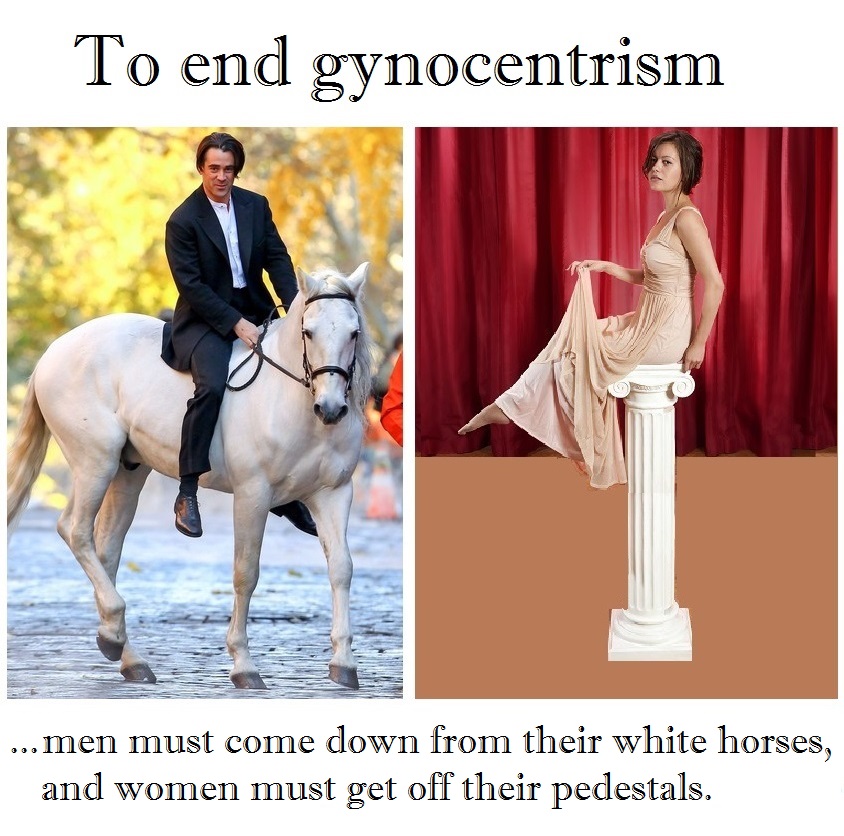
Gynocentrism is the ideological practice, conscious or otherwise, of asserting a female (or specifically a feminist) point of view on social issues, possibly to the detriment of non-females.1, 2, 3 The perceptions, needs, and desires of women have primacy in this approach, where the female view is the lens through which issues are addressed and analyzed.4

Description

Scholars Katherine K. Young and Paul Nathanson state that ideologically, the overriding focus of gynocentrism is to prioritize females hierarchically, and as a result may be interpreted as misandry (the hatred and prejudice towards men). Feminist calls for equality or even equity are often, according to their research, a subterfuge for gynocentrism.5

Young and Nathanson define gynocentrism as a worldview based on the implicit or explicit belief that the world revolves around women, a cultural theme so well entrenched that it has become ‘de rigueur’ behind the scenes in law courts and government bureaucracies, which has resulted in systemic discrimination against men.6 They further state that gynocentrism is a form of essentialism – as distinct from scholarship or political activity on behalf of women- to the extent that it focuses on the innate virtues of women and the innate vices of men.7

Some authors make more subtle discriminations between types of gynocentrism, such as individual gynocentric acts and events (eg. Mother’s Day), and the broader concept of a gynocentric culture which refers to a larger collection of culture traits that have major significance in the way people’s lives were lived.8

History

Elements of gynocentric culture existing today are derived from practices originating in medieval society such as feudalism, chivalry and courtly love that continue to inform contemporary society in subtle ways.9 Peter Wright refers to such gynocentric patters as constituting a “sexual feudalism,” as attested by female writers such as Lucrezia Marinella who in 1600 AD recounted that women of even lower socioeconomic classes were treated as superiors by men who acted as servants or beasts born to serve them, or by Modesta Pozzo who in 1590 wrote, “don’t we see that men’s rightful task is to go out to work and wear themselves out trying to accumulate wealth, as though they were our factors or stewards, so that we can remain at home like the lady of the house directing their work and enjoying the profit of their labors? That, if you like, is the reason why men are naturally stronger and more robust than us — they need to be, so they can put up with the hard labor they must endure in our service.”10

Criticism

Some post-modern feminists such as Nancy Fraser question the assumption of a stable concept of ‘woman’ which underlies all gynocentrism.11 Scholars Paul Nathanson and Katherine Young make a comparable claim that gynocentrism is a form of essentialism as distinct from scholarship or political activity on behalf of women, to the extent that it focuses on the innate virtues of women. Nathanson and Young add that “This worldview is explicitly misandric too, because it not only ignores the needs and problems of men, but also attacks men.12

Christina Hoff Sommers has argued that gynocentrism is anti-intellectual and holds an antagonistic view of traditional scientific and creative disciplines, dismissing many important discoveries and artistic works as masculine. Sommers also writes that the presumption of objectivity ascribed to many gynocentrist theories has stifled feminist discourse and interpretation.13

Feminist writer Lynda Burns emphasises that gynocentrism calls for a celebration of women’s positive differences – of women’s history, myths, arts and music – as opposed to an assimilationist model privileging similarity to men.14 However observed in practice, the preeminence of women associated with gynocentric narratives is often seen as absolute: interpersonally, culturally, historically, politically, or in broader contexts socially (i.e. popular entertainment). As such, it can shade into what Rosalind Coward called “womanism…a sort of popularized version of feminism which acclaims everything women do and disparages men”.15

Sources:

[1] Oxford English Dictionary 2010
[2] Wiktionary Gynocentrism
[3] Gynocentrism and its cultural origins
[4] Nicholson, Linda J. ”The second wave: a reader in feminist theory” Routledge, 1997
[5] Katherine K. Young and Paul Nathanson, Legalizing Misandry, 2006 p.116
[6] Katherine K. Young and Paul Nathanson, Legalizing Misandry, 2006 p.309
[7] Katherine K. Young and Paul Nathanson, Sanctifying Misandry, 2010 p.58
[8] Wright, Peter, ”Gynocentrism: From Feudalism to Modern Disney Princesses”, 2014 p.8
[9] Wright, Peter, ”Gynocentrism: From Feudalism to Modern Disney Princesses”, 2014 p.28
[10] Wright, Peter, ”Gynocentrism: From Feudalism to Modern Disney Princesses”, 2014 p.28
[11] Burns, p. 160-1
[12] Katherine K. Young and Paul Nathanson, Sanctifying Misandry, 2010 p.58
[13] Christina Hoff Sommers, ”Who Stole Feminism?: How Women Have Betrayed Women” (1994) p. 64-73
[14] Lynda Burns, ”Feminist Alliances” (2006) p. 153
[15] Rosalind Coward, ”Sacred Cows” (1999) p. 11

Early references to “Men going their own way”

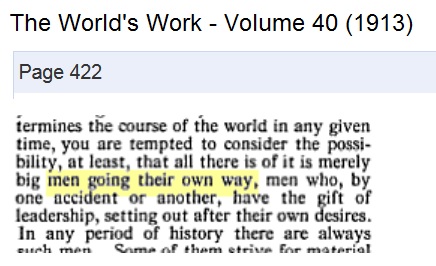
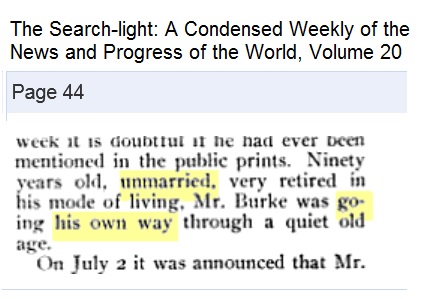
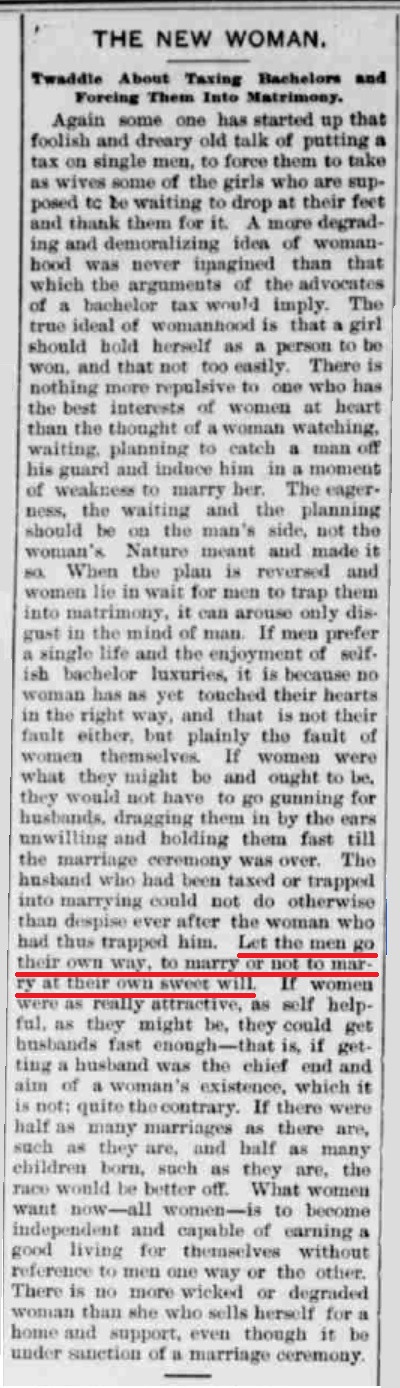
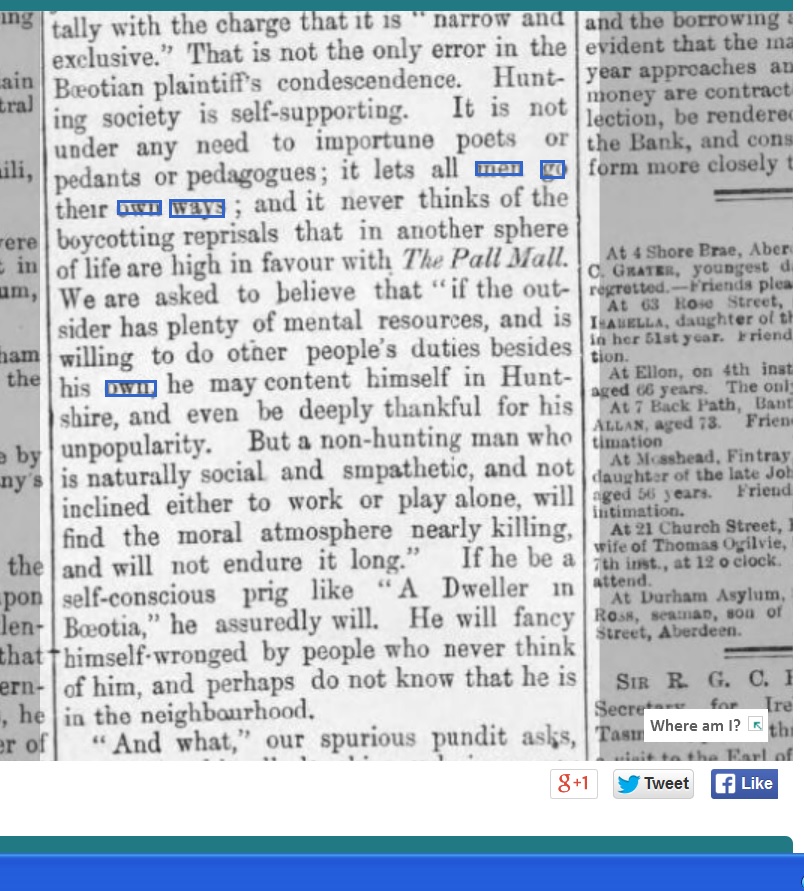
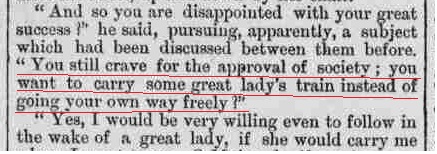
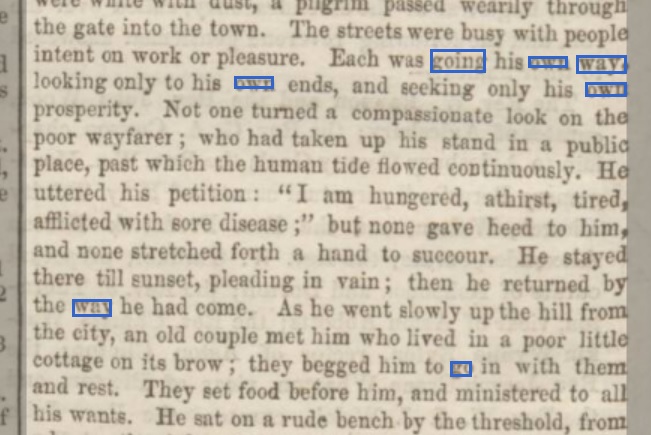
Despite false claims that the phrase was invented during the last decade, “Men Going Their Own Way,” or variants such as “going his own way,” or “go his own sweet way,” is now hundreds of years old.

Here are a few examples (out of thousands) showing that the phrase, as used in reference to men’s freedoms, is an old one:

1996
MGTOW 1996

1939
MGTOW 1939

1936
MGTOW 1936

1922
MGTOW 1922

1917
MGTOW 1917

1913
MGTOW 1913

1902
1902 MGTOW

1899
MGTOW 1899 Morning Post - Friday 22 September 1899

1897
Let men go their own way - MGTOW 1897 The Copper country evening news., October 09, 1897, Image 2

1889
MGTOW 1889 - letter written by Walt Whitman

1886
MGROW 1886 Aberdeen Journal - Monday 06 December 1886

1880
MGTOW 1880 Hull Packet - Friday 03 September 1880

1856
MGTOW 1856 Bucks Herald - Saturday 07 June 1856

1853
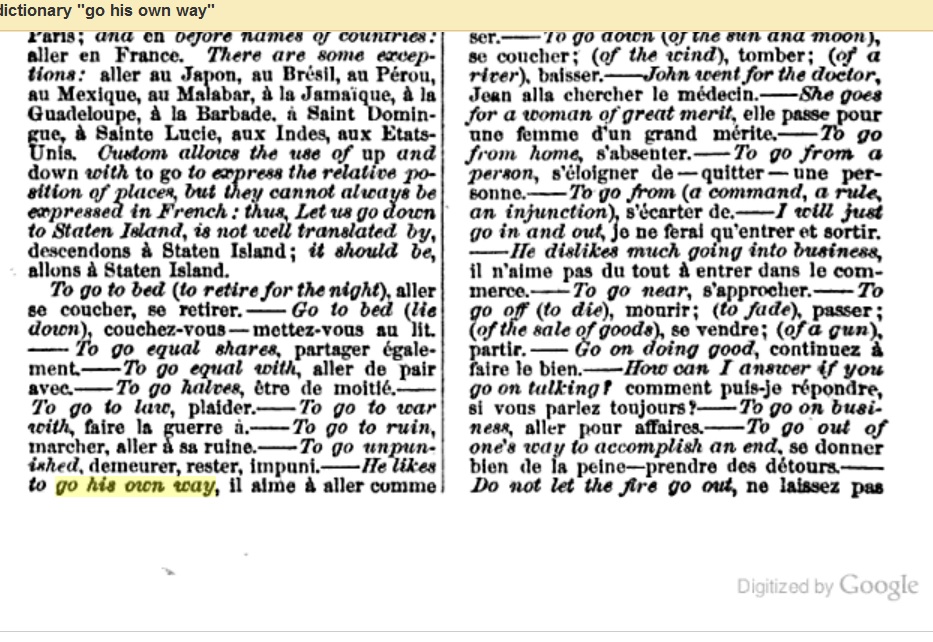
MGTOW 1853 Dictionary of English and French Idioms Illustrating, by Phrases and Examples, the Peculiarities of Both Languages, and Designed as a Supplement to the Ordinary Dictionaries Now in Use

The 200th anniversary of the Good Men Project

hen

“Many a good man of the Henpecked Club has to be on his good behaviour in order to keep on anything like peaceable footing with his better half – (1860)1

It may come as a surprise to readers to learn that the Good Men Project is only the most recent incarnation of a longer tradition teaching men how to be obsequious ‘good men’ toward the fairer sex.

The Good Men Project takes its place within a long-running tradition exemplified by ‘The Henpecked Club’ — a very real organization, global in scope, that has been in continuous operation for at least the last 200 years.

The Henpecked Club, essentially a project for creating Good Men™, consists of an international network of meeting-places where men came for marital support, especially if enduring emotional and physical abuse from wives. In this aspect the club reminds of Al-Anon, the modern support-movement for spouses of alcoholics. However, the club members had a strange way of showing support – they actively encouraged husbands to tolerate their wives’ abuse, and to placate her with any means necessary to moderate her behaviours. Henpecked Club members, moreover, were expected to take their wives breakfast in bed daily, and to do most of the household chores, even after a hard day’s work, with the hope that this would place wives in a more amiable frame of mind or – perhaps more accurately – in a less abusive mood.

Men were also advised to absorb any violence or abuse without complaint, stoically tolerating it so as not to provoke or further upset his wife. This, explained club policy, was how one become a ‘good man.’ If his wife continued with her abuse after these conciliatory gestures, Club officials would ask the man what he may have unwittingly done to provoke her, followed by “How might you better serve her so she doesn’t become upset again?” The answer to that question was typically for the husband to do more housework, but there was also a novel intervention of ‘rocking a wife to sleep,’ of which I will say more shortly.

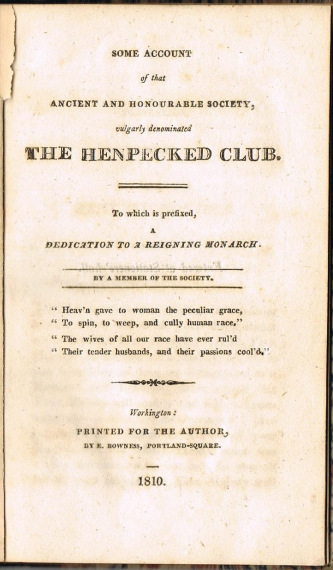
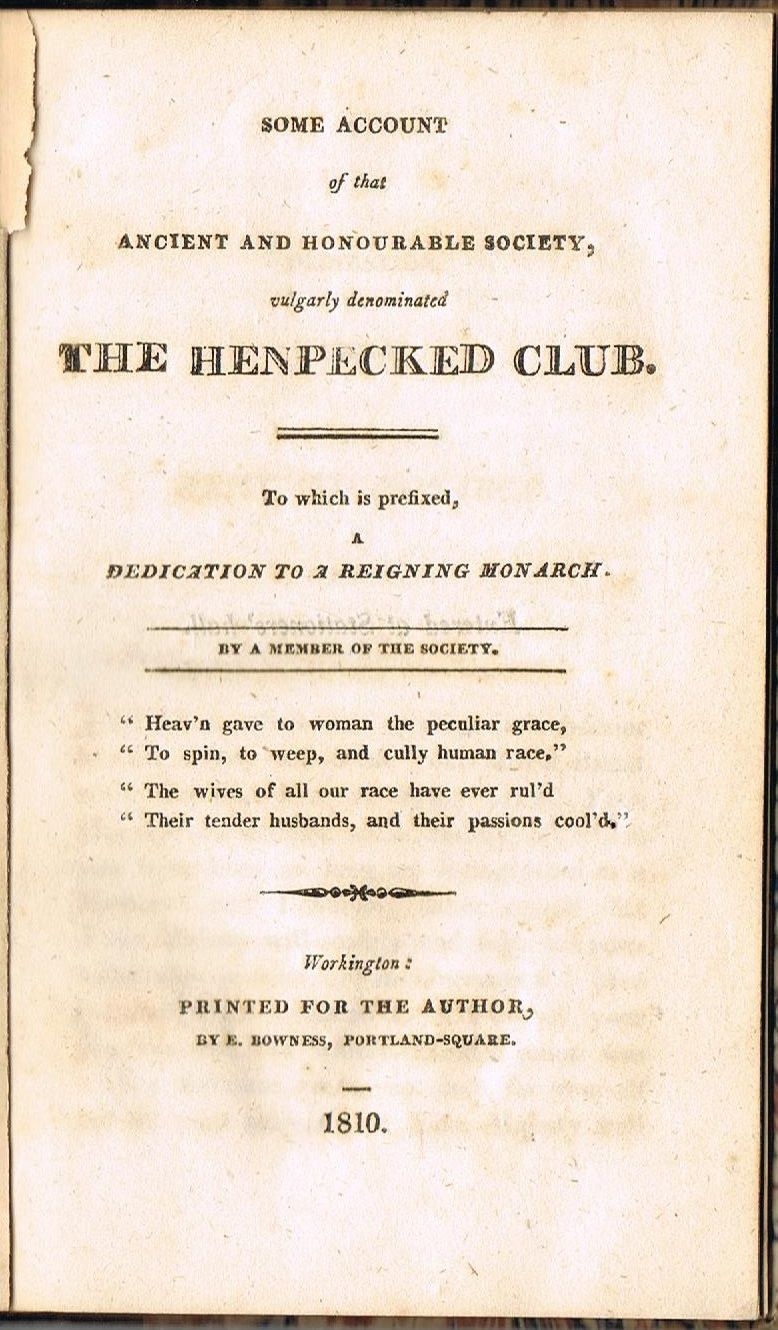
Henpecked-Club-cover-page-singleHenpecked clubs existed in their hundreds from the 1700s through to contemporary times, and in places as diverse as England, Austria, USA, Germany, France, Australia, Yugoslavia, China, and Japan.

Why haven’t we heard of these clubs – many containing several hundred members struggling to find ways to deal with difficult marriages – in an age when we are so hyper-focused on gender relations? Not even a peep from historians, despite the availability of material about Henpecked Clubs. Why?

Because it doesn’t chime with the image of a ‘dominant patriarchal husband’ proffered in modern interpretations of history.

So in a gesture of redressing history, here is small part of an 1810 book entitled, Some Account of that Ancient and Honourable Society, Vulgarly Denominated The Henpecked Club – showing that the project of creating ‘good men’ has been going on for at least 200 years, and probably more:

“[Husbands] submit to the pleasing bondage of their wives, in as great numbers, and with as much good will, as in any enlightened period of ancient or modern times.

“Henpeckicism, which has been graced by ranking as its Members the greater part of the most celebrated men who have appeared since the creation to the present day, whether legislators, philosophers, conquerors, poets of divines, requires no other argument to vindicate and establish its right to the most extensive influence and operation, than the language of every lover, who readily acknowledges himself to be, and swears to continue, the slave of his mistress, before marriage; ergo, he who denies her supremacy, when she becomes his wife, is guilty of the most criminal and unnatural rebellion against womanly authority that God himself have set over him. If other arguments were wanted, however, many might be adduced to prove that the superiority of the female is an ordination of Nature. For example, the noblest or fiercest dog will tamely submit to the snarling and snapping of the most pitiful bitch of the species.”

“For in Henpeckicism there is no distinction: the peerless woman lords it over her vassal even as the peasant: All are equally comprised in the description so happily given by the poet:

“The crouching vassal of the tyrant wife,
“Who has no sixpence but in her possession,
“Who has no will but in her high permission,
“Who must to her his dear friends secrets tell,
“Who dreads a curtain lecture worse than hell”

“The rules observed by the Members of those Meetings were every way adapted to preserve the existence of the institution. Such Members as had the honour of receiving a black eye from their spouses, were entitled to an allowance of 10s. 6d. per week, for so long as the glorious colouring remained: The allowance for two black eyes was £1 1s 0d. In all cases, proof was required that the contusion was received according to the true spirit of genuine Henpeckicism, that is, without resistance or murmuring, according to the example of that inestimable deceased Member, Socrates, who, together with his Lady, is alluded to by the poet in the following lines:

“How oft she scolded in a day he knew,
“How many pisspots at the sage she threw,
“Who took it patiently, and wip’d his head-
Rain follows thunder – that was all he said.”

Such married men as had not the honour to appertain to the Society, were earnestly requested to attend these Meetings, not as Members, but as visitors, in order that they might be induced to unite themselves with it, by witnessing the perfect happiness which it was calculated to confer. For what happiness can be greater than that of belonging to a spouse who takes upon herself the weighty care of regulating not only her own conduct, but that of her husband and the rest of her family; to a spouse who takes the trouble of receiving and paying all money; to a spouse who kindly undertakes the task of judging for her husband (in every occurence) of what is proper for him to do; of what time he should spend in public houses; of how much money he must expend; of what secrets ought to be retained in his or rather her possession, and of what ought to be divulged to the world? In short, she who takes upon herself all anxiety, all trouble, and leaves to her darling husband nothing to do but the delightful task of executing her commands; well remembering that:

“His proper body is not his, but mine,
“For so said Paul, and Paul’s a sound divine.”

The design and ostensible object of the Institution having always been to preserve, and even, if possible, to extend the just and laudable dominion of the fair sex, the several meetings thought it proper, also, to request the attendance of bachelors, not merely with a view that they might be benefited by witnessing such perfect examples of submission, but that those bachelors who had not yet turned their thoughts toward matrimony, or who might have overlooked so great an inducement to enter into the married state as the existence of out Institution, might be induced, as early as possible, to place themselves on a level, in this respect, with most of the greatest men in the world.

“The most common methods by which females attempt the full exercise of that unlimited power which of right belongs to them, is, at a very early period after marriage, to become extremely noisy and abusive, and to make a point of dealing out blame very liberally to their husbands for every action which they commit, whether they are really of the opinion that their conduct has been reprehensible or not. This method is at some times attended by blows. Though a vigorous and persevering course of this treatment may frequently be successful, yet there is considerable danger of resistance from those brutal fellows injudiciously termed men of spirit, a resistance which may be attended with consequences extremely injurious to female countenance. I would strenuously recommend this method be pursued by women, however, with all those effeminate characters who are more afraid of sustaining a drubbing, than eager to vindicate their title to manhood, as would especially advise it to be practiced on the whole tribe of fops or puppies, creatures possessed of no better proofs that they are privileged to rank as men, than that they have two legs and wear breeches.

“Some women pursue a course quite the opposite of this, and with greater success. They at one time load their husbands with caresses, magnify their own affection, and seem to have no other avocation worth their attention but that of convincing them that the sole study of their lives will be to invent fresh blandishments, and to render them in all respects completely happy. At other times, however, they affect a sulkiness of behaviour: a sudden and sullen gloom succeeds their former cheerfulness; they sigh frequently, and burst into floods of tears; nay, they are even seized with swoonings and hysterics.

The wretched husband of such a wife, alarmed at these surprising symptoms, anxiously enquires the cause. She affects to evade the question–he becomes more importunate–she persists in declining to assign a reason–his importunities are redoubled–till he is at last informed, with gentle reproaches and a burst of grief, that he himself is breaking her heart; that the reward of all her love is his neglect, &c. &c. Astonished at a charge which he is wholly unconscious of having merited, he at first endeavours to ridicule what he terms her childish uneasiness. She affects, however, still to doubt–he makes solemn protestations of his innocence; and they are reconciled. In a few days, however, the same farce is played out again, and again, and again, till the unhappy man is at length almost convinced, contrary to the evidence of his own senses, that his conduct has been criminal. Nay, to pacify his afflicted partner, he is even brought to confess his imaginary faults, and to promise amendment in the future. For fear of unintentionally giving offence, he learns to keep a strict watch over his own actions, becomes afraid to take any notice of those of his wife, and is, for the same reason, cautious of contradicting her, lest his cruelty should cause her to swoon; and, in short, becomes a Member of the Henpecked Society.

“Though the great object of our Society is to extend the domination of the female sex, it is far from being its intention to obtain that end by such reprehensible or unhappy means. The only worthy Members of the Society are those who have become so, as much by conviction of its utility, as by entertaining a due sense of the superiority of their wives. All such Members, however, have been treated in a manner very different from the preceding. They have (and let every wife endeavour to follow the same plan) been first brought to acknowledge that their wives, by their care and economy, were better adapted than Themselves to manage their concerns; have been satisfied, by their attentive behaviour, that they were well qualified to govern their families; and have been convinced, by their mildness and moderation, that the authority with which they were invested would never be abused. In such a family, resistance will never be attempted. Commands from the one party will be met by prompt obedience from the other. Perpetual harmony will be established; and correction, when necessary, will be submitted to, according to the fundamental rule of the Society, without murmuring and without resistance.”

The Good Man’s Wife Pacifier

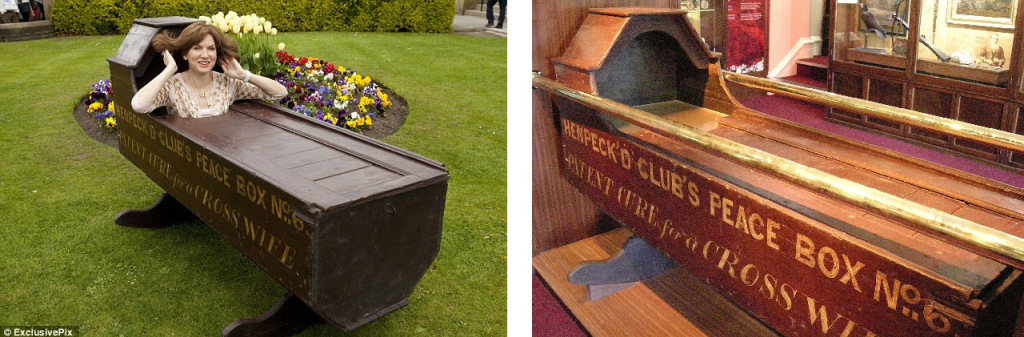
Henpeck’d Club’s Peace Box – Patent Cure for a Cross Wife

Henpeck’d Club’s Peace Box – Patent Cure for a Cross Wife

The good men of the Henpecked Club were responsible for an interesting innovation: an adult-sized rocking cradle, which was used for soothing nagging wives instead of babies. If you look closely you can see curved feet that allowed the cradle to be gently rocked from side-to-side by the dutiful husband.

The ‘Peace Box’ was invented by a club member named Harry Tap in 1862, and several were manufactured for hire by Henpecked Club members suffering under tempestuous behaviour from wives. If a wife was abusing her husband too much, the husband would entreat his wife to recline in the box, which could be rocked like a child’s cot in order to send the wife to sleep. While she was sleeping the husband would perform all the household chores then awaken his wife who would hopefully have calmed down.

With those juicy historical morsels now in the open, we seem to have come full circle, back to the future. Here we remain, with hat in hand, beseeching Dear Woman for forgiveness for having displeased her, hoping that she will notice how hard we are trying to be good men.

You may at this point be feeling nauseous in the knowledge that men have been kowtowing to such abuse for hundreds if not thousands of years, and yet we’re still being asked to to Take It Like A Man™, Man Up™, and be Good Men™. If you are feeling that way you are not alone, and with the growing army of men and women in the MHRM you can help bring an end to such appalling gynocentric customs.

SOURCES:

[1] Huddersfield Chronicle – Saturday 11 August 1860

Elizabeth Poole Sandford: Female Power, Influence, and Privileges in 1835

“Female Power, Influences, and Privileges” is Chapter-one from ‘Woman: As She Is, And As She Should Be,’ by Elizabeth Poole Sandford. It was published 1835 by Cochrane & Co., and is reprinted here in searchable text form for the first time. This book, written after the death of Mary Wollstonecraft and before the famed Seneca Falls Convention, is already questioning the idea of women as oppressed and lacking in power.- PW.

O ye men; it is not the great king, nor the multitude of men, neither is it wine that excelleth: who is it then that ruleth them, or hath the lordship over them? – Are they not women? By this also ye must know that women have dominion over you. Do ye not labour, and toil, and give, and bring all to the woman? Yea! many there be that have run out of their wits for women, and become servants for their sakes. Many also have perished, and erred, and sinned, for women. — ESDRAS. “

§ 1.–The supremacy of the weak over the strong is a very remarkable phenomenon, and it is as mischievous as it is remarkable. Whatever nature or law may have denied women, art and secret sway give them all: they are influential to a degree perfectly unguessed, and men are possessed by, not possessors of them.

“Woman was made of the man, and for the man:” this is the language of Scripture. Yet, though “expressly given to man for a comforter, for a companion, not for a counsellor,” Woman has managed to overstep her sphere – she has usurped the dominion of the head, when she should have aimed but at the subjection of the heart; and the hand which ought to be held out to the man, only to sustain and cheer him on his journey, now checks his steps, and points out the way he is to go! From moment to moment his purposes are thwarted and broken in upon by a capricious influence, which he scarcely dares to question, yet makes it his pride to indulge. Of this mighty evil it is that we are desirous to give a plain and unbiased view.

There is, perhaps, no country on earth where women enjoy such, and so great privileges, as in our own. The phenomenon has never passed unobserved by foreigners; and smartly enough it has been said, that were a bridge thrown across our Channel, the whole sex would be seen running to the British shores. In many countries women are slaves; in some they hold the rank of mistresses; in others they are (what they should be everywhere) companions; but in England they are queens!

It was remarked by Steele, even in his time, that “by the gallantry of our nation, the women were the most powerful part of our people;” and assuredly, female influence, far from finding its becoming level, has been on the growth among us ever since. It is now in its “high and palmy state,” and the star of Woman was perhaps never more in the ascendant than at this present writing.1 “The influence of Englishwomen,” as a contemporary observes, “of attractive women” (and a large portion of our countrywomen are attractive) “is vast indeed: be they slaves or companions, sensual toys or reasoning friends, that influence is all but boundless.”

§ 2.–Female influence necessarily exists by sufferance: it can only be by man’s verdict that it exists at all. And herein is the unaccountable part of the whole matter: there is actually something “stronger than strength,” —

And mighty hearts are held in slender chains.”

In the moral philosophy of Paley, there is a remark, so profoundly true, bearing upon our subject, that we cannot consent to hide it in a note. “Could we regard mankind,” says that writer, “with the same sort of observation with which we read the natural history, or remark the manners of any other animal, there is nothing in the human character which would more surprise us, than the almost-universal subjugation of strength to weakness. Among men (in the complete use and exercise of their personal faculties) you see the ninety-and-nine toiling and scraping together a heap of superfluities for one, and this one, too, oftentimes the feeblest and worst of the whole set–a child, a Woman, a madman, or a fool.”

And thus does Man (too often a creature of passion, but never so much or completely so, as when Woman is its object) yield himself an unthinking victim: a most willing bond-slave here, he suffers his head to become the dupe of his passions. How (perhaps many a man asks himself) should he look for harm, where he has garnered up his heart, and where his earliest, latest wishes centre? And yet we may love, like Othello, “not wisely, but too well;” we make unto ourselves idols of the heart, that shall wean us (as they weaned the wisest of old) from sobriety and duty. If the enthusiasm of devotion has sometimes stooped to borrow the language of love, far more often has the madness of love dared to borrow the language of devotion. Like the father in Parnell, our affections may become criminal, and “erring fondness” of this kind, amiable though it be, has to abide its consequences. Providence never fails to avenge any trespass on its own designs.

Led away “by a captive face,” “disturbed by a smile, or undone by a kiss;” a look sufficing to persuade, and a sigh to convince him: this is man’s position!

All they shall need, is to protest and swear,
Breathe a soft sigh, and drop a tender tear.” – Pope

Beauty has but to lecture through her tears, and with Dido of old, “ire iterim in lacrymas, iterum tentare precando,” and resolution is no longer a manly virtue. We resist, and resist, and resist again, –but at length turn suddenly round, and passionately embrace the enchantress.

Few are to be found who do not assume themselves with a toy of some kind during every stage of life, and Woman (though perhaps as little enduring in outward charm as any other, and one that, if critically eyed, would not retain its divinity long), is the most common and most fondled toy of all. How many, calling themselves men, are fooled by those who ought to be their comforters–prayed upon by harpies in the form of angels! The hypocrite affects attachment; the coquette trifles with feeling; the prude strikes at judgment; while the less principled reprobate lays out her traps for heedless passion.

In their most trifling pursuits do women somehow manage to create an almost-universal interest; in all their ordinary doings, in their ‘whereabouts,’–“leurs brouilleries leurs indiscretions, leurs repugnances, leurs penchans, leurs jalousies, leurs piques;” — They have, in fine, continues the author Montesquieu we are quoting, “cet art qu’on les petites ames d’interesser les grandes.” Nor are those mere “women’s fools” –the refuse of the other sex–who are led away blindfold thus: many of its chiefest ornaments are among their “following.” The great and small seem equally content to shape their desires to female foolishness, and with one false tear a pretty woman can undo at a moment what the best and wisest of men have been labouring for years to establish.

What is it Woman cannot do?
She’ll make a statesman quite forget his cunning,
And trust his dearest secrets to her breast,
Where fops have daily entrance.”

Where (apart from outward attractions) this especial fascination which belongs to woman lies, it is difficult to determine; wearing, as it does, the garb of secret and speculative influence, it becomes too vague to submit to a definition–and thus bases itself on a foundation as difficult to examine as to shake. We cannot look into the heart; and where women are concerned, the heart is more especially an enigma.

Thus much, however, may safely be concluded: were women really strong, the contact or the occasional superiority might alarm pride; but, as the truth is, this “mortal omnipotence” is at last but an insect in the breeze; and though a creature which by its will, its wit, or its caprices, is sometimes able to shake us, soul and body, it nevertheless, from instant to instant, is dependent upon ourselves for the minutest succour.

§ 3.–Let us consider female influence under the several aspects in which it presents itself;– and first, as acting upon society at large. The supremacy of women is quite as much general and public, as it is domestic and individual: it spreads along the innumerable lines of social intercourse,–exerting itself, not merely over manners, but, which is often to be regretted, over modes of thinking. We see around the sex an almost-Chinese prostration–of mind as well as body: their approval it is that stamps social reputation–their favour, and their favour alone, that is supposed to confer happiness. Nothing, forsooth, is right, but that which bears their approbation; and theirs alone is the great catholic creed of manners, any deviation from which is heresy. And women have no merit or qualifications then such as they themselves please to dictate,–having been early taught to feel their own consequence, more than what is due to their creature, Man.

§ 4.–But in the connubial state do women exercise the most unlimited power. Female influence, in its action merely over manners and conventionalisms, might seem somewhat on the surface; but such is by no means its narrow bounds: mediately, if not directly, it is an agent in every possible direction. The wife controls her husband, and he acts upon others, and upon the state at large, according to his sphere in life.

Within the whole circle of deception, there is perhaps no creature so completely beguiled as manya modern husband;–we can all, in our private circles, point to a score of instances. Such a being is but an appendage to another–nothing of himself; he is a slave, and a slave of the worst kind–fooled by the bent of another’s will. Free agency is a thing quite gone from him, and, if mere confinement makes not captivity, he suffers a loss of liberty at his own hearth. He is under a charm–loving, as Shakespeare phrases it, with an “enraged affection.” Let the dear enchantress cry for the moon, she should have it from its sphere, were it possible. He would have the world from its axis, to give it her: no one can be richer than she in his promises: she, who but she, the cream of all his care!

Dilige, et dic quicquid voles.”

Women there are affectionate enough–it may be, devoted–in their character as wives; but then, it is at their husbands’ peril to be happy by other means than such as in their wisdom they please to subscribe. Regents of the heart, they take care to govern it most absolutely: and thus it happens (as Phaedrus said long ago) that “men are sure to be losers by the women, as well when they are objects of their love, as when they lie under their displeasure!”

In right of marriage, Englishwomen become endowed with many and great privileges,–privileges that are growing in number and importance every day. Claims, greater than were ever before awarded, are now allowed them in Law and in Equity: over pecuniary matters they have no small control, and are always at full liberty to plunge into wanton expenditure, leaving their husbands the responsible parties.

In short, the ceremony of wedlock, with its present obligations, more than restores any natural inequality between the sexes. No longer are women cyphers beyond the sphere of domestic life: they are parceners of of our power. They are not, it is true, suffered as yet to dispute the prizes of ambition, but they partake largely of its reward; they have the lion’s share–they divide, where they do not monopolise the spoil!

Were it not for difference of dress and person, one might almost mistake the wife for the husband in this country. Her will is not carried in His pocket, as is wisely arranged elsewhere:– “he pays the bills indeed, but my lady gives the treat.” And while she is spending money with both hands, and with a zeal that would lighten the bags of a loan-monger, he has to sell his woods and lands, borrow, or beg!

Slyly and unperceived does the foot of female authority slip itself in: the wedge is easily driven home. This is a species of power that never exists long without favouring itself;–let an ascendancy be once gained (and the collar of command is soon slipped!)–let a system of unsinuation once transfer the authority of wedlock,–and, afterwards, every act, be it of large or small import–what must be done, what is to be said,–becomes not the act of the Man, but of the Woman. It is not planned, it is determined; and where the lady cannot give her reason, she gives her resolution.

Hoc volo, sic jubeo; sit pro ratione voluntas:
Imperat ergo viro!”

This is “Gynocracy” with a vengeance! as Lord Byron was pleased, on some occasion, to denominate petticoat-sway. This very peculiar and distinct species of government (partaking in its nature not so much of mild despotism, as of a pure unmixed tyranny) has now grown so common among us, that (albeit laid down neither in Plato nor Aristotle) it well deserves, as it has obtained, a definite and scientific denomination.

We have all seen the ivy twining around the oak, but behold a novelty–the oak twining itself about the ivy! The man who suffers himself to be led away blindfold thus, can only be likened to the fool “that rejoiceth when he goeth to the correction of the stocks.”–“Give not thy soul to a woman, to set her foot upon thy substance.” To submit thus is contrary to the first law of nature–it is a direct spurning of Revelation:-

Was she thy God, that thou didst obey?
Or was she made they guide,
Superior, or but equal–that to her
Thou didst resign thy manhood?” — MILTON, P.L.

Let us presume to offer one word of advice to the sex that, in truth, most needs it. Men should let their love be at least manly; it is always possible to be affectionate without being over-fond;–to copy the gentleness, without the amorousness, of the dove. It is in itself a folly to allow those we love to perceive the vehemence of our affection; for such is human nature,–and such especially is female nature, that where it can control, it is nearly sure to become indifferent about pleasing, and at last despotic. Persecution may appear in many shapes, at home as well as abroad; it may address us in the voice of mildness as well as of imperious command; and the soft and playful creatures of our idle hours may cause us misery for years: Nothing is to be disregarded, however seemingly powerless! Though the capacities of Woman are comprised within a narrow sphere, these act within the circle of vigour and uniformity. It is often by seeming to despise power, that women secure it to satiety! A love of power would seem almost part and parcel of Woman’s composition;–for to this end they early learn to enlist every art they are mistresses of;–

In men we various ruling passions find.
In women two almost divide the kind;
These only fix’d, they first or last obey–
The love of pleasure, and the love of sway. — POPE

§ 5.–Nor is the political influence belonging to women of contemptible amount. There is an old and true maxim, that though kings may reign, women virtually govern: ’tis they who hold the strings of all intrigues, great or small. “There are perhaps few instances,” says an elegant writer, “in which the sex is not one o the secret springs that regulate the most important movements of private or public transactions.”

Not merely over the fanciful regions of fashion does the female empire extend itself; it dictates to the senate, as well as legislates for the ball-room. Women make no laws, it is true; they abrogate none: in so far Law shakes hands with Divinity; but they have an influence beyond any law: “Ce que femme veut, Dieu le veut?” Nothing resists them! What follows, though it be poetry, is too true a picture.

What trivial influences hold dominion
O’er wise men’s counsels and the fate of empire!
The greatest schemes that human wit can forge,
Or bold ambition dares to put into practice,
Depend upon our husbanding a moment,
And the light lasting of a Woman’s will!” — ROWE

Nor are women without civil and political power of the direct kind. They are vested with many important trusts, and enjoy most of those privileges which accompany property. They vote for many public functionaries, and their sweet voices are made admissible in electing directors for the government for thirty or forty millions of souls of British India.

And where their influence is but indirect, it is little less powerful on that account. In our public elections ’tis they who are the actual constituency,–they, after all, who virtually elect; for which is the vote that they do not influence? The system of female canvassing has of late years become a traffic quite notorious.

The lady in Hudibras, did not exceed the truth when she asserted the vast powers and privileges of her sex:–

We manage things of greatest weight
In all the world’s affairs of state;
We make and execute all laws
can judge the judges and the cause;
We rule in every public meeting
And make men do what we judge fitting;
We are magistrates in all great towns
Where men do nothing but wear gowns!
We are your guardians, that increase,
Or waste, your fortunes as we please;
And, as you humour us, can deal
In all your matters, ill or well.”


Notes:

[1] “A low estimate of female pretensions is certainly not the fault of the present day. Women are, perhaps, sometimes in danger of being spoilt, but they cannot complain that they are too little valued. Their powers are too highly rated: their natural defects are overlooked, and the consideration in which they are held, the influence they possess, and the confidence placed in their judgment, are in some instances disproportionate with their real claims.” — Mrs. Sandford