The following excerpt is from the book Marriage and love in England: Modes of reproduction 1300-1840, by Alan Macfarlane (1986).
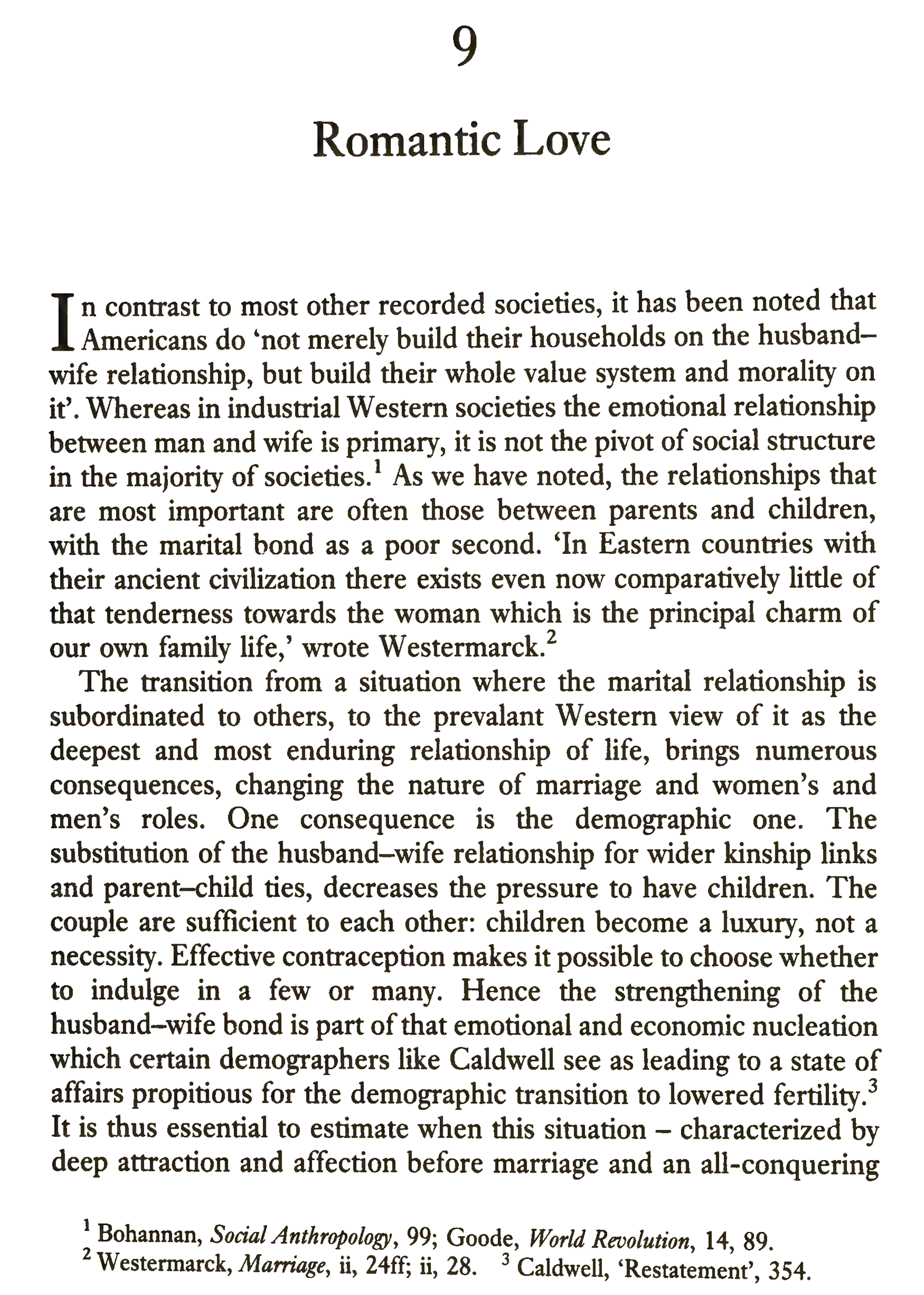
The following excerpt is from the book Marriage and love in England: Modes of reproduction 1300-1840, by Alan Macfarlane (1986).
Several human populations show little to no evidence of the classic ~2:1 female-to-male reproductive skew (i.e., female Ne = 2× male Ne), and in a few cases, the pattern is reversed (male Ne > female Ne). These exceptions are crucial because they prove the skew is not a universal biological law of human mating (e.g., inevitable female hypergamy or male disposability), but a cultural and historical contingency.
Populations Where the ~2:1 Skew Did Not Occur
|
Population
|
Genetic Evidence
|
Key Finding
|
Implication
|
|---|---|---|---|
|
Matrilineal / Matrilocal Societies
|
High Y-chromosome diversity relative to mtDNA
|
Male Ne = Female Ne (or even male Ne > female Ne)
|
Skew is absent or reversed when descent and residence are traced through women
|
|
Khasi (Northeast India)
|
Batini et al. (2019), Zeng et al. (2018)
|
Y-diversity not reduced; male Ne = female Ne
|
Matrilineal inheritance prevents lineage pruning
|
|
Mosuo (China)
|
Similar pattern in regional studies
|
Near parity in effective population sizes
|
Matrilocal residence disperses male genes
|
|
Minangkabau (Indonesia)
|
High male genetic diversity
|
Minimal Y-bottleneck
|
Largest matrilineal society (~5M people)
|
|
Nair (South India)
|
Historical matriliny
|
Genetic studies show balanced Ne
|
Tradition of polyandry and female-centered kinship
|
|
Some African Forager Groups
|
Lippold et al. (2014), Karmin et al. (2015)
|
No Holocene Y-bottleneck in Khoisan, Hadza, Pygmy groups
|
Hunter-gatherer egalitarianism avoids lineage consolidation
|
Populations with Reversed Skew (More Men Reproduced Than Women)Yes — male Ne > female Ne in some groups:
|
Population
|
Ratio (Male:Female Ne)
|
Source
|
|---|---|---|
|
Some Papua New Guinea Highland Groups
|
~1.5:1 to 2:1 (male > female)
|
Genomic studies of language-specific bottlenecks
|
|
Certain Amazonian Tribes (e.g., Yanomami subgroups)
|
Male Ne slightly higher
|
Due to female infanticide or bride capture reducing female reproduction
|
|
Historical Polynesian Isolates
|
Occasional male bias
|
Small founder effects + cultural practices
|
Why the Skew Is Absent in These Groups
|
Mechanism
|
In Patrilineal Societies
|
In Matrilineal/Forager Societies
|
|---|---|---|
|
Lineage Pruning
|
Elite male clans dominate – most Y-lines die out
|
No male kin groups – Y-chromosomes stay diverse
|
|
Residence Pattern
|
Patrilocal: sons stay, daughters leave – male gene flow restricted
|
Matrilocal: men move – Y-chromosomes disperse
|
|
Inheritance
|
Wealth/power to sons – reproductive inequality
|
Often to daughters or shared – less male monopolization
|
|
Violence/Warfare
|
Organized between patrilines – low-status males killed/excluded
|
Rare or ritualized – less impact on reproduction
|
Takeaway Argument
This destroys the evosimp/red-pill appeal to “genetic inevitability”. The data shows social structure, not female choice or male competition, is the primary driver.
“Twice as many women as men reproduced in our evolutionary past. That proves women are hypergamous—choosy gold-diggers who only sleep with the top 20% of men.”
Wrong.
The reproductive skew—the fact that ~80% of ancestral females left descendants while only ~40% of males did—is real.
But it is not evidence of female mate choice.
It is not evidence of hypergamy.
It is not even evidence that women had any say in the matter.
|
Genetic Fact
|
What It Means
|
|---|---|
|
Female effective population size = 2× male
|
Twice as many women as men contributed genes to the next generation.
|
|
~80% females reproduced
|
Almost every woman who reached adulthood had kids.
|
|
~40% males reproduced
|
Most men died genetic dead-ends.
|
That’s it.
That’s all the DNA tells us. It says nothing about why.
These are not edge cases.
They are the rule in 85% of documented societies (Murdock’s Ethnographic Atlas).
|
Argument
|
Reality Check
|
|---|---|
|
“Women evolved to pick high-status men.”
|
Sure—if they had the power. Most didn’t.
|
|
“Modern surveys show women want rich guys.”
|
Modern women have options. Ancestral women often had none.
|
|
“Dating apps prove the 80/20 rule.”
|
Apps are opt-in, anonymous, urban, post-feminism. Not Paleolithic.
|
Effective population size (Ne): Female Ne = 2× male Ne.
Translation: Twice as many unique mothers as fathers.
Possible causes:
The relative influence of each of these factors varies across cultures, time periods, and ecological conditions.
Buss’s work is about modern mate preferences, not ancestral monopolization.
He never says the skew “proves” hypergamy — that’s a post-hoc fan fiction by gynocentric ideologues.
Reproductive skew is evidence of asymmetric mating outcomes, not asymmetric agency. It shows some men monopolized sex—but reveals nothing indicating that women chose them freely. For this reason, we can stop letting evosimps weaponize a Y-chromosome statistic to guilt men into pandering to modern female narcissism under the false banner of “natural” hypergamy.