Pleasure-seeking has long been a cornerstone of philosophical and psychological thought. From the ancient Greek philosopher Epicurus to Sigmund Freud, the idea that humans are fundamentally driven by the pursuit of pleasure has shaped much of Western thinking. Freud crystallized this in his pleasure principle, stating, “What decides the purpose of life is simply the programme of the pleasure principle.”
However, mid-20th-century developments in psychoanalysis, particularly Object Relations theory, challenged this view. Pioneered by British psychoanalyst Ronald Fairbairn, Object Relations theory posits that the primary motivational force in human life is not raw pleasure or instinctual discharge, but the drive to form and maintain relationships with others—termed “object-seeking.”
Fairbairn’s Reorientation of Libido Theory
In 1944, Fairbairn articulated a significant departure from classical Freudian theory:
“The basic conception… is to the effect that libido is primarily object-seeking (rather than pleasure-seeking, as in the classic theory), and that it is to disturbances in the object-relationships of the developing ego that we must look for the ultimate origin of all psychopathological conditions.”
Fairbairn emphasized that libido is not primarily about gratifying biological drives through “erotogenic zones” but about establishing satisfactory relationships. Pleasure, in this framework, is a byproduct or a secondary mechanism used to mitigate failures in relational aims: “Explicit pleasure-seeking is thus not a means of achieving libidinal aims, but a means of mitigating the failure of these aims.”
This shift aligns with broader evolutionary insights. In evolutionary psychology and biology, strong pair bonds facilitate biparental care, kin support, and offspring survival—critical for humans given the extended dependency period of our altricial young. Without stable relational environments, paternal investment declines, and reproductive success suffers.
Graphic 1: The Relational Aim of Libido
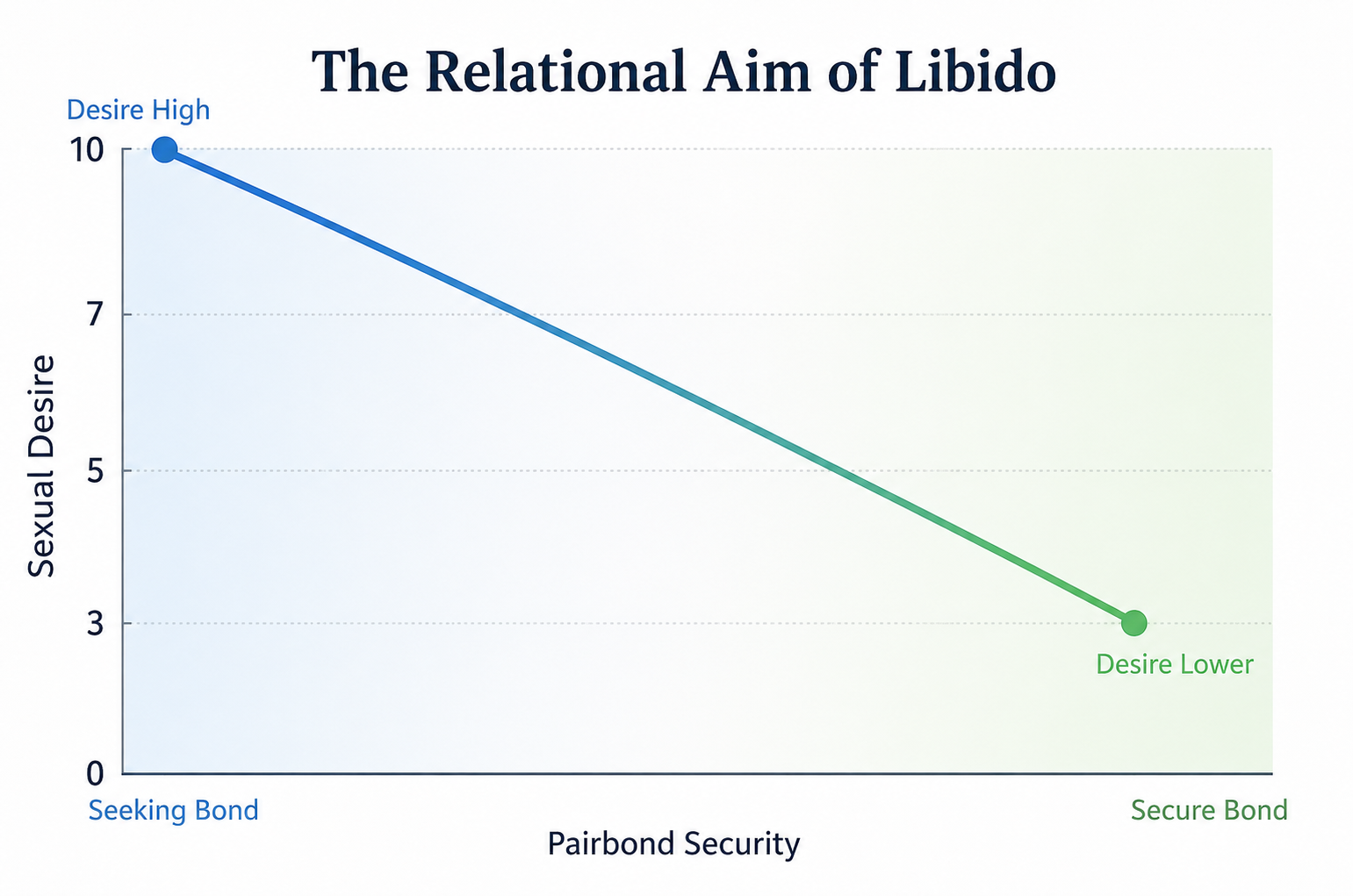
The graphic illustrates this dynamic perfectly: sexual desire (or neediness) is highest in the seeking bond phase and naturally subsides as pairbond security is achieved.
Make-Up Sex and Hate Sex: Repairing the Relational Bond
A compelling real-world demonstration of Object Relations principles is “make-up sex,” or “hate sex”—intense sexual encounters following conflict or alienation. Far from being paradoxical, these experiences reflect the libido’s object-seeking nature. When a bond is threatened, sexual intimacy mobilizes hormonal mechanisms (including surges in oxytocin and vasopressin) to restore connection and security.
Fairbairn’s theory explains why sex is harnessed to repair failing relationships: it serves as a powerful avenue to reaffirm the bond when security feels tenuous. This is not simply pleasure-seeking but an instinctual attempt to reinstate a failing relational bond. The phenomenon provides strong proof-of-concept for the central thesis of this article: that sex primarily serves the creation and maintenance of relationships, rather than relationships existing merely as a vehicle for sex.
In other words, the sexual drive is fundamentally relational in its aim—oriented toward bonding and repair—rather than relationships being secondary to constant pleasure-seeking. This aligns with both clinical observations in Object Relations theory and evolutionary evidence showing that sexual behavior in humans is deeply integrated with attachment systems that promote long-term pair bonding and parental investment.
The Irony of “Spinning Plates” and Pickup Strategies
If Object Relations theory is correct—that male sexual neediness is fundamentally oriented toward securing a pair bond, after which the drive naturally attenuates—then modern “spinning plates” (maintaining multiple casual sexual relationships) does the opposite: it perpetuates and amplifies neediness.
Techniques designed to increase female attraction and facilitate short-term encounters keep the practitioner in a perpetual seeking state. This exploits the Coolidge effect—renewed sexual interest with novel partners, observed across species including humans—preventing habituation and sustaining high arousal through dopamine resets.
Biologically, this strategy correlates with elevated testosterone levels typical of single or low-commitment men, fueling a higher sex drive and restless seeking behavior. In contrast, stable pair bonds are associated with lower testosterone and greater contentment via oxytocin and vasopressin-mediated attachment.
Men in long-term relationships often experience a natural decline in spontaneous desire after the honeymoon phase due to familiarity, but they gain relational satisfaction that reduces compulsive “neediness.” Rapid variety, however, keeps the system in high mating-effort mode without the stabilizing effects of deep attachment.
Graphic 2: Sexual Neediness Levels by Group
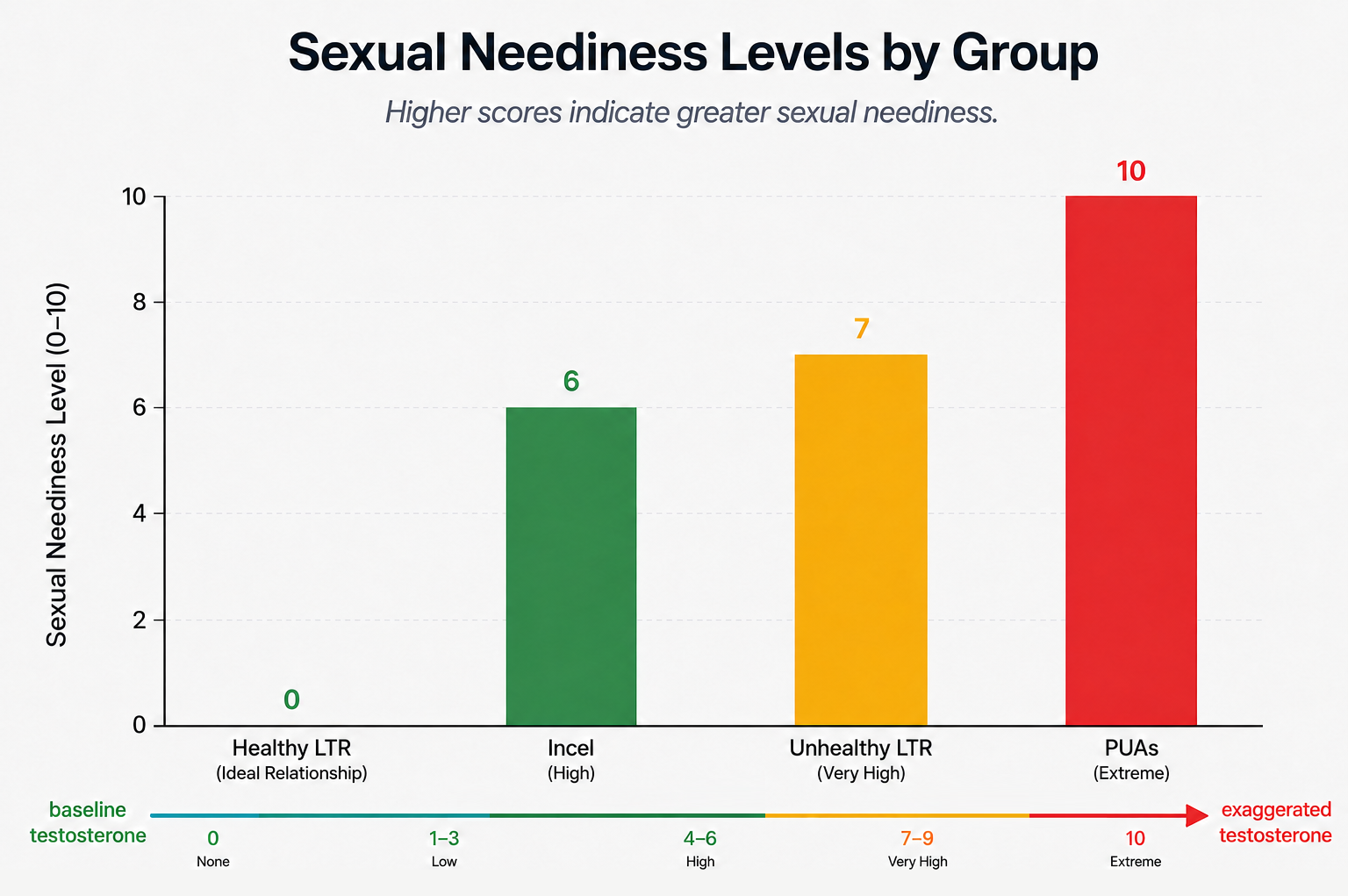
The more frequently a man is tantalized by a pairbond, the higher his sexual neediness becomes
The graphic summarizes sexual neediness across groups, with higher scores reflecting greater ongoing drive and seeking behavior, mapped against baseline testosterone dynamics:
- Healthy LTR: Low neediness (0). Secure attachment and moderate intimacy allow habituation and contentment.
- Incel: High (6). Frustrated seeking without outlets.
- Unhealthy LTR: Very high (7). Insecure bonds activate repair mechanisms like heightened desire.
- PUAs: Extreme (10). Perpetual novelty and spinning plates exaggerate testosterone-driven drive in a self-reinforcing loop.
These patterns are modulated by individual factors like age, health, and sociosexual differences, but the average trends hold.
Evolutionary Synthesis
From an evolutionary perspective, human libido evolved with pair bonding as a key adaptation. While short-term mating strategies offer reproductive benefits (especially for males via sperm competition and genetic diversity), the relational infrastructure of pair bonds supports the intensive parental investment required for human offspring survival.
Modern casual-sex cultures, exaggerated by dating apps and pickup culture, create a mismatch: they hijack novelty-seeking mechanisms (Coolidge effect, elevated T) in ways that sustain high sexual neediness without delivering the pair-bond security toward which the system is ultimately oriented. Practitioners may celebrate the cycle as victory, but Object Relations and evolutionary lenses suggest it often represents a self-perpetuating loop of unfulfilled relational aims.
In summary, while pleasure remains part of the human experience, Object Relations theory—bolstered by evolutionary biology—reminds us that our deepest libidinal aims are relational. Secure pair bonds represent not the end of desire, but its maturation from urgent seeking to stable attachment.
That said, men today are reluctant to trade the pleasure-seeking cycle for commitment, and with damn good reason. A large proportion of modern women are not pairbonding material – because they have been shaped by cultural trends that undermine loyalty, emotional stability, and companionate partnership. The prospect of commitment comes with real dangers of failure, and the potential rewards do not justify the risk if the woman lacks the qualities necessary for a secure bond. In such an environment, the “juice” is frequently not worth the squeeze.
This leaves men with a difficult but narrowly actionable path forward. As Paul Elam has long argued, genuine pairbonding is still possible, but it demands significantly greater effort in vetting and filtering. Only a shrinking minority of women today understand and are willing to invest in a loyal, companionate bond. So any success that a man might achieve requires rigorous discernment, strong personal boundaries, and a willingness to walk away from women who do not meet that standard.
Understanding this framework can help men navigate modern mating landscapes more consciously — whether choosing strategic singlehood, a more carefully selected commitment, or something in between — while remaining grounded in the fundamental relational purpose of libido.
References
1. Fairbairn, R. (1952). Psychoanalytic Studies of the Personality. Tavistock Publications. (Especially pp. 82–83 on libido as object-seeking.)
2. Freud, S. (1991). Civilization, Society and Religion (Penguin Freud Library Vol. 12).
3. GoodTherapy.org. “Object Relations” entry.
4. Various supporting studies on the Coolidge effect, testosterone dynamics in pair bonds, and attachment hormones (e.g., reviews in Psychology Today, Proceedings of the Royal Society B, Frontiers in Psychology, and related evolutionary psychology literature).
5. General evolutionary psychology sources on human pair bonding, biparental care, and mating strategies (e.g., work by David Buss, Helen Fisher, and others on attachment and reproductive success).