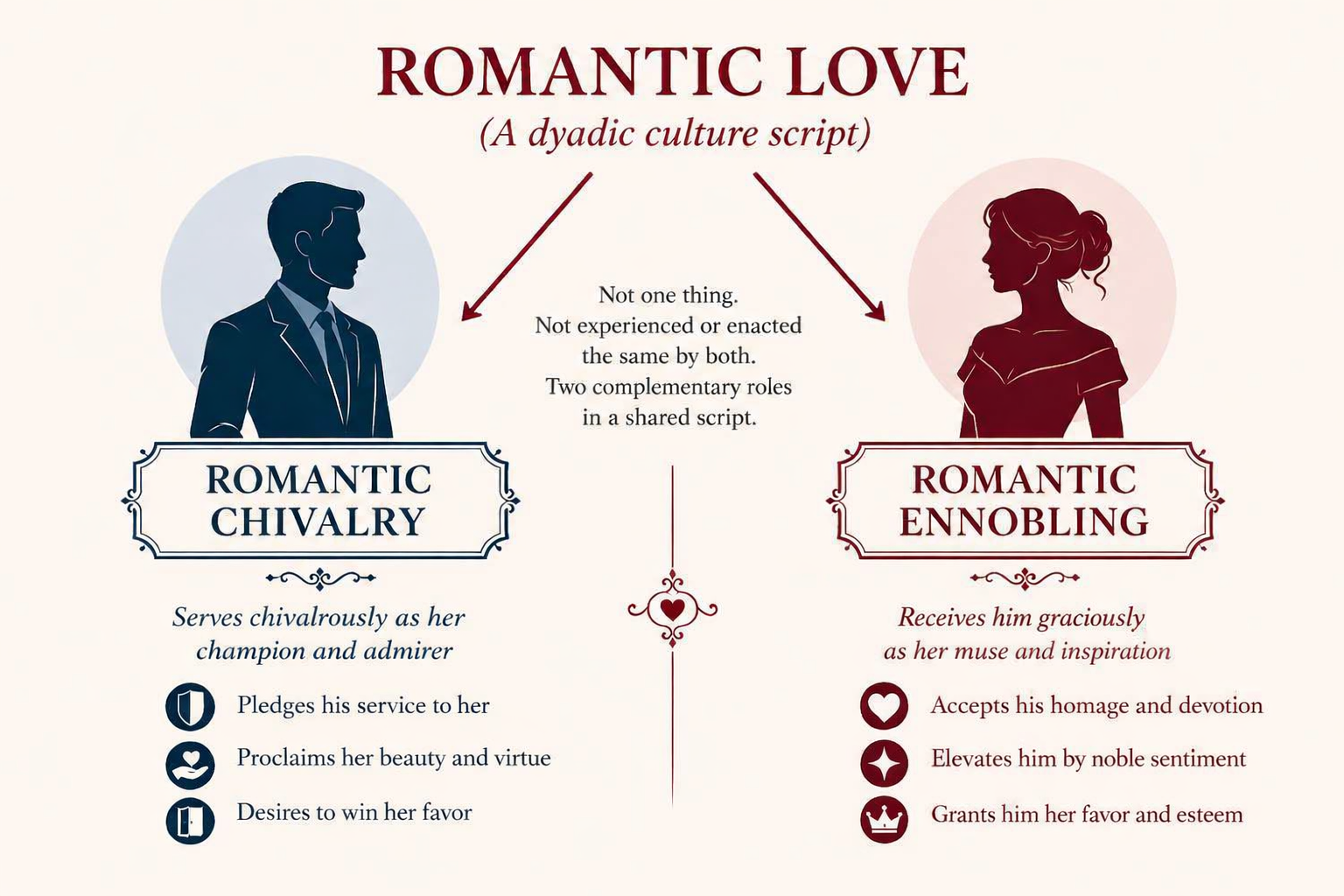
Since its invention in medieval Europe, the concept of romantic love has referred to a specific cultural template: a feudal-inspired dyad in which the man acts as a devoted servant (embodied in the rituals of chivalry) and the woman occupies the pedestal traditionally reserved for a feudal lord. This structural relationship, adapted from feudal society and applied to intimate bonds, became the defining framework for romantic love. It spread globally and remains symbolically potent today—for instance, in the common image of a man kneeling on one knee to propose marriage, an act that implies the same roles between men and women even when not literally performed.
This core template—the feudal structure itself—is what distinguishes romantic love from other forms of affection. Over time, however, it underwent category creep through its increasing association with two related but distinct elements:
1. The freedom to choose one’s love partner.
2. Sexual desire and activity.
The first of these, freedom of partner choice, is more apparent than real. In the romantic template, “freedom of choice” means only this: a woman may choose her vassal, a man may choose his lady. That is a choice of persons inside a fixed pair of roles. It confines free choice only to people willing to enact those roles, not to people free of them. Genuine choice can weigh many other things—stability, reciprocity, material contribution, character. Romance doesn’t facilitate that wider freedom; it imprisons choice inside a narrow feudal script.
The second association, sexual desire, was not inherent or necessary to the original model. Courtly love (amour courtois), the direct precursor to what we call romantic love, was frequently and even ideally Platonic in nature. Troubadour poetry and chivalric literature often celebrated an elevated, non-physical devotion in which the man’s service and the woman’s pedestal remained pure; consummation was neither required nor always desired. Sex sometimes occurred as an additional element, but its presence or absence did not define the romantic construct. This historical reality makes clear that sexual activity is merely an adjunct—something that may accompany the template but is not identical to it.
Because sexual desire is clearly an evolved human behavior, its frequent close proximity to the romantic template has encouraged academics and lay observers alike to interpret the entire phenomenon—including the cultural feudal template—as a biological universal rather than a historically specific construct. The result is a form of misplaced adaptationism: the assumption that because one component is innate, the whole package must be as well. The feudal template was smuggled in as an instinct: a medieval idea disguised as biology and conflated with it.
A Foundational Study and Its Limitations
A widely cited 1992 paper by William Jankowiak and Edward Fischer examined evidence of “romantic love” across 166 cultures and reported its presence in 147. They defined it as intense attraction involving idealization of the other “within an erotic context.” Their coding criteria then looked for generic features of passionate courtship and pair-bonding: personal anguish and longing, love songs or folklore, elopements based on affection, and ethnographers’ reports. Sexual passion (eros) was part of that mix. The feudal template was not. Missing from their construct was the man-as-vassal, woman-as-lord dynamic at the heart of European romantic love. Without that element, what they described aligns with broader passionate or early pair-bonding experiences, not with romantic love in its historically specific sense.
I put this objection to both authors in 2023. Jankowiak agreed that “romantic love” should be reserved for the Western European form that took shape from the twelfth century. Passionate love, he said, is another thing: “equivalent to pair-bond love,” an emotion that “arises naturally unless it is tightly controlled through social norms.” (W. Jankowiak, personal communication, June 2023)
Fischer wrote that he had not worked on the topic for a long time, but that the critique “seems valid”: the emotion may be widespread, “but you rightly argue that it may well not fit into the European feudal ideal,” and that “pairbonding love” is a better formulation. (E. Fischer, personal communication, June 2023)
Neither man withdrew the finding that passionate or pair-bond love is common across cultures. However, both agreed that what they had documented was not romantic love, and not the feudal mechanism that defines it.
Uncritical Reliance in Evolutionary Psychology
Despite these clarifications, the conflation stuck. Popular culture had already fused the feudal template with sexual passion and other evolved features of pair-bonding. Evolutionary psychologists and much of the manosphere then followed that usage and treated the package as an instinct.
Steve Stewart-Williams, in his otherwise insightful book The Ape That Understood the Universe, relies on Jankowiak and Fischer’s findings to reach that conclusion without fully addressing the missing feudal component. He writes:
“And why, as far as we can tell, is romantic love found in all cultures? That’s right; contrary to stubborn anthropological myth, people everywhere fall in love. One line of evidence for this claim comes from the anthropologists William Jankowiak and Edward Fischer, who scoured the anthropological research on 166 historically independent cultures, noting down any evidence of romantic love that they came across: romantic poetry, elopement, all the usual symptoms. Their conclusion? Romantic love was unambiguously present in around 89 percent of cultures…
The question all these findings raise is a straightforward one: If romantic love is an invention of Western culture, why is it found in every geographical region, historical period, and ethnic group? The simplest and most plausible answer is that romantic love is not an invention of Western culture. Instead, the idea that romantic love is an invention of Western culture is itself an invention of Western culture, and a rather implausible one at that. Human beings were falling in and out of love for hundreds of thousands of years before we ever had Hollywood blockbusters or knights in shining armor. We’re just that kind of animal – the kind that falls in love from time to time.”
This passage illustrates a category error. Stewart-Williams takes Jankowiak and Fischer’s bundle—sexual passion, longing, courtship intensity, pair-bonding—and treats that bundle as “romantic love.” Those features may well be old and widespread. They are not the feudal template: the man in service to an elevated beloved. That template is a medieval European invention that later spread. Folding it into an evolved courtship package, and giving the package the European name, treats a composite as a biological given.
That said, Stewart-Williams distinguishes the intense early phase of passion from later companionate attachment. As he notes, companionate love is “a less exhilarating form of love than romantic love, but in many ways, it’s more real.”
That is a real distinction between early and later stages of pairbonding, but it is not the one at issue. Early passion versus mature companionship still leaves the feudal template mixed with both eros and pair-bonding under one label: “romantic love.” Precise definitions still matter. Romantic love, properly understood as the feudal template adapted to intimate relations, is a cultural innovation with a clear historical origin—not a timeless biological given. Eros and pair-bonding are older. Using one word for all of them is the error.
Sloppy handling of these distinctions in academic work, even by otherwise capable researchers, perpetuates confusion and overgeneralization. Clearer categorization keeps the evolved foundations of attachment separate from later cultural inventions—including the romantic template, which is not an expression of those foundations but a maladaptive departure from them.
References
Jankowiak, W. R., & Fischer, E. F. (1992). A cross-cultural perspective on romantic love. Ethnology, 31(2), 149-155.
Stewart-Williams, S. (2018). The Ape That Understood the Universe: How the Mind and Culture Evolve. Cambridge University Press.