The whole attitude of courtly love has been rightly described as ‘a feudalisation of love’. ~ C.S. Lewis
Both liberal-feminism and traditional conservatism can be viewed as two heads of the same Hydra. What common purpose do these rival ideologies actually share? C.S. Lewis captured it perfectly in his phrase “the feudalisation of love.”
According to C.S. Lewis, the “feudalisation of love” refers to the medieval innovation in which the feudal contract between lord and vassal was repurposed as a model for relations between men and women. Noblewomen cast themselves in the role of lord (midons in the poetry — etymologically “my lord”), with the man as her vassal. This dynamic is still vividly symbolised today in the iconic image of a man kneeling on one knee to propose, offering his service and devotion.
This ambitious social engineering project proved wildly successful. Through centuries of cultural diffusion, the model spread across borders and now governs the vast majority of interactions between men and women globally — such has been its extraordinary power to colonise. Today we simply call it “romantic love.”
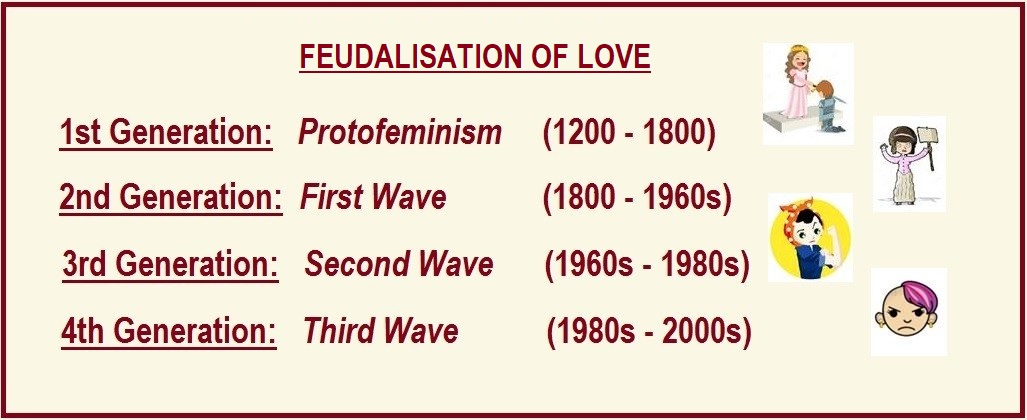
Lewis states that in comparison with the revolution generated by the feudalisation of love, the Renaissance amounts to a mere ripple on the surface of literature. It forms the internal rationale of post-industrial societies, along with the subsequent waves of feminism which embraced this concept with fervor, applying its principles more aggressively with each iteration of the movement.
.
C.S. Lewis dates the rise of this “feudalisation of love” quite precisely: it appeared suddenly at the end of the eleventh century in France. What began as an elitist fad among the troubadours rapidly spread to the courts of Europe. From there it filtered downward, eventually permeating the imagination of all social classes. Its success was so complete that today the feudalised model is widely regarded as “timeless” and “natural” — a sacrosanct pillar of gender relations now accepted by laypeople and academics alike.
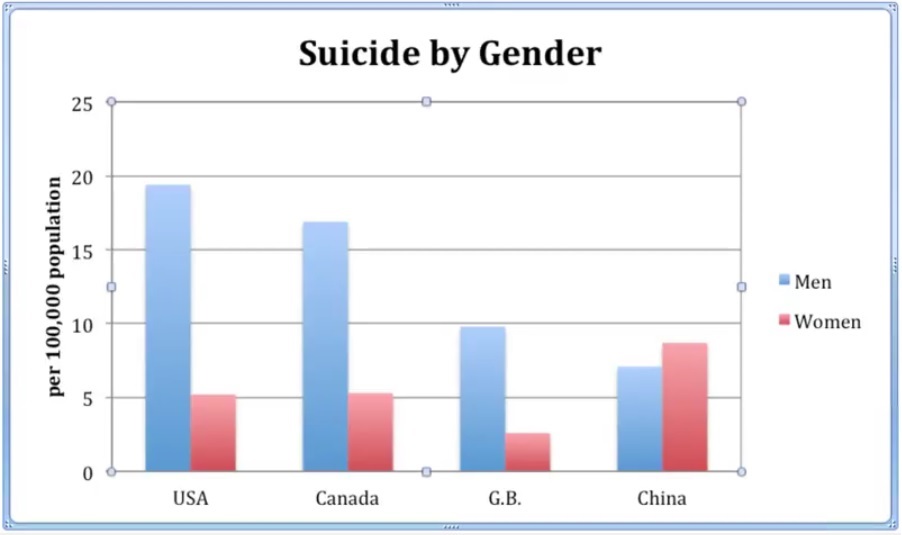
The feudalisation of love is founded on one central principle: male service to women. This arrangement produces systemic poor treatment of males and lies at the root of the many destructive outcomes addressed by men’s advocates. Chief among them is male suicide. Yet even family members, friends, and academics who have lost loved ones to suicide remain reluctant to name the true cause: the gynocentrism and misandry embedded in the feudalisation of love itself.
The only major exception occurs in rural China, where female suicide rates have historically exceeded male rates — precisely the region where women have traditionally held lower social value than men. Notably, China is also the country where the feudalisation of love never fully took root. Mao explicitly suppressed it during the Cultural Revolution, denouncing romantic love as a bourgeois and disintegrative cultural product.
.
Outside certain parts of Asia, most cultures today are decidedly gynocentric, placing disproportionate value on women’s identities, needs, and wants. While many factors contribute to male suicide, the devaluation of men’s sense-of-self is central. If we dismantled the feudalisation of love and its attendant gynocentrism, the majority of these suicides would theoretically not occur. Men would be buoyed by the one essential ingredient they currently lack: social value. This requires a full-throated rejection of gynocentrism and a deliberate, society-wide revalorisation of men and boys.
Those who adhere to the feudalisation of love script in their relationships, please don’t be surprised when it begins to hurt or when tragedy hits. In order to regain your sense of value you will need to divest yourself of it and, in the long run, find alternative models to live by.
__________________________