Uncategorized
The Troubadours – H.J. Chaytor
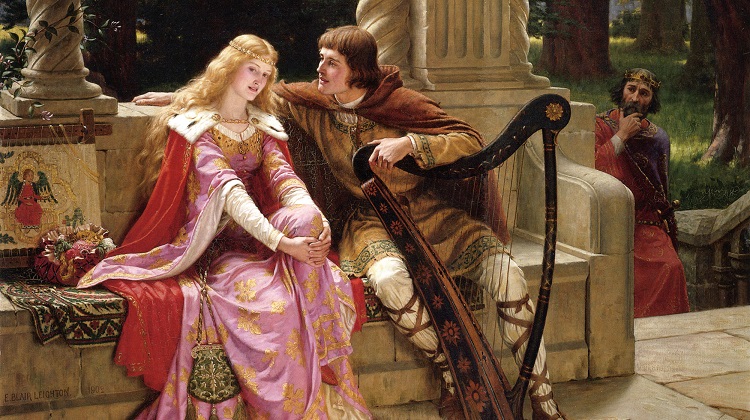
As courtly love culture developed, a class of self-styled and avant-garde poets arose called the troubadours. Like the knights of the period they sought to devote themselves to the love and adoration of women, though unlike the knights many of the troubadours practiced a chaste kind of devotion to Ladies that did not involve sexual intercourse. The following excerpt is from the 1913 classic volume titled The Troubadours, by Rev. H.J. Chaytor, M.A.
_________
CHAPTER II

THE THEORY OF COURTLY LOVE
Troubador poetry dealt with war, politics, personal satire and other subjects: but the theme which is predominant and in which real originality was shown, is love. The troubadours were the first lyric poets in mediaeval Europe to deal exhaustively with this subject, and as their attitude was imitated with certain modifications by French, Italian, Portuguese and German poets, the nature of its treatment is a matter of considerable importance.
Of the many ladies whose praises were sung or whose favours were desired by troubadours, the majority were married. Troubadours who made their songs to a maiden, as did Gui d’Ussel or Gausbert de Puegsibot, are quite exceptional. Love in troubadour poetry was essentially a conventional relationship, and marriage was not its object.
This conventional character was derived from the fact that troubadour love was constituted upon the analogy of feudal relationship. If chivalry was the outcome of the Germanic theory of knighthood as modified by the influence of Christianity, it may be said that troubadour love is the outcome of the same theory under the influence of mariolatry.
In the eleventh century the worship of the Virgin Mary became widely popular; the reverence bestowed upon the Virgin was extended to the female sex in general, and as a vassal owed obedience to his feudal overlord, so did he owe service and devotion to his lady. Moreover, under the feudal system, the lady might often be called upon to represent her husband’s suzerainty to his vassals, when she was left in charge of affairs during his absence in time of war. Unmarried women were inconspicuous figures in the society of the age.
“Thus there was a service of love as there was a service
of vassalage, and the lover stood to his lady in a position
analogous to that of the vassal to his overlord”
Thus there was a service of love as there was a service of vassalage, and the lover stood to his lady in a position analogous to that of the vassal to his overlord. He attained this position only by stages; “there are four stages in love: the first is that of aspirant (fegnedor), the second that of suppliant (precador), the third that of recognised suitor (entendedor) and the fourth that of accepted lover (drut).”
The lover was formally installed as such by the lady, took an oath of fidelity to her and received a kiss to seal it, a ring or some other personal possession. For practical purposes the contract merely implied that the lady was prepared to receive the troubadour’s homage in poetry and to be the subject of his song.
As secrecy was a duty incumbent upon the troubadour, he usually referred to the lady by a pseudonym (senhal); naturally, the lady’s reputation was increased if her attraction for a famous troubadour was known, and the senhal was no doubt an open secret at times.
How far or how often the bounds of his formal and conventional relationship were transgressed is impossible to say; “en somme, assez immoral” is the judgment of Gaston Paris upon the society of the age, and is confirmed by expressions of desire occurring from time to time in various troubadours, which cannot be interpreted as the outcome of a merely conventional or “platonic” devotion.
In the troubadour biographies the substratum of historical truth is so overlaid by fiction, that little reliable evidence upon the point can be drawn from this source.
However, transgression was probably exceptional. The idea of troubadour love was intellectual rather than emotional; love was an art, restricted, like poetry, by formal rules; the terms “love” and “poetry” were identified, and the fourteenth century treatise which summarises the principles of grammar and metre bore the title Leys d’Amors, the Laws of Love.
The pathology of the emotion was studied; it was treated from a psychological standpoint and a technical vocabulary came into use, for which it is often impossible to find English equivalents. The first effect of love is to produce a mental exaltation, a desire to live a life worthy of the beloved lady and redounding to her praise, an inspiring stimulus known as joi or joi d’amor (amor in Provencal is usually feminine).
Other virtues are produced by the influence of this affection: the lover must have valor, that is, he must be worthy of his lady; this worth implies the possession of cortesia, pleasure in the pleasure of another and the desire to please; this quality is acquired by the observance of mesura, wisdom and self-restraint in word and deed.
The poetry which expresses such a state of mind is usually idealised and pictures the relationship rather as it might have been than as it was. The troubadour who knew his business would begin with praises of his beloved; she is physically and morally perfect, her beauty illuminates the night, her presence heals the sick, cheers the sad, makes the boor courteous and so forth.
For her the singer’s love and devotion is infinite: separation from her would be worse than death; her death would leave the world cheerless, and to her he owes any thoughts of good or beauty that he may have. It is only because he loves her that he can sing. Hence he would rather suffer any pain or punishment at her hands than receive the highest favours from another.
The effects of this love are obvious in his person. His voice quavers with supreme delight or breaks in dark despair; he sighs and weeps and wakes at night to think of the one subject of contemplation. Waves of heat and cold pass over him, and even when he prays, her image is before his eyes. This passion has transformed his nature: he is a better and stronger man than ever before, ready to forgive his enemies and to undergo any physical privations; winter is to him as the cheerful spring, ice and snow as soft lawns and flowery meads.
Yet, if unrequited, his passion may destroy him; he loses his self-control, does not hear when he is addressed, cannot eat or sleep, grows thin and feeble, and is sinking slowly to an early tomb. Even so, he does not regret his love, though it lead to suffering and death; his passion grows ever stronger, for it is ever supported by hope. But if his hopes are realised, he will owe everything to the gracious favour of his lady, for his own merits can avail nothing.
Sometimes he is not prepared for such complete self-renunciation; he reproaches his lady for her coldness, complains that she has led him on by a show of kindness, has deceived him and will be the cause of his death; or his patience is at an end, he will live in spite of her and try his fortune elsewhere.
Source: Full-text of the book is available here; The Troubadours, by H.J. Chaytor
Gynocentric culture
Did female-centered culture begin in the prehistoric era?
This question is sometimes asked by people who feel that gynocentrism has been around for the entirety of human evolution. The answer to that question is of course yes – isolated examples of gynocentrism have been around throughout human history. However it’s important to make a distinction between individual examples of gynocentrism (that is, individual gynocentric impulses, acts, customs, or events) and gynocentric culture (a pervasive cultural complex that affects every aspect of life). We will never be precise enough to make sense of this subject unless we insist on this distinction between gynocentric acts, and gynocentric-culture.
Gynocentrism:
It’s easy to overstate the import of specific examples of gynocentrism when in fact such examples may be equally balanced, culturally speaking, by male-centered acts, customs, or events which negate the concept of a pervasive gynocentric culture. Here we are reminded of the old adage that one swallow does not make a summer, and that likewise individual gynocentric acts, or even a small collection of such acts, do not amount to a pervasive gynocentric culture.
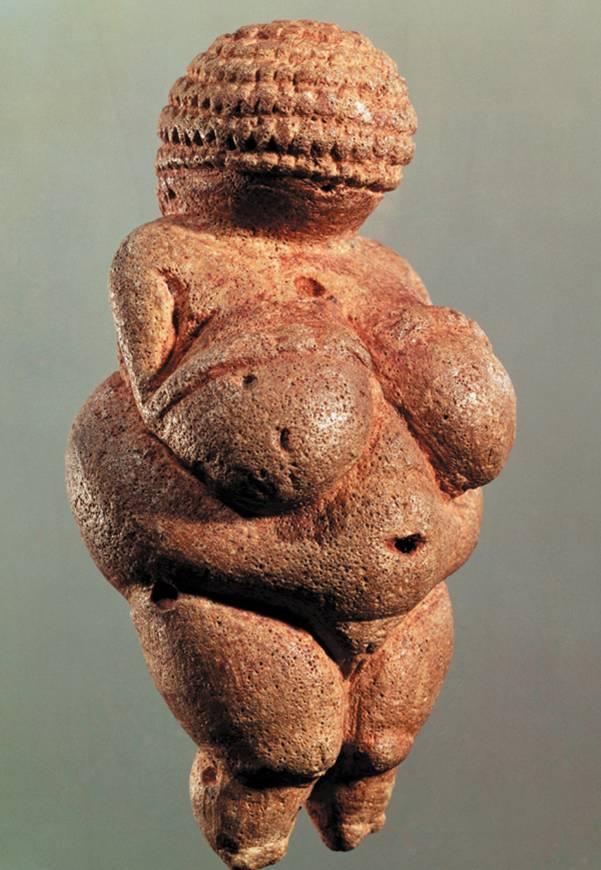
Individual examples of gynocentrism are sometimes misconstrued as representing a broader culture, as seen in the discussion around ancient female figurines which some claim are indications of goddess-worshipping, gynocentric cultures. Not only is the import of the female figurines vastly overstated, the quantity discovered is potentially exaggerated according to leading feminist archeologists:
“Quantitative analyses of Upper Paleolithic imagery make it clear that there are also images of males and that, by and large, most of the imagery of humans-humanoids cannot readily be identified as male or female. In fact, no source can affirm that more than 50 per cent of the imagery is recognizably female.” [Ancient Goddesses]
Even if the majority of these figurines had proven to be female, this wouldn’t indicate a gynocentric culture any more than would statues of the goddess Athena and the Parthenon built in her honor indicate that ancient Athens was a gynocentric city – which it clearly was not.
Archeologists discovered stencils of female hands in ancient caves, created by the practice of spraying mud from the mouth onto a female hand. Some were led to surmise, without evidence, that those same hands served as authorship of the animals that were also painted on the cave walls. Additionally, these archeologists assumed that the presence of female hand images not only meant that women painted the more complex cave art but that the entire ancient world “must have” consisted of a completely gynocentric culture. These assumptions show the dangers of allowing imagination to depart too far from the evidence.
Further examples of overreach are the citing of fictional material from classical era, such as Helen of Troy (a Greek myth), or Lysistrata (a Greek play) as proof of gynocentric culture; unfortunately these examples are about as helpful for understanding gynocentrism as would be the movie Planet of the Apes to future researchers studying the history of primates.
Gynocentric culture:
A cultural complex refers to a significant configuration of culture traits that have major significance in the way people’s lives were lived. In sociology it is defined as a set of culture traits all unified and dominated by one essential trait; such as an industrial cultural complex, religious cultural complex, military cultural complex and so on. In each of these complexes we can identify a core factor – industry, religion, military – so we likewise require a core factor for the gynocentric cultural complex in order for it to qualify for the title. At the core of the gynocentric cultural complex is the feudalistic structure of lords and vassals, a structure which eventually became adopted as a gender relations model requiring men to serve as vassals to women. C.S. Lewis called this restructuring of gender relations ‘the feudalisation of love’ and rightly suggested that is has left no corner of our ethics, our imagination, or our daily life untouched.
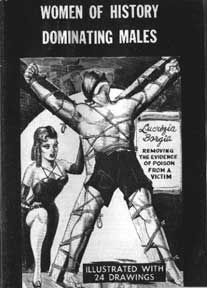
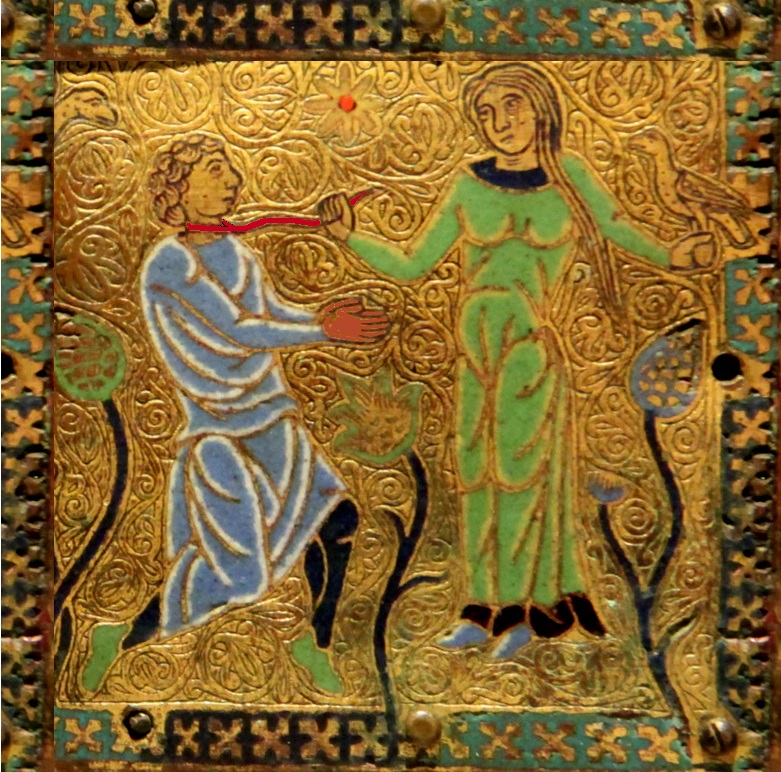
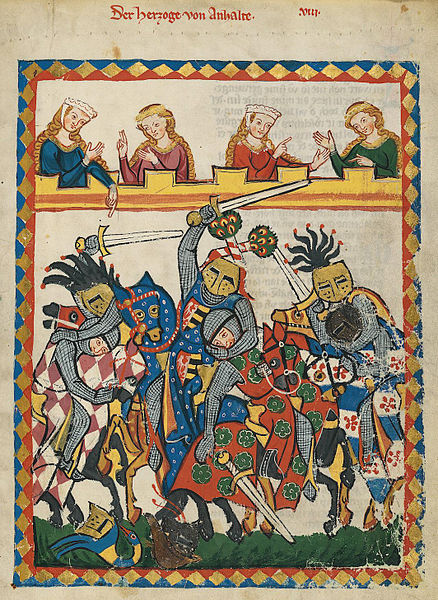
The feudalisation of love was not something seen in pre-medieval times, let alone in the Paleolithic era when feudalism simply didn’t exist. For example, we have not yet seen a cave painting equal to this art from the Middle Ages showing a male acting as subservient vassal to a dominant woman who leads him around by a neck halter.
In summary, it appears everyone agrees that examples of gynocentric acts have existed throughout human history. The question is not whether an act occured but whether or not it was part of a more dominant culture of gynocentrism. We are interested not in when some gynocentric act was recorded but in when the larger gynocentric cultural complex (GCC) began, on which point there appear to be three main theories:
- Ancient Genesis
- Medieval Genesis
- Recent Genesis
This website provides evidence that clearly favors medieval genesis, as there is simply not enough evidence for it in ancient culture beyond scattered examples of gynocentrism. In fact what we do know of classical civilizations appears to favour the reverse conclusion – that these were patently androcentric cultures that held sway globally until the 12th century European revolution.
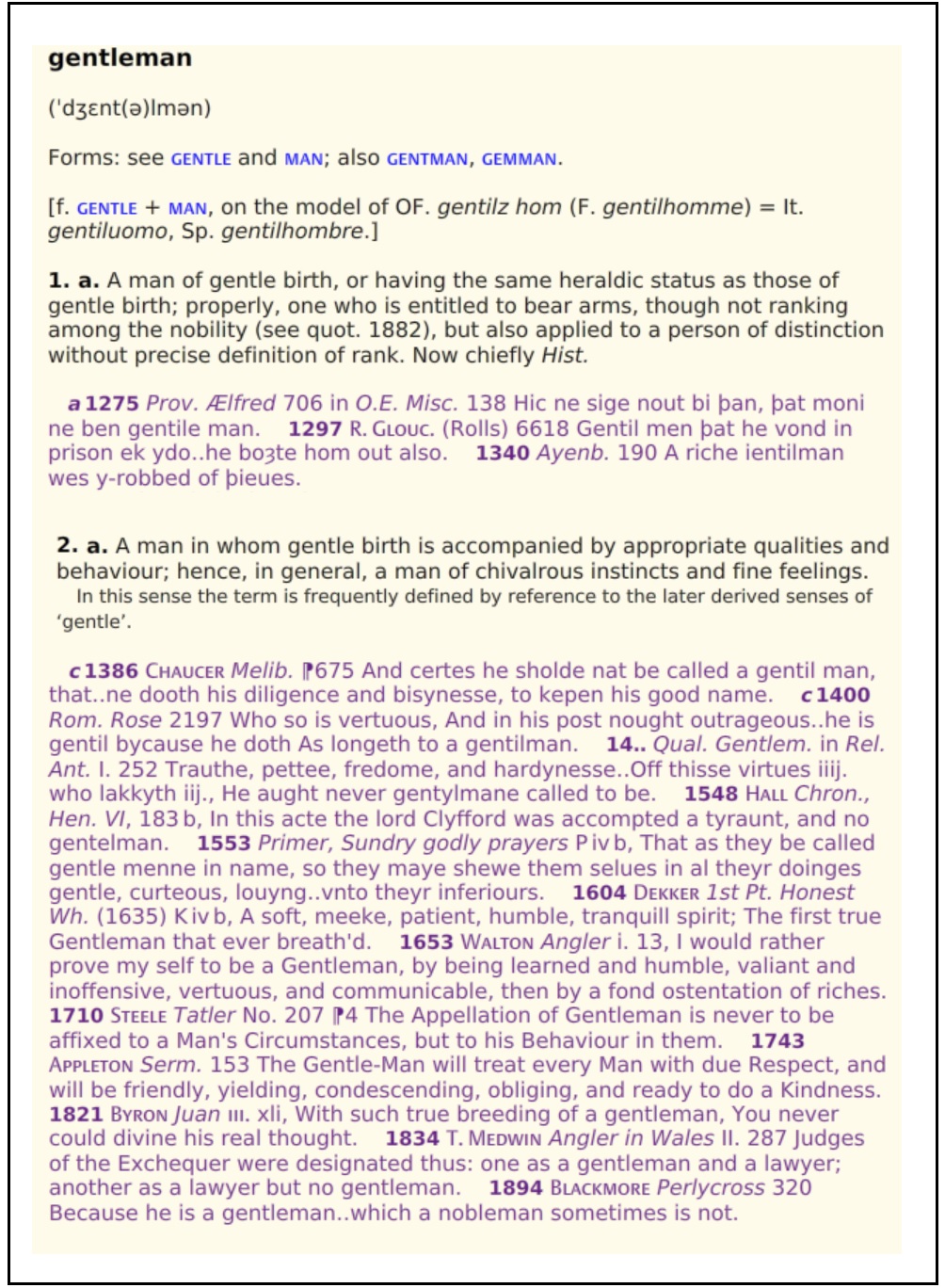
The origins of the term ‘gentleman’
The Spirit of Chivalry, by Sir Walter Scott (1818)
The following excerpts describing gynocentric-chivalry are taken from Sir Walter Scott’s 1818 essay in the volume Essays on Chivalry, Romance, and the Drama
* * *
The main ingredient in the spirit of Chivalry, second in force only to the religious zeal of its professors, and frequently predominating over it, was a devotion to the female sex, and particularly to her whom each knight selected as the chief object of his affection, of a nature so extravagant and unbounded as to approach to a sort of idolatry. The original source of this sentiment is to be found, like that of Chivalry itself, in the Customs and habits of the northern tribes who possessed, even in their rudest state, so many honourable and manly distinctions, over all the other nations in the same stage of society. The chaste and temperate habits of these youth, and the opinion that it was dishonourable to hold sexual intercourse until the twentieth year was attained, was in the highest degree favourable not only to the morals and health of the ancient Germans, but must have contributed greatly to place their females in that dignified and respectable rank which they held in society.
____________________________
Amid the various duties of knighthood, that of protecting the female sex, respecting their persons, and redressing their wrongs, becoming the champion of their cause, and the chastiser of those by whom they were injured, was represented as one of the principal objects of the institution. Their oath bound the new-made knights to defend the cause of all women without exception ; and the most pressing way of conjuring them to grant a boon was to implore it in the name of God and the ladies. The cause of a distressed lady was, in many instances, preferable to that even of the country to which the knight belonged. Thus, the Captal de Buche, though an English subject, did not hesitate to unite his troops with those of the Comte de Foix, to relieve the ladies in a French town, where they were besieged and threatened with violence by the insurgent peasantry.
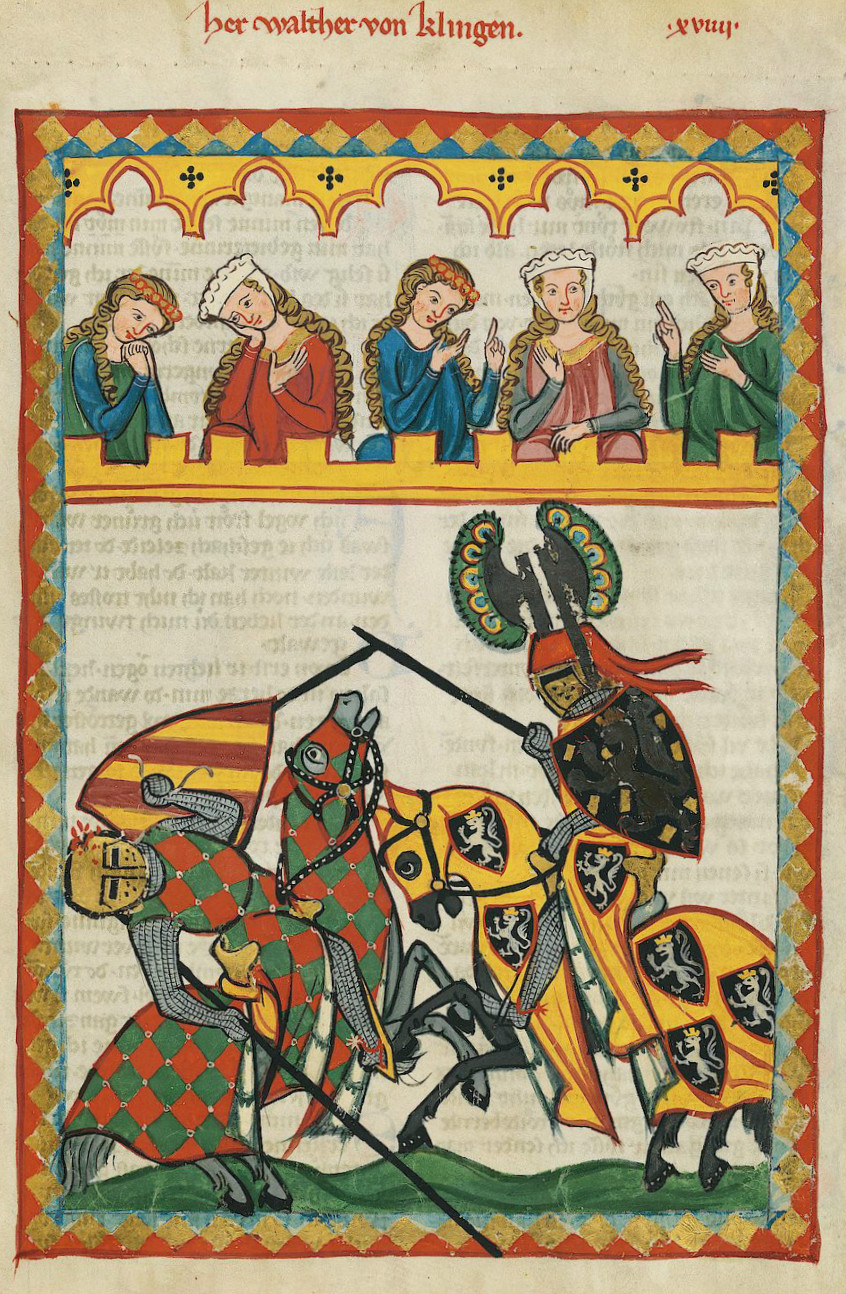
The looks, the words, the sign of a lady, were accounted to- make knights at time of need perform double their usual deeds of strength and valour. At tournaments and in combats, the voices of the ladies were heard like those of the German females in former battles, calling on the knights to remember their fame, and exert themselves to the uttermost. “Think, gentle knights,” was their cry, “upon the wool of your breasts, the nerve of your arms, the love you cherish in your hearts, and do valiantly for ladies behold you.” The corresponding shouts of the combatants were, “Love of ladies! Death of warriors! On, valiant knights, for you fight under fair eyes? Where the honour or love of a lady was at stake, the fairest prize was held out to the victorious knight, and champion from every quarter were sure to hasten to combat in a cause so popular. Chaucer, when he describes the assembly of the knights who came with Arcite and Palemon to fight for the love of the fair Emilie, describes the manners of his age in the following lines;
“For every knight that loved chivalry,
And would his thankes have a passant name,
Hath pray’d that he might ben of that game,
And well was him that thereto chusen was.
For if there fell to-morrow such a case,
Ye knowen well that every lusty knight
That loveth par amour, and hath his might,
Were it in Engellande, or elleswhere,
They wold hir thanked willen to be there.
To fight for a lady! Ah! Benedicite,
It were a lusty sight for to see.”
It is needless to multiply quotations on a subject so trite and well known. The defence of the female sex in general, the regard due to their honour, the subservience paid to their commands, the reverent awe and courtesy, which, in their presence, forbear all unseemly words and actions, were so blended with the institution of Chivalry as to form its very essence. But it was not enough that the “very perfect, gentle knight,” should reverence the fair sex in general. It was essential to his character that he should select, as his proper choice, “a lady and a love,” to be the polar star of his thoughts, the mistress of his affections, and the directress of his actions. In her service, he was to observe the duties of loyalty, faith, secrecy, and reverence. Without such an empress of his heart, a knight, in the phrase of the times, was a ship without a rudder, a horse without a bridle, a sword without a hilt ; a being, in short, devoid of that ruling guidance and intelligence, which ought to inspire his bravery, and direct his actions. The least dishonest thought or action was, according to her doctrine, sufficient to forfeit the chivalrous lover the favour of his lady.
It seems, however, that the greater part of her charge concerning incontinence is levelled against such as haunted the receptacles of open vice ; and that she reserved an exception (of which, in the course of the history, she made liberal use) in favour of the intercourse which, in all love, honour, and secrecy, might take place, when the favoured and faithful knight had obtained, by long service, the boon of amorous mercy from the lady whom he loved par amours.In these extracts are painted the actual manners of the age of Chivalry. The necessity of the perfect knight having a mistress, whom he loved par amours, the duty of dedicating his time to obey her commands, however capricious, and his strength to execute extravagant feats of valour, which might redound to her praise, –for all that was done for her sake, and under her auspices, was counted her merit, as the victories of their generals were ascribed to the Roman Emperors— was not a whit less necessary to complete the character of a good knight.
__________________________
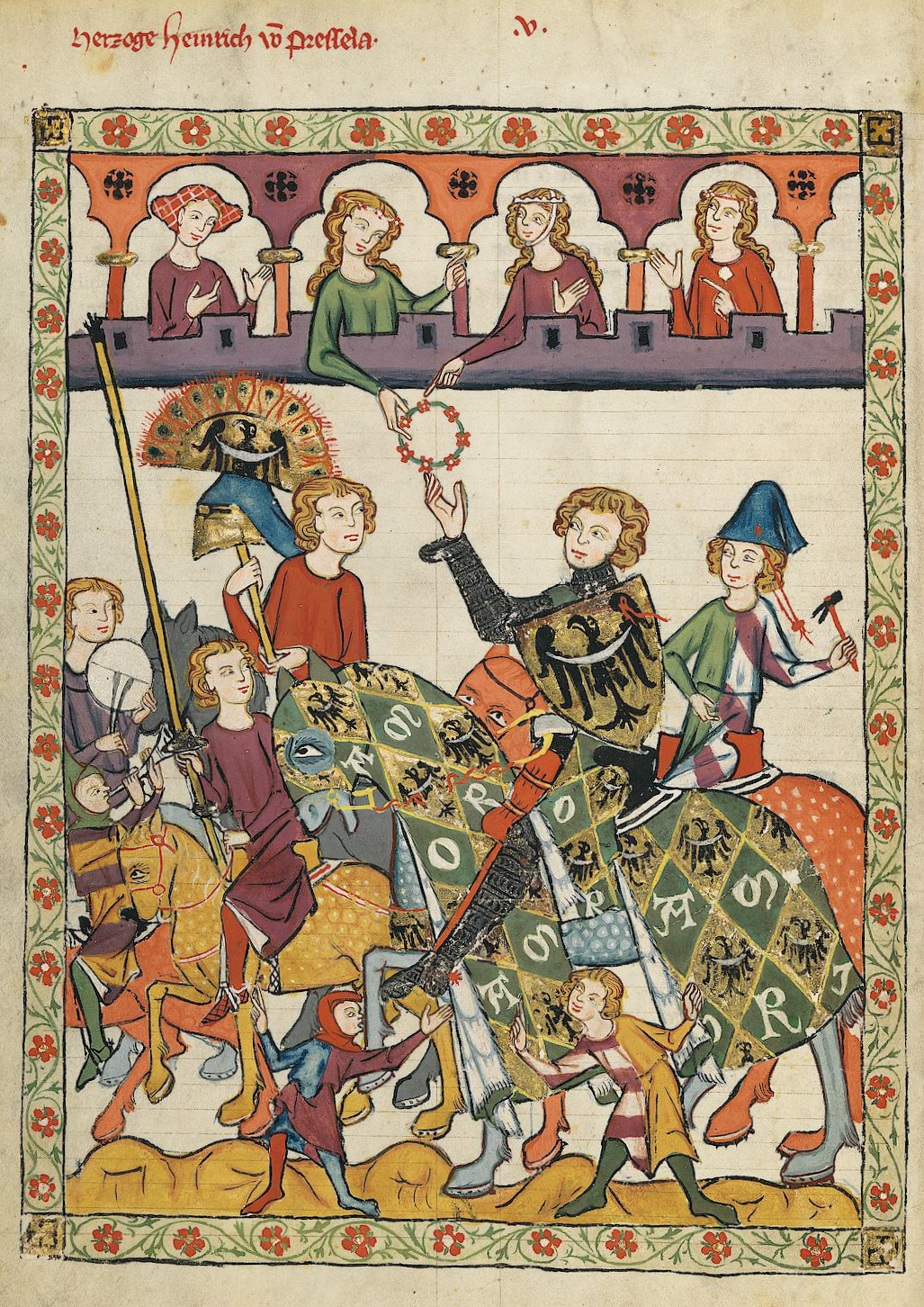
On such occasions, the favoured knight, as he wore the colours and badge of the lady of his affections, usually exerted his ingenuity in inventing some device or cognisance which might express their love, either openly, as boasting of it in the eye of the world, or in such mysterious mode of indication as should only be understood by the beloved person if circumstances did not permit an avowal of his passion. The ladies, bound as they were in honour to requite the passion of their knights, were wont, on such occasions, to dignify them by the present of a scarf, ribbon, or glove, which was to be worn in the press of battle and tournament. These marks of favour they displayed on their helmets, and they were accounted the best incentives to deeds of valour. The custom appears to have prevailed in France to a late period, though polluted with the grossness so often mixed with the affected refinement and gallantry of that nation.
Sometimes the ladies, in conferring these tokens of their favour, saddled the knights with the most extravagant and severe conditions. But the lover had his advantage in such cases, that if he ventured to vencounter the hazard imposed, and chanced to survive it, he had, according to the fashion of the age, the right of exacting, from the lady, favours corresponding in importance.
The annals of Chivalry abound with stories of cruel and cold fair ones, who subjected their lovers to extremes of danger, in hopes that they might get rid of their addresses, but were, upon their unexpected success, caught in their own snare, and, as ladies who would not have their name made the theme of reproach by every minstrel, were compelled to recompense the deeds which their champion had achieved in their name. 
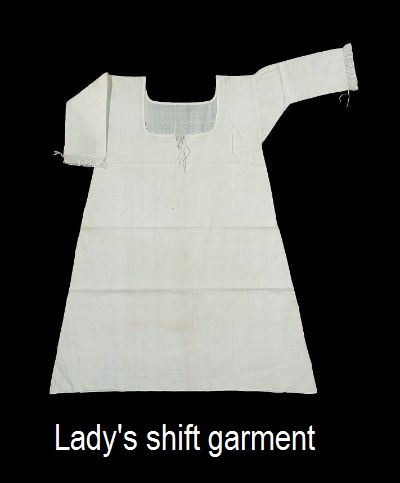
There are instances in which the lover used his right of reprisals with some rigour, as in the well-known fabliau of the three knights and the shift; in which a lady proposes to her three lovers, successively, the task of entering, unarmed, into the mêlée of a tournament, arrayed only in one of her shift. The perilous proposal is declined by two of the knights and accepted by the third, who thrusts himself, in the unprotected state required, into all the hazards of the tournament, sustains many wounds, and carries off the prize of the day.
On the next day the husband of the lady (for she was married) was to give a superb banquet to the knights and nobles who had attended the tourney. The wounded victor sends the shift back to its owner, with his request, that she would wear it over her rich dress on this solemn occasion, soiled and torn as it was, and stained all over with the blood of its late wearer. The lady did not hesitate to comply, declaring, that she regarded this shift, stained with the blood of her “fair friend, as more precious than if it were of the most costly materials.” Jaques de Basin, the minstrel who relates this curious tale, is at a loss to say whether the palm of true love should be given to the knight or to the lady on this remarkable occasion. The husband, he assures us, had the good sense to seem to perceive nothing uncommon in the singular vestment with which his lady was attired, and the rest of the good company highly admired her courageous requital of the knight’s gallantry. It was the especial pride of each distinguished champion, to maintain, against all others, the superior worth, beauty, and accomplishments of his lady; to bear her picture from court to court, and support, with lance and sword, her superiority to all other dames, abroad or at home. To break a spear for the love of their ladies, was a challenge courteously given, and gently accepted, among all true followers of Chivalry, and history and romance are alike filled with the tilts and tournaments which took place upon this argument, which was ever ready and ever acceptable. Indeed, whatever the subject of the tournament had been, the lists were never closed until a solemn course had been made in honour of the ladies.
There were knights yet more adventurous, who sought to distinguish themselves by singular and uncommon feats of arms in honour of their mistresses; and such was usually the cause of the whimsical and extravagant vows of arms which we have subsequently to notice. To combat against extravagant odds, to fight amid the press of armed knights without some essential part of their armour, to do some deed of audacious valour in face of friend and foe, were the services by which the knights strove to recommend themselves, or which their mistresses (very justly so called) imposed on them as proofs of their affection.
Sometimes the patience of the lover was worn out by the cold-hearted vanity which thrust him on such perilous enterprises. At the court of one of the German emperors, while some ladies and gallants of the court were looking into a den where two lions were confined, one of them purposely let her glove fall within the palisade which enclosed the animals, and commanded her lover, as a true knight, to fetch it out to her. He did not hesitate to obey, jumped over the enclosure ; threw his mantle towards the animals as they sprung at him; snatched up the glove, and regained the outside of the palisade. But when in safety, he proclaimed aloud, that what he had achieved was done for the sake of his own reputation, and not for that of a false lady, who could, for her sport and cold-blooded vanity, force a brave man on a duel so desperate. And, with the applause of all that were present, renounced her love for ever. This, however, was an uncommon circumstance. In general, the lady was supposed to have her lover’s character as much at heart as her own, and to mean by pushing him upon enterprises of hazard give him an opportunity of meriting her good graces, which she could not with honour confer upon one undistinguished by deeds of chivalry.
Source:Essays on Chivalry, Romance, and the Drama, by Sir Walter Scott
Gynarchy in America
Modern dictionaries usually define gynarchy as a political system governed by women or a woman. For a more nuanced understanding it’s important to recognise that “the political system” that women govern may actually be staffed by male servants called prime ministers, presidents, or politicians who work on behalf of the ruling female gender.[1] In her book What’s Right With Feminism, Cassandra Langer gives a concise definition that accounts for the proxy role of male leaders: “Gynarchy refers to government by women, or women-centered government.” – PW
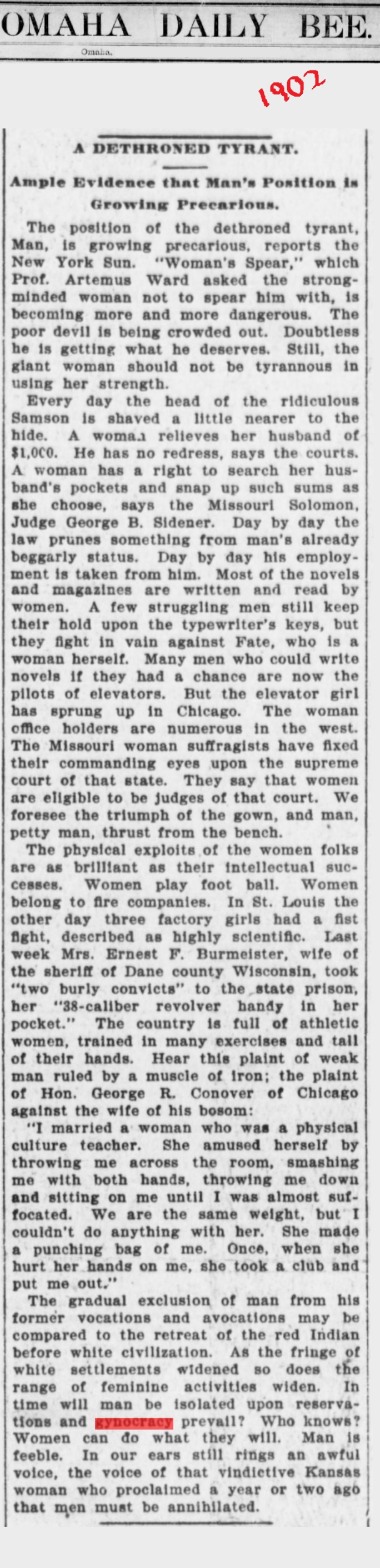
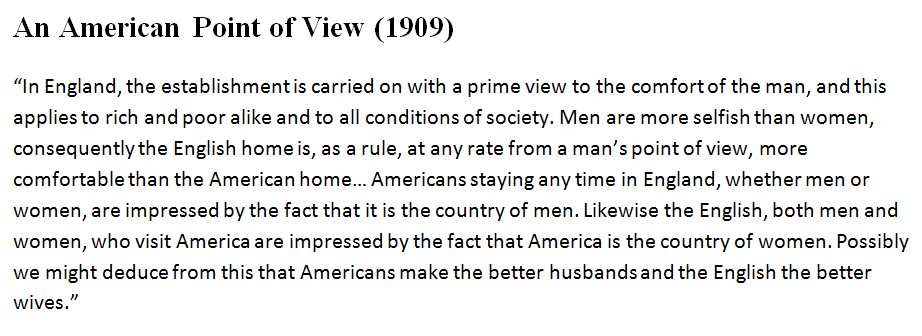
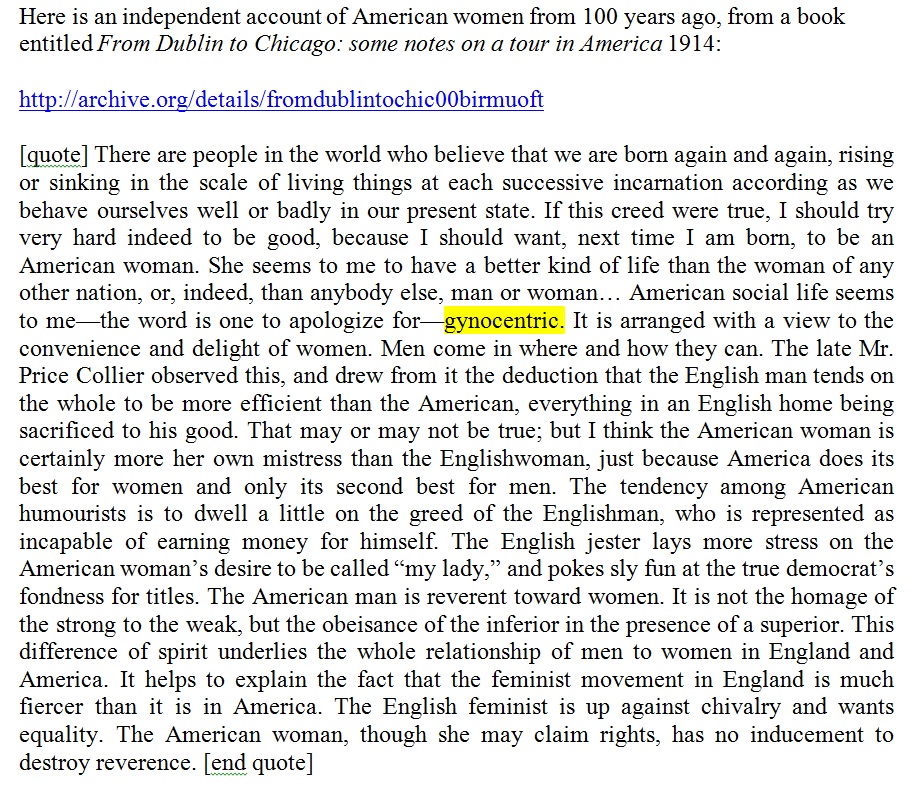
The following articles show that Columbia was more than an empty symbol of America’s pedestalisation of women (*click articles to enlarge):
The Philadelphia Record – 1903
England and the English from an American Point of View – 1909
From Dublin to Chicago: Some Notes on a Tour in America – 1914
Albert Einstein declares Women Rule Here – 1921
Eleanor of Aquitaine and her ‘Courts of Love’
By Amy Kelly (1937)
2. Title Tractatus de Amore et de Amoris Remedio referred to in English as ‘The Art of Courtly Love’
Infantriarchy
By Gordon Wadsworth
If our species were observed by an alien race for any length of time, two profound defects in the human condition would rapidly become apparent to them. One is a defect in the female character, and the other is a defect in the male character. Although they weren’t always defects, they have become such because they are fundamentally at odds with both legal equality and self-actualization.
The female defect is her desire to infantilize herself; to project a facade of weakness and victimhood. The female does this because part of her identity is contingent on compelling males to act on her behalf. This is a mechanism which allows the female to feel desirable, important, and powerful. The female often mistakes this behavior as personal empowerment, when in reality it is quite the opposite. Taking personal responsibility is something she will inherently resist, because as soon as she takes personal responsibility and stops infantilizing herself, her identity can no longer command others to act on her behalf. Thus, the female defect keeps her from assuming personal responsibility, which presents a barrier to her self-actualization.
This is why the self-actualized female finds playing the victim so repugnant; she is shunning part of her old identity.
The male defect is his desire to compensate for the infantilized female. He does this because part of his identity is contingent on earning female validation. He thus demonstrates his ability to protect, provision and inform. This is a mechanism for feeling useful, powerful, knowledgeable, and important. The male defect leads him to compete with other males to demonstrate his primacy to females, and it ultimately turns him into a guardian, which keeps him from relinquishing responsibility. This becomes his own barrier to self-actualization.
This is why the self-actualized male sees competing for female validation as idiotic; he is shunning part of his old identity.
These defects mean that the female path of self-actualization is one of taking responsibility, and the male path of self-actualization is one of relinquishing responsibility.
It is vitally important to recognize that the majority of males and females in our culture enjoy their dysfunction. The female has a puerile sexual identity validated by compelling a man to act on her behalf, and the male has a similarly puerile sexual identity validated by demonstrating his ability to act on her behalf. This is a drug that our species has been addicted to for millennia, and it is one we desperately need to cast aside. Moving past this behavior is the next step humanity must make to realize equality.
We already have a name for this drug. It’s the blue pill. Those in the blue pill paradigm aren’t conscious of this behavior, they’re merely stuck engaging in it. Consciously recognizing this defective behavior is, in my opinion, the source of red pill wisdom. Once this behavior is seen for what it is, the blue pill paradigm becomes observable, and the transition to the red pill paradigm is made.
An understanding of the male defect is vital for contextualizing feminist criticism of men. Our defect, for example, is why many feminists are partially correct when they point to demonstrating power as a male motivation. We display power to demonstrate our readiness to compensate for the infantilized female. Our defect is also the source of feminist complaints about “mansplaining.” Men engaging in “mansplaining” are largely attempting to demonstrate their knowledge and value in order to demonstrate their capability to compensate for the infantilized female. Additionally, the “fatherly” guardian status that results from our defect is why the feminists are superficially correct about patriarchy, but why they are also leaving out half the picture.
Where the feminist is completely wrong is where she believes that pre-feminist Western culture was in its totality a patriarchy. Since the traditional paradigm of pre-feminist Western culture was an expression of both the male and the female defects, patriarchy was only half the picture.
Let’s clarify what patriarchy means.
For the most part, patriarchy is simply a word to describe the male defect. On its own, however, patriarchy says exactly nothing about the female defect. If we’re to have a fair and balanced discussion on sex and gender, we need a word to address both defects. Let us therefore add the word infantriarchy to describe the female defect.
Patriarchy and infantriarchy are simple concepts that reflect a relationship of codependency between the male and female defects. If the male defect is over expressed in society, female infantilization is compelled, and patriarchy results. If the female defect is over expressed in society, male compensation is compelled, and infantriarchy results.
Thus, the traditional paradigm of pre-feminist Western culture wasn’t in its totality a patriarchy, because it was built around the expression of both the male and the female defects. The fact that there exist both males and females who wish to return to traditionalism proves this. The traditionalist female was thus perfectly happy to infantilize herself, and infantriarchy was a part of traditionalism that cannot be ignored.
The feminist response to this, of course, will be to claim that patriarchy infantilizes women and that the second concept is therefore unnecessary. To clarify this response, the feminist will essentially be claiming that the male defect is wholly to blame. This line of reasoning is problematic because it denies the existence of the female defect, and in doing so it assumes women are perfect and asserts that the defect necessarily exists solely within men.
This can only be described as hate.
Because feminism doesn’t acknowledge the existence of the female defect, it denies female complicity in traditionalism, and thus distorts the male defect of compensating into one of oppressing. Thus, feminists mistakenly believe that women were uniquely oppressed because they’re using half of a theoretical model to examine traditionalism.
The notion of female oppression becomes highly dubious when one considers the female defect. The female defect, for example, becomes apparent when a woman claims that women have always been the primary victims of war, despite the countless millions of men who have died. The female defect has led a woman to cry about being victimized over a t-shirt, and it has led a journalist to claim that MHRM efforts are based on “victim envy.” So it isn’t terribly surprising that the female defect might lead certain women to claim that human history was one long story of female oppression. It is simply an expression of the female defect. It is the female projecting her victimhood.
What then, is feminism?
To be fair, I have met a handful of feminists whose goals I thought were legitimate. To a significant extent, however, feminism is merely a sociopolitical platform for these defects, an arena for them to play in, and the cultural force which is expanding infantriarchy. Feminists claim their movement is about female equality, but I disagree. Being an expression of the female defect, feminism is merely a movement to express female victimhood; more specifically, it is an expression of female victimhood to compel sociopolitical male compensation with the humorous goal of preventing female victimhood.
This results in a merry-go-round to hell, wherein feminism actively entrenches the same value it seeks to fight.
Because feminism is essentially an expression of female victimhood working to end female victimhood, most feminists are stuck in the destructive convulsions of an individual fighting against a victim identity she has chosen for herself.
The nail in the coffin for our society is that the male defect supports and encourages this female behavior. The majority of feminists are fighting an identity they’ve chosen for themselves, one that makes them feel deeply unhappy and traumatized, and the majority of males, instead of criticizing them, are simply trying to compensate for them. The male’s drive to compensate for the infantilized female knows no bounds. If the female is expressing her oppression the male will seek to compensate. If the female is ruthlessly attacking the male’s identity and stripping him of his rights, the male will still seek to compensate.
It is important to understand that both defects must disappear, or neither one will. These two defects are codependent. Females must stop infantilizing themselves, and males must stop compensating for infantilized females. If the female defect isn’t addressed, then no matter how savagely the male defect is attacked, directly or indirectly, the problems with these defects will never be solved. One behavior compels the other, since men and women are and will always be two sides of the same coin. Men and women will evolve their consciousness together, or their consciousness will not evolve.
With this in mind, “patriarchal” expression of the male defect doesn’t disappear in an infantriarchy, it merely changes forms. Remember, in infantriarchy, male compensation is compelled. “White knights” and “manginas” are the expressions of patriarchy, because they are the expressions of the compelled male defect, and often this expression is so pathetic as to beggar belief.
This patriarchal behavior goes largely unnoticed by feminists because they don’t see the male defect directly for what it is. They arbitrarily define patriarchal behavior as authoritative, but they’re mistaken in this regard. Patriarchal behavior is any expression of the male defect. White knights and manginas are thus expressing patriarchal behavior because their behavior seeks to compensate for the female, and it thus encourages the female to continue expressing her victimhood and self-infantilization.
This is the reason some feminists are beginning to recognize and reject men like Hugo Schwyzer for what they are. Men like Schwyzer will never criticize women on any level, simply because men like Schwyzer aren’t remotely interested in equality. They are merely interested in validating their own puerile sexual identities by demonstrating their compensatory capacity. They are cowards, content to ignore real world suffering as they continue taking hits off the blue pill crack pipe. And they are ironically the very agents of patriarchy feminists denounce.
The profound irony of this is that feminism claims to oppose patriarchy while fiercely upholding it, and the MHRM hates the concept of patriarchy, but is currently the only cultural force actually fighting it.
Finally, an infantriarchy will be built around male blame. This is because the female defect leads her to project all authority on to the male, and this forms the basis for blaming him for all wrongdoing. In order to project victimhood, it is necessary for the female to cast the responsibility for her problems elsewhere. Thus, the more infantriarchal a society, the more male blame can be expected.
In our society, this blame is expressed in the feminist’s belief that equality can be achieved by examining “masculinities,” and by deconstructing “patriarchy.” It is also why the feminist believes men just need to shut up and listen to women in order for equality to happen; inequality, after all, was “men’s fault,” and men should shut up and let women fix it.
In late stage infantriarchy, men even become blamed for a woman’s feelings.
If a joke offends a woman, men are blamed. If a man says hello in an elevator in a way a woman dislikes, he is blamed for making her feel victimized. If a man approaches a woman in a bar and she doesn’t like it, he is blamed for making her feel bad, and society responds by prohibiting men from talking to women in this way. If a man looks at a woman who is half naked and it makes her feel bad, he is blamed for looking.
Since the purpose of feminism is largely to express victimhood, “victim blaming” becomes one of its tools. “Victim blaming” is simply another expression of male blame. It is a tool designed to protect female victimhood by savagely casting blame at any male who ever dares to question it.
Feminism does not seek to address either defect, it seeks to criticize male behavior while upholding the male defect and openly expressing the female one. Feminism thus upholds both patriarchy and infantriarchy. Since directly deconstructing and understanding both defects is a minimum prerequisite to promote equality between the sexes, feminism will never achieve equality on its own, however viciously it attacks men.
In my opinion, the MHRM sees these two defects for what they are, and criticizes both of them directly. The MHRM opposes feminism as an unrestrained expression of the female defect, and it opposes “white knights,” “manginas,” and the forces of chivalry as expressions of the male defect and enablers of the female defect. The MHRM opposes both patriarchy and infantriarchy.
For all its claims, feminism is not a progressive movement. Whatever its stated goals, feminism binds humanity to an archaic sexual identity. The MHRM is the socially progressive movement because it is spearheading a move toward greater self actualization for both men and women.
Cornelius Castoriadis: Infantile Narcissism Replaced by a Narcissistic Social Contract
According to Freud, childhood omnipotence & narcissism undergo displacement via a series of clashes with the reality principle. For a special group of humans, however, culture offers to compensate them for that displacement by offering elevated status, a contract that restores the narcissistic bubble. Cornelius Castoriadis describes the situation:
‘The “narcissistic contract,” theorizes what the psyche expects from society as compensation for the abandonment of its “monadic ultranarcissism”. That’s the narcissistic contract: If you behave in this or that way, you’ll then have other people’s recognition; you will be cathected by the others, who will fill the narcissistic breach opened by the abandonment of originary omnipotence.’ [Figures Of The Thinkable, by Cornelius Castoriadis, Stanford University Press, 2007]