Henrich on human evolution and culture

By Douglas Galbi

Culture has made human beings who they are. Leading human evolutionary biologist Joseph Henrich compellingly makes that point in his recent book, The Secret of Our Success: How Culture is Driving Human Evolution, Domesticating Our Species, and Making Us Smarter. Henrich declares:

The answer to why humans are different is that we crossed the Rubicon. Cultural evolution became cumulative, and then both this accumulating body of information and its cultural products, like fire and food-sharing norms, developed as the central driving forces in human genetic evolution. … Having crossed the Rubicon, we can’t go back. The impact of this transition is underlined by the fact that, despite our long evolutionary history as foragers, we generally can’t survive by hunting and gathering when we have been stripped of that relevant culturally acquired knowledge. … So, yes, we are smart, but not because we stand on the shoulders of giants or are giants ourselves. We stand on the shoulders of a very large pyramid of hobbits. The hobbits do get a bit taller as the pyramid ascends, but it’s still the number of hobbits, not the height of particular hobbits, that’s allowing us to see farther. [1]

Henrich’s explanation draws upon an ancient Roman rhetorical figure involving Julius Caesar, J. R. R. Tolkien’s influential fictional creation of hobbits, a reference from a twelfth-century Latin text of Bernard of Chartres, and perhaps an allusion to the Great Pyramid of Gaza, a monument of bureaucracy. No other organism creates such linguistic figures. Yet that reality differs subtly from the claim that culture is domesticating us and making us smarter. Human cultural evolution doesn’t support a master narrative of inevitable progressive enlightenment. Cultural evolution can make humans more brutal and more stupid.

In Henrich’s view, humans get smart in evolutionary and development time through social learning. Human toddlers outperform chimpanzees and orangutans not in cognitive tests concerning space, quantities, and causality, but only in social learning.[2] Social learning depends on making sense of presence of another like oneself. Long duration, broad bandwidth, synchronous, ephemeral communication, e.g. in-person communication among associates, supports sense of presence and social learning more than does short, narrow bandwidth, asynchronous, stored communication, e.g. short text messaging. Cultural evolution in which communication time shifts to the latter makes persons dumber.

Henrich associates greater population size and greater interconnectedness of individuals with greater cultural development. Those mechanisms suggest the importance of concentrating persons in factories and in cities in spurring the industrial revolutions of the past two centuries. However, England and Wales (and probably other European countries as well) over the past two centuries has experienced a significant cultural change: a massive flattening of the given name distribution. In contrast, symbolic markets in which a larger number of individuals can communicate with each other more cheaply and more quickly tend to promote blockbuster economics. Blockbuster economics involves social success that undermines objective justification for status and exacerbates wealth inequalities. Blockbuster economics also favors cultural homogenization and concentration of symbolic power. Masses who are more easily manipulated are less likely to advance collective intelligence. If the secret to our success is acting like sheep, crossing the Rubicon points to how charismatic leaders like Julius Caesar or Hitler can greatly change human societies.

A good case study of cultural evolution is twelfth-century Europe. That century experienced elite promotion of men’s subservience to women in love (“courtly love”). Some scholars have even interpreted knights brutalizing other knights in service to idealized women as a means of civilizing and domesticating men. That cultural development remains influential in competition for prestige. Thus a best-selling author recently credited feminization of civilization for contributing to the long-run historical decline in violence. That author approvingly proclaimed an astonishing cultural development:

At the top, a consensus has formed within the international {elite} community that violence against women is the most pressing human rights problem remaining in the world. [3]

In the U.S. today, four times more men than women die from violence. Around the world, violence overwhelmingly occurs against men. Elite consensus that violence against women is the most pressing human rights problem in the world today shows that social learning can powerfully promote stupidity.

For social learning to develop a humane, rational collective mind, human societies need intellectual counterbalances to gynocentrism. Henrich promotes ideals of elite intellectual culture:

It’s the willingness and ability of large numbers of individuals at the knowledge frontier to freely interact, exchange views, disagree, learn from each other, build collaborations, trust strangers, and be wrong. [4]

As the recent persecution of Nobel-prize-winning scientist Tim Hunt has made clear, any deviation from the narrow path of social propriety in speaking about women can today cause anyone enormous harm. Men’s biological inferiority to women in social communication has been well-established in scholarly literature. Cultural cognition and the structure of current academic prestige competition has produced comically tendentious experiments, mind-numbing academic “scientific” rhetoric, and wide-spread dissemination of grotesque, highly damaging falsehoods about men.

Preventing the collective mind from going insane requires supporting recalcitrant masculine voices like those in medieval Latin literature. In medieval Europe, men writing in Latin freely expressed outrageous views about wives, the church, and women in general. Latin provided a language for views that couldn’t be expressed in commonly spoken languages. Medieval Latin literature addressed violence against men in ways far more intelligent than currently fashionable anti-men bigotry (talk of “toxic masculinity”). Medieval Latin literature played a crucial role in limiting the damage to the collective mind from vernacular gynocentrism.

With U.S. universities leading efforts, within existing conditions of mass incarceration, to criminalize men for ordinary sexual interactions, the future of the collective mind looks grim. But the die is not cast. Joseph Henrich’s new book The Secret of Our Success underscores the importance of culture. From an economic and political perspective, the most important cultural issue today is collective understanding of women and men in relationship to each other.[5] Under particular human biological predispositions, the twelfth-century European cultural inheritance, imperatives of collegiality in academic competition for prestige, overwhelming mass media patronage of women, and particular national-political circumstances, cultural evolution is making us less humane and less intelligent. To become more humane and more intelligent, our culture must embrace medieval Latin literature of men’s sexed protest and similar recalcitrant masculine voices.

* * * * *

Notes:

[1] Henrich (2015) pp. 317, 323.

[2] Id. pp. 13-5.

[3] Pinker (2011) p. 414. For related claims, see note [2] in my post on violence and enlightenment.

[4] Henrich (2015) p. 325. Underscoring his emphasis on techno-elite culture, Henrich further states:

It bears emphasizing that once the body of know-how becomes sufficiently complex, cultural evolution will often favor an increasingly complex division of labor (really, a division of information). In this new world, the size of the collective brain will be influenced by the size and interconnectedness of people at the knowledge frontier {emphasis in the original}, the place at which individuals know enough to have any chance of making improvements on existing forms.

Id. Persons in their teens have written highly successful mobile phone apps. Persons who dropped out of college have founded and led enormously powerful, high-tech corporations. The most important and most difficult aspects of culture concern human relations. Life experience and broad literary study contribute greatly to thinking about the most important aspects of culture.

Henrich briefly recognizes that cultural poetic sophistication is more important than factual knowledge:

The framing of the message and the messenger are crucial, but the mini causal models (the “facts”) are merely secondary — only necessary to support any acquired practices or social norms.

Id. p. 328.

[5] Marsupials, once a gregarious species, are now solitary mammals. The significance of that development shouldn’t be minimized. Human pair bonding is being challenged by social promotion of female promiscuity (celebrating slut walks) and men’s opportunistic response to that development. In addition, Men Going Their Own Way (MGTOW) is one of the most significant social movements of our time.

References:

Henrich, Joseph. 2015. The secret of our success: how culture is driving human evolution, domesticating our species, and making us smarter. Princeton: Princeton University Press.

Pinker, Steven. 2011. The better angels of our nature: why violence has declined. New York: Viking.

Article licensed under a Creative Commons Attribution-ShareAlike 3.0 Unported License.

Lancelot and men’s love servitude

By Douglas Galbi

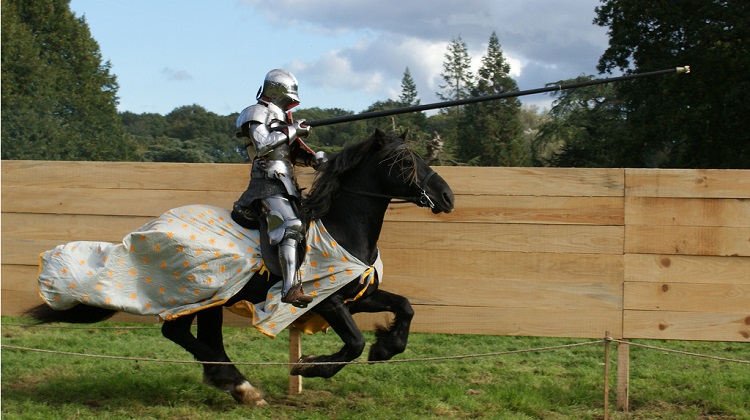
Knight jousting horse medieval Flickr commons

In twelfth-century Europe, did men unquestioningly accept love servitude to women? Today, many men don’t protest men being deprived of all reproductive rights whatsoever. Men say little about acute anti-men gender discrimination in family courts and child custody decisions. Men maintain stoic indifference to being smeared as rapists and being targeted on college campuses for absurd sex regulations. Perhaps men enjoy love servitude to women, relish working as slaves, and cherish being imprisoned. Yet Chrétien de Troyes’s late-twelfth-century Arthurian romance Lancelot hints at a different answer. Men apparently resisted love servitude to women with the same tactics subordinate workers resist orders around the world today.

In Lancelot, a girl rescued the knight Lancelot from his imprisonment atop a tall tower. In popular romance, usually the white knight in shining armor rescues the damsel in distress from imprisonment atop a tall tower. The white knight Lancelot, however, was a manlet. That helps to explain some subsequent events. After the girl rescued Lancelot from the tower, she took him to her favorite retreat, a country house, safe, secluded, and well stocked with provisions. There servants removed Lancelot’s cloths, which were filthy from his languishing in prison. Then:

the girl put him to sleep
In a tall, magnificent bed,
And later gave him a bath
And such wonderful care that I couldn’t
Tell you half if I tried:
She treated him as sweetly
As if he’d been her father.
She brought him back to life,
Completely renewed and restored. [1]

An earlier Latin romance, Apollonius King of Tyre, presented a much different account of a young man-doctor reviving a beautiful young woman. If the girl in Lancelot was receptive and not ugly, a manly knight might have expressed his gratitude to her in a more exciting way. Perhaps she noticed something lacking extension. That would explain why she gave him a bath and treated him as if he were her father.

Urging the girl to rescue him, the manlet Lancelot swore to be her obedient servant. He implicitly promised to be not like other men in servitude to women. Lancelot declared:

I swear I’ll be yours to command
For all the rest of my life

there’ll never be a day
When I won’t do what you ask.
Whatever you ask, if it’s in
My power, will be done — and done
as quickly as I can do it. [2]

Most women who order their man-servant (husband, boyfriend, etc.) to do something resent the response “not today.” Lancelot swore that there would never be such a day. Another standard man-servant response is “later.” Lancelot swore that he would obey the woman’s orders “as quickly as I can.” Lancelot, of course, hedged and qualified with words about his potency. Those reservations about potency probably were relevant when the girl gave him a bath.

From the commanding heights of culture, influential institutions and voices teach men to be subordinate to women. But boys aren’t stupid, and men aren’t stupid, either. Overpowered in social communication, men resort to passive resistance. Such passive resistance, however, isn’t sufficient to advance men’s liberation.

* * * * *

Notes:

[1] Chrétien de Troyes, Lancelot ll. 6670-8, from Old French trans. Raffel (1997) p. 210.

[2] Lancelot ll. 6597-8, 6001-5. The ideal of men’s love servitude to women has come to be widely celebrated as courtly love (amour courtois).

Article licensed under a Creative Commons Attribution-ShareAlike 3.0 Unported License.

Feature image by Spencer Wright

Reference:

Raffel, Burton, trans. 1997. Chrétien de Troyes. Lancelot, the knight of the cart. New Haven: Yale University Press.

Stanford historian says falsified medieval history helped create feminism

Through research into the first historians of medieval Europe, Professor Paula Findlen discovers that an interest in women’s history began much earlier than is assumed.

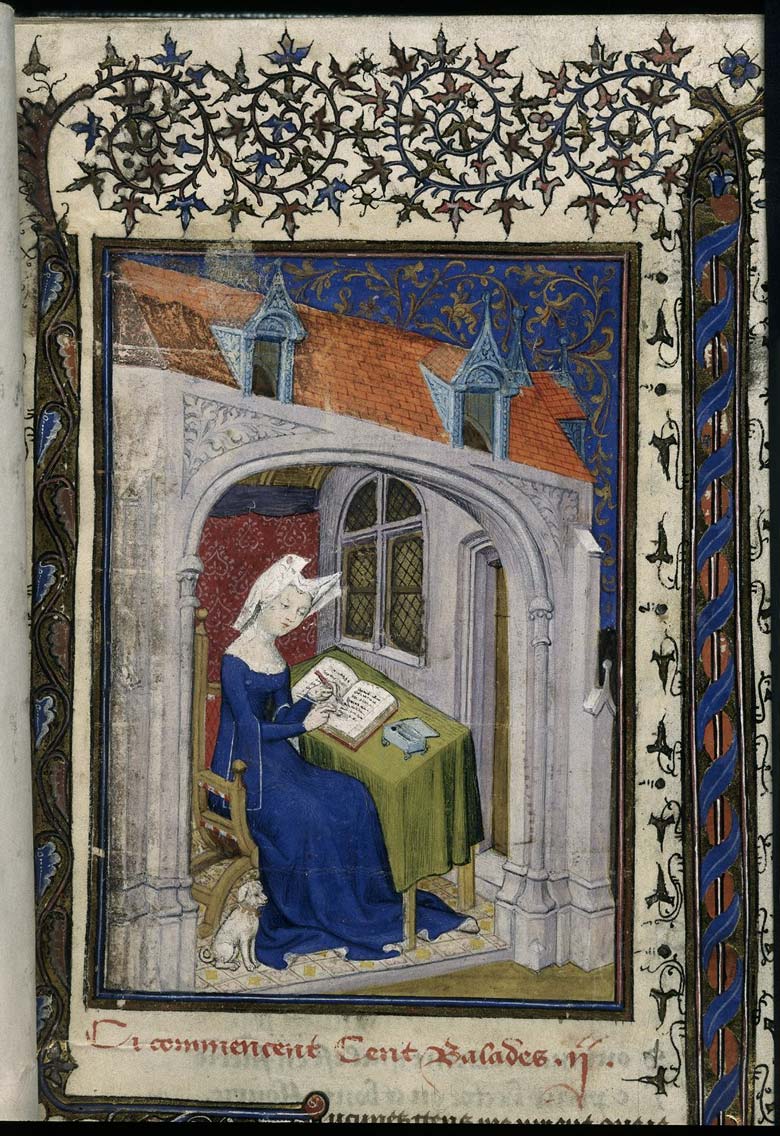
Harley 4431 f.4

Detail of a miniature of medieval writer Christine de Pizan. Stanford historian Paula Findlen has studied Renaissance biographies of medieval women and says these often embellished tales represent a kind of feminism.

Today, feminism is often associated with the political protests of the 1960s or the earlier women’s suffrage movement, but Stanford historian Paula Findlen‘s latest research reveals that the impetus to champion women started in the late Middle Ages.

A scholar of the Italian Renaissance, Findlen has collected biographies of medieval women, written in Italy from the 15th to 18th centuries, several centuries after the women lived.

Through a close examination of these texts, Findlen found that these early modern writers were so passionate about medieval women that they sometimes fabricated stories about them.

As Findlen carefully tracked down the claims in these stories, she found they varied from factual to somewhat factual to entirely false.

These invented women were often mentioned in regional histories, with imaginary connections to important institutions. They were described as having law degrees or professorships, claims that turned out to be fictitious.

Findlen argues that these embellished tales represent what could possibly be described as the origins of a certain kind of feminism.

“Early modern forgers used stories of women to create precedents in support of things they wanted to see in their own time but needed to justify by invoking the past,” Findlen said. “While debating the existence of these medieval women, the writers also contributed to the science of history as we know it.”

Expanding her archival base from Bologna to other Italian cities, and observing how these stories traveled beyond Italy, Findlen found that the stories of local women gained international recognition.

Findlen described her foray into conjectural history “a project partly about how early modern medievalists invented the Middle Ages, claiming and defining this past.” She added, “Making up history is a way of ensuring that you get the past you want to have.”

In her forthcoming publication, currently titled “Inventing Medieval Women: History, Memory and Forgery in Early Modern Italy,” Findlen pays particular attention to Alessandro Macchiavelli, an 18th-century lawyer from a Bolognese family.

Macchiavelli was passionate about finding evidence to support Bologna’s reputation as a “paradise for women.” He created stories and footnotes about learned medieval women from the region, including writer Christine de Pizan.

According to Findlen, “He aggressively made up [biographies of] medieval women and supplied the evidence that was missing for them.”

Presented as facts, these fables forged the medieval origins of Bologna’s female intelligentsia. Findlen initially worked on this material because she was searching for – and failing to find – evidence of medieval precedents that kept being invoked in early modern sources. “In the end,” she said, “it intrigued me.”

While people later recognized that Macchiavelli was a forger, it was true that he brought critical attention to women’s lives.

In a sense, Macchiavelli demonstrates “a quirky early modern male version of feminism,” Findlen said. He also contributed to the beginnings of the discipline of medieval history. When he forged a document, he did so based on extensive knowledge of the archives and a fine understanding of historical method.

“Medieval history is one of the really important subjects where people develop a documentary culture during the late 17th and 18th centuries, and they begin to identify and select the documents that matter for defining the Middle Ages,” Findlen said.

Imagining the women of Bologna

Between the 15th and 18th centuries, Findlen said, representations of medieval women enhanced a city’s reputation.

For example, scholars in Bologna wanted to learn about its presumed tradition of learned women. They craved information about medieval women who could provide historical precedents for someone like Laura Bassi, the first woman who can be documented as receiving a degree and professorship from the University of Bologna in 1732. Having precedents made her seem like a reinvention of the old rather than someone threateningly new.

Findlen first turned to Christine de Pizan (c. 1364-1430), the daughter of a University of Bologna graduate and professor. She is perhaps best known for her writings praising women.

In her Book of the City of Ladies (1405), a catalog of illustrious women, Christine contemplated her Italian roots. This longing for her past inspired Christine to imagine “what the ingredients were of this world that made her, and other women like her,” Findlen said.

Although inspired by some kernels of truth, Christine’s writings invented evidence to fill out her narratives, Findlen said. In this way, Christine provides a starting point for Bologna’s interest in women’s history that will unfold over the next four centuries.

What we want from history

Findlen’s project rethinks our compulsion to write about the past. “Some of the stuff we take for granted is legend, not fact,” she said, “but I think that I’m even more interested in having people understand why we want it.”

Despite the presence of fake facts in medieval women’s biographies, Findlen emphasized that “the unreliability of the past is also part of the evidence that we have to account for.” Moreover, she added, this project requires “knowing the archives … well enough to catch the nuances.”

“The process of creating a history of women,” Findlen said, “starts with this impulse to create collective biographies in the 14th and 15th centuries onward.”

Envisioning the wider impact of her work, Findlen said: “I would like this project to offer an interesting window into the invention of history, taking Italy as a case study, to understand why [early modern] people were so passionate about the Middle Ages.”

During the Renaissance, “people are increasingly concerned with documenting the history that was,” Findlen said. “They’re interested in the history that might have been. And then they’re also interested in the history that should have been. And those are three different approaches to history.”

Article reprinted with permission.

1857: Conference on Men’s Rights proposed

The following essay entitled Men’s Rights by Mr. Todd proposes a men’s rights conference be held in response to the women’s convention. The author’s compassion and advocacy for men is testament to the skewed gender wars being waged in the 1800s – PW

* * *

MEN’S RIGHTS. — TODD.

1. You are aware that the ladies, dear souls, have just been holding a most important Convention, at which they had resolutions, speeches, addresses, and appeals, in abundance, but no prayers. There were eloquence, wit, sharp and pointed rebuke, and thrilling disclosures of unsuspected facts, — all on the subject of Woman’s Rights.

2. There was a Rev. Miss, besides doctoresses and the like; and they seemed to unite in one deep lamentation over the wrongs, oppressions, and slavery of woman in these United States. I read the newspapers containing full reports of this convention, and rubbed my eyes, trying to get them wide open; for I had hitherto supposed that the ladies of this country were held in high esteem, and were treated so tenderly that they had no wish to complain.

3. Alas! alas! I find they are bowed down and trampled upon; and there is not one drop of misery in the most galling slavery, which our ladies have not tasted; —not one word in the recital of the wrongs of Egyptian bondage,1 that cannot apply to them. So they tell us!

4. Well, I sat and thought it over, till my soul was moved; and with sorrow I thought what a cruel creature I had been, all my life, to my wife, daughters, and sisters! To be sure, I have always given my poor earnings into my wife’s hands to spend for the family; because I knew she could do it better than I; and I have given my daughters the best education possible, and far better than I had.

5. But what then? Are they not oppressed? Don’t they have to use a side-saddle, while I don’t? Don’t they have to carry a muff, and sit under the buffalo, in a cold day, while I have the privilege of driving? When the snow is deep, don’t they have to wait till I can dig paths?

6. Ah me! and is there nothing to be said on the other side? Suppose we carry the war into the enemy’s camp a little, and speak of our sufferings and grievances. Can we not excite sympathy if we speak of our unredressed wrongs?

7. Now I propose to call a Man’s Convention in some important place, say Matildatown, and to have a meeting of the greatest and best, the wisest and the boldest, and see if we can not emancipate ourselves from this thralldom.

8. What do I propose? that a question! Why, sir, I would have a cavalcade of butchers as long as Maiden Lane;2 and I would let them tell how they had been compelled to do the dirty, disagreeable work of killing calves and pigs, sheep and oxen, and then dressing and cutting and carrying them to the door, and feeling very thankful if dear woman would just come out to the cart, and point, with her jeweled finger, at the piece she would like for the table!

9. I would have a long line of coal-diggers come up from the deep mines where they live, two miles from daylight, and never see the bright heavens but once a week; and they should come with their little lamps in their caps, and all covered with coal-dust! No, they would not come; they couldn’t be spared long enough.

10. But they should send up their story of wrong and oppression, and tell the Convention that no woman ever came there with pickax and blasting-powder. What heart in the assembly, especially what female heart, could remain unmoved when the voice came from those dreary subterranean caverns! and when the buried cried out against the wrongs imposed on my sex!

11. There are, it is said, three millions of men constantly on the deep, as sailors, standing at the helm, working the pump, climbing the shrouds, wet and cold in the storm, clinging to the wreck, going down to watery graves,—and for what? Why, that our dear ones may have their silks, their shawls, their laces, their china, and their perfumes!

12. It is estimated that fifty thousand men, every year, are buried in the mighty deep. O woman, woman! What do you mean? Why are you not hanging on the swinging yards, climbing the mast, and facing these hardships and dangers? I do protest against the slavery to which you have sunk my kind!

13. And the Convention should be electrified by the eloquence of men who fill_our streets; who bear burdens; who carry all the brick and mortar to build the fine houses; who are obliged to handle pork and tobacco, train-oil and sugar, molasses and codfish; who are all day long confined in dusty, close counting-rooms, and exhausting life and strength- over blotted account-books; who, in lonely church-yards, must dig graves, and work with no company save the moldering dead!

14. Are we not compelled, early and late, to do the hardest, vilest, filthiest work that human beings ever performed? What a story of wrong could we not tell? When I come to your great city, I can’t get a seat in the cars till the ladies are provided for, and that, too, next the window!

15. I can’t get a seat at the table, in the hotel or in the steam-boat, till the ladies are seated at the head of the table, where, I understand, the greatest delicacies are placed; and if any body has to wait for the second table, and eat fragments, it is not a lady. If a gentleman has a seat in the cars, and a lady comes in and wants it, though he were the king him self, he must give it up cheerfully.

16. Ah! and who feeds the iron horse and makes the cars go? Who lights the street-lamps, brushes boots, colors your hats, and pounds down the stones in the street? O men, men poor men! my soul yearns over you, and longs for your deliverance!

17. Do you not see that it’s the women who keep you down to these ignoble toils, and who snuff out the very light of your existence? Do you not see that, if they would only come and help us, and lift off our burden, we might be free?

18. I used to think — foolish me! — I used to think that the Bible made us to be the protectors of women, and that thus the strong were to bear the infirmities of the weak, and that we could not fulfill the designs of Providence without doing all this hard drudgery, and exempting our feebler sisters from it. But since their famous Convention I have learned differently.

19. I knew it was disagreeable to be surgeons, and to amputate arms and legs, and cut out tumors, and sew up wounds; but I had no idea that the ladies were longing, to cut and saw too.

20. I knew that our lawyers were a kind of civil police to keep the community quiet, and aided, as a chimney, to carry off the smoke of society; but I had no idea that our ladies were grieved that they were not chimneys too! In short, I see things in a new and strange light; and I am all awake for having a Men’s Rights Convention.

Notes:

[1] Egyptian bondage, a bondage the most rigorous and unreasonable, which was inflicted upon the Israelites for several centuries by the hard-hearted kings of Egypt
[2] Maiden Lane, the name of a street in the city of New York.

Source: The Progressive Fourth Reader, for Public and Private Schools. pp. 97-100, (published in 1857 by Bazin & Ellsworth)

A Word for Men’s Rights (1856)

The following long article from 1856 discusses the sexist laws that oppressed men and benefited women, including the practice of frivolous, unjustified lawsuits for supposed breach of marriage promise (or implied promise, or imagined promise). Such suits came, by the late part of the nineteenth century to be a standard operating procedure for women who either felt genuinely spurned or, just as frequently, women who saw an opportunity to misuse laws to control men. By the late 1920s, the practice had become a widespread criminal enterprise, highly profitable for both weeping bogus sweetheart and racketeering lawyer that it gained the appellation, “The Heart Balm Racket.”

***
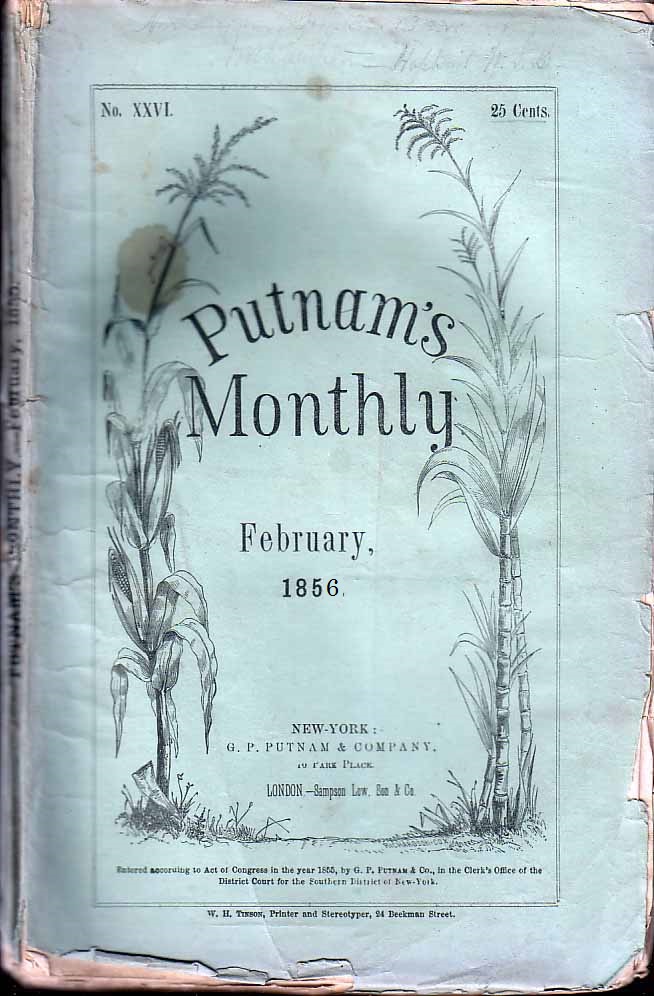
Putnam's 1856

— A Word for Men’s Rights —

FULL TEXT: The notions which rule inside of men’s heads, and the phrases in vogue to represent them are hardly less liable to fluctuation than is the fashion of the outward adornment, whether by hats, caps, bonnets, periwigs, or powder. Sixty or seventy years ago, scarcely anything was so much talked of as the rights of man. Where this phrase came from, we cannot tell. It is not to be met with in any writer of prior date to the middle of the last century. James Otis used it in his famous tract on the Rights of the American Colonies, nor are we aware of any earlier appearance of it in print. Sudden, however, and obscure as its first appearance was, it took, and soon became one of the most fashionable of phrases. It played a great part in the American Revolution. It found its way into our Declaration of Independence, and into the fundamental laws of most of our states. It played a still greater part in the French revolution. Ten or a dozen French constitutions, more or less, were founded upon it. Thomas Paine wrote a famous book, with this title. For a while, nothing was so much talked of as the rights of man—talked of, we say—for, as happened in the case of the thirsty Indian, so with respect to these rights, it was pretty much all talk, with very little cider.

In sixty years, however, fashions have changed. The rights of man —once in everybody’s mouth—are seldom heard of now-a-days—unless it be in an abolition convention—or, if mentioned at all, in Congress and other respectable places, these rights, once the hope of humanity, are referred to, only to be sneered at, as a flourish of rhetoric—a chimera of the imagination.

Still, we are not left speechless nor hopeless. Hope still remains at the bottom of the box, with a fine sounding phrase to back it. Let the men go to the deuce. What of that? Does not lovely woman still remain to us? Today, the fashionable phrase is—woman’s rights. The women have discovered, or think they have, that they are, and long have been tyrannized over, in the most brutal manner, by society, the laws, and their husbands. Woman’s rights is now the watch-word of a new movement for social reform, and even for political revolution—the women, among other things, claiming to vote.

It must be confessed that such general outcries are not commonly raised, without some reason. They are the natural expressions of pain and unsatisfied desire. It was not without reason that America and Europe, towards the close of the last century, raised the cry of the rights of man; and so, we dare say, it is not without reason that the rights of woman are now dinged into our ears. Nor is this cry without a marked effect, not merely upon manners and society, but also upon laws. Almost all our state legislatures are at work, with more or less diligence and enthusiasm, modifying their statute books, under the influence of this new zeal. To that we do not object. Putnam is for reform. Putnam is for progress. Putnam is for woman’s rights; but also for man’s rights—for everybody’s rights; and, in that spirit, we are going to offer a few hints to our legislators, whose vaulting zeal, on behalf of the ladies, seems a little in danger of overleaping itself, and jolting on t’other side. It is well to stand straight, but not well to tumble over backward, in attempting to do so.

Those who go about to modify our existing laws, as to the relation of husband and wife, will do well to reflect that the old English common law on this subject, if it be a rude and barbarous system, little suited to our advanced and refined state of society—which we do not deny—is also a consistent and logical system, of which the different parts mutually rest upon and sustain each other. In the repair, or modification of such a system, it is material that every part of it should be taken into account. Changes in one part will involve and require changes in other parts; otherwise, alterations, made with a view only to relieve the wife from tyranny and oppression, may work a corresponding injustice to the husband. Nor are the changes already made in our laws, partly by legislation and partly by usage, free from glaring instances of this sort.

The English common law makes the husband the guardian and master of the wife, who stands to him in the relation of a child and a servant. In virtue of this relation, the husband is legally responsible for the acts of the wife. If she slanders or assaults her neighbors, he is joined with the wife in the action to recover damages, and he alone is legally responsible for the amount of damages recovered, even to the extent of being sent to jail in default of payment. He is likewise responsible for debts contracted by the wife to the same extent that a father is responsible for the debts of his minor children. Even in criminal proceedings, it is he who must pay, or go to jail for not paying the fines imposed on his wife; and there are many cases, even cases of felony, in which the wife, acting in concert with her husband, is excused from all punishment, on the presumption that she acts by his compulsion, though in fact she may, as in the noted case of Macbeth’s wife, have been the instigator. Public opinion goes even further than the law, and holds the husband accountable, to a certain extent, for all misbehaviors and indiscretions on the part of his wife. Not only is he to watch that she does not steal, he is to watch that she does not flirt, and every species of infidelity, or even of levity on her part, inflicts no less disgrace upon him than upon her—disgrace which the received code of honor requires him to revenge upon the male delinquent not only in defiance of the law which forbids all breaches of the peace, but even at the risk of his own life.

The law and public opinion having anciently imposed all these heavy obligations on the husband, very logically and reasonably proceeded to invest him with corresponding powers and authority. Standing to the wife, as he was made to stand, in the relation of father and master, the law very reasonably invested him with all the rights and authority of a father and a master. How, indeed, was he to exercise the authority and to fulfill the obligations which the law and public opinion imposed upon him, of regulating the conduct of his wife, unless invested at the same time with means both of awe and coercion? Accordingly, the law and usage of England authorized the husband to chastise his wife—in a moderate manner—employing for that purpose a rod not thicker than his finger. The husband was also entitled to the personal custody of his wife, and was authorized in proper cases—if, for instance, she seemed disposed to run off with another man—to lock her up, and, if need were, to keep her on bread and water.

Now these, it must be confessed, were extensive powers—harsh and barbarous powers, if you please—though the law always contemplated that, in his exercise of them, the husband would .be checked by the same tenderness towards the wife of his bosom which tempers the exercise by the father of a similar authority over his children. But however extensive, however harsh or barbarous the powers of the husband may be, we appeal even to our female readers — if, indeed, a single female has had patience and temper to follow us thus far—we appeal even to that single female (or married one, as the case may be), to say how, in the name of common sense, is the husband to keep the wife in order, to the extent which the law and public opinion demands of him, except by the exercise of these powers, or at least by the awe which the known possession and possible exercise of them is fitted to inspire? If the fractious child is neither to be spanked nor shut up in the closet, how is domestic discipline to be preserved? What more effectual sedative to an excited and ungovernable temper, which might provoke both suits for assault and actions for slander, than retirement in one’s closet with the door locked and a glass of cold water to cool one’s burning tongue?

And so of another great topic of complaint on the part of the advocates of woman’s rights—the power which the husband has by the common law over the wife’s property. He being responsible for her debts and her acts, and being bound to provide for the support of the children, has, as a corollary thereto, the custody and disposition of the wife’s property, if she chances to inherit or to acquire any—which, unfortunately, in the middle ranks of life, where these notions of woman’s rights most extensively prevail, is, we are sorry to say, but too seldom the case.

Such are the relative rights and duties of the husband under the old English common law. Under this law a husband is not a mere chimera, a surd and impossible quantity. There is a logical consistency about him. He is, as Horace says of the stoic philosopher, terei ef rotundus, round and whole, armed at all points, provided with powers adequate to the duties expected of him.

In America we have no such husbands. Long before the cry of woman’s rights was openly raised, the powers and prerogatives of the American husband had been gradually undermined. Usage superseded law, and trampled it under foot. Sentiment put logical consistency at defiance, and the American husband has thus become a legal monster, a logical impossibility, required to fly without wings, and to run without feet.

Women care nothing for logic, but they have a sense of justice and tender hearts, and to their sense of justice we confidently appeal. Who can wonder that the men are so shy in taking upon them the responsibilities of the married state? Those responsibilities all remain exactly as in old times, while the means of adequately meeting them are either entirely taken away, or are in a fair way to be so. By the law as it now is, we believe in every state of the Union, the husband cannot lay his finger on his wife in the way of chastisement except at the risk of being complained of for assault and battery, and, perhaps, sued for a divorce, and (which is worse than either) of being pronounced by his neighbors a brutal fellow. The nominal custody of the person of the wife, which the law still, in some of the states, affects to bestow upon the husband, is a mere illusion. If he attempts to lock her up, she can sue out her habeas corpus, and oblige him to pay the expenses of it; and if she wishes to quit her husband’s house, and go elsewhere, he has no means of compelling her return. He may sue those with whom , takes refuge, for harboring her, but if he obtain damages at all, they will be only nominal. In many of the states, laws have been enacted and soon will be in all of them, giving the wife the exclusive control of her own property, acquired before or after marriage, by gift, inheritance, or her own industry.

While the wife is thus rendered to a great extent independent of her husband, he, by a strange inconsistency, is still held, both by law and public opinion, just as responsible for her as before. The old and reasonable maxim, that he who dances must pay the piper, not apply to wives—they dance, and the husband pays. To such an extent is this carried, that if the wife beats her husband, and he, having no authority to punish her in kind, applies to the criminal courts for redress, she will be fined for assault and battery, which fine he must pay, even thought she has plenty of money of her own. or, in default of paying, go to jail! Such cases are by no means of unprecedented occurrence in our criminal courts.

Now, what sense or reason is there in making the husband responsible for the licenses of the wife’s tongue, after he has lost all power to control it? If the wife is to hold her property separately, ought she not to be sued separately, both for debts and damages? If her property ought not to go to pay the husband’s debts, why ought his to go to pay hers? If the husband has lost the power to control tile goings in and runnings out of the wife, why ought public opinion to hold him any longer responsible therefor?

We have no objection to an amendment of the law in relation to husband and wife. Public opinion demands it. The progress of society requires it. But the new wine ought not to be put into old bottles, nor the old garments to be patched with new pieces, lest, as the proverb says, the rent be made worse than before.

But there is yet another recent innovation in the law, liable to still more serious objections. Not content with placing the unfortunate husband in an absurd and anomalous condition, not content with still demanding of him certain duties and obligations, at the same time that he is deprived of the powers and the rights essential to their fulfillment, reducing him in fact to a position hardly less ridiculous, and not at all less embarrassing, than that of a short-tail bull in fly-time—the law (as if conscious that, before entering into such an unequal alliance, the men would grow pretty critical as to the personal qualities of the women in whose power they were about so completely to place themselves) seeks to entrap us into matrimony against our inclinations, by holding, as it does, that any man who shows signs of having been impressed by a woman, becomes, if she is single, her lawful prize, and is bound to marry her if she insists upon it, or eke—stand a suit for breach of promise.

Though suits for breach of promise of marriage are comparatively a recent thing, in order fully to understand their nature it is necessary to go back to the dark ages. We pretend to be protestants; we rail against the popish church; yet in how many important matters are we still the mere slaves and tools of that church! The canon law was one of the most crafty devices of the middle age theocracy, and is a standing topic of reproach against Catholicism ; and yet in the most delicate of all our relations, that of marriage and divorce, we protestants are to this day substantially governed by the canon law! The canon law was made by monks, men forbidden to marry themselves, and therefore destitute of any personal experience by which to shape their legislation on this subject. They had, indeed, the Roman law as their guide, but this they departed from in the most essential particulars, as being altogether too reasonable to suit their ascetic theories or serve their purpose. The monks who made the canon law looked upon marriage as a sensual and unholy state, only to be tolerated in the gross laity, to prevent something worse; and they seem to have exerted their whole ingenuity to render this sinful condition as uncomfortable as possible. Hence the excessive hostility of the canon law to divorce, it being held a just punishment of the immorality of marrying at all, that persons Unsuitably or unhappily married should be kept during their natural lives tied together neck and heels, Bo that their torments in this world might give them, as it were, a relishing foretaste of what married sinners had to expect in the next. But while unhappy marriages were thus cursed with a perpetuity beyond the reach of the parties or the law, the ingenious canonists at the same time suspended over the heads of every happy couple the terror of an involuntary and forced separation, which should unmarry them and bastardize their children. One of the means employed for this devilish purpose was the doctrine of pre-contracts. A promise to marry was, according to the canon law, equivalent to a marriage, and every subsequent marriage to another party, pending the life of the party to whom the promise had been made, was vitiated by it. The canonists even went so far as to allow suits for the specific performance of these marriage contracts—the officers of their courts, on the suit of some disappointed virgin, entering the household of love, breaking up the family, stigmatizing the woman as a concubine and her children as illegitimate, and compelling the man to take his legal wife—as by virtue of some pretended pre-contract she was held to be—into his house and his bed. It is from this canonist doctrine of precontracts that our suits for breach of promise are derived. The common law, indeed, being the work of ruder hands, is ignorant of that beneficial process of the Roman law—the suit for specific performance. In the case of the nonperformance of a contract, the common law contents itself with attempting to set matters right, by awarding damages for the non-performance. In this particular case, even this defect in the common law was a very fortunate thing, as otherwise, instead of merely having damages to pay for refusing to marry against our inclination, we might have been brought up to the ring-bolt of specific performance, and forced into the yoke any how.

It is often said that no woman of any delicacy or self-respect ever would or ever does bring a suit for breach of promise of marriage. That may be so; still nothing prevents a great many women, who would be entirely unwilling to confess to any deficiency of delicacy or self-respect, from taking advantage of the law, or more properly speaking, of the public sentiment out of which the law grows and which sustains it, to force their once lovers, but lovers no longer, into a reluctant and repugnant marriage ceremony. Whose private experience does not enable him to recount instances, in which men, sensibility and honor have suffered themselves to be thus forced into unsuitable matches, of which the unfortunate result has corresponded with the inauspicious beginning? Contrary to every principle of common sense, as well as to every instinct of sentiment, as are suits for breach of promise of marriage, yet undoubtedly they are fully sustained by the prevailing public sentiment. Otherwise it would be impossible to explain the extravagant lengths to which courts have gone in inferring a promise of marriage from the most trivial circumstances—waiting on a lady home from church; going to see her of a Saturday night; asking her twice of a winter to a ball; corresponding with her, though nothing is said in the letters about love or marriage; allowing her to darn your stockings. There is, indeed, no circumstance, however light or trivial, upon which the busy tongues of a country parish get up a rumor of an engagement, which is not held amply sufficient by our courts of law to establish the fact of a promise of marriage, and to lay the foundation of a suit for damages.

It is not, however, upon these extreme cases that we rest our opposition. We object to the proceeding in any case, no matter how solemn and formal the promise, nor how often renewed. We object to the whole idea of obligation in such a case, and, of course, to the enforcement of such supposed obligation by law. The whole thing is a gross abuse—to speak the truth—a scandalous abomination. The very idea of marriage, according to any but the grossest and lowest conception of it, implies the free and full consent of both the parties to it. On the part of the man, if not of the woman, it implies something more, not a mere tacit consent, but a forward, active, joyous consent. A great deal of sympathy has been expended over women forced by tyrannical fathers to give their hands without their hearts. A miserable case, truly, but altogether less miserable than that of a man, drawn, by a false sense of honor and a ridiculous public opinion, to speak a public lie, and, in the face of God and man, to pledge himself as a husband, when he knows he cannot be one. All promises are made with this implied reservation—that he who promises shall have it in his power to fulfill. This is true even of mercantile promises. No man is held to be under any moral obligation to pay his debts, any further than he has the means to pay; and upon giving up the property that he has, our insolvent laws will discharge him from the legal obligation. A promise to marry carries with it the implied reservation that he who promises shall continue to love. The promise is not, and is not understood to be, either by him who makes, or her who receives it, a promise merely to assume the legal responsibility of marriage; it is a promise to assume the moral and sentimental responsibilities also; and if, by change of circumstances or change of mind, it has become impossible to fulfill one part of the promise, if it is impossible to love. the whole necessarily falls to the ground.

What is the object and intent of that intimacy called an engagement of marriage, unless to enable the parties to live together in that freedom of intercourse which the mutual expectation of marriage inspires, for the very purpose of giving them an insight they would not otherwise have into each other’s character, and an opportunity of repentance and retraction before taking the irrevocable step? And if this be the object of an engagement—as who will venture to say it is not—how absurd to hold a man bound to marry, by the very process of socking to discover whether it will be judicious for him to marry or not?

Of all miserable things in this world of misery, a miserable marriage is the most miserable, yet every acute observer must have noticed that the misery of many of these marriages arises from causes too immaterial, so to speak, too spiritual to attract the notice of the casual observer. At a time when our courts and our legislatures are besieged by wives and husbands struggling to get rid of uncongenial partners; when the laws on the subject of divorce are loudly complained of in so many quarters, as failing to afford that relief which they ought, one measure, it would seem, might suit equally well both the friends and the enemies of the freedom of divorce. An ounce of prevention is worth a pound of cure. It may be necessary to allow those married persons to separate, who have become not merely tiresome, but hateful to each other; but how much better to avoid the blunder of bringing such people together? Divorce at the pleasure of either party, after the marriage has been consummated, and especially after children are born, is limited to some very weighty objections; but what can be the objection to allowing the freedom of separation in cases where no marriage has yet been celebrated? If, indeed, to seek the intimacy of a lady with a view to discover if she is fit to be your wife, is to carry with it the obligation to make her so, at all events, we are in no respect better off than the Chinese, who marry their wives without over having seen them. So far, indeed, as the wife’s person is concerned, we have an advantage over the Chinamen, in the privilege of seeing so much of it as she exhibits to the world at large in the street, or as she displays to a select circle in a ballroom. Looks, however, in this climate, are not much to be depended upon. American beauty fades with marvellous rapidity; while, as to the lady’s temper, and mental and moral traits, which in our state of civilization are of at least equal importance with her face, if we are so impertinent as to peep into them, the law and public opinion insist that in so doing we have contracted an obligation to marry her. Thus, in fact, we are worse off than the Chinaman. He, if not suited with one wife, can take another, and so on, till he is suited. We, when once married, are done for. We can neither get rid of our uncongenial wife nor take a congenial one. Under these circumstances, we ought at least to have the privilege of making a choice with our eyes open, and not be held by the very act of examination to have precluded ourselves from declining to accept an article, which, however taking it might seem at first sight, proves, on being more closely looked at, not what we wanted.

[“A Word For Men’s Rights.” Putnam’s Monthly, A Magazine of Literature, Science , and Art, Vol. II, Feb. 1856, No. XXXVIII, p. 208]


Courtly love ideology leaves bitter men with only fantasies

By Douglas Galbi

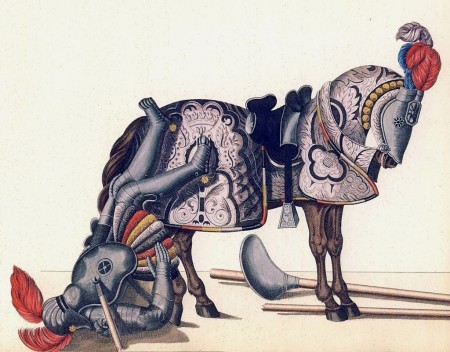
courtly-love-failure-450x352

In medieval Latin love lyrics, courtly lovers yearn for carnal love. They praise women’s bodily beauty, they beg for love and pitifully lament being rejected, and they plaintively foretell their death through lovesickness. Medieval clerics, white knights, and courtiers are standard-bearers of courtly love. They display ignorance, dogma, and fantasy that endures to our day as an alternative to the empirical science of seduction.

For long now I have shown myself
to be a devoted soldier of Love,
as whose bidding I rushed headlong
to commit foolish, daring deed,
loving at great hazard
one who never casts a kindly eye on me.
If I now entirely ceased,
I would serve myself well,
But only the inferior man
flees the clamor of battle.
Let it be, as I will!
Carelessly I offer my life to fortune’s hazards.
She must know of my soul’s greatness,
greater than my bodily form,
for I climb the loftiest bough
seeking for fruit on the tree
and claiming: guile
has no place in a lover who knows no fear.[1]

Soldiers of love are men who believe in the ideology of courtly love. They are men such as Ulrich von Liechtenstein, Suero de Quinones, and Nitin Nohria. Living in fantasies, they are generally not successful in love with women. They commonly became bitter men who hate themselves and other men. They tend to marry as beta-provider hubbies. They face a high risk of sexless marriage and being cuckolded. You don’t want your son, if you have one, to become that kind of man.

In the Middle Ages, just as in our current Dark Age, a few transgressive poets challenged the benighted scholars, gynocentric apparatchiks, and sophistic social-climbers that construct and re-enforce the ideology of courtly love. Drawing upon the full resources of classical, biblical, and contemporary culture, these poets offered a messianic secret. Their secret is accessible only to those who read medieval Latin poetry knowingly.

If I were to speak with angelic and human tongues,
I could not describe the prize, no worthless one.
By that I am rightly set above all Christians,
while unbelieving rivals envy me.
Sing, my tongue, therefore of causes and effects!
Yet keep the lady’s name cloaked,
so that it isn’t spread widely among the people,
and the secret is kept apart and hidden from the masses.

{Si linguis angelicis loquar et humanis,
non valeret exprimi palma, nec inanis,
per quam recte preferor cunctis Christianis,
tamen invidentibus emulis profanis.
Pange, lingua, igitur causas et causatum!
nomen tamen domine serva palliatum,
ut non sit in populo illud divulgatum,
quod secretum gentibus extat et celatum.} [2]

The medieval Latin poem Si linguis angelicis, written in a Latin meter associated with satire, subtly mocks the delusions of courtly love. The lover’s case history begins with plausible circumstances of despair:

In a beautiful, flowering bush I stood,
turning around in my heart this: “What should I do?”
I hesitate to plant seeds in infertile soil.
Loving the flower of the world, behold, I am in despair.”

{In virgultu florido stabam et ameno,
vertens hec in pectore: “quid facturus ero?
dubito, quod semina in harena sero;
mundi florem diligens ecce iam despero.} [3]

This stanza thoroughly mixes sexual and biblical imagery: standing erect in a beautiful bush, God from a burning bush instructing Moses, sexual intercourse not propitious for creating descendants as numerous as the sand on the seashore, and the microcosm-macrocosm flower of the world / vulva of God. Life is wonderfully complex. The question in despair for every man conscious of his human nature: “what should I do?”

In the context of deeply rooted social hostility toward men’s sexuality, men increasingly are choosing to do nothing. As an alternative to life in the flesh, historically much more prevalent than pornography has been fantasies of courtly love:

I saw a blossoming flower, saw the flower of flowers,
saw a May rose more beautiful than all others,
saw a shining star brighter than the rest,
by which I passed into the experience of love.

{Vidi florem floridum, vidi florum florem,
vidi rosam Madii cunctis pulchriorem,
vidi stellam splendidam, cunctis clariorem,
per quam ego degeram sentiens amorem.}

The experience of courtly love centers on other-worldly idealization of the beloved woman. The deluded lover, feeling ineffable joy from this imaginary woman, rushes to her and greets her on bended knee:

Hail, most beautiful one, precious jewel!
Hail, glory of virgins, maiden glorious,
hail, light of lights, hail, rose of the world,
A Blanchefleur and a Helen, a noble Venus!

{Ave, formosissima, gemma pretiosa,
ave, decus virginum, virgo gloriosa,
ave, lumen luminum, ave, mundi rosa,
Blanziflour et Helena, Venus generosa!} [4]

Yes, even in medieval times, most women would regard this guy as creepy. She doesn’t even know him. He had seen her at a summer feast, fully five or six years ago. Since then, he has been suffering grievously from lovesickness. He has never spoken to her, but he thinks of her:

Drink, food, and sleep have deserted me,
By medicine I am unable to be healed.

These privations and many more have I endured,
No consolations fortify against my cares,
except repeatedly in the darkness of night
I am with you in forms shaped by the imagination.

{Fugit a me bibere, cibus et dormire,
medicinam nequeo malis invenire.

Has et plures numero pertuli iacturas,
nec ullum solacium munit meas curas,
ni quod sepe sepius per noctes obscuras
per imaginarias tecum sum figuras.}

Offering a fantastic alternative to the folklore motif “man gets sex without paying for it,” the imaginary woman declares:

So tell me, young sir, what you have in mind;
do you ask for silver, so as to enrich yourself,
or for precious stones to adorn yourself?
For if it be possible, I will give you whatever you seek.

{Dicas ergo, iuvenis, quod in mente geris;
an argentum postulas, per quod tu diteris,
pretioso lapide an quod tu orneris?
nam si esse poterit, dabo quidquid queris.}

Imagine — while he was secretly pining for her, she was also secretly in love with him! Even better, she wants to give him expensive gifts. Needless to say, real life five or six years after seeing a beautiful woman, but not speaking to her, isn’t like this. Continuing more realistically, the man dallies further verbally. Recognizing that he needs additional, explicit instruction, as many students do after being terrified in mandatory affirmative-consent classes, the loving woman declares:

Whatever you want to do, such I cannot foreknow,
however to your entreaties I desire to consent.
Therefore, what I have, sedulously investigate,
undertaking, if you can find it, whatever you seek.

{Quicquid velis, talia nequeo prescire;
tuis tamen precibus opto consentire.
ergo, quicquid habeo, sedulus inquire,
sumens si quod appetis, potes invenire.}

She speaks like a true scholastic. She even offers a hint of now-fashionable gender ambiguity. The lover throws his arms around her neck and kisses her a thousand times. As Ovid said after hugging his mistress Corinna’s lovely, naked body, who doesn’t know what then ensued?[5] Men bitter with the failures of courtly love will find pleasure in this fantasy. They must not lose heart, but have stronger hope that repeated failures of courtly love indicate forthcoming success.[6] Can anyone doubt that triumph in courtly love comes from fantasy, not empirical science?

Medieval Latin poetry shows a still more excellent way. With guile, amused mastery, and fear for his holiness, a man can aspire to be like God to the woman he wants to love:

Game, he may game, you all game! In your jesting now listen,
the sweet joys of the present life soothe and make merry:
the player roles the dice,
the student by his embraces
would delude women.
Love must be sung in sweet melodies;
It should not be held back in the shackles of grave homilies.
A little maiden should pledge her hand,
she flowering like a rose,
overcome by pious words.
She should say “yes!” readily, not refusing when asked,
Not inquiring of the aforesaid man’s standing.
She should do what is asked;
what is neglected to be requested,
the lauded young woman should provide.

{Lude, ludat, ludite! iocantes nunc audite,
quos presentis gaudia demulcent leta vite:
histrio tesseribus;
clericus amplexibus
deludat mulieres.
Amor est iam suavibus canendus melodiis,
qui non tardet gravibus detentus homiliis.
spondeat puellula
florens quasi rosula,
verbis devicta piis.
Dicat “ita!” facile, nil deneget rogata,
non viri notitiam rimetur prenotata.
faciat, quod petitur;
quod prece negligitur,
prestet virgo laudata.} [7]

The Virgin Mary said yes to the mysterious words of the angel Gabriel. About two millennia later, the Mystery Method has been extensively field-tested. Among all possible outrages — and medieval Latin provided now inconceivably broad latitude for outrageous words — the greatest of these is love.

* * * * *

Notes:

[1] Carmina Burana 166 (Iam dudum Amoris militem), from Latin my English translation, with borrowings from the English translations of Marshall (2014) p. 205 and Walsh (1993) p. 187. In the final Latin line, Walsh replaces non from the manuscript with nunc and translates the last two lines thus:

claiming that in a lover who knows no fear there is now a role for native talent.

Perhaps climbing trees is a “native talent,” but that makes little poetic sense in context. For the original manuscript text, Walsh provides the alternate translation:

in a lover who knows no fear, there is no place for the crafty approach.

Id. pp. 187-8. My translation is similar, but makes more clear that the relevant craft is social ingenuity (ingenio): guile.

The phrase amoris militem (soldier of Love) “sounds the keynote of the poem; this is to be the proclamation of the courtly lover.” Id. p. 187. Ovid explored that theme, but with much more insight and sophistication.

[2] Carmina Burana 77 (Si linguis angelicis loquar et humanis) st. 1-2, from Latin my English translation, with borrowings from the English translations of Marshall (2014) p. 101-5 and Walsh (1993) pp. 65-8. Here’s a complete Latin text of the poem from Biblotheca Augustana. Above I provide the Latin text from id. pp. 62-65. That Latin text has some small differences from Bibliotheca Augustana‘s Latin text. All the subsequent quotes above, except the final one, are similarly from Si linguis angelicis, stanzas 3, 6, 8, 20 (ll. 1-2) & 21, 26, and 28. This poem has survived only in the Carmina Burana manuscript (Bavarian State Library, Munich, clm 4660/4660a).

The opening line of Si linguis angelicis cites 1 Corinthians 13:1. The next three lines are boastful and arrogant. Cf. 1 Corinthians 13:4. Robertson (1976/1980) p. 141 insightfully notes:

the assertion of that self-esteem after the suggestion of charity in the first line is more than a little ridiculous and hence humorous. I do not mean that it produced loud laughter, but I am confident that it did produce a smile.

The reference in the second line to the prize (palma) plausibly derives from Apocalypse 7:9. Id.

The second stanza’s first two words Pange, lingua evoke the crucifixion hymn of Venantius Fortunatus. Fortunatus wrote that hymn for the presentation of a cross relic to Queen Radegund at Poitiers in 570. It subsequently was commonly used in the Christian liturgy for Good Friday. Robertson provides a learned exegesis of the phrase causas et causatum:

The rare participle causatus (from causo rather than the usual Classical causor) used substantially occurs prominently in only one familiar {sic} work: the translation of Aristotle’s Posterior Analytics by Boethius. It appears in 1.7 toward the close in the clause “cum non ex causatis sciat causis,” which forms part of an argument to show that demonstrative principles appropriate to one discipline cannot be used for demonstration in another discipline unless the axioms of the two are the same, or unless one discipline can be thought of as being logically subordinate to the other.

Without being able to draw upon insights from the subsequently developed body of seduction field reports, Robertson makes a false distinction:

Divinity and seduction do not have the same axioms, since it is an axiom of Divinity that fornication is forbidden. For the same reason Divinity cannot be subordinated to seduction. The two are incompatible, and our lover is speaking foolishly.

Id. p. 142. On the messianic secret, Mark 8:29-30 and Romans 16:25-6. On men’s love for women in relation to crucifixion, Ephesians 5:25. The issue of divinity and seduction is further elaborated in the discussion of Lude, ludat, ludite! above.

The satire on courtly love in Si linguis angelicis hasn’t been recognized within Latin literary scholarship that largely celebrates man-oppressing courtly love. Considering Si linguis angelicis, Dronke declares:

The poet makes constant liturgical allusions — yet these are not in any way parodistic or blasphemous: they are not to establish an incongruity but to overcome one.

Dronke (1965) p. 318. The poem is written in a “goliardic” meter. That form is commonly associated with “satirical or jocular purposes.” Walsh (1993) p. 69. The poem has technical similarities with the immediately preceding poem in the Carmina Burana, Dum caupona verterem. Id. pp. 59-60. Dum caupona verterem is about a man of distinction who spent three months in a brothel having sex with Venus. He left as a pauper with fantastic memories. In contrast to Dronke’s and Walsh’s views, both poems seem to me to ridicule men’s ignorance and folly in love.

[3] The phrase in harena more literally means “in sand.” Cf. Mark 4:5-6. Ovid, Heroides 5.115 associates sowing seed in sand with prophecy of death. The context is Paris leaving Oenone for Helen. Walsh (1993) p. 70, which notes that reference, observes “the crudity of this double entendre is lightened by the literary reminiscence.” Male sexual function isn’t crude; it’s natural, beautiful, and in some instances fruitful. In context, the reference to sand evokes barrenness. The reminiscence of Helen and the Trojan War adds a dark note of brutal violence against men.

[4] The first three lines of the above stanza evoke Marian hymns. The fourth line refers to a secular romance and traditional Roman myth. Walsh (1992) p. 197 observes:

The identification of the loved one with Helen, who is cited as an exemplum of peerless beauty without animadversion to morals, should not have troubled Dronke, since it is a prominent feature in other lyrics and is recommended in the rhetorical handbooks.

Robertson offers broader insight:

Although it is true that in the twelfth century after it became commonplace to see the bride in the Canticle as Mary, the attractiveness of her physical attributes was sometimes indicated in very frank terms, and love for her was often expressed in what is today startling imagery, no one would seriously have sought to combine the Blessed Virgin, Blanchefleur, Helen and Venus in the same person. To deny that the effect of this line is humorous seems to me to be insensitive. Whatever we may think of Blanchefleur, Helen had an unsavory reputation in the twelfth century; and it would hardly have been possible for a girl to be a “virgo gloriosa,” which Helen certainly was not, and a “Venus generosa” at the same time.

Robertson (1976/1980) p. 145. Being humorous doesn’t exclude the serious purpose of challenging the dominant ideology of courtly love.

Medieval writers fearlessly combined sacred and profane themes. Carmina Burana 215 (Lugeamus omnes in Decio) uses the form of the Mass as a disparaging liturgy against the god of dice. The mid-fifteenth-century Middle English poem Kyrie, so kyrie rewrites Jankyn’s subordination to Alisoun. The Arundel Lyrics is a wide-ranging collection that evokes the extraordinary mixture of the Incarnation. Boncompagno da Signa (c. 1170- c. 1240) in his Rhetorica novissima declared:

A certain man who had had carnal knowledge of a nun said: “I did not defile the divine bed, but since the Lord had favored me in his words, I wished to raise his horn.” Moreover, a nun could say to her lover: “Thy rod and thy staff, they comfort me.”

From Latin trans. Huot (1997) p. 67. Cf. on Boncompagno, Dronke (1965) p. 318. Luke 2:23 offered possibilities for celebrating the sacredness of men’s sexuality. For relevant discussion, Huot (1997) p. 67.

[5] Ovid, Amores 1.5-23-24.

[6] Cf. the last two stanzas of Si linguis angelicis. Those stanzas offer platitudinous inspiration for courtly lovers:

So let every lover be mindful of me. He must not lose heart, though at that point his lot is bitter. For certainly some day will dawn upon him at which he will later triumph over his troubles.

Indeed it is from bitterness that pleasant joys are sprung; the greatest gains are not won without toils. Those who seek sweet honey often feel the sting, so those whose lot is more bitter should maintain the stronger hope.

Trans. Walsh (1993) p. 68. A later hand inserted amara (bitternesses) to make the first line of the final stanza to be in part “it is from bitterness that bitternesses are sprung.” With some dissent, modern scholars have tended to amend amara to grata (pleasant joys). Id. p. 73.

Interpretations of Si linguis angelicis have varied considerably within common respect for courtly love. Walsh declared:

The poem is serious insofar as the poet enthusiastically associates himself with the courtly experience, but the theme is handled wittily as a literary mode rather than with deep emotional involvement. In short, the composition is a stylized exercise

Id. p. 68. Robertson didn’t take the poem seriously. He speculated its “original purpose may have been to serve as a grammatical exercise for students.” Robertson (1976/1980), p. 150. Dronke read the fantasy of courtly love in Si linguis angelicis to cover seriously amour courtois generally:

‘Si linguis angelics’ draws together some of the poetically most notable attitudes of the twelfth-century courtois love-lyric. … In many ways I am tempted to see this poem almost as an emblem of the twelfth- and thirteenth-century European poetry of amour courtois.

Dronke (1965) p. 330. The above quote is part of the concluding paragraph for the whole interpretive volume of Dronke’s learned and influential work on medieval Latin love lyric.

Scholars haven’t recognized the seriousness of the parodic critique of courtly love in Si linguis angelicis. Courtly love ideology has deep psychological roots among elite men. Walsh’s view of twelfth-century clerics probably applies more accurately to many leading modern scholars of medieval literature: their understanding of seduction is “filled in imagination by love encounters with the pen rather than by personal approaches to ladies in real life.” Walsh (1992) p. 203. The modern empirical science of seduction and online documentary field reports enable much better appreciation for extraordinary medieval Latin love poetry.

[7] Carmina Burana 172 (Lude, ludat, ludite!), from Latin my English translation, with borrowings from the English translations of Marshall (2014) p. 210. Flowering like a rose, interpreted as blushing, suggests an erotic aspect of pious words. Marshall, id., entitles the poem Magicians of Love. Mystery, the eponym of the Mystery Method, seduced women under the persona of a magician.

Dronke declares:

All mankind {humanity} is one in love, all aspects of love are linked. This is the basic assumption of a poem such as ‘Si linguis angelicus’. It is grounded in a unity of experience which can affirm divine love and every nuance of human love without setting up dichotomies: all are involved together in the ‘Rota Veneris’.

Dronke (1965) p. 318. Those abstract assertions, which have little connection to the text of Si linguis angelicus, can be given considerable textual and practical meaning with respect to Lude, ludat, ludite!

[image] Knight knocked off his horse. From Kottenkamp, Franz, and Friedrich Martin von Reibisch. 1842. Der Rittersaal, eine Geschichte des Ritterthums, seines Enstehens und Fortgangs, seiner Gebra?uche und Sitten. Stuttgart: Carl Hoffmann. Thanks to Wikimedia Commons.

References:

Dronke, Peter. 1965. Medieval Latin and the rise of European love-lyric. Vol. 1 — Problems and interpretations. Oxford: Clarendon Press.

Huot, Sylvia. 1997. Allegorical play in the Old French motet: the sacred and the profane in thirteenth-century polyphony. Stanford, Calif: Stanford University Press.

Marshall, Tariq. 2014. The Carmina Burana: Songs from Benediktbeuren: a full and faithfull translation with critical annotations. 3rd edition. Los Angeles: Marshall Memorial Press.

Robertson, D. W. 1976/1980. “Two Poems from the Carmina Burana.” American Benedictine Review 27 (1): 36-59, reprinted pp. 131-50 in Robertson, D. W. 1980. Essays in medieval culture. Princeton, N.J.: Princeton University Press (cited to pages in 1980 reprint).

Walsh, Patrick Gerard. 1992. “Amor Clericalis.” Ch. 12 (pp. 189-203) in Woodman, Anthony. J., and Jonathon G. F. Powell, eds. Author and audience in Latin literature. Cambridge, England: Cambridge University Press.

Walsh, Patrick Gerard. 1993. Love lyrics from the Carmina Burana. Chapel Hill: University of North Carolina Press.

Creative Commons Attribution-ShareAlike 3.0 Unported License.

I asked Bing AI to give me an example of gynocentric behavior. Here is the response.

Can you give me an example of gynocentric behavior?

Searching for: examples of gynocentric behavior

Generating answers for you…

Sure, I can give you an example of gynocentric behavior. Gynocentric behavior is any action or attitude that prioritizes the interests, needs, and perspectives of women over those of men. For instance, a gynocentric behavior could be:

  • Expecting men to pay for dates, gifts, and other expenses, while not offering to reciprocate or share the costs.
  • Demanding that men perform chivalrous acts, such as opening doors, carrying bags, or giving up seats, while not showing appreciation or respect for their efforts.
  • Assuming that women are always right, innocent, or victimized, while dismissing, blaming, or vilifying men for any conflict or problem.
  • Believing that women’s opinions, feelings, and preferences are more important, valid, or relevant than those of men, and disregarding or silencing men’s voices.
  • Claiming that women are oppressed, discriminated, or marginalized by a patriarchal society, while ignoring or denying the privileges, benefits, and advantages that women enjoy.
  • Advocating for policies, laws, or programs that favor women over men, such as affirmative action, quotas, or special grants, without considering the fairness, merit, or impact on men.

These are some examples of gynocentric behavior that can be seen in various contexts, such as social, cultural, political, or interpersonal. Gynocentric behavior can have negative consequences for both men and women, as it can create resentment, hostility, inequality, and division between the genders. Therefore, it is important to challenge and overcome gynocentric behavior and promote a more balanced and respectful way of relating to each other.

I asked Bing AI what is gynocentrism? – Here’s the response

Gynocentrism is a term that refers to the tendency to prioritize women’s interests, needs, and perspectives over those of men. It is often associated with feminism, but it can also be seen as a broader cultural phenomenon that affects both men and women in various ways. One of the possible psychological explanations for gynocentrism is that it is a form of narcissism, a personality disorder characterized by an inflated sense of self-importance, a lack of empathy, and a need for admiration and validation.

According to some researchers, gynocentrism can be seen as a gendered expression of narcissism that operates within the context of heterosexual relationships and exchanges. They argue that gynocentric women exhibit features of both grandiose and vulnerable narcissism, such as entitlement, manipulation, exploitation, self-enhancement, self-victimization, and resentment. These women tend to view themselves as superior to men, expect special treatment and favors from them, use them as sources of narcissistic supply, and discard them when they are no longer useful or satisfying. They also tend to blame men for their own problems, deny their own responsibility, and seek sympathy and support from others.

Gynocentrism as a narcissistic pathology can have negative consequences for both men and women. For men, it can lead to feelings of frustration, resentment, alienation, and depression, as well as a loss of self-esteem, identity, and autonomy. For women, it can prevent them from developing healthy and fulfilling relationships with men, as well as from achieving personal growth and happiness. It can also create a backlash from men who feel oppressed, exploited, and devalued by gynocentric women, resulting in hostility, aggression, and violence.

Therefore, gynocentrism as a narcissistic pathology is a serious issue that needs to be addressed and challenged. It is not a healthy or sustainable way of relating to others, nor is it a fair or respectful way of treating others. It is a distorted and dysfunctional way of thinking and behaving that harms both men and women, as well as society as a whole.