Love sick (part 1)

The following is Part 1 of a three-part extract from Frank Tallis’ excellent book Love Sick. The book takes a good look at romantic love, or more accurately the sickness of it, a fact underlined in several of the articles on this website. Dr. Tallis’ extensive clinical experience confirms just how sick-making these practices are for all who indulge them.
_______________

Incurable Romantics

Love, love, love – all the wretched cant of it, masking egotism, lust, masochism, fantasy under a mythology of sentimental postures, a welter of self-induced miseries and joys, blinding and masking the essential personalities in the frozen gestures of courtship, in the kissing and the dating and the desire, the compliments and the quarrels which vivify its barrenness.

The Female Eunuch, Germaine Greer

Romantic love has been described by the Jungian psychoanalyst Robert Johnson as `the single greatest energy system in the Western psyche’. Although this sounds like a wildly extravagant claim, it is almost certainly true. Love – and in particular romantic love – is our great preoccupation. Almost every aspect of our life is affected, in some way, by the concept of romantic love.

The word ‘romantic’ is troubled by a long history. It is like an overworked canvas, the composition and brushwork of which cannot conceal the suggestion of earlier drafts. English dictionaries distinguish ‘romantic’ with several definitions, but in reality, such tidy divisions are misleading. When we use the word, these different meanings bleed into each other. To be romantically involved is an admission that carries a host of implications: passion, folly, obsession, anguish, recklessness, intrigue, and adventure; archetypes rise from varying depths and jostle with each other for recognition and influence.

As with any native tongue, we first speak the language of romantic love without being able to explain its grammar. The assumptions on which romantic love is predicated are buried in the unconscious mind, where they exert a powerful influence on our beliefs, attitudes, and expectations. We never pause to question their legitimacy. When a romantic hero decides he will sacrifice everything for love, no one will ask ‘Is she really worth it?’ or ‘Can’t he find someone else?’ Romantic love has its own obscure logic which we all tacitly accept.

The roots of romantic love run deep. Indeed, the fundamental mental conventions of romantic love were consolidated on the ancestral plains of Africa, where evolutionary pressures determined that men should court women, that women should be coy, that relationships should be exclusive, and that love should storm the mind like a form of madness. However, since the rise of civilisation, these features have been increasingly complicated by ideological factors. The roots of romantic love are profoundly deep, but, now, they are also hopelessly tangled.

To understand fully the concept of romantic love requires an examination of its cultural history (in addition to its evolutionary history)…

* * *

The Islamic courtly tradition was introduced into Western culture by the troubadours, whose poetry preserved many features of Arab mysticism – particularly, a quasi-religious praise of female beauty. However, as this theme was reworked, it also began to change. Spiritual inaccessibility gradually evolved into alluring aloofness, which in turn became regal disdain. Thus, a recurring figure in troubadour poetry was the cold, cruel mistress.

The theme of inaccessibility was also explored in another way: the introduction of a female character, immensely desirable, but unavailable through marriage.

Even at this very early stage, the authenticity of love was being judged according to its difficulty (with respect to obstacles and impediments) and its irrationality. In troubadour poetry, we can recognise the cultural ancestry of modern concepts such as Lee’s mania or Tennov’s limerence: love that does not need liking – love that may even thrive in response to rejection or contempt. The troubadour’s cruel mistress reappears again and again in literature in different guises: the enchantress, the femme fatale, the Belle Dame sans Merci. Long before psychologists began to study love in a systematic way, literature required a particular female type who would represent unhappy love.

The doctrine of romantic love (also known as courtezia or amour courtois) would have spread across Europe irrespective of royal patronage; however, the process was certainly accelerated by events at the court of Poitiers, where William IX is reputed to have been ‘the first troubadour’ (on account of having written the earliest surviving examples of coutly verse in the Provencal language). It was also at Poitiers that William’s granddaughter, Eleanor of Aquitaine, and her daughter, Marie de Champagne, encouraged celebrated poets such as Bernard de Ventadour and Chretien de Troyes to compose works that exemplified courtly ideals. A narrative vehicle that was popular among the poets of Poitiers was Arthurian legend, which delivered a cast of characters whose relationships could be fully exploited to dramatise the frustrating dynamics of romantic love. Thus, Guinevere’s beauty is beyond compare, and Lancelot – Arthur’s most loyal servant – must fall hopelessly in love with the queen. (English readers are more familiar with this dynamic through Sir Thomas Malory’s Le Morte d’Arthur.) In the poetry of Chretien de Troyes, love – always complicated, but even more complicated by courtly conventions – is once again described as an illness: ‘My illness is what I want. And my pain is my health… I suffer agreeably… I am sick with delight.’

One of the most extraordinary developments at Poitiers was the creation of an inner court – the Court of Love – where noblewomen would meet to pose questions about love and the proper conduct of lovers. Questions would then be disputed, juried and judged, according to the increasingly dogmatic principles of courtezia. Perhaps, in an effort to make the task of this inner court easier, Marie instructed a cleric, Andrew Capelanus (also known as Andrew the Chaplain), to write a formal book of statutes: a kind of lovers’ charter.

Andrew began his task by consulting a classical authority – the Ars Amatoria (or Art of Love) by Ovid. It is difficult to imagine a more inappropriate work on which to base a ‘respectable’ canon. As with much to do with romantic love, history reveals cross-purposes, because for Ovid adoration is only a means to an end. Ovid adores, not because he can’t help himself, but because by feigning adoration he is more likely to succeed in seduction. He is a cunning and manipulative strategist, who advises on everything from good ‘chat up’ lines to how physical defects can be concealed by adopting special positions during intercourse. In an age of political correctness, he is still able to offend modern sensibilities. He recommends pretending to cry, making false promises, writing flattering verses (however insincere) and even coercion: `Some force is permissible – women are often pleased by force.’

Ovid also advises the aspirant libertine to affect the symptoms of love sickness: ‘All lovers should be pallid, it’s chic to be pale;/ Only fools deny it, pale skins rarely fail.’ Moreover, he observes that loss of appetite and worry ‘make the young lover as thin as a rake’. Therefore, if wishing to attract the attention of women, one should: `Look lean – it suggests passion.’

When Andrew Capelanus came to write his own work – The Art of Courtly Love – he did so by borrowing from Ovid. Thus, Ovid’s cynical observations were used to shore up the romantic ideal. Love sickness – merely another weapon in Ovid’s armamentarium – became fully established as a crucial sign of love’s authenticity.

Capelanus described love as `a certain inborn suffering’ and suggested thirty-one rules of love. They include the following:

Rule 2 He who is not jealous cannot love.
Rule 9 No one can love unless he is impelled by the persuasion of love (also translated as: No one can love who is not driven to do so by the power of love).
Rule 13 When made public love rarely endures.
Rule 14 The easy attainment of love makes it of little value; difficulty of attainment makes it prized.
Rule 15 Every lover regularly turns pale in the presence of his beloved.
Rule 16 When a lover suddenly catches sight of his beloved his heart palpitates.
Rule 20 A man in love is always apprehensive (also translated as: A lover is always fearful).
Rule 21 Real jealousy always increases the feeling of love.
Rule 22 Jealousy, and therefore love, are increased when one suspects his beloved.
Rule 30 A true lover is constantly and without intermission possessed by the thought of his beloved (Also translated as: The true lover is continuously obsessed with the image of his beloved.

Love and mental illness were closely linked according to the principles of Hippocratic medicine; however, Capelanus’s principles seem to do much the same thing. At Poitiers it was decided that love – if true – must be disturbed and slightly perverse; it must be obsessive, compulsive, agitated, anxious, jealous, suspicious, clandestine, and frustrating.

There is still some debate concerning to what extent Capelanus meant his rules to be taken seriously. It is possible that The Art of Courtly Love was meant to be satirical – but if so, its satirical content was lost on contemporary and subsequent generations. The Art of Courtly Love was never viewed as a critique. It was always viewed as a manifesto.

Romantic love became an increasingly important feature of literature in the late twelfth and thirteenth centuries. The Lais of Marie de France and de Lorris’s Romance of the Rose are significant examples; however, the quintessential courtly romance of the middle ages must be Tristan – now more widely encountered in the opera house as Wagner’s Tristan and Isolde.

Although Tristan does not feature King Arthur, it is an ‘Arthurian’ romance set in a landscape of castles, quests and dragons. An authenticated ‘original’ does not exist, but five versions have been handed down – the most famous being those of Beroul, Gottfried von Strassburg and Thomas.

Tristan is raised by his uncle, King Mark of Cornwall, and it falls upon him to escort King Mark’s bride-to-be, the beautiful Princess Isolde, from her home in Ireland to the king’s castle. While crossing the Irish Sea, they both mistakenly drink a love potion, and subsequently fall in love. The love potion – a potent symbol of love’s madness – neatly excuses Tristan’s betrayal of his uncle.

In Gottfried’s version, the bemused Tristan complains: `I do not know what has come over poor Isolde and me, but we have both of us gone mad in the briefest space of time, with unimaginable torment – we are dying of love …’

Tristan and Isolde (against their better judgement) become clandestine lovers and, in doing so, stir the gods of tragedy. Much of the ensuing drama concerns their attempts to avoid discovery, and eventually they must separate. Tristan is wounded by a poisoned spear and, as his life ebbs away, he calls for Isolde. She rushes to be with him, but arrives too late and can do nothing to save him. Clasping his dead body, she gives up her spirit and dies.

During the middle ages, romantic narrative’s landscape of kings and queens, knights and ladies, heroism, bravery, destiny and magic became established in the Western imagination, and is familiar to children, appearing in numerous story-books. The idea of romantic love has penetrated so deep into our culture, that few people escape its influence before leaving the nursery. Unfortunately, a consequence of this is that many grow up assuming they will find fairy-tale happiness in the real world – an expectation that is rarely fulfilled. Moreover, it is curious that the main exemplars of courtly romance (which in a sense foster our fairy-tale aspirations) rarely end with a `happy ever after’, but with torment, tears and death.

Continued in part-2….

Part 1
Part 2
Part 3

__________________________

About Dr. Frank Tallis

6EBScmv

Frank Tallis is an author and clinical psychologist. He has held lecturing posts at the Institute of Psychiatry and King’s College, London, and written self help manuals (How to Stop Worrying, Understanding Obsessions and Compulsions), non-fiction for the general reader (Changing Minds, Hidden Minds, Love Sick), academic text books and over thirty academic papers in international journals. He has also written several novels including: Killing Time, Sensing Others, Mortal Mischief, Vienna Blood, Fatal Lies, Darkness Rising, Deadly Communion, and Death And The Maiden.

Main Website

A Values-Based Approach To Gynocentrism For Men

By Paul Elam

For the values centered model, I assume three states of being most typical to modern western men. Those are:

1. Gynocentric
2. Gynocentric Reactive
3. Gynocentric Proactive

Gynocentric refers to the average man. He usually, but not always, operates with women unconsciously, just following whatever scripts he has adopted from early life. He seeks women’s acceptance without an intact set of values that are designed to protect him. In fact, it is his values that put him at risk. Many men value only being accepted sexually and romantically, by any woman they are attracted to, regardless of her moral character and any possible risk she represents.

The gynocentric man is the one with a piece of paper that says kick me taped to his back. We can mock him if we want, but we are well to remember that we have all been this man at one point or another in our lives.

The next state of being, Gynocentric Reactive, is a much more complicated affair. Here we see men who are infinitely more conscious than gynocentric men. They are aware of relationship pitfalls, may even be quite familiar with concepts like gynocentrism, hypergamy and male disposability.

It is their reaction to that information that may foment troubles. These men can be perpetually fulminating and overtly hostile to anything female. It’s the “all women are bitches and hoes” crowd, and the ever present resentments they carry can cause emotional and psychological atrophy. They may have a diminished capacity for reason and defensively take refuge in an ideology that shields them from examining their anger productively.

Another manifestation of the gynocentric reactive man is one who hides inside emotional armor, simply reducing women to their sexual utility, doing their best to get sex then get out. Unfortunately, it is a form of self-protection that may well heighten risk with repeated sexual contact with women who have not been assessed for anything other than physical attraction.

Finally, there are still other gynocentric reactive men who are just frustrated by the realities of lived experience with women. They find themselves caught in a web of confusion and consternation. They tend to be understandably mistrustful of women, and sometimes vacillate between being indifferent to them and being attracted. They feel stuck and outgunned. Chronic loneliness is often part of their lot. For this reason, many of them may be attracted to the other forms of reaction-based mindsets that don’t leave them feeling so vulnerable.

Gynocentric Reactive men get call misogynists a lot. They’re not. Setting aside judgements about the efficacy of their state of being, they are just men rationally demonstrating the will to self-protect. Regardless of how tiring the perpetual anger may be, they are much more functional and conscious than the gynocentrist.

Finally, there is the Gynocentric Proactive man. He routinely operates consciously with women. He has a clearly identified, personally chosen set of values that trump his sexual instincts and significantly temper his need for female approval.

Whether he includes women in his life or not, he is not burdened by fear of, or resentment toward, them.

He does not tolerate abuse, doesn’t take unnecessary financial risks or commit thoughtlessly. He can be available for a relationship if he chooses. He is also willing and able to let a relationship go that threatens his well-being. And he can do it without undue emotional distress.

Importantly, he is willing, indeed insistent, on evaluating any woman on his radar for risk and maintenance concerns.

It is important to reiterate here that none of these states of being can be called wrong. They are simply ways of coping in the modern sexual milieu. Even the gynocentric male is trying to cope in his way.

I will point out, however, that when I see men belittling and shaming other men for not walking in lockstep with them, it usually comes from gynocentric and gynocentric reactive men. Those are also the two states of being where, exceptions notwithstanding, I have observed the least happiness and the least reasonable points of view.

So, obviously, the intent here is to suggest that there is much more benefit to men in a Gynocentric Proactive state of being. The benefits are certainly there for emotional health.

Tradicionalismo vs. tradicionalismo

By Peter Wright & Paul Elam

El tema del ginocentrismo está siempre en el trasfondo de la filosofía de la pastilla roja. Volvió a surgir hace poco, en una crítica a una comentarista muy popular y muy crítica con el feminismo de tercera ola. Esto tocó una fibra sensible en el MHRM (Movimiento por los Derechos Humanos de los Hombres), y desencadenó un debate encendido, incluso resentido.

Creemos que esa fibra sensible está conectada directamente con una frontera divisoria; una línea de demarcación dentro del sector no feminista que consigue resurgir con regularidad dentro de este nuevo mensaje.

La historia indica que esta fricción volverá con mayor intensidad en los próximos meses y años. Ese calor aumentará paralelamente al aumento de popularidad del no feminismo. Merece la pena intentar identificar y explicar, de buena fe, lo que está ocurriendo. Puede que incluso consigamos reconducir algunos problemas.

Tradicionalismo vs. Modernismo

Aparentemente, se diría que desde hace mucho tiempo existe un conflicto entre los tradicionalistas y aquellos que querrían romper por completo con todas las construcciones sociales que establecen identidades y expectativas en base al sexo.

Sin embargo, el debate sobre el tradicionalismo es mucho más complejo que un mero desacuerdo entre los que quieren relaciones tradicionales vs. no tradicionales, un hecho que resulta mucho más evidente con cada estallido de controversia y disensión.

Sí, lo vamos a decir: NATALT (Not All Traditionalists Are Like That, «No todos los tradicionalistas son así»). No todo aquel que acepta algunos aspectos de las relaciones tradicionales acepta también la caballerosidad o la desechabilidad masculina.

En el pequeño pero existente pensamiento colectivo del MHRM hemos tendido a marcar unos límites bastante estrictos de lo que percibimos como relaciones tradicionales. Si ella trabaja en el hogar y él trabaja fuera, y/o ella es la que se ocupa principalmente de los hijos, y él corta el césped y se ocupa de las reparaciones caseras, tendemos a agruparlo todo en la misma categoría, a menudo de forma poco favorecedora.

Incluso hemos creado un término peyorativo, tradcon (traditional conservative, «conservador tradicional») para designar a quienes deciden seguir la vida familiar y de casado.

Esta división no es insignificante, y ha creado facciones y rupturas durante años dentro del movimiento principal.

Tradicionalistas ginocéntricos vs. Tradicionalistas no ginocéntricos

Pensamos que aquí está la diferencia definitiva más clara. Mucho más que la división entre tradicionalistas y no tradicionalistas, esta otra división identifica a aquellos que siguen legítimamente un camino que apoya la restauración del valor humano de hombres y niños.

Dentro de estafrontera divisoria también se pueden diferenciar dos tipos de acuerdos de relaciones: entre tradicionalistas ginocéntricos y tradicionalistas no ginocéntricos. Sin embargo, ambos grupos pueden decidir casarse y fundar una familia. Lo que queremos decir, sencillamente, es que uno de esos dos tipos de familia tiene mayores probabilidades de producir hijos más completos, individuos con agencia y responsabilidad.

La frontera divisoria, que merece existir, separa a aquellos que siguen los postulados de la caballerosidad y el amor romántico, y a aquellos que no lo hacen.

El tradicionalismo no ginocéntrico puede seguir basándose en una división de roles, siempre que sea una división equitativa en términos de esfuerzos y riesgos para la salud asociados. Esto quiere decir que las divisiones de roles no pueden basarse en la caballerosidad ni en otros tipos de servidumbre masculina. No hay división de tareas tal que pueda devolver o compensar la muerte de un hombre en su trabajo.

Por ejemplo, este texto de Modesta Pozzo en 1590 nos habla de la división de esfuerzos desigual, y por tanto de la tradición ginocéntrica:

“¿No vemos que la tarea legítima de los hombres es salir a trabajar y agotarse intentando acumular riquezas, como si fuesen nuestros criados o representantes, para que nosotras podamos quedarnos en el hogar como señoras de la casa, dirigiendo su trabajo y disfrutando del beneficio de su trabajo? Ese, si les parece, es el motivo de que los hombres sean naturalmente más fuertes y robustos que nosotras: lo necesitan para poder soportar el duro trabajo que deben llevar a cabo a nuestro servicio.” [1]

La descripción de los roles ginocéntricos tradicionales de Pozzo no es una simple teoría, como muestran las palabras de una coetánea suya, Lucrezia Marinella (c.1571-1653), que describía de esta manera la situación entre hombres y mujeres:

“Es una visión maravillosa, en nuestra ciudad, ver a la esposa de un zapatero, un carnicero o un porteador, bien arreglada con cadenas de oro alrededor del cuello, con perlas y valiosos anillos en los dedos, acompañada por un par de mujeres a cada lado que la asistan y ayuden, y por el contrario, ver a su marido cortando carne, manchado de sangre de buey y mal vestido, o cargado como una bestia de carga, vestido con ropa áspera como la que llevan los porteadores. Al principio puede parecer una increíble anomalía ver a la esposa vestida como una dama y al marido vestido de forma tan vil que a menudo se diría que es su sirviente o su criado, pero si consideramos el asunto correctamente, lo encontramos razonable, porque es necesario que una mujer, aunque sea de baja y humilde cuna, se ornamente de esa forma, por su dignidad y excelencia naturales, y que el hombre no lo haga tanto, como un sirviente o una bestia nacida para servirla a ella.” [2]

Este tipo de caballerosidad y amor romántico, que promueve un contrato sexual ginocéntrico entre el hombre y la mujer, es algo que puede abandonarse fácilmente aunque se sigan aceptando normas tradicionales que estrechen los lazos familiares y la educación de hijos funcionales y equilibrados.

Lo que queda después de extirpar el ginocentrismo son los aspectos beneficiosos de las relaciones tradicionales, como la división de tareas equilibrada (en la que tanto hombres como mujeres cortan carne y se empapan de sangre de buey) o tareas equilibradas en diferentes áreas (ella friega el baño y él corta el césped). La disposición de la mujer para el trabajo era muy común en el pasado, pues trabajaban regularmente como carniceras, panaderas y fabricantes de velas junto con sus cónyuges.

En esa atmósfera cooperativa de contribución mutua, hombres y mujeres se sentían más atraídos hacia el matrimonio y la pertenencia a una amplia y extensa familia, cuyos miembros cuidasen de la seguridad y la salud de la red familiar.

Hay otros aspectos del tradicionalismo que también merecen una mención, como aquellos que benefician a los hombres. Estos aspectos incluyen más tiempo entre padre e hijo, y la aceptación de poder disfrutar de los espacios masculinos, como las cantinas masculinas, los equipos deportivos, los salones de billar y las organizaciones fraternales: Elks, Masones, Golden Fleece y muchos otros. [3]

La pregunta, hoy en día, es dónde demonios puede un hombre encontrar una relación tradicional con una mujer que huya de la caballerosidad y del amor romántico, alias ginocentrismo. Es como buscar una aguja en un pajar, y por eso seguir tu propio camino, o más bien alejarte del tradicionalismo ginocéntrico, es lo más sensato que puede hacer un hombre.

Las escasas probabilidades de éxito son la razón por la que los hombres modernos rechazan las relaciones tradicionales con mujeres, incluso con las no ginocéntricas, en favor de nuevas y novedosas ideas: porque no creen que las mujeres de hoy estén dispuestas a corresponderles mientras la mano del ginocentrismo siga dando. Y a menudo tienen razón.

Los defensores de los derechos humanos de los hombres que deseen promover los aspectos beneficiosos o valiosos de las tradiciones tienen que ser más activos a la horade denunciar el ginocentrismo tóxico de las mismas; en caso contrario, los hombres que no estén dispuestos a jugar a la ruleta rusa con un mundo de princesas Disney seguirán desechando tanto lo bueno como lo malo sin miramientos.

Aun así, sigue quedando la pregunta de si los aspectos valiosos del tradicionalismo se pueden separar en la vida, ya que los aspectos buenos y malos llevan siglos interconectados.

La respuesta a esta pregunta probablemente sea afirmativa para aquellos pocos hombres con la perspicacia, inteligencia y determinación suficientes para crear esa clase de relaciones.

Pero lo que sigue siendo cierto es que esos hombres, y otros, no se van a beneficiar de una fachada de apoyo a los hombres que, una vez apartada, resulta tener detrás obediencia ginocéntrica y desechabilidad masculina.

Dicho en pocas palabras, el antifeminismo no basta. Enfrentarse a los justicieros sociales es un pasatiempo entretenido, pero por si solo es un falso aliado para los hombres preocupados por la misandria y la desechabilidad masculina.

Si te preocupa la humanidad de los hombres, su acceso a la compasión y la capacidad de decisión, harías mal en considerar tu aliado a cualquiera que diga en la misma frase que el feminismo es perjudicial, y que necesitamos que los hombres aprendan a tratar a las mujeres de acuerdo a un código de caballerosidad.

Fue ese mismo código el que se transformó en las olas contaminadas de ideología del feminismo.

Referencias:

[1] The Worth of Women: their Nobility and Superiority to Men (1590) «El valor de la mujer: su nobleza y superioridad frente al hombre»

[2] The Nobility and Excellence of Women and the Defects and Vices of Men (1600) «La nobleza y excelencia de la mujer y los defectos y vicios del hombre»

[3] Edward Ward, The Secret History of Clubs, (publicado en 1709). «La historia secreta de los clubs». [Este es uno de los cientos de libros que describen los clubs masculinos, cofradías y fraternidades tradicionales. Los ejemplos que se dan muestran que los clubs eran lugares alborotados llenos de risas, vínculos masculinos, bebida, invenciones y colaboraciones en varios proyectos, y por encima de todo eran lugares en los que se podía disfrutar de un poco de libertad voluntaria. Participaban tanto solteros como casados, y en la mayoría de los clubs no podían entrar las mujeres.]

[4] E. Belfort Bax, ‘Chivalry Feminism’ in The Fraud of Feminism (1913) “Feminismo caballeroso” El fraude del feminismo.

http://www.avoiceformen.com/sexual-politics/traditionalism-vs-traditionalism/

Henrich on human evolution and culture

By Douglas Galbi

Culture has made human beings who they are. Leading human evolutionary biologist Joseph Henrich compellingly makes that point in his recent book, The Secret of Our Success: How Culture is Driving Human Evolution, Domesticating Our Species, and Making Us Smarter. Henrich declares:

The answer to why humans are different is that we crossed the Rubicon. Cultural evolution became cumulative, and then both this accumulating body of information and its cultural products, like fire and food-sharing norms, developed as the central driving forces in human genetic evolution. … Having crossed the Rubicon, we can’t go back. The impact of this transition is underlined by the fact that, despite our long evolutionary history as foragers, we generally can’t survive by hunting and gathering when we have been stripped of that relevant culturally acquired knowledge. … So, yes, we are smart, but not because we stand on the shoulders of giants or are giants ourselves. We stand on the shoulders of a very large pyramid of hobbits. The hobbits do get a bit taller as the pyramid ascends, but it’s still the number of hobbits, not the height of particular hobbits, that’s allowing us to see farther. [1]

Henrich’s explanation draws upon an ancient Roman rhetorical figure involving Julius Caesar, J. R. R. Tolkien’s influential fictional creation of hobbits, a reference from a twelfth-century Latin text of Bernard of Chartres, and perhaps an allusion to the Great Pyramid of Gaza, a monument of bureaucracy. No other organism creates such linguistic figures. Yet that reality differs subtly from the claim that culture is domesticating us and making us smarter. Human cultural evolution doesn’t support a master narrative of inevitable progressive enlightenment. Cultural evolution can make humans more brutal and more stupid.

In Henrich’s view, humans get smart in evolutionary and development time through social learning. Human toddlers outperform chimpanzees and orangutans not in cognitive tests concerning space, quantities, and causality, but only in social learning.[2] Social learning depends on making sense of presence of another like oneself. Long duration, broad bandwidth, synchronous, ephemeral communication, e.g. in-person communication among associates, supports sense of presence and social learning more than does short, narrow bandwidth, asynchronous, stored communication, e.g. short text messaging. Cultural evolution in which communication time shifts to the latter makes persons dumber.

Henrich associates greater population size and greater interconnectedness of individuals with greater cultural development. Those mechanisms suggest the importance of concentrating persons in factories and in cities in spurring the industrial revolutions of the past two centuries. However, England and Wales (and probably other European countries as well) over the past two centuries has experienced a significant cultural change: a massive flattening of the given name distribution. In contrast, symbolic markets in which a larger number of individuals can communicate with each other more cheaply and more quickly tend to promote blockbuster economics. Blockbuster economics involves social success that undermines objective justification for status and exacerbates wealth inequalities. Blockbuster economics also favors cultural homogenization and concentration of symbolic power. Masses who are more easily manipulated are less likely to advance collective intelligence. If the secret to our success is acting like sheep, crossing the Rubicon points to how charismatic leaders like Julius Caesar or Hitler can greatly change human societies.

A good case study of cultural evolution is twelfth-century Europe. That century experienced elite promotion of men’s subservience to women in love (“courtly love”). Some scholars have even interpreted knights brutalizing other knights in service to idealized women as a means of civilizing and domesticating men. That cultural development remains influential in competition for prestige. Thus a best-selling author recently credited feminization of civilization for contributing to the long-run historical decline in violence. That author approvingly proclaimed an astonishing cultural development:

At the top, a consensus has formed within the international {elite} community that violence against women is the most pressing human rights problem remaining in the world. [3]

In the U.S. today, four times more men than women die from violence. Around the world, violence overwhelmingly occurs against men. Elite consensus that violence against women is the most pressing human rights problem in the world today shows that social learning can powerfully promote stupidity.

For social learning to develop a humane, rational collective mind, human societies need intellectual counterbalances to gynocentrism. Henrich promotes ideals of elite intellectual culture:

It’s the willingness and ability of large numbers of individuals at the knowledge frontier to freely interact, exchange views, disagree, learn from each other, build collaborations, trust strangers, and be wrong. [4]

As the recent persecution of Nobel-prize-winning scientist Tim Hunt has made clear, any deviation from the narrow path of social propriety in speaking about women can today cause anyone enormous harm. Men’s biological inferiority to women in social communication has been well-established in scholarly literature. Cultural cognition and the structure of current academic prestige competition has produced comically tendentious experiments, mind-numbing academic “scientific” rhetoric, and wide-spread dissemination of grotesque, highly damaging falsehoods about men.

Preventing the collective mind from going insane requires supporting recalcitrant masculine voices like those in medieval Latin literature. In medieval Europe, men writing in Latin freely expressed outrageous views about wives, the church, and women in general. Latin provided a language for views that couldn’t be expressed in commonly spoken languages. Medieval Latin literature addressed violence against men in ways far more intelligent than currently fashionable anti-men bigotry (talk of “toxic masculinity”). Medieval Latin literature played a crucial role in limiting the damage to the collective mind from vernacular gynocentrism.

With U.S. universities leading efforts, within existing conditions of mass incarceration, to criminalize men for ordinary sexual interactions, the future of the collective mind looks grim. But the die is not cast. Joseph Henrich’s new book The Secret of Our Success underscores the importance of culture. From an economic and political perspective, the most important cultural issue today is collective understanding of women and men in relationship to each other.[5] Under particular human biological predispositions, the twelfth-century European cultural inheritance, imperatives of collegiality in academic competition for prestige, overwhelming mass media patronage of women, and particular national-political circumstances, cultural evolution is making us less humane and less intelligent. To become more humane and more intelligent, our culture must embrace medieval Latin literature of men’s sexed protest and similar recalcitrant masculine voices.

* * * * *

Notes:

[1] Henrich (2015) pp. 317, 323.

[2] Id. pp. 13-5.

[3] Pinker (2011) p. 414. For related claims, see note [2] in my post on violence and enlightenment.

[4] Henrich (2015) p. 325. Underscoring his emphasis on techno-elite culture, Henrich further states:

It bears emphasizing that once the body of know-how becomes sufficiently complex, cultural evolution will often favor an increasingly complex division of labor (really, a division of information). In this new world, the size of the collective brain will be influenced by the size and interconnectedness of people at the knowledge frontier {emphasis in the original}, the place at which individuals know enough to have any chance of making improvements on existing forms.

Id. Persons in their teens have written highly successful mobile phone apps. Persons who dropped out of college have founded and led enormously powerful, high-tech corporations. The most important and most difficult aspects of culture concern human relations. Life experience and broad literary study contribute greatly to thinking about the most important aspects of culture.

Henrich briefly recognizes that cultural poetic sophistication is more important than factual knowledge:

The framing of the message and the messenger are crucial, but the mini causal models (the “facts”) are merely secondary — only necessary to support any acquired practices or social norms.

Id. p. 328.

[5] Marsupials, once a gregarious species, are now solitary mammals. The significance of that development shouldn’t be minimized. Human pair bonding is being challenged by social promotion of female promiscuity (celebrating slut walks) and men’s opportunistic response to that development. In addition, Men Going Their Own Way (MGTOW) is one of the most significant social movements of our time.

References:

Henrich, Joseph. 2015. The secret of our success: how culture is driving human evolution, domesticating our species, and making us smarter. Princeton: Princeton University Press.

Pinker, Steven. 2011. The better angels of our nature: why violence has declined. New York: Viking.

Article licensed under a Creative Commons Attribution-ShareAlike 3.0 Unported License.

Lancelot and men’s love servitude

By Douglas Galbi

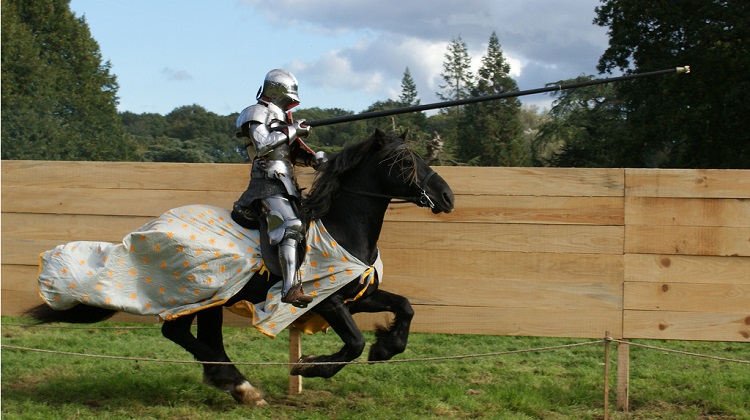
Knight jousting horse medieval Flickr commons

In twelfth-century Europe, did men unquestioningly accept love servitude to women? Today, many men don’t protest men being deprived of all reproductive rights whatsoever. Men say little about acute anti-men gender discrimination in family courts and child custody decisions. Men maintain stoic indifference to being smeared as rapists and being targeted on college campuses for absurd sex regulations. Perhaps men enjoy love servitude to women, relish working as slaves, and cherish being imprisoned. Yet Chrétien de Troyes’s late-twelfth-century Arthurian romance Lancelot hints at a different answer. Men apparently resisted love servitude to women with the same tactics subordinate workers resist orders around the world today.

In Lancelot, a girl rescued the knight Lancelot from his imprisonment atop a tall tower. In popular romance, usually the white knight in shining armor rescues the damsel in distress from imprisonment atop a tall tower. The white knight Lancelot, however, was a manlet. That helps to explain some subsequent events. After the girl rescued Lancelot from the tower, she took him to her favorite retreat, a country house, safe, secluded, and well stocked with provisions. There servants removed Lancelot’s cloths, which were filthy from his languishing in prison. Then:

the girl put him to sleep
In a tall, magnificent bed,
And later gave him a bath
And such wonderful care that I couldn’t
Tell you half if I tried:
She treated him as sweetly
As if he’d been her father.
She brought him back to life,
Completely renewed and restored. [1]

An earlier Latin romance, Apollonius King of Tyre, presented a much different account of a young man-doctor reviving a beautiful young woman. If the girl in Lancelot was receptive and not ugly, a manly knight might have expressed his gratitude to her in a more exciting way. Perhaps she noticed something lacking extension. That would explain why she gave him a bath and treated him as if he were her father.

Urging the girl to rescue him, the manlet Lancelot swore to be her obedient servant. He implicitly promised to be not like other men in servitude to women. Lancelot declared:

I swear I’ll be yours to command
For all the rest of my life

there’ll never be a day
When I won’t do what you ask.
Whatever you ask, if it’s in
My power, will be done — and done
as quickly as I can do it. [2]

Most women who order their man-servant (husband, boyfriend, etc.) to do something resent the response “not today.” Lancelot swore that there would never be such a day. Another standard man-servant response is “later.” Lancelot swore that he would obey the woman’s orders “as quickly as I can.” Lancelot, of course, hedged and qualified with words about his potency. Those reservations about potency probably were relevant when the girl gave him a bath.

From the commanding heights of culture, influential institutions and voices teach men to be subordinate to women. But boys aren’t stupid, and men aren’t stupid, either. Overpowered in social communication, men resort to passive resistance. Such passive resistance, however, isn’t sufficient to advance men’s liberation.

* * * * *

Notes:

[1] Chrétien de Troyes, Lancelot ll. 6670-8, from Old French trans. Raffel (1997) p. 210.

[2] Lancelot ll. 6597-8, 6001-5. The ideal of men’s love servitude to women has come to be widely celebrated as courtly love (amour courtois).

Article licensed under a Creative Commons Attribution-ShareAlike 3.0 Unported License.

Feature image by Spencer Wright

Reference:

Raffel, Burton, trans. 1997. Chrétien de Troyes. Lancelot, the knight of the cart. New Haven: Yale University Press.

Stanford historian says falsified medieval history helped create feminism

Through research into the first historians of medieval Europe, Professor Paula Findlen discovers that an interest in women’s history began much earlier than is assumed.

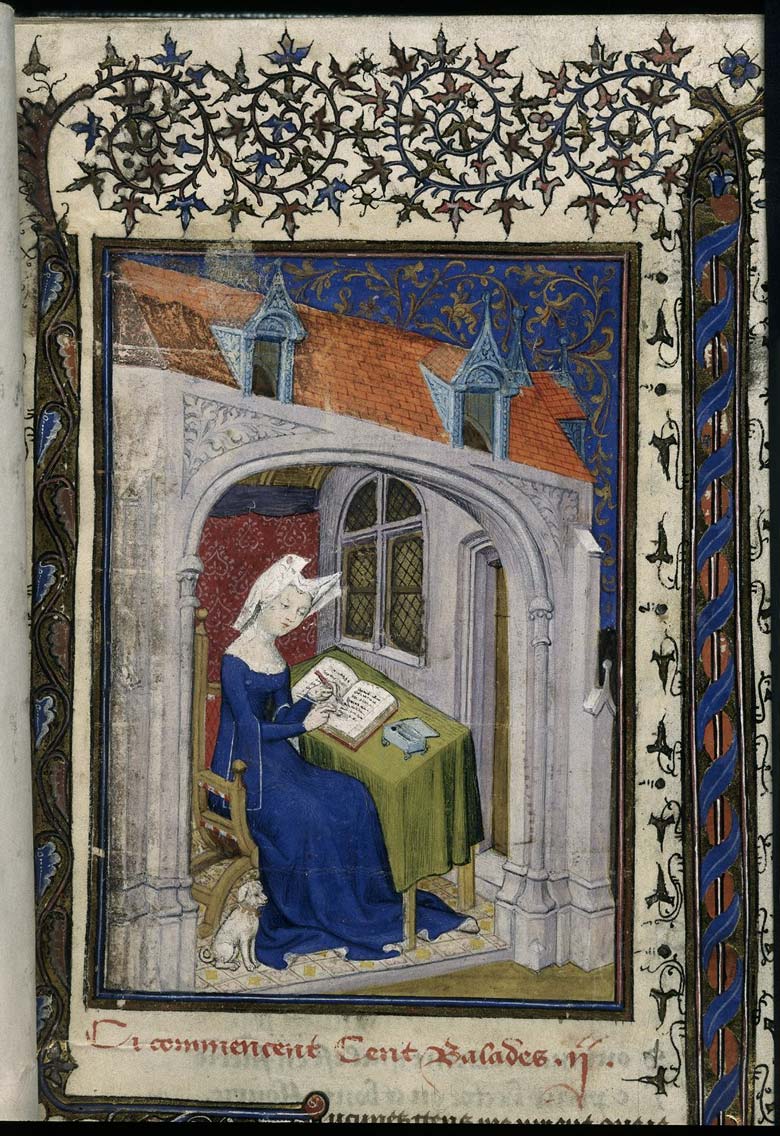
Harley 4431 f.4

Detail of a miniature of medieval writer Christine de Pizan. Stanford historian Paula Findlen has studied Renaissance biographies of medieval women and says these often embellished tales represent a kind of feminism.

Today, feminism is often associated with the political protests of the 1960s or the earlier women’s suffrage movement, but Stanford historian Paula Findlen‘s latest research reveals that the impetus to champion women started in the late Middle Ages.

A scholar of the Italian Renaissance, Findlen has collected biographies of medieval women, written in Italy from the 15th to 18th centuries, several centuries after the women lived.

Through a close examination of these texts, Findlen found that these early modern writers were so passionate about medieval women that they sometimes fabricated stories about them.

As Findlen carefully tracked down the claims in these stories, she found they varied from factual to somewhat factual to entirely false.

These invented women were often mentioned in regional histories, with imaginary connections to important institutions. They were described as having law degrees or professorships, claims that turned out to be fictitious.

Findlen argues that these embellished tales represent what could possibly be described as the origins of a certain kind of feminism.

“Early modern forgers used stories of women to create precedents in support of things they wanted to see in their own time but needed to justify by invoking the past,” Findlen said. “While debating the existence of these medieval women, the writers also contributed to the science of history as we know it.”

Expanding her archival base from Bologna to other Italian cities, and observing how these stories traveled beyond Italy, Findlen found that the stories of local women gained international recognition.

Findlen described her foray into conjectural history “a project partly about how early modern medievalists invented the Middle Ages, claiming and defining this past.” She added, “Making up history is a way of ensuring that you get the past you want to have.”

In her forthcoming publication, currently titled “Inventing Medieval Women: History, Memory and Forgery in Early Modern Italy,” Findlen pays particular attention to Alessandro Macchiavelli, an 18th-century lawyer from a Bolognese family.

Macchiavelli was passionate about finding evidence to support Bologna’s reputation as a “paradise for women.” He created stories and footnotes about learned medieval women from the region, including writer Christine de Pizan.

According to Findlen, “He aggressively made up [biographies of] medieval women and supplied the evidence that was missing for them.”

Presented as facts, these fables forged the medieval origins of Bologna’s female intelligentsia. Findlen initially worked on this material because she was searching for – and failing to find – evidence of medieval precedents that kept being invoked in early modern sources. “In the end,” she said, “it intrigued me.”

While people later recognized that Macchiavelli was a forger, it was true that he brought critical attention to women’s lives.

In a sense, Macchiavelli demonstrates “a quirky early modern male version of feminism,” Findlen said. He also contributed to the beginnings of the discipline of medieval history. When he forged a document, he did so based on extensive knowledge of the archives and a fine understanding of historical method.

“Medieval history is one of the really important subjects where people develop a documentary culture during the late 17th and 18th centuries, and they begin to identify and select the documents that matter for defining the Middle Ages,” Findlen said.

Imagining the women of Bologna

Between the 15th and 18th centuries, Findlen said, representations of medieval women enhanced a city’s reputation.

For example, scholars in Bologna wanted to learn about its presumed tradition of learned women. They craved information about medieval women who could provide historical precedents for someone like Laura Bassi, the first woman who can be documented as receiving a degree and professorship from the University of Bologna in 1732. Having precedents made her seem like a reinvention of the old rather than someone threateningly new.

Findlen first turned to Christine de Pizan (c. 1364-1430), the daughter of a University of Bologna graduate and professor. She is perhaps best known for her writings praising women.

In her Book of the City of Ladies (1405), a catalog of illustrious women, Christine contemplated her Italian roots. This longing for her past inspired Christine to imagine “what the ingredients were of this world that made her, and other women like her,” Findlen said.

Although inspired by some kernels of truth, Christine’s writings invented evidence to fill out her narratives, Findlen said. In this way, Christine provides a starting point for Bologna’s interest in women’s history that will unfold over the next four centuries.

What we want from history

Findlen’s project rethinks our compulsion to write about the past. “Some of the stuff we take for granted is legend, not fact,” she said, “but I think that I’m even more interested in having people understand why we want it.”

Despite the presence of fake facts in medieval women’s biographies, Findlen emphasized that “the unreliability of the past is also part of the evidence that we have to account for.” Moreover, she added, this project requires “knowing the archives … well enough to catch the nuances.”

“The process of creating a history of women,” Findlen said, “starts with this impulse to create collective biographies in the 14th and 15th centuries onward.”

Envisioning the wider impact of her work, Findlen said: “I would like this project to offer an interesting window into the invention of history, taking Italy as a case study, to understand why [early modern] people were so passionate about the Middle Ages.”

During the Renaissance, “people are increasingly concerned with documenting the history that was,” Findlen said. “They’re interested in the history that might have been. And then they’re also interested in the history that should have been. And those are three different approaches to history.”

Article reprinted with permission.

1857: Conference on Men’s Rights proposed

The following essay entitled Men’s Rights by Mr. Todd proposes a men’s rights conference be held in response to the women’s convention. The author’s compassion and advocacy for men is testament to the skewed gender wars being waged in the 1800s – PW

* * *

MEN’S RIGHTS. — TODD.

1. You are aware that the ladies, dear souls, have just been holding a most important Convention, at which they had resolutions, speeches, addresses, and appeals, in abundance, but no prayers. There were eloquence, wit, sharp and pointed rebuke, and thrilling disclosures of unsuspected facts, — all on the subject of Woman’s Rights.

2. There was a Rev. Miss, besides doctoresses and the like; and they seemed to unite in one deep lamentation over the wrongs, oppressions, and slavery of woman in these United States. I read the newspapers containing full reports of this convention, and rubbed my eyes, trying to get them wide open; for I had hitherto supposed that the ladies of this country were held in high esteem, and were treated so tenderly that they had no wish to complain.

3. Alas! alas! I find they are bowed down and trampled upon; and there is not one drop of misery in the most galling slavery, which our ladies have not tasted; —not one word in the recital of the wrongs of Egyptian bondage,1 that cannot apply to them. So they tell us!

4. Well, I sat and thought it over, till my soul was moved; and with sorrow I thought what a cruel creature I had been, all my life, to my wife, daughters, and sisters! To be sure, I have always given my poor earnings into my wife’s hands to spend for the family; because I knew she could do it better than I; and I have given my daughters the best education possible, and far better than I had.

5. But what then? Are they not oppressed? Don’t they have to use a side-saddle, while I don’t? Don’t they have to carry a muff, and sit under the buffalo, in a cold day, while I have the privilege of driving? When the snow is deep, don’t they have to wait till I can dig paths?

6. Ah me! and is there nothing to be said on the other side? Suppose we carry the war into the enemy’s camp a little, and speak of our sufferings and grievances. Can we not excite sympathy if we speak of our unredressed wrongs?

7. Now I propose to call a Man’s Convention in some important place, say Matildatown, and to have a meeting of the greatest and best, the wisest and the boldest, and see if we can not emancipate ourselves from this thralldom.

8. What do I propose? that a question! Why, sir, I would have a cavalcade of butchers as long as Maiden Lane;2 and I would let them tell how they had been compelled to do the dirty, disagreeable work of killing calves and pigs, sheep and oxen, and then dressing and cutting and carrying them to the door, and feeling very thankful if dear woman would just come out to the cart, and point, with her jeweled finger, at the piece she would like for the table!

9. I would have a long line of coal-diggers come up from the deep mines where they live, two miles from daylight, and never see the bright heavens but once a week; and they should come with their little lamps in their caps, and all covered with coal-dust! No, they would not come; they couldn’t be spared long enough.

10. But they should send up their story of wrong and oppression, and tell the Convention that no woman ever came there with pickax and blasting-powder. What heart in the assembly, especially what female heart, could remain unmoved when the voice came from those dreary subterranean caverns! and when the buried cried out against the wrongs imposed on my sex!

11. There are, it is said, three millions of men constantly on the deep, as sailors, standing at the helm, working the pump, climbing the shrouds, wet and cold in the storm, clinging to the wreck, going down to watery graves,—and for what? Why, that our dear ones may have their silks, their shawls, their laces, their china, and their perfumes!

12. It is estimated that fifty thousand men, every year, are buried in the mighty deep. O woman, woman! What do you mean? Why are you not hanging on the swinging yards, climbing the mast, and facing these hardships and dangers? I do protest against the slavery to which you have sunk my kind!

13. And the Convention should be electrified by the eloquence of men who fill_our streets; who bear burdens; who carry all the brick and mortar to build the fine houses; who are obliged to handle pork and tobacco, train-oil and sugar, molasses and codfish; who are all day long confined in dusty, close counting-rooms, and exhausting life and strength- over blotted account-books; who, in lonely church-yards, must dig graves, and work with no company save the moldering dead!

14. Are we not compelled, early and late, to do the hardest, vilest, filthiest work that human beings ever performed? What a story of wrong could we not tell? When I come to your great city, I can’t get a seat in the cars till the ladies are provided for, and that, too, next the window!

15. I can’t get a seat at the table, in the hotel or in the steam-boat, till the ladies are seated at the head of the table, where, I understand, the greatest delicacies are placed; and if any body has to wait for the second table, and eat fragments, it is not a lady. If a gentleman has a seat in the cars, and a lady comes in and wants it, though he were the king him self, he must give it up cheerfully.

16. Ah! and who feeds the iron horse and makes the cars go? Who lights the street-lamps, brushes boots, colors your hats, and pounds down the stones in the street? O men, men poor men! my soul yearns over you, and longs for your deliverance!

17. Do you not see that it’s the women who keep you down to these ignoble toils, and who snuff out the very light of your existence? Do you not see that, if they would only come and help us, and lift off our burden, we might be free?

18. I used to think — foolish me! — I used to think that the Bible made us to be the protectors of women, and that thus the strong were to bear the infirmities of the weak, and that we could not fulfill the designs of Providence without doing all this hard drudgery, and exempting our feebler sisters from it. But since their famous Convention I have learned differently.

19. I knew it was disagreeable to be surgeons, and to amputate arms and legs, and cut out tumors, and sew up wounds; but I had no idea that the ladies were longing, to cut and saw too.

20. I knew that our lawyers were a kind of civil police to keep the community quiet, and aided, as a chimney, to carry off the smoke of society; but I had no idea that our ladies were grieved that they were not chimneys too! In short, I see things in a new and strange light; and I am all awake for having a Men’s Rights Convention.

Notes:

[1] Egyptian bondage, a bondage the most rigorous and unreasonable, which was inflicted upon the Israelites for several centuries by the hard-hearted kings of Egypt
[2] Maiden Lane, the name of a street in the city of New York.

Source: The Progressive Fourth Reader, for Public and Private Schools. pp. 97-100, (published in 1857 by Bazin & Ellsworth)

A Word for Men’s Rights (1856)

The following long article from 1856 discusses the sexist laws that oppressed men and benefited women, including the practice of frivolous, unjustified lawsuits for supposed breach of marriage promise (or implied promise, or imagined promise). Such suits came, by the late part of the nineteenth century to be a standard operating procedure for women who either felt genuinely spurned or, just as frequently, women who saw an opportunity to misuse laws to control men. By the late 1920s, the practice had become a widespread criminal enterprise, highly profitable for both weeping bogus sweetheart and racketeering lawyer that it gained the appellation, “The Heart Balm Racket.”

***

Putnam's 1856

— A Word for Men’s Rights —

FULL TEXT: The notions which rule inside of men’s heads, and the phrases in vogue to represent them are hardly less liable to fluctuation than is the fashion of the outward adornment, whether by hats, caps, bonnets, periwigs, or powder. Sixty or seventy years ago, scarcely anything was so much talked of as the rights of man. Where this phrase came from, we cannot tell. It is not to be met with in any writer of prior date to the middle of the last century. James Otis used it in his famous tract on the Rights of the American Colonies, nor are we aware of any earlier appearance of it in print. Sudden, however, and obscure as its first appearance was, it took, and soon became one of the most fashionable of phrases. It played a great part in the American Revolution. It found its way into our Declaration of Independence, and into the fundamental laws of most of our states. It played a still greater part in the French revolution. Ten or a dozen French constitutions, more or less, were founded upon it. Thomas Paine wrote a famous book, with this title. For a while, nothing was so much talked of as the rights of man—talked of, we say—for, as happened in the case of the thirsty Indian, so with respect to these rights, it was pretty much all talk, with very little cider.

In sixty years, however, fashions have changed. The rights of man —once in everybody’s mouth—are seldom heard of now-a-days—unless it be in an abolition convention—or, if mentioned at all, in Congress and other respectable places, these rights, once the hope of humanity, are referred to, only to be sneered at, as a flourish of rhetoric—a chimera of the imagination.

Still, we are not left speechless nor hopeless. Hope still remains at the bottom of the box, with a fine sounding phrase to back it. Let the men go to the deuce. What of that? Does not lovely woman still remain to us? Today, the fashionable phrase is—woman’s rights. The women have discovered, or think they have, that they are, and long have been tyrannized over, in the most brutal manner, by society, the laws, and their husbands. Woman’s rights is now the watch-word of a new movement for social reform, and even for political revolution—the women, among other things, claiming to vote.

It must be confessed that such general outcries are not commonly raised, without some reason. They are the natural expressions of pain and unsatisfied desire. It was not without reason that America and Europe, towards the close of the last century, raised the cry of the rights of man; and so, we dare say, it is not without reason that the rights of woman are now dinged into our ears. Nor is this cry without a marked effect, not merely upon manners and society, but also upon laws. Almost all our state legislatures are at work, with more or less diligence and enthusiasm, modifying their statute books, under the influence of this new zeal. To that we do not object. Putnam is for reform. Putnam is for progress. Putnam is for woman’s rights; but also for man’s rights—for everybody’s rights; and, in that spirit, we are going to offer a few hints to our legislators, whose vaulting zeal, on behalf of the ladies, seems a little in danger of overleaping itself, and jolting on t’other side. It is well to stand straight, but not well to tumble over backward, in attempting to do so.

Those who go about to modify our existing laws, as to the relation of husband and wife, will do well to reflect that the old English common law on this subject, if it be a rude and barbarous system, little suited to our advanced and refined state of society—which we do not deny—is also a consistent and logical system, of which the different parts mutually rest upon and sustain each other. In the repair, or modification of such a system, it is material that every part of it should be taken into account. Changes in one part will involve and require changes in other parts; otherwise, alterations, made with a view only to relieve the wife from tyranny and oppression, may work a corresponding injustice to the husband. Nor are the changes already made in our laws, partly by legislation and partly by usage, free from glaring instances of this sort.

The English common law makes the husband the guardian and master of the wife, who stands to him in the relation of a child and a servant. In virtue of this relation, the husband is legally responsible for the acts of the wife. If she slanders or assaults her neighbors, he is joined with the wife in the action to recover damages, and he alone is legally responsible for the amount of damages recovered, even to the extent of being sent to jail in default of payment. He is likewise responsible for debts contracted by the wife to the same extent that a father is responsible for the debts of his minor children. Even in criminal proceedings, it is he who must pay, or go to jail for not paying the fines imposed on his wife; and there are many cases, even cases of felony, in which the wife, acting in concert with her husband, is excused from all punishment, on the presumption that she acts by his compulsion, though in fact she may, as in the noted case of Macbeth’s wife, have been the instigator. Public opinion goes even further than the law, and holds the husband accountable, to a certain extent, for all misbehaviors and indiscretions on the part of his wife. Not only is he to watch that she does not steal, he is to watch that she does not flirt, and every species of infidelity, or even of levity on her part, inflicts no less disgrace upon him than upon her—disgrace which the received code of honor requires him to revenge upon the male delinquent not only in defiance of the law which forbids all breaches of the peace, but even at the risk of his own life.

The law and public opinion having anciently imposed all these heavy obligations on the husband, very logically and reasonably proceeded to invest him with corresponding powers and authority. Standing to the wife, as he was made to stand, in the relation of father and master, the law very reasonably invested him with all the rights and authority of a father and a master. How, indeed, was he to exercise the authority and to fulfill the obligations which the law and public opinion imposed upon him, of regulating the conduct of his wife, unless invested at the same time with means both of awe and coercion? Accordingly, the law and usage of England authorized the husband to chastise his wife—in a moderate manner—employing for that purpose a rod not thicker than his finger. The husband was also entitled to the personal custody of his wife, and was authorized in proper cases—if, for instance, she seemed disposed to run off with another man—to lock her up, and, if need were, to keep her on bread and water.

Now these, it must be confessed, were extensive powers—harsh and barbarous powers, if you please—though the law always contemplated that, in his exercise of them, the husband would .be checked by the same tenderness towards the wife of his bosom which tempers the exercise by the father of a similar authority over his children. But however extensive, however harsh or barbarous the powers of the husband may be, we appeal even to our female readers — if, indeed, a single female has had patience and temper to follow us thus far—we appeal even to that single female (or married one, as the case may be), to say how, in the name of common sense, is the husband to keep the wife in order, to the extent which the law and public opinion demands of him, except by the exercise of these powers, or at least by the awe which the known possession and possible exercise of them is fitted to inspire? If the fractious child is neither to be spanked nor shut up in the closet, how is domestic discipline to be preserved? What more effectual sedative to an excited and ungovernable temper, which might provoke both suits for assault and actions for slander, than retirement in one’s closet with the door locked and a glass of cold water to cool one’s burning tongue?

And so of another great topic of complaint on the part of the advocates of woman’s rights—the power which the husband has by the common law over the wife’s property. He being responsible for her debts and her acts, and being bound to provide for the support of the children, has, as a corollary thereto, the custody and disposition of the wife’s property, if she chances to inherit or to acquire any—which, unfortunately, in the middle ranks of life, where these notions of woman’s rights most extensively prevail, is, we are sorry to say, but too seldom the case.

Such are the relative rights and duties of the husband under the old English common law. Under this law a husband is not a mere chimera, a surd and impossible quantity. There is a logical consistency about him. He is, as Horace says of the stoic philosopher, terei ef rotundus, round and whole, armed at all points, provided with powers adequate to the duties expected of him.

In America we have no such husbands. Long before the cry of woman’s rights was openly raised, the powers and prerogatives of the American husband had been gradually undermined. Usage superseded law, and trampled it under foot. Sentiment put logical consistency at defiance, and the American husband has thus become a legal monster, a logical impossibility, required to fly without wings, and to run without feet.

Women care nothing for logic, but they have a sense of justice and tender hearts, and to their sense of justice we confidently appeal. Who can wonder that the men are so shy in taking upon them the responsibilities of the married state? Those responsibilities all remain exactly as in old times, while the means of adequately meeting them are either entirely taken away, or are in a fair way to be so. By the law as it now is, we believe in every state of the Union, the husband cannot lay his finger on his wife in the way of chastisement except at the risk of being complained of for assault and battery, and, perhaps, sued for a divorce, and (which is worse than either) of being pronounced by his neighbors a brutal fellow. The nominal custody of the person of the wife, which the law still, in some of the states, affects to bestow upon the husband, is a mere illusion. If he attempts to lock her up, she can sue out her habeas corpus, and oblige him to pay the expenses of it; and if she wishes to quit her husband’s house, and go elsewhere, he has no means of compelling her return. He may sue those with whom , takes refuge, for harboring her, but if he obtain damages at all, they will be only nominal. In many of the states, laws have been enacted and soon will be in all of them, giving the wife the exclusive control of her own property, acquired before or after marriage, by gift, inheritance, or her own industry.

While the wife is thus rendered to a great extent independent of her husband, he, by a strange inconsistency, is still held, both by law and public opinion, just as responsible for her as before. The old and reasonable maxim, that he who dances must pay the piper, not apply to wives—they dance, and the husband pays. To such an extent is this carried, that if the wife beats her husband, and he, having no authority to punish her in kind, applies to the criminal courts for redress, she will be fined for assault and battery, which fine he must pay, even thought she has plenty of money of her own. or, in default of paying, go to jail! Such cases are by no means of unprecedented occurrence in our criminal courts.

Now, what sense or reason is there in making the husband responsible for the licenses of the wife’s tongue, after he has lost all power to control it? If the wife is to hold her property separately, ought she not to be sued separately, both for debts and damages? If her property ought not to go to pay the husband’s debts, why ought his to go to pay hers? If the husband has lost the power to control tile goings in and runnings out of the wife, why ought public opinion to hold him any longer responsible therefor?

We have no objection to an amendment of the law in relation to husband and wife. Public opinion demands it. The progress of society requires it. But the new wine ought not to be put into old bottles, nor the old garments to be patched with new pieces, lest, as the proverb says, the rent be made worse than before.

But there is yet another recent innovation in the law, liable to still more serious objections. Not content with placing the unfortunate husband in an absurd and anomalous condition, not content with still demanding of him certain duties and obligations, at the same time that he is deprived of the powers and the rights essential to their fulfillment, reducing him in fact to a position hardly less ridiculous, and not at all less embarrassing, than that of a short-tail bull in fly-time—the law (as if conscious that, before entering into such an unequal alliance, the men would grow pretty critical as to the personal qualities of the women in whose power they were about so completely to place themselves) seeks to entrap us into matrimony against our inclinations, by holding, as it does, that any man who shows signs of having been impressed by a woman, becomes, if she is single, her lawful prize, and is bound to marry her if she insists upon it, or eke—stand a suit for breach of promise.

Though suits for breach of promise of marriage are comparatively a recent thing, in order fully to understand their nature it is necessary to go back to the dark ages. We pretend to be protestants; we rail against the popish church; yet in how many important matters are we still the mere slaves and tools of that church! The canon law was one of the most crafty devices of the middle age theocracy, and is a standing topic of reproach against Catholicism ; and yet in the most delicate of all our relations, that of marriage and divorce, we protestants are to this day substantially governed by the canon law! The canon law was made by monks, men forbidden to marry themselves, and therefore destitute of any personal experience by which to shape their legislation on this subject. They had, indeed, the Roman law as their guide, but this they departed from in the most essential particulars, as being altogether too reasonable to suit their ascetic theories or serve their purpose. The monks who made the canon law looked upon marriage as a sensual and unholy state, only to be tolerated in the gross laity, to prevent something worse; and they seem to have exerted their whole ingenuity to render this sinful condition as uncomfortable as possible. Hence the excessive hostility of the canon law to divorce, it being held a just punishment of the immorality of marrying at all, that persons Unsuitably or unhappily married should be kept during their natural lives tied together neck and heels, Bo that their torments in this world might give them, as it were, a relishing foretaste of what married sinners had to expect in the next. But while unhappy marriages were thus cursed with a perpetuity beyond the reach of the parties or the law, the ingenious canonists at the same time suspended over the heads of every happy couple the terror of an involuntary and forced separation, which should unmarry them and bastardize their children. One of the means employed for this devilish purpose was the doctrine of pre-contracts. A promise to marry was, according to the canon law, equivalent to a marriage, and every subsequent marriage to another party, pending the life of the party to whom the promise had been made, was vitiated by it. The canonists even went so far as to allow suits for the specific performance of these marriage contracts—the officers of their courts, on the suit of some disappointed virgin, entering the household of love, breaking up the family, stigmatizing the woman as a concubine and her children as illegitimate, and compelling the man to take his legal wife—as by virtue of some pretended pre-contract she was held to be—into his house and his bed. It is from this canonist doctrine of precontracts that our suits for breach of promise are derived. The common law, indeed, being the work of ruder hands, is ignorant of that beneficial process of the Roman law—the suit for specific performance. In the case of the nonperformance of a contract, the common law contents itself with attempting to set matters right, by awarding damages for the non-performance. In this particular case, even this defect in the common law was a very fortunate thing, as otherwise, instead of merely having damages to pay for refusing to marry against our inclination, we might have been brought up to the ring-bolt of specific performance, and forced into the yoke any how.

It is often said that no woman of any delicacy or self-respect ever would or ever does bring a suit for breach of promise of marriage. That may be so; still nothing prevents a great many women, who would be entirely unwilling to confess to any deficiency of delicacy or self-respect, from taking advantage of the law, or more properly speaking, of the public sentiment out of which the law grows and which sustains it, to force their once lovers, but lovers no longer, into a reluctant and repugnant marriage ceremony. Whose private experience does not enable him to recount instances, in which men, sensibility and honor have suffered themselves to be thus forced into unsuitable matches, of which the unfortunate result has corresponded with the inauspicious beginning? Contrary to every principle of common sense, as well as to every instinct of sentiment, as are suits for breach of promise of marriage, yet undoubtedly they are fully sustained by the prevailing public sentiment. Otherwise it would be impossible to explain the extravagant lengths to which courts have gone in inferring a promise of marriage from the most trivial circumstances—waiting on a lady home from church; going to see her of a Saturday night; asking her twice of a winter to a ball; corresponding with her, though nothing is said in the letters about love or marriage; allowing her to darn your stockings. There is, indeed, no circumstance, however light or trivial, upon which the busy tongues of a country parish get up a rumor of an engagement, which is not held amply sufficient by our courts of law to establish the fact of a promise of marriage, and to lay the foundation of a suit for damages.

It is not, however, upon these extreme cases that we rest our opposition. We object to the proceeding in any case, no matter how solemn and formal the promise, nor how often renewed. We object to the whole idea of obligation in such a case, and, of course, to the enforcement of such supposed obligation by law. The whole thing is a gross abuse—to speak the truth—a scandalous abomination. The very idea of marriage, according to any but the grossest and lowest conception of it, implies the free and full consent of both the parties to it. On the part of the man, if not of the woman, it implies something more, not a mere tacit consent, but a forward, active, joyous consent. A great deal of sympathy has been expended over women forced by tyrannical fathers to give their hands without their hearts. A miserable case, truly, but altogether less miserable than that of a man, drawn, by a false sense of honor and a ridiculous public opinion, to speak a public lie, and, in the face of God and man, to pledge himself as a husband, when he knows he cannot be one. All promises are made with this implied reservation—that he who promises shall have it in his power to fulfill. This is true even of mercantile promises. No man is held to be under any moral obligation to pay his debts, any further than he has the means to pay; and upon giving up the property that he has, our insolvent laws will discharge him from the legal obligation. A promise to marry carries with it the implied reservation that he who promises shall continue to love. The promise is not, and is not understood to be, either by him who makes, or her who receives it, a promise merely to assume the legal responsibility of marriage; it is a promise to assume the moral and sentimental responsibilities also; and if, by change of circumstances or change of mind, it has become impossible to fulfill one part of the promise, if it is impossible to love. the whole necessarily falls to the ground.

What is the object and intent of that intimacy called an engagement of marriage, unless to enable the parties to live together in that freedom of intercourse which the mutual expectation of marriage inspires, for the very purpose of giving them an insight they would not otherwise have into each other’s character, and an opportunity of repentance and retraction before taking the irrevocable step? And if this be the object of an engagement—as who will venture to say it is not—how absurd to hold a man bound to marry, by the very process of socking to discover whether it will be judicious for him to marry or not?

Of all miserable things in this world of misery, a miserable marriage is the most miserable, yet every acute observer must have noticed that the misery of many of these marriages arises from causes too immaterial, so to speak, too spiritual to attract the notice of the casual observer. At a time when our courts and our legislatures are besieged by wives and husbands struggling to get rid of uncongenial partners; when the laws on the subject of divorce are loudly complained of in so many quarters, as failing to afford that relief which they ought, one measure, it would seem, might suit equally well both the friends and the enemies of the freedom of divorce. An ounce of prevention is worth a pound of cure. It may be necessary to allow those married persons to separate, who have become not merely tiresome, but hateful to each other; but how much better to avoid the blunder of bringing such people together? Divorce at the pleasure of either party, after the marriage has been consummated, and especially after children are born, is limited to some very weighty objections; but what can be the objection to allowing the freedom of separation in cases where no marriage has yet been celebrated? If, indeed, to seek the intimacy of a lady with a view to discover if she is fit to be your wife, is to carry with it the obligation to make her so, at all events, we are in no respect better off than the Chinese, who marry their wives without over having seen them. So far, indeed, as the wife’s person is concerned, we have an advantage over the Chinamen, in the privilege of seeing so much of it as she exhibits to the world at large in the street, or as she displays to a select circle in a ballroom. Looks, however, in this climate, are not much to be depended upon. American beauty fades with marvellous rapidity; while, as to the lady’s temper, and mental and moral traits, which in our state of civilization are of at least equal importance with her face, if we are so impertinent as to peep into them, the law and public opinion insist that in so doing we have contracted an obligation to marry her. Thus, in fact, we are worse off than the Chinaman. He, if not suited with one wife, can take another, and so on, till he is suited. We, when once married, are done for. We can neither get rid of our uncongenial wife nor take a congenial one. Under these circumstances, we ought at least to have the privilege of making a choice with our eyes open, and not be held by the very act of examination to have precluded ourselves from declining to accept an article, which, however taking it might seem at first sight, proves, on being more closely looked at, not what we wanted.

[“A Word For Men’s Rights.” Putnam’s Monthly, A Magazine of Literature, Science , and Art, Vol. II, Feb. 1856, No. XXXVIII, p. 208]