Academic definitions of romantic love portray it as a single, universal construct experienced identically by both sexes. This unitary framing is a serious misrepresentation. It erases the distinctly feudal dynamic that has always defined the tradition, bleaching its asymmetrical structure into a feel-good myth of mutual (read identical) behaviors, emotions and reciprocity.
In reality, romantic love is a dyadic cultural script – a single overarching construct built from two distinct, complementary roles. Unlike other forms of love such as eros (sexual desire), agape (charity/compassion), storge (bonded/familial affection), companionate love (pairbonding), philia (friendship), and pragma (pragmatic, material gestures of care) — each of which operates as a single construct enacted similarly by either sex — romantic love requires not one, but two separate sets of roles, each governing the expectations, behaviors, and moral obligations of one sex.
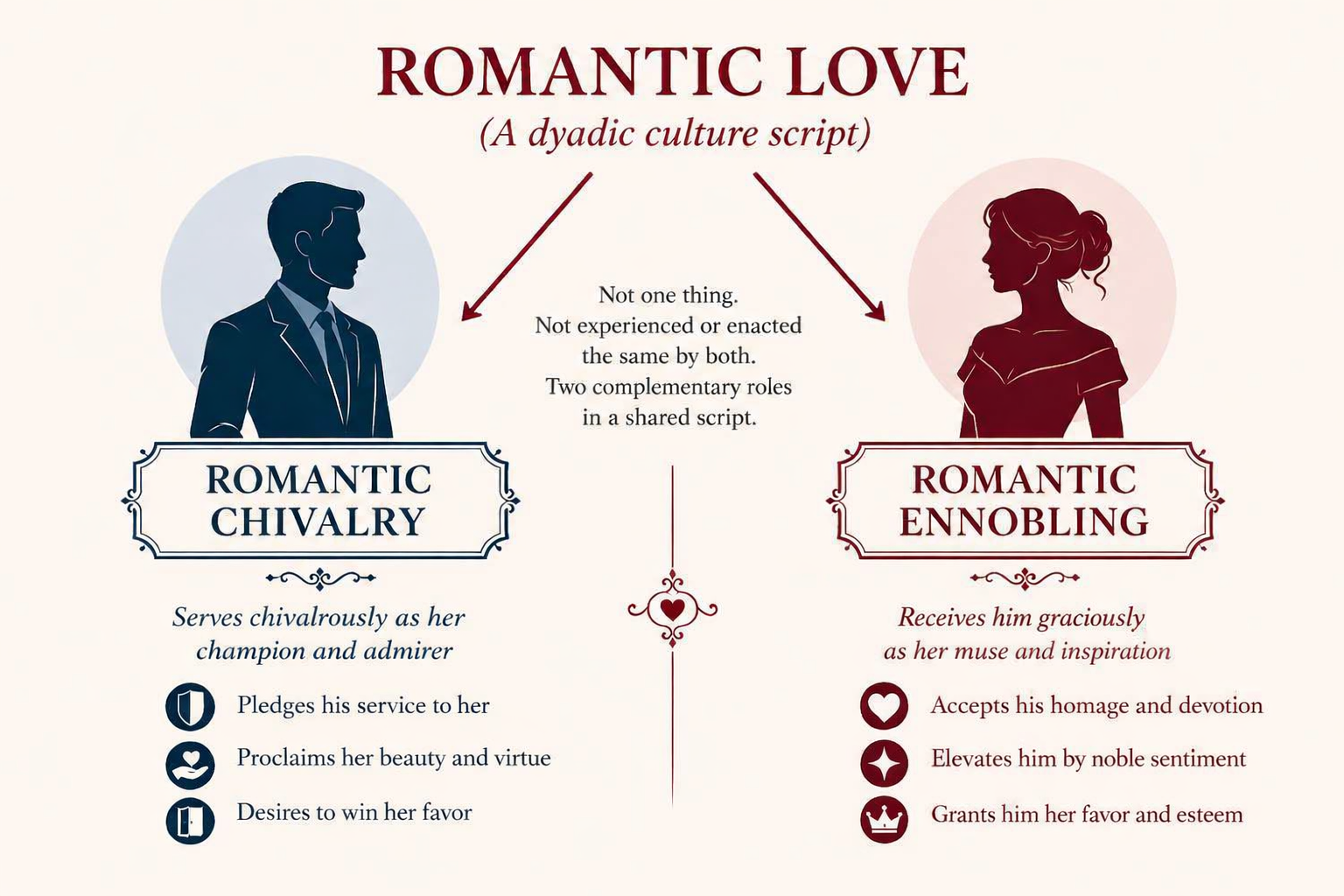
On the male side stands romantic chivalry: the active performance of proving oneself by service, protection, provision, and devotional elevation of the woman. This is the vassal’s role – deferential, sacrificial, and oriented toward earning favour.
On the female side stands romantic ennobling: the active claiming and performance of elevated, aristocratic status within the romantic dyad. She embraces and reinforces her position as the “Dame” or “midons” (my lord) – the ennobled figure who receives devotion while occupying the superior, sovereign place in the hierarchy. This is the lordly role transposed into the feminine — a role that persists today in the widespread feminist emphasis on women’s “status,” “esteem,” “worth,” “dignity,” and “respect” in heterosexual relationships, terms once reserved exclusively for nobles.
These two roles are not symmetrical. They are deliberately complementary in the feudal sense: his chivalric service is meaningful only because she performs and expects ennoblement. Together they form the complete script that Western romantic love has inherited from medieval courtly tradition, where the lady was addressed with masculine titles of lordship precisely to signal her exalted position.
The ‘Freedom of Choice’ claim
Romantic love is built on the feudal template: the relationship of a servant to a pedestalized overlord. The much-touted “freedom of choice” in the romantic model therefore shrinks to two narrow options – a woman may choose her vassal, a man may choose his domina.
That is an extremely limited set of roles, and it looks a long way from genuine freedom of choice. Outside the romantic model, freedom of choice (what the Greeks called eleutheria) can draw on a far wider range of qualities in a prospective partner: emotional stability, willingness to contribute materially, balanced reciprocity, moral values, and so on.
Recognising romantic love as a dyadic construct rather than a unitary one restores analytical clarity. It explains why the experience, the expectations, and the moral economy differ so sharply between the sexes — a difference that the prevailing academic narrative works hard to obscure. Romantic love is not a gender-neutral emotion. It is a structured cultural system with two interlocking parts, each carrying its own distinct imperatives.
See also: Romantic Love vs. Sexual Urge: Ending the Evopsych Conflation