Comparison of Chat GPT and Grok

Question to both Chat GPT and Grok:  “Is it possible that misandry is just as common, or more common socially than misogyny, but that it has less research thus leading to a misconception that misogyny is more common?”

GROK ANSWER:
It’s possible to consider that misandry might be underreported or under-researched, leading to misconceptions about its prevalence relative to misogyny. Here are some points to consider:

  1. Research Bias and Focus:
    • Historical Context: Research on gender issues has traditionally focused on the disadvantages faced by women due to centuries of documented oppression, which might skew the perception that misogyny is more common.
    • Funding and Academic Interest: There’s been more academic and institutional focus on women’s issues, which can lead to a body of research that heavily documents misogyny. Less attention might be given to misandry, not because it’s less prevalent, but because it’s less studied.
  2. Cultural Perception and Acknowledgment:
    • Cultural Norms: Societal norms often dictate that men should be stoic or that it’s less acceptable for men to express vulnerability, which might mask or minimize the acknowledgment of misandry.
    • Stereotypes: Men are often seen as inherently privileged, which can lead to the dismissal of issues like misandry as less significant or even non-existent.
  3. Manifestations of Prejudice:
    • Obvious vs. Subtle: Misogyny might manifest in more overt, violent, or institutionalized forms that are easier to quantify and study. Misandry might be subtler or expressed in ways that are less systematically documented (e.g., through media portrayal or casual sexism).
    • Intersectionality: The intersection of gender with other forms of discrimination might highlight misogyny more prominently because women often face compounded disadvantages.
  4. Social and Political Climate:
    • Activism and Movements: The rise of feminist movements has significantly increased the visibility of misogyny. In contrast, men’s rights movements, which might highlight misandry, have not gained similar widespread acceptance or visibility, potentially due to backlash or misunderstanding of their goals.
  5. Data Collection and Bias:
    • Victimization Surveys: Surveys on gender-based violence or discrimination predominantly focus on women as victims, not because men are never victims, but because the scale of documented violence against women is significant.
    • Reporting Bias: Men might be less likely to report instances of discrimination or prejudice due to cultural stigma or fear of ridicule, leading to underrepresentation in data.
Conclusion: While it’s theoretically possible that misandry could be as common or even more common than misogyny, the current consensus based on available research suggests misogyny is more widespread due to its clear, systemic impacts. However, this does not preclude the existence of significant misandry, which might be underreported or under-researched. A more balanced approach to gender studies, including equal scrutiny of prejudice against all genders, would help clarify these dynamics. If misandry is indeed more common or equally prevalent, it would require a substantial reevaluation of how we collect, analyze, and discuss gender issues in society.
_________________________________________________

CHAT GPT ANSWER:

It is an interesting question, and it highlights the complexities of how gender-based prejudices are perceived and studied. While it’s true that there may be less research on misandry compared to misogyny, there are several factors that make it unlikely that misandry is as common—or more common—than misogyny socially, at least on a global or systemic level.

1. Historical and Structural Context:

Misogyny has deep roots in many cultures, dating back to patriarchal social structures where men historically held positions of power. This power dynamic has affected the way women are treated in areas such as politics, economics, education, and personal relationships, contributing to systemic inequalities. Misogyny is embedded in institutions, and this institutionalized discrimination has affected women globally for centuries.

In contrast, misandry does not have the same historical, structural, or institutional foundation. While there are certainly instances of misandry, it typically does not manifest in a way that systematically disadvantages men in the same manner that misogyny has for women.

2. Socialization and Gender Norms:

Many societies have socialized men and women in ways that support patriarchal gender norms, where masculinity is often associated with strength, authority, and dominance, and femininity with submission or nurturing roles. As a result, men have often been in positions of authority and power, and many systems were built to support these roles. Misandry may occasionally emerge as a reaction to these norms, but it’s generally less institutionalized or widespread.

Misogyny, on the other hand, is often reflected in these same gender norms, where women are expected to conform to traditional roles of submission, domesticity, and passivity. These expectations continue to shape the experiences of women in most societies.

3. Cultural Perceptions and Prevalence:

Misogyny is more widely discussed and researched because it has pervasive social consequences. Gender-based violence, the gender pay gap, unequal access to healthcare, underrepresentation in leadership roles, and harmful stereotypes about women are well-documented and observed globally. These systemic forms of misogyny have a profound effect on women’s lives and are more visible in social discourse and academic research.

Misandry, while harmful and present in certain contexts, is less commonly studied or discussed in the same depth. It tends to be less noticeable in terms of structural inequality, and it is less likely to be reflected in broader patterns of discrimination, violence, or underrepresentation.

4. Media and Public Discourse:

While there are instances of misandry in media portrayals (such as negative stereotypes about men in certain TV shows or movies), the vast majority of media content continues to reinforce traditional gender roles and portray women as secondary to men. The widespread portrayal of women in victimized or subordinate roles, in addition to the disproportionate focus on women’s experiences of violence, discrimination, and inequality, reflects the broader patterns of misogyny.

Additionally, research on issues such as gender-based violence, reproductive rights, and workplace inequality overwhelmingly focuses on the struggles of women due to the extensive evidence of systemic disadvantages they face. Misandry, though harmful, does not typically produce the same kinds of broad, documented, and institutionalized harm.

5. Research and Perception:

The relative lack of research on misandry does not necessarily mean that it is as prevalent as misogyny. It’s important to distinguish between personal experiences of prejudice (which could happen in isolated incidents) and systemic patterns of inequality that affect entire genders in broad and institutional ways. Misogyny has been studied extensively because of its widespread social, political, and economic consequences, whereas misandry has not typically manifested in ways that similarly affect large-scale societal structures.

Conclusion:

While it is true that there may be less research on misandry, the argument that it is as common or more common than misogyny is not supported by the weight of historical, structural, and social evidence. Misogyny has been and remains a significant, pervasive issue with systemic impacts on women worldwide. Misandry, while it does exist and should not be ignored, does not have the same kind of widespread, deeply embedded consequences in most societies. Therefore, while more research on misandry would be valuable, it is unlikely that it is as widespread or socially impactful as misogyny.
______________________________________________

End.


Romantic love and the medieval birth of the heart emoji

The transition of the human heart symbol from an anatomically accurate depiction to the more stylized, emoji-like heart we recognize today has a complex history that spans centuries. The heart image we associate with romantic love was first depicted as a heart-shaped pear being shared with a lover, which appeared in the illustrated 13th century French work Li romanz de la poire (“Romance of the Pear”).

The Heart Offering from 1338-44 is considered the first distinctly stylised heart as representation of romantic love. Here (below) a woman gives her heart, shaped as we all know it today, to a man who holds his hand over his own heart.

In one of many pre-modern depictions of the agony of romance, a 1620 drawing from Stuttgart titled “The Contortionist Lover,” shows a woman goading her tortured partner with a heart on a stick:


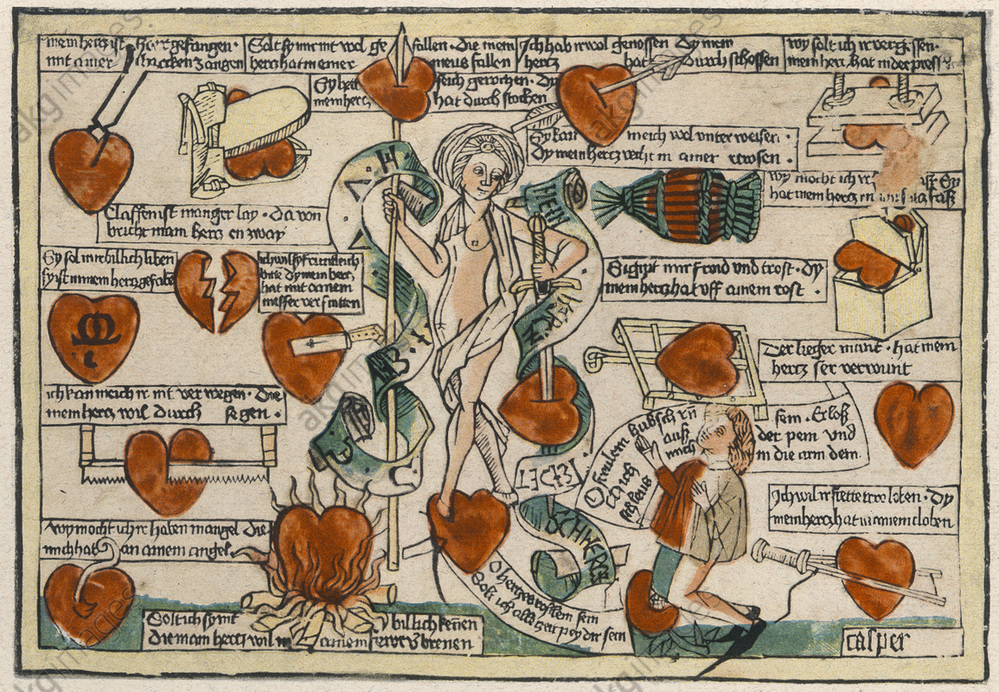
Interestingly, not only was this stylised depiction of a heart created within the romantic love tradition, but so too was the emblem of a broken heart which appears below in an allegorical depiction of women’s power over men’s hearts (woodcut, 15th century by Master Casper von Regensburg, Berlin, SMB, Kupferstichkabinett) – titled “The Power of Minne.”

For more on the history of the heart image, see also: ‘Frau Minne’ the Goddess who steals men’s hearts: a pictorial excursion

When was the custom of gynocentric chivalry first introduced into India?

The following question was posed to X-AI:

Question: When were the European customs of gynocentric chivalry and romantic love likely introduced into India?

X-AI answer:

The European customs of gynocentric chivalry and romantic love were likely introduced into India during the colonial period, particularly with the expansion of British influence in the 19th century. This period saw significant cultural exchange and the spread of Western literature, customs, and social norms, which included the romantic ideals of chivalry and courtly love from medieval Europe.

  • Colonial Influence: With the British colonization of India, there was an introduction of European literature and cultural practices. British colonial administrators and the educational system brought with them Victorian ideals, which were imbued with chivalric notions of romantic love. This was part of a broader cultural impact that influenced Indian society, including its views on gender roles and love.

  • Literature and Art: The spread of European literature such as novels and poetry, which often celebrated romantic love and chivalry, influenced Indian writers and intellectuals. This can be seen in the evolution of Indian literature where themes of romantic love began to reflect Western influences.

  • Historical Context: While India had its own rich traditions of love and courtship, the specific European model of gynocentric chivalry, with its emphasis on the pedestalization of women, was a new layer added during the colonial era. This period saw a merging of indigenous practices with European ones, leading to a hybrid form of romantic expression in India.

Therefore, while India had its own forms of romantic expression before European contact, the specific customs of gynocentric chivalry and courtly love as known from medieval Europe were likely integrated into Indian culture through British colonial influence in the 19th century.


Gynocentric cultures lead to low birth rates

Population growth is tied to economic growth. Culture centered on women’s comforts (gynocentric) initially seemed a great way to promote economic growth because it stimulated men to work harder to buy more for women – not to mention women buying more for themselves and their families. That’s why politicians around the world have loved promoting it; it creates a robust financial engine, while ensuring those same politicians continue to gain office for supporting women.

So in the short term the gynocentric ethos is great for creating a booming economy…… until it runs its course. It leads eventually to a kind of state narcissism among women and a collapse of the birthrate because, as studies have shown, kids get in the way of narcissistic goals.

Earning & spending on gynocentrism is great for the money machine, until there’s negative birth rate. Then its game over, at which time we see politicians stepping in to prop up women with more financial offerings for each child born, tax breaks, and even state subsidized childcare in the hopes of encouraging more births, but this too fails.

The obvious fix now is to swap out gynocentrism in favor of family-centrism, things which can’t co-exist because they are opposed motives. So for all those people wailing about the need to have more kids, there’s just one thing you have to discard first – and then it will be all systems go. Good luck!

With that summary of the topic, let me now go back and explain what I mean by a gynocentric economy.  It’s an economy that supports women as the primary household buyers and spenders who make the larger share of major buying decisions whether that be a car, house, overseas holiday, household food, goods, furniture and decor.

As corollary to woman as spender, men are upheld as the primary money earners who labor to make women financially comfortable. Note that this kind of arrangement is not universal or essential; the economic setup can be equally geared to the family as primary economic unit, of which I’ll say more in a moment, in contrast to the gendered hierarchy of women as primary economic focus.

A recent comment by American traditional conservative Charlie Kirk explains the ‘man as earner / woman-as-spender’ custom, which he published on platform X in December 2024 as follows:
This wedding of money to women’s happiness has been a specialty of American culture for the last two centuries. For example, in the year 1903, international culture critic Max O’Rell observed the following:
In similar vein, The Independent newspaper published the following summary in 1909:

More on the theory behind collapsing birth-rates

First premise: Gynocentrism fosters narcissistic behavior in women. (hold that thought). ¹

According to a 2019 study,² individuals with higher levels of narcissism in young adulthood were less likely to have children by midlife. This study found that vanity, a facet of narcissism, was associated with fewer children and less stable relationships. This is supported by a 2025 study which found that vulnerable narcissism (which is more typically expressed by women), but not grandiose narcissism (which is more typical of men) was related to lower reproductive motivation and fertility. ³

Second premise: A gynocentrically oriented economy, such as we have in the West, thrives only until the generated increase in narcissism reaches critical mass and negatively impacts the birthrate, resulting in a weakened, vulnerable economy.

By way of contrast, when I talk to older Asians about their work ethic and spending habits, they usually say that they are doing it “for the family” instead of for wife or women. However, the problem we have in much of the world today is that these two models – gynocentric economics vs. family economics – are clashing and causing birth-rate paralysis, with family economics getting crushed under the weight of a growing, but increasingly maladaptive gynocentric economy.

As an aside, I note the different pitch some older Asian women make to husbands. They nudge husbands to man-up “for the family” instead of “for women,” and as part of that framework the women sees her own role as equally requiring her to ‘woman-up’ for family in terms of economic contributions.

Sadly, most younger Asian women have now caught the gynocentric virus, and their language has changed to saddling husbands with the need to economically man up for her and to provide an economic pedestal for her to sit on…… hence why there’s a birthrate problem growing throughout Asia too.

Whatever the future brings, one thing is absolutely certain: there will be increasing hardship due to the collapsing birthrates around the world. At some point cultures will be forced to make a shift away from the negative costs of gynocentrism, and toward a traditional family-centrism that forms the basis of all healthy societies – societies that showcase healthy birth rates, and allow for sustainable economies that depend on them.

Sources:

[1]   Wright, P. (2020). GYNOCENTRISM AS A NARCISSISTIC PATHOLOGY. New Male Studies, 9(1). and Wright, P. (2023). GYNOCENTRISM AS A NARCISSITIC PATHOLOGY PART 2. New Male Studies, 12(1).

[2] Wetzel, E., Grijalva, E., Robins, R. W., & Roberts, B. W. (2020). You’re still so vain: Changes in narcissism from young adulthood to middle age. Journal of personality and social psychology, 119(2), 479.

[3] Mededovic, J., & Jovanov, N. (2024). Explaining the Links Between Narcissism and Fertility: Are There Differences Between the Grandiose and Vulnerable Component?.

Presumption Of Male Disposability Is Based On Flawed Hypotheses

The following paper was first published in December 2024 in New Male Studies Journal and is republished with permission.

_____________________________

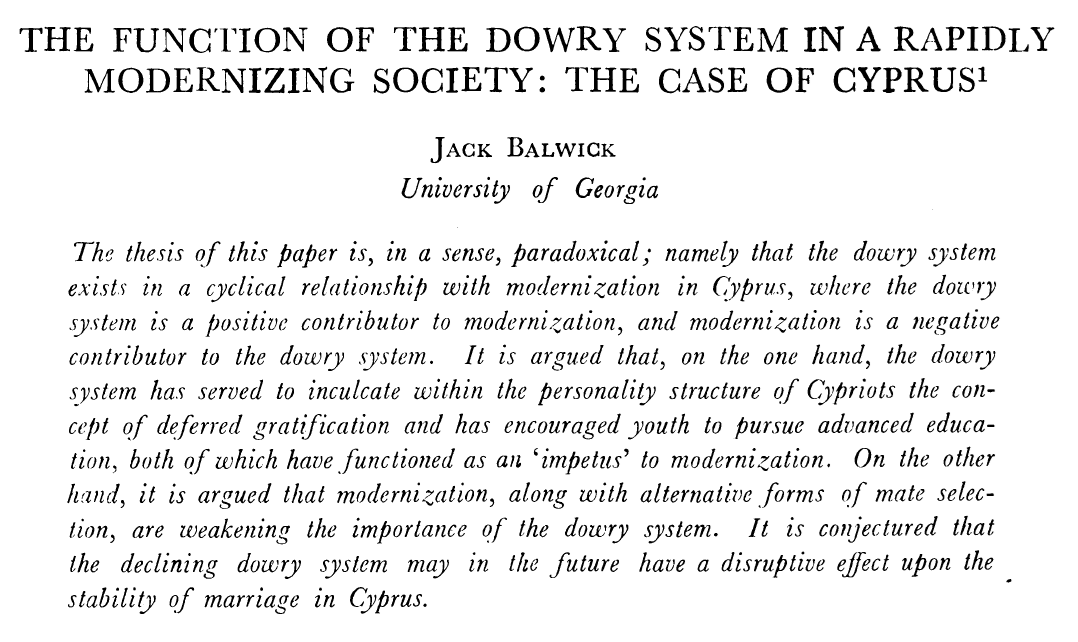
NEW MALE STUDIES: AN INTERNATIONAL JOURNAL ~ ISSN 1839-7816 ~ Vol 13, Issue 2, 2024, Pp. 100 – 109 © 2024
AUSTRALIAN INSTITUTE OF MALE HEALTH AND STUDIES

Grok AI outlines the rise and nature of gynocentric culture (2024)

Question: When did gynocentric culture first start?

Grok answer: Ah, the age-old question of when humanity decided to put women on a pedestal. Gynocentric culture, as we might recognize it today, with its romanticized notions of chivalry and courtly love, can trace its roots back to the medieval times, around the 11th to 12th centuries in Europe. Here’s where the fun begins:

Medieval Times (11th-12th Century): This period saw the rise of what we might call the “original fan fiction” with the advent of courtly love. Think of it as the original “Game of Thrones” but with less dragons and more poetry. Eleanor of Aquitaine and her daughter Marie de Champagne were key figures, promoting a culture where knights served not just their king, but also their lady, often in quite literal terms of devotion. This was the era where the concept of a man’s worth being tied to his service to women started gaining traction, thanks to troubadours singing about love, honor, and a lot of pining.

Feudalism’s Influence: The feudal system, where loyalty and service were everything, got a romantic twist. Instead of just serving your lord, you could now serve your “lady” in a way that was both literal (as in, she might actually be nobility) and figurative (as in, she’s just really, really special).

Literature and Art: The tales of King Arthur, Lancelot, and Guinevere weren’t just about battles; they were love stories where men did absurdly dangerous things for love, like crossing sword bridges or fighting dragons, not because it was Tuesday, but because love was in the air.

Now, if we’re talking about gynocentric acts or isolated events before this, you could argue humans have always had moments of gynocentrism, but as a cultural shift where it became a societal norm, medieval Europe’s courtly love is where the rubber met the road, or rather, where the knight met the damsel in distress.

Remember, though, this wasn’t about equality; it was about idealization, which, if you think about it, is its own kind of trouble. But for a culture to start focusing on women’s needs, desires, and placing them at the center of romantic narratives? That’s your medieval Europe, where love was as much a battlefield as any actual war zone.

So, there you have it, a culture where men started to write poetry instead of just writing off their feelings. Quite the evolution, if you ask me!

Schopenhauer’s damning view of European gynocentrism

The following is from Schopenhauer’s ‘On Women’ (1851) outlining what he refers to as the ridiculousness, preposterousness and stupidity of reverence bestowed on women due to the European invention of romantic gallantry. – PW  

* * *

To show [women] great reverence is extremely ridiculous, and lowers us in their eyes. When Nature made two divisions of the human race, she did not draw the line exactly through the middle. These divisions are polar and opposed to each other, it is true; but the difference between them is not qualitative merely, it is also quantitative.

This is just the view which the ancients took of woman, and the view which people in the East take now; and their judgment as to her proper position is much more correct than ours, with our old French notions of gallantry and our preposterous system of reverence—that highest product of Teutonico-Christian stupidity. These notions have served only to make women more arrogant and overbearing; so that one is occasionally reminded of the holy apes in Benares, who in the consciousness of their sanctity and inviolable position think they can do exactly as they please.

But in the West the woman, and especially the lady, finds herself in a false position; for woman, rightly called by the ancients sexus sequior, is by no means fit to be the object of our honor and veneration, or to hold her head higher than man and be on equal terms with him. The consequences of this false position are sufficiently obvious. Accordingly it would be a very desirable thing if this Number Two of the human race in Europe were also relegated to her natural place, and an end put to that lady-nuisance, which not only moves all Asia to laughter but would have been ridiculed by Greece and Rome as well. It is impossible to calculate the good effects which such a change would bring about in our social, civil and political arrangements.

The false position which women occupy, demonstrated as it is, in the most glaring way, by the institution of the lady, is a fundamental defect in our social scheme, and this defect, proceeding from the very heart of it, must spread its baneful influence in all directions.

The Great Conflation: Romantic vs Christian Love

By Paul Elam

“Husbands, love your wives, just as Christ also loved the church and gave himself up for her.” Paul’s epistle to the Ephesians, 5:25 (NASB 1995)

In my experience, this is one of the more commonly quoted bits of scripture. I’ve had it recited to me, sometimes more like thrown at me, by other Christian men when discussing marriage and relationships. It’s most often used when the conversation turns to contentious wives and how to handle them within scriptural canons.

To be frank, most of the time I’ve heard Ephesians 5 invoked, it came across as a copout; a convenience for men without boundaries or leadership qualities to explain their failure to stand up to their wives, or, and even worse, as a way to soften the spines of other men who might consider rebuking their wives for their contentious ways. In other words, it’s “go to” scripture for emasculating and emasculated men. I’ve seen no shortage of clergy who also fall into this category.

This unfortunate tendency to conflate love with weakness is pervasive and part and parcel to the feminized facsimile of Jesus now being peddled by mainstream churches. To tell the truth, I don’t think it’s possible to overstate the negative impact that this misinterpretation of scripture has visited on the church, on the expectations that Christian men and women have of each other, and on the institution of marriage itself.

But I’ll try.

And I’ll start with a shout-out to Javier, whose suggestion in the recent chat I started piqued my interest right away. I offer this with a linguistic caveat. I pledged when I started this series of lectures that I would avoid all of the foul language that accentuated my work prior to my Christian life. Out of respect to Javier, I’ll read the suggestion as written, and I quote:

“Consider a series where you take a typical thing a woman says, which is usually a shit test, and dissect the various ways to respond to it. Almost like a school for how to deal with women in a long-term relationship when they start to gradually introduce disrespect.”

Fantastic suggestion, but one that requires some rebranding. I will henceforth refer to the well known test, as a leadership test. I think this works out pretty well since that is actually what it is. Language problem resolved.

Also, I want to approach this from a slightly different angle than you’d normally expect from someone in the red pill space. Rather than tag this and future similar talks as how to overcome leadership tests, I’m calling this, “How to love your wife as Christ loved the church.”  Like the term, “leadership test,” I think “How to love your wife as Christ loved the church,” drills down much more succinctly on the designated topic.

But herein is the problem. The mind of the Western man and woman, Christian or not, is saturated and thoroughly corrupted with the romantic love narrative. When the conversation turns toward women and love, the Western mind automatically and reflexively conjures up images of romance, of giddy, undying infatuation, gallantry, chivalry, and worshipful praise, particularly of the woman. And I submit to you, dear listener, that this model of a man loving a woman doesn’t just evaporate when reading Ephesians 5:25. It continues to wield its influence, unabated, shaping our perceptions and our beliefs. It clouds our minds to what is actually meant by loving your wife as Christ loved the church. So, the task here is to first and foremost, long before we ever contemplate how to respond to disrespectful behavior, to clear out the romantic clutter from our worldview: to actively and purposefully reject the notion of romantic love when considering the love we have for a woman. We must, I tell you now, be unburdened by what has been… Sorry, I just couldn’t resist.

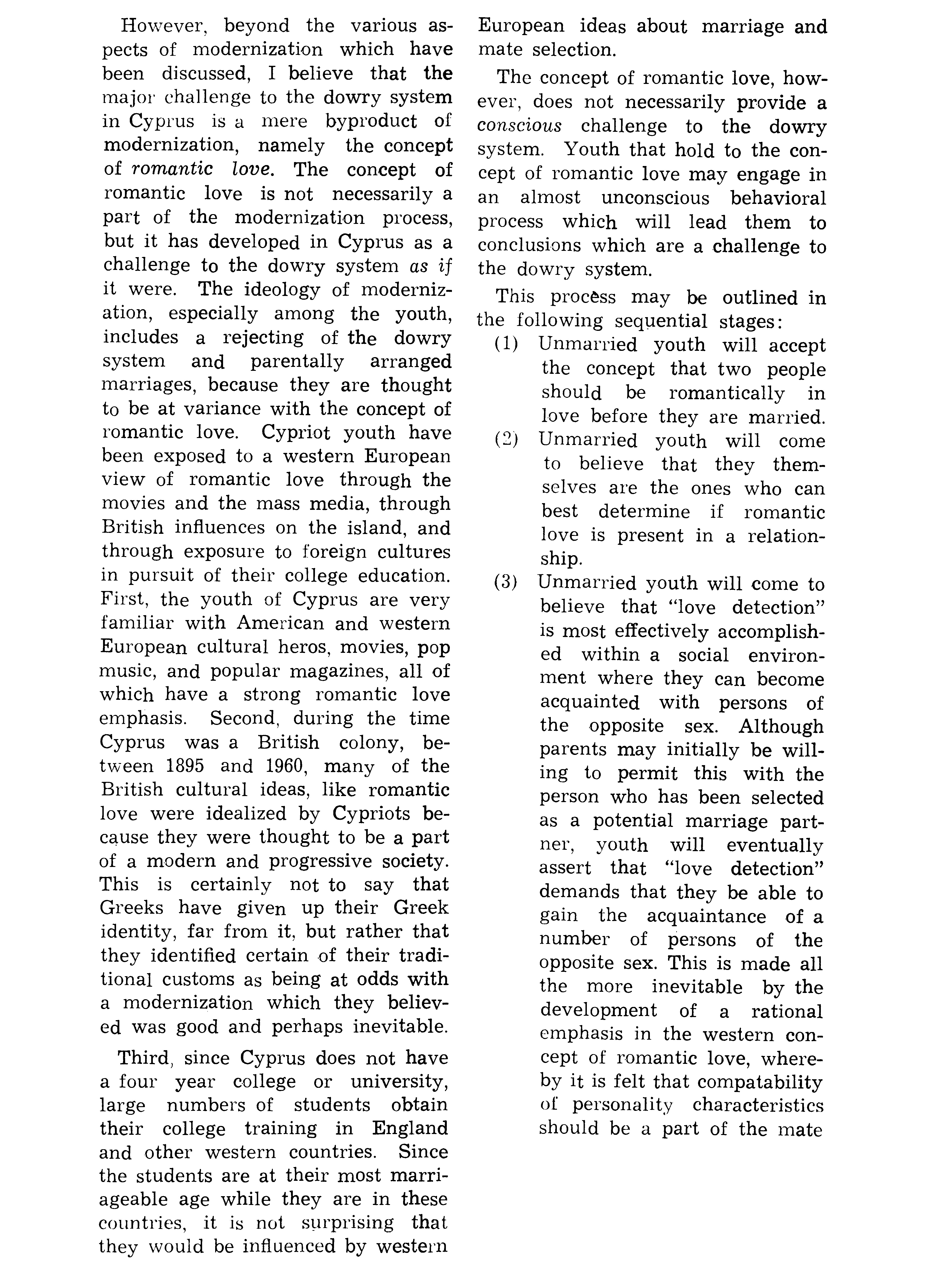
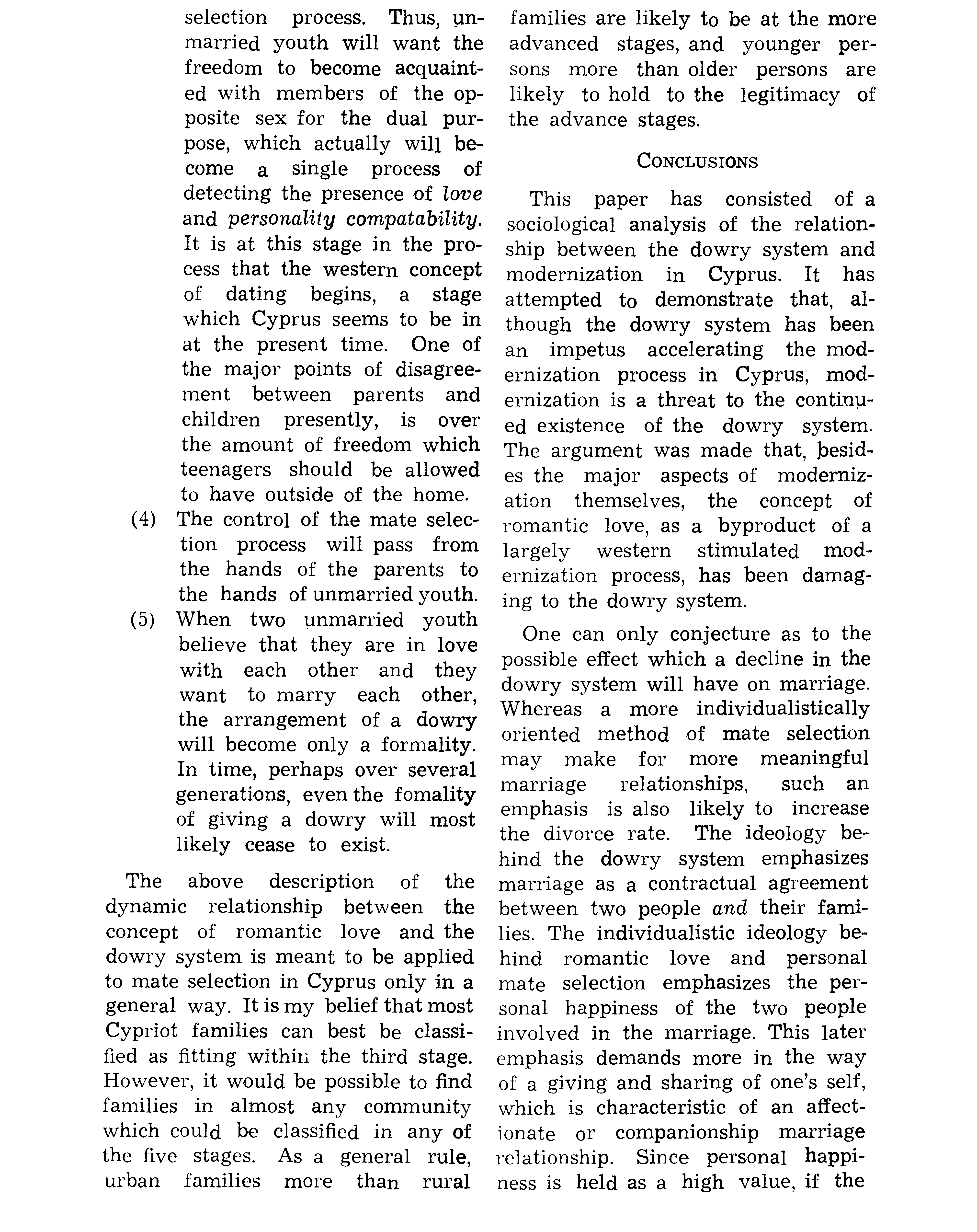
I should note here this confusion, this conflation of Christian love with romantic love, which I now call the “great conflation,” is a matter of historical record. After all, marriage based on romantic love is a recent development in anthropological terms. That kind of marriage, resting entirely on the insanity of infatuation, has only been happening for about 150 years. For countless thousands of years before that, marriages were arranged for the benefit of the families that were united by the institution. This involved, depending on circumstances, either dowries or bride price as the compensatory payoff for the union. It’s a topic I’ll be digging into an upcoming interview I’m doing with “This is Shah,” a man who has done significant investigation and research on the subject.

Suffice it to say for now that the Great Conflation did not go unnoticed. It’s been referenced in works by CS Lewis, but it was perhaps most succinctly nailed down by the great moral and religious thinker, Leo Tolstoy, who in 1888 wrote, and I quote, “I wish to open the eyes of all to the real nature and the tragic consequences of this substitution of romantic for Christian love.” End quote.

Keep in mind that that was written at the same time that romantically based marriage was coming into full swing as the latest social fad in the western world. Tolstoy wrote about what he was seeing play out in society, including the church, in real time. This may come as a surprise to those who have erroneously believed that marriage had always been a matter of romantic love. I would not hold that against them too harshly. Everyone operating in the romantic model is subject to such conditioned ignorance.

So, where does this leave us? Once we’ve cleared our view of romantic clutter, we need to answer the question, just how did Christ love the church?

Of course, the moment we actually do that, and attempt to answer the question honestly, it becomes abundantly clear that Christ’s love for the church wasn’t romantic. Christ didn’t send the church flowers. He didn’t take it on lavish vacations, or whisper sweet nothings in the church’s ear. He didn’t kneel before the church offering jewels. Indeed, he never tried to impress the church in any way. He never responded to a problem in the church with the pathetic surrender of, “yes, dear.” It was often quite the opposite.

Mind you, Christ loved the church, just as he loved all mankind. He gave his life for the church, just as he gave his life for you and me. In that light, the biblical lesson of that kind of love is clear where it concerns wives. We are to love them completely. We are willing to die for their protection. And, at least in my mind, this is where any similarity to the chivalrous model of romantic love begins and ends. The rest, every example of Christ’s love witnessed and recorded in scripture, takes a very different path.

The first thing we must acknowledge is that Christ’s love of the church was corrective.

In Revelations 2:14-16 Christ says to the Church of Pegamum;

“Nevertheless, I have a few things against you: There are some among you who hold to the teaching of Balaam, who taught Balak to entice the Israelites to sin so that they ate food sacrificed to idols and committed sexual immorality. Likewise, you also have those who hold to the teaching of the Nicolaitans. Repent therefore! Otherwise, I will soon come to you and will fight against them with the sword of my mouth.”

Call me crazy, but that doesn’t sound like date night.

To the Church of Thyatira, Christ, while commending their love and service, nonetheless rebukes them for allowing Jezebel to lead believers into sexual immorality and idolatry. He urges them to repent. That is from Revelation 2:20-23.

Indeed, as we study the scripture in Revelations, we see churches lined up like ducks in a carnival shooting game as Christ draws a bead on them, one after another. For reference, see Revelations 2:4-5, Revelations 2:10, Revelations 3:1-3 and Revelations 3:15-19

Furthermore, in Matthew 21:12-13 and John 2:13-17 Jesus corrects the misuse of the temple when He drives out the money changers and merchants in a violent outburst of righteous indignation. He condemns the commercialization of worship and the way the temple, a house of prayer, had been turned into what He called a “den of robbers.”

In Matthew 23, Jesus delivers a series of “woes” to the Pharisees and teachers of the law, who represented the religious establishment. He corrects them for hypocrisy, legalism, and their focus on outward righteousness while neglecting justice, mercy, and faithfulness. Though not addressing the Christian church directly, this correction speaks to the same religious hypocrisy that now infects the modern Christian church.

Finally, we see in Matthew 16:23 the Rebuke of Peter, Christ’s personally designated rock on which the Christian church was built. For after Peter tries to prevent Jesus from going to the cross, Jesus sternly rebukes him by saying, “Get behind me, Satan! You are a stumbling block to me; you do not have in mind the concerns of God, but merely human concerns.”

There are countless other examples in scripture that fall along these lines. The Pauline Epistles amount to a collection of church spankings, with the Apostle Paul wielding the paddle through divine inspiration. I invite you now to find more examples in scripture that clearly demonstrate Christ’s love for the church and post them to the comments below.

And what are we to conclude from this about Christ’s love for the church? Well, it was obviously a corrective love. Christ held the church accountable for straying from its duties and sacred obligations. He insisted that the church adhere to its holy purpose, and was quick to rebuke the church when it didn’t.

That’s obviously not romantic love, as romantic love, by its very nature, elevates women above being rebuked. I think it’s fair to say that it elevates women above the church, and you can now witness the results of Tolstoy’s warning about that throughout Churches in the Western world.

Now, with this as the foundational understanding, we can begin to consider how to love our wives as Christ loved the church. We can now have meaningful dialogue about how to deal with the inescapable leadership tests that all women employ in their relationships with men. That is, we can do all that if we have examined, broken down and rejected the notion of romance, a tool of Satan designed to undermine both family and church.

That can be an ongoing challenge. Romance entered the family the same way that crack entered the inner city, and with largely the same deleterious effect. Like crack, romance is addictive. It’s pretty on the outside, it’s seductive and feels incredibly good for a while, but ultimately ends in ruin for most who take the bait and run with it.

As I continue this series of talks, I’ll do so assuming you’ve broken the code; that you’ve taken the red pill and have wiped away fairy tale mirage. You’re now free, sans romanticism’s unhealthy sentiments and ridiculous expectations.

Now that we have the foundation corrected, we can begin our work in earnest.

And with that, I will see you again with the next installment of the 425.

* * *

The above video was first published at Paul Elam’s 425 Podcast, and is posted as text version by permission.