The following paper by Shah Mirza was first published in July 2026 in New Male Studies Journal.
Month: August 2026
Frau Minne as “Goddess”
Several medieval (especially Middle High German) writers explicitly or by clear equivalence refer to the personified figure of love—Frau Minne / vrouwe Minne (Lady Love), or the related Dame Amor / Dame Amour in French traditions—as a goddess (gotinne / Göttin).
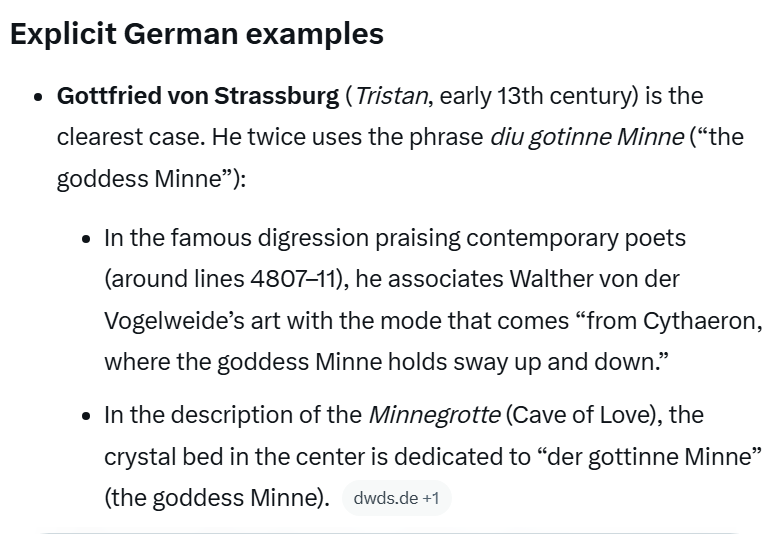
Religious scholar Joseph Campbell tells that Dame Amor was also worshipped as a goddess in Germany, quote:
The minnesingers of Germany recognized that this power of amor was indeed divine. It wasn’t simply a secular thing but contained the compulsion of the goddess. The word Minne in German is a reference to this kind of love, and minnesinger means “singer of love.” The greatest of all these poets was Walter von der Vogelweide, a delightful figure whose poetry is simply delicious. Walter speaks of the goddess Minne in her power, in her majesty, and so here you’re on the brink of a religion of love. This religion of love was actually rendered most powerfully, I would say, in the Tristan of Gottfried von Strassburg. Gottfried’s poem was left incomplete when he died in 1210. In this story, the potion that Tristan and Iseult drink represents the breakthrough of compulsive love. [Romance Of The Grail: Magic And Mystery Of Arthurian Legend]
For more on the significance of courtly love/chivalry as a religious practice, see the following:
[1] To ‘Believe’ in Love – The Religious Significance of the Romantic Love Myth in Western Modernity (Sarah Balstrup – 2012)
[2] Courtly Love as Religious Dissent, by Jeffrey B. Russell (1965)
5 Reasons Not to Center Your Life Around Romantic Love
I had intended for this article to come out close to Valentine’s Day this year. After all, it was originally intended as a rebuttal against Evie Magazine’s article ‘The Case for Centering Your Life Around Romantic Love‘
I don’t mind talking about the subject of Romantic love months after Valentine’s Day because frankly, the subject need not be limited to that day. We have critiqued the Romantic model for great reason and the relevance of the subject is year-round. I have no qualms about completing these thoughts at this time of year.
While this is not a step-by-step takedown of the article itself, some context is clearly required. If one can see the tag line for the article by Jaimee Marshall, it reads: “That our greatest novels, most enduring works of art, most popular songs, and most affecting films overwhelmingly center around themes of romantic love is telling.”
Amounting to nothing much more than “It’s in our media and recent history, therefore it is right”, it sums up the gist of the article. Okay, if you want more, here are some gimmies.
“We all knew that those who vocally ‘hated’ Valentine’s Day really just meant they hated spending it alone and resented everyone who got to partake in the festivities with a chivalrous, thoughtful lover.”
A hasty summarization alleging that there are no legitimate critiques on the idea of the holiday (Yes, I know it’s not actually a holiday but judging by the pious and worshipful attitudes of its celebrators, is it not practically a “holiday”?) And, the allegation that men are lonely and bitter because they ain’t got no woman. Seems like projection, since these women appear to be constantly bitter at men deciding not to let women be the center of their lives.
And that’s what the title of the article, ‘The Case for Centering Your Life Around Romantic Love’, means in the end, doesn’t it? It reads, ‘The Case for Centering Your Life Around Women’.
The article tries to sound nuanced, as follows:
“Since children are dependent on their parents for survival, some form of sustained pair bonding is clearly essential, though (Richard S.) Schwartz says there’s no reason to think it must be romantic. You could imagine, and indeed there is precedent, for a sort of kin-based, communal structure to raising children that gets the job done without monogamous romantic love. However, romantic love’s persistence across cultures suggests it’s a core feature of human psychology, not an incidental cultural invention.”
I promise this will be the last of the Evie article, but referring to “renowned” biological anthropologist Helen Fisher:
“…one of the world’s leading experts on the neuroscience of romantic love, has described it as humanity’s most powerful drive. ‘People pine for love, they live for love, they kill for love, and they die for love,’ she has said, framing romantic love as a deeply embedded neural system that cannot simply be opted out of. According to Fisher, humans are hardwired for pair bonding through their very brain circuitry.”
Appropriate, is it not, that the emotional impulse to die for and kill for and dedicate one’s life to women comes from an “expert on neuroscience”, presenting male disposability as a norm. And yes, for those new to basic humanity for the male of the human species: the glorification and exaltation of male disposal for the sake of females is precisely what is being talked about here. The Romanticist thinks it’s dreamy. Anyone with basic esteem for men would think it is ghastly.
Since when is love in its most meaningful sense a cause or motive for death and abnegation?
But that’s the gist of that article. Blubbering pontifications confusing romanticism with proper pairbonding between the sexes, elevating Romantic love above all human relations (“All other human relationships pale in comparison”) and the constant appeal to hardwiring and biological inevitability.
In my mind, this all amounts to human (male) self-destruction as an argument for human species survival – this is the essence of collectivism, the denial of humanity to one segment of the species to serve a societal idealism.
Alright, enough of the nonsense. Here are the Five Reasons Not to Center Your Life Around Romantic Love.
1. The History of Romantic Love
The original article implies that our novels, artworks, “popular songs” and “most affecting films” are the proof we need that we need to center our lives around romance. To me, this accidentally suggests that all these are vastly new to human history, and nothing evolutionary in the sense that it was a cornerstone to our becoming homo sapiens, standing on our own two feet and achieving the glory of civilization.
While I am not saying that choices made from human infatuation never happened earlier in human history, nobody called it a virtue per se. The codifying of these infatuations into a whole framework of romantic love, or courtly love, appears to be in the order of centuries old.
Romantic love is as such not a biological constant. Instead it was a new, aristocratic cultural edict in which asymmetrical emotionalism was declared as a virtue. Emotion over mind became the standard. The result was the preaching of man’s sacrifice of rational interests, priorities, personal dignity, discernment, and resources.
What’s more, if we are talking history, marriage was primarily done with economic and political endpoints in mind, and yes as well as kinship. Passion was not the key factor. While to the uninitiated these arrangements seem like a game for the very rich, even the much poorer classes married for economic and survival purposes. The poor in particular did not appear to have the luxury of impulsive romantic acts.
The man grovels for the pedestalized female, who is both superior and more fragile than the man at the same time. Such is the legacy of romantic love, continuing to this day in modern formats. But the modern formats are taken today, erroneously, as evidence of the biological evidence of homo romanticus patiens…the suffering romantic man, as the apex of evolution.
(Some runner ups were homo troubadorus, and homo pedestalicus, but I digress)
Being the farthest from the historical authority on the subject myself, I will leave some readily accessible links to Peter Wright’s gynocentrism.com, in particular the ones under ‘Courtly & Romantic Love’:
These will be able to tell you more than I can of the historical details that make clear that Romantic love is far less wholesome than most people delude themselves into thinking. Much of the Romantic ideal is downright misandric, if one can uncover his or her self-imposed blindfolds and take a good look.
2. Romantic Love is for Show and Public Acceptance.
Ever notice how in the process of promoting Romanticism, it always entails an element of loudness and publicity? Romantic love is to be “shouted”, one must want everybody to know it, and it is what the world needs right now to solve all our problems.
In the otherwise genuinely entertaining show Family Matters, Carl Winslow (the husband and father in the show) is too often portrayed as what I can only describe as henpecked, though to be fair this quality did not necessarily dominate the character’s run on the show. In the b-story of the episode “It Didn’t Happen One Night”, Harriette (the wife/mother) is upset with her husband, essentially, because he won’t express how he feels about her in public, and instead prefers to keep things private. This cumulates into what is essentially a concession on Carl’s part as he takes his police megaphone and shouts to the entire neighborhood out his door about how he loves his wife, after which Harriette is happy.
Certainly there are other moments like this in media and no doubt in romantic stories. There are other vestiges of this in our world – the awkward kiss cams in stadiums, carvings in trees with cupid’s arrows, blimps conveying messages that Boy loves Girl (yes, Family Matters did this too), the get-down-on-one-knee and propose in public that I’ve seen too often to my exasperation, and many more.
The marketing used here is “true love against the world”. As if the world will never approve of the love of this fine couple, but they don’t care, they are going to scream it out into the world and it doesn’t matter who knows it!
The problem with that is, that this is false – it’s not about being in defiance of societal expectations. Instead, it is about making sure society approves it.
The Romantic model, certainly as we are seeing it today, is all about advertising one’s love instead of keeping things intimate and private, leaving things within the pairbond and not shoving it into people’s faces. What we have is all about having an audience, and the approval of said audience.
It’s all about making it everybody’s business.
The approval, then, is focused on making sure the female half is “treated right”, when concerning the heterosexual side of things. As a sidenote, romantic framing within the LGBTQ+ contexts are always celebrated and subject to public approval, such to the point that any objection to that is immediately shot down as “bigotry” even if the objection was more akin to “get a room”.
But back on point. This societal scrutiny and approval is what the romantic model thrives on. It has nothing properly to do with indifference or defiance of what others may think.
Let’s talk more on how this is all for the performative benefit for the female. We know that the romantic model enables female narcissism vastly. A key quality about narcissism is the requisite of an audience to adore and uphold the narcissist. This “shout your love” aspect of the social Romantic model is tailor-made for the narcissist.
This is a danger for both healthy pairbonding and to one’s actual character, male or female. The society that abides under the Romantic model is essentially promoting living by consensus.
Under this, men are only “approved humans” if they center their lives around women. The rebuttals for failing to do so are ready-made and women of all stripes are equipped with them: Incel, Misogynist, something referencing penis size, Loser, and whatever else they can scrounge up.
The women in question cannot conceive of a life in which they aren’t showered with social approval, in essence demanding a lifelong princess treatment. Jettisoning self-accountability, she becomes just a set of whims and firing emotions.
And this is supposed to be essential to the human race biologically? This is what we must celebrate?
I’ll close off this second point by mentioning that in a proper pairbond, privacy is non-negotiable to the intimacy. There is nothing wrong with passion (rationally navigated and arrived at), but by its very design it is not something one advertises the particulars of. “None of your business” should be the norm regarding the details of the relationship as far as the passion goes.
The over-advertising and screaming-to-the-world of romance is deluded. If there is a good pair bond, why not keep it personal? Public romance is to involve the world – and so the pair is beholden to that world.
If we as a race evolved to uphold anything, it is our notion of privacy – but that is a subject for another time.
3. Pathologies Particular to the Romantic Model
The big error that Romanticists repeat that make them sound somewhat credible is the conflation of Romantic love with pairbonding itself.
Pairbonding, by the term alone, should imply mutual respect, values-based meaningful love, and above all, a close understanding and a type of friendship. If we look closely at romance, any pretense that it is a valid form of pairbonding has a way of unraveling.
I have already talked about the narcissism it induces particularly in women. The attention-seeking works in two ways: making sure the woman looks well-taken care of and tended to (“treat her right”, etc), and making sure the man us under her thumb and heel as needed, at her beck and call.
The latter sometimes is blatant; he is observably submissive when one takes a quick glance at the relationship. There are other circumstances in which this is not obvious, however: the pretense of leadership. Women, often the tradgyn types, love to talk about how a man leads.
Translating what such a woman says, this reads: “He pulls the carriage I am resting on while I crack the whip.”
Such “leadership” is performative, and she is nothing but condescending towards the very man she is allegedly pairbonded with. But this is neither friendship, understanding, nor any meaningful notion of love.
It resembles a relational pathology.
By design, the male fills the sacrificial role in anything deriving from the Romantic model. In a proper pairbond, a woman should be aghast at the notion that her male partner, her close friend, is to be sacrificed at all; she should be equally aghast that she is the beneficiary and endpoint.
This horror is a rational response, assuming we can expect women to feel this at all at this point. What do we have instead in this world? Adoration, gratitude, and joy – because a man is degraded. She is the visible cause of this, and her response is the opposite of horror. This is the pathology of society, the legacy of Romantic love. And it appears to be essentially exclusive to this model.
I’d be remiss if I failed to mention the accidents of youth that are the result of marketing Romantic love by and large. Emotional damage, radical adjustment to expectations physically and mentally, humiliation, all the way up to teen pregnancy – those are the fruits of Romantic love and the embracing of infatuation as standard instead of a challenge to overcome.
And what about the darker things that have been done? Murders due to jealousy, the murder of children in the light of affairs, suicidal acts of the moment, hybristophilic situations with women romanticizing dangerous criminals, and the most common popular result of romance: the thriving divorce industry and women looting their ex-husbands property without a care in the world.
We can safely say that it is rational to avoid Romantic love. When women, even those who allegedly “defend” men like the busybodies in Evie, instead insist that we need more Romantic love, and assert that only nasty, “lonely and bitter” men are against this, then this only indicates how deep the pathology runs in society. If the antifeminists themselves still fight for gynocentric ideology, it’s more uphill a battle than one wishes it is.
4. Companionate Love is Superior to Romantic Love
I for one wish we had a snappier label for this variant of love that we advocate. Companionate love, for the moment, seems to suffice.
It incorporates Storge in the sense that it is in fact a love of the family in a real sense. A pairbond, assuming it is built to last, is literally chosen family. The reason I don’t care to *only* call it Storge and leave it that is due to the privacy/intimate factor – it specializes it just enough to earn what is possibly a distinct categorization, or a subcategory.
Now let’s talk about Eros, or Erotic love. While Eros is often conflated with Romantic love, this is a mistake, and the reason goes beyond a simple mis-categorization.
Eros, properly, is unabashed. Romantic love, on the other hand, serves to both curtail and subordinate Eros. Romantic love serves to starve and control sex in a way that cartelizes it, to manipulate a man by withholding sex and general affection. So I think it is wrong to directly equate it with Eros.
In case I haven’t made it clearer before, those that hold the reins of Romantic love don’t approve of men’s Eros in any meaningful way. It goes without much explanation that male sexuality is demonized, with the express directive that it is only proper when it serves women. If anything, Romantic love whitewashes Eros, demonizes it and then “forgives” it in men if certain shit-tests are passed.
As the erotic factor is important to a pairbond (albeit in varying degrees; men are different in the volume of their sexuality here), is Erotic love the proper descriptor of what we are looking for?
Well, while it is part of it, a pairbond isn’t necessary per se for erotic love to have some presence, so again it isn’t a complete picture. Like Storge, it isn’t an estimate of it, but it is adjacent. What we are looking for incorporates both to be sure, but it needs a proper category that isn’t Romantic love.
Whatever we call this (and again, Companionate love seems to do for the time being), it is the more rational, moral choice over Romantic love.
So, does this mean we must center our lives around Companionate love instead? The answer…is no.
5. You Shouldn’t Be Centering Your Life Around “Love” Anyway.
Even if Romantic love is all it’s cracked up to be (and I hope I’ve indicated successfully that it isn’t), one must not center one’s life around it. So it should follow that whatever remains that *is* all it’s cracked up to be – that is, what we call Companionate love or any proper form of intimate love – should likewise not be the center of one’s life.
Romantic love is practically by definition centering one’s life around a woman on the man’s part, and on the woman’s part the indulging and moralizing of men’s centering of her in his life. We disavow this paradigm by rejecting Romanticism itself.
So, as a proper form of Companionate love doesn’t involve this centering, it follows we shouldn’t force it to be the center as it is not natural to do so.
A human life essentially is about values and the pursuit of happiness. Things like love are a detail (albeit non-trivial), not an end goal. If anything, the pairbond should be among the number of things that reflect how you live your life with the values you aim for. They are not the aim itself.
Your ikigai, that sense of life purpose and worth, is something particular to yourself that cannot be simplified by who you have a relationship with. Everything and everybody you choose to surround yourself with should be an indicating detail and reflection of the choices you made as per your ikigai. They are not the ikigai itself.
In plainer language, your pairbond should reflect your values, yes. But it is not in itself the center.
While this is the most important reason in this article, there isn’t much to be more longwinded about, and I think this is very straightforward. Love is not the most important thing on this planet nor for our existence, and there are other things more important than the even best iterations of partner love.
Respect, especially for oneself, comes to mind. From that flows mutual respect, the understanding of values and boundaries, and one another. Love being the greatest value in the world tends to comfort people, but it’s time to challenge that.
Some Closing Thoughts on Love
Even if we extracted the toxic elements – the sacrificial expectation for men, the pedestalizing, and the exhibitionistic performances – the very notion that one must center their life around love is a funny thing.
I have come to properly understand love as an action that is self-initiated. In some of its purest forms, it manifests itself as attention that bring out the life in something, be it work on one’s car, a dedicated train set, a well-designed composition or architecture, a meal cooked in just the right way, and many other examples.
Love, then, appears to be a cultivation and a process. It’s not an end goal to center one’s life around, but just something we wield mindfully. It cannot be faked – “duty” or “obligation” to love then becomes inexact, as again this is self-initiated.
The same should stand when love is applied to human relations. Love brings out the life in people where needed. Relationships, and loves, are built over time.
But reliance on another’s love is only an indicator that one has failed to love oneself in a meaningful way as I have described thus far: taking charge of one’s own life and freeing it from being beholden to another’s approval.
The centering of love, and the “pursuit” of it, then makes for two pratfalls: one – the insistence to perform love to the point of sacrificial behavior, and two – the complete, narcissistic reliance on love by another such that they will fall apart when they have to stand alone.
Standing alone is the key to humanity and despite the familiar prattling of how man is a social animal, humanity’s true evolutionary distinction is the ability to stand alone…but that is an article for another time.
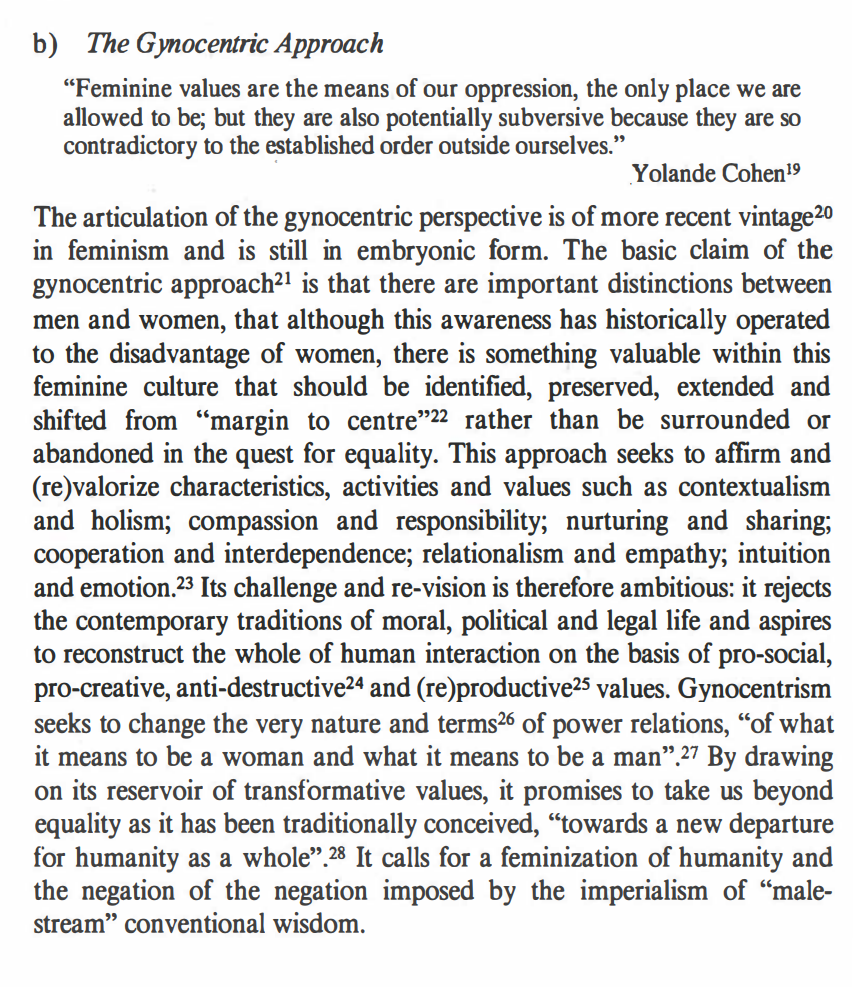
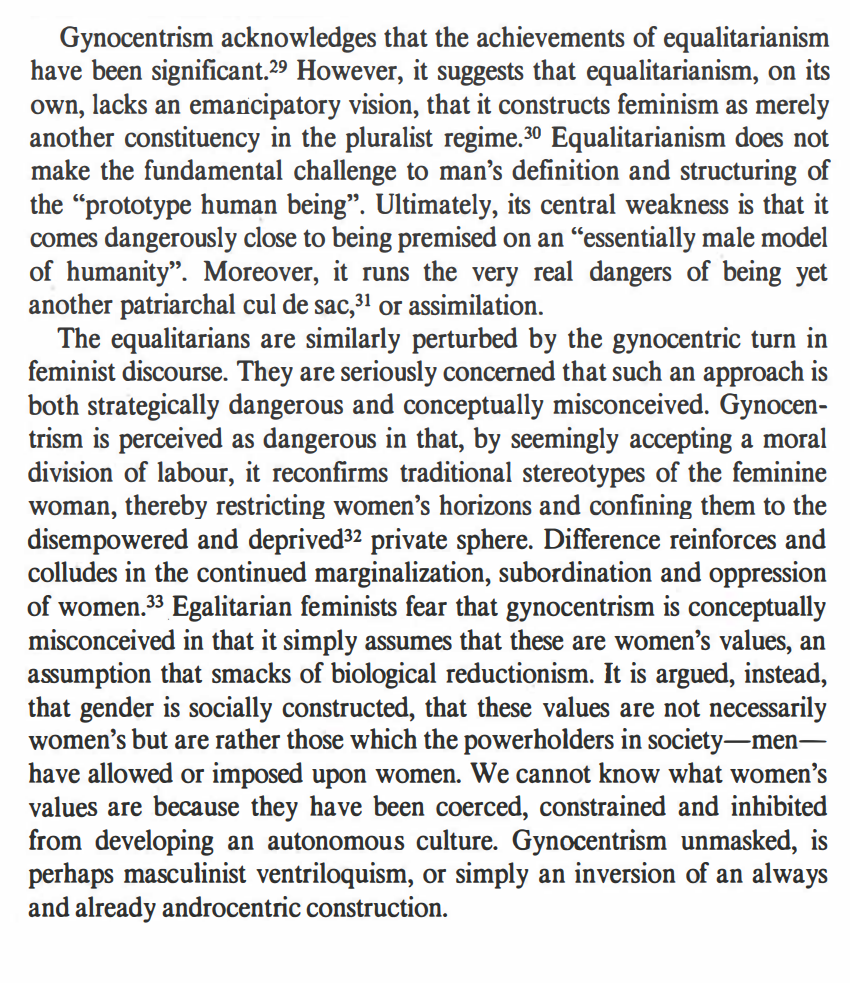
The Gynocentric Approach (1990) – by Richard Devlin
The following excerpt provides an example of the gynocentric social-engineering worldview reemerging during the 1990s.
SOURCE: Devlin, R. F. (1990). Nomos and Thanatos (Part B)-Feminism as Jurisgenerative Transformation, or Resistance through Partial Incorporation. Dalhousie LJ, 13, 123.
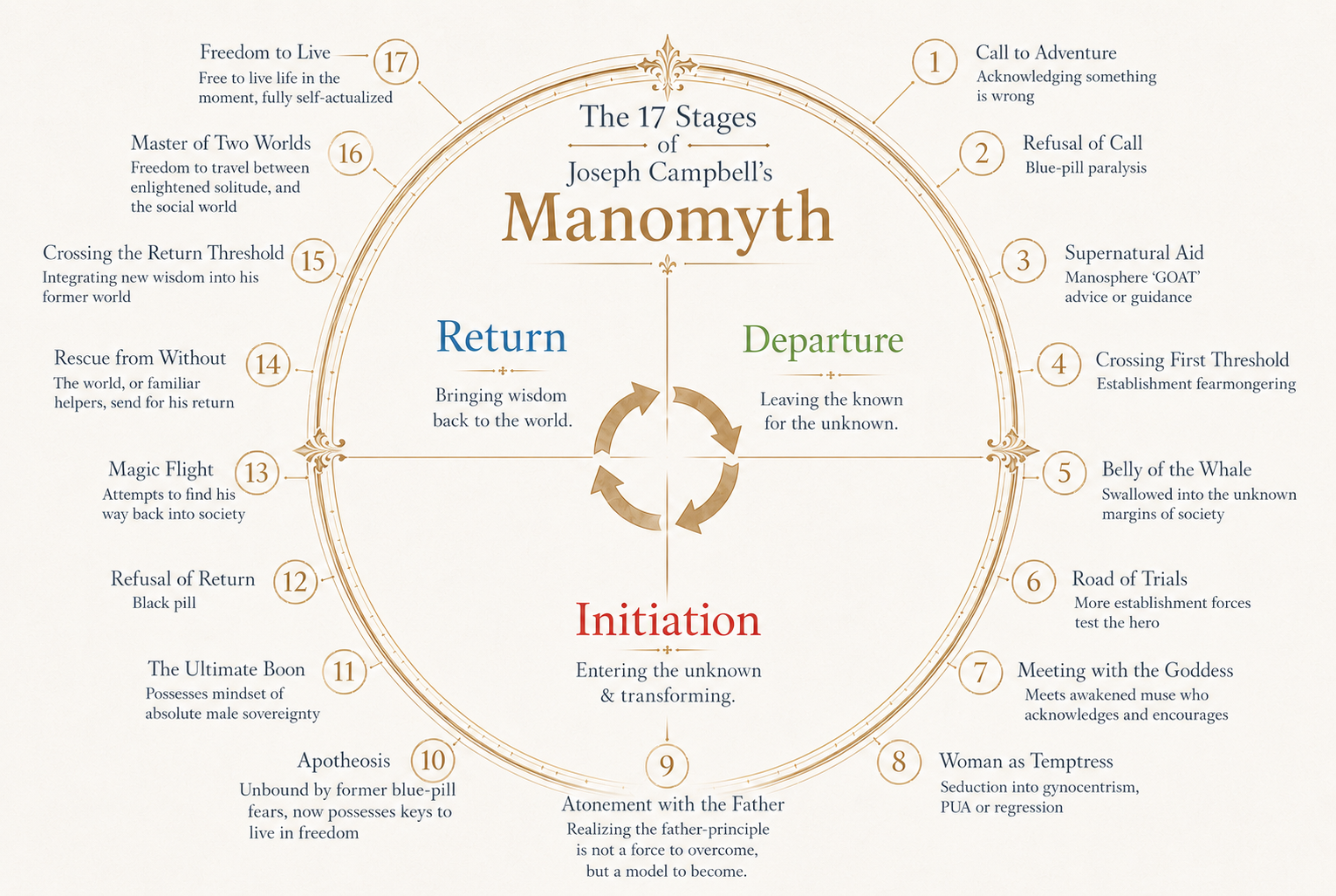
Manomyth: Joseph Campbell’s Hero Journey for Men
Men’s individuation closely mirrors Joseph Campbell’s Hero’s Journey. In this article we explore that connection in depth.
Campbell’s The Hero with a Thousand Faces analyzes mythologies, legends, and folklore from around the world and reveals a universal pattern of transformation and transcendence—the monomyth. We argue that this pattern maps especially well onto the path of non-gynocentric men.
The idea of applying the monomyth to men’s lives did not begin with the modern men’s movement or with what later became known as the red pill. That work was already underway in the Mythopoetic Men’s Movement of the 1980s and 1990s, especially in the orbit of Robert Bly.
Bly and others drew heavily from Jungian theory, archetypal psychology, folklore, myth, ritual, and the work of Joseph Campbell to describe the masculine journey. They understood that men were not merely political or economic actors, but mythic beings as well – men shaped by initiation, exile, confrontation, ordeal, shadow, father hunger, and the need to recover something essential inside themselves.
That was the strength of the mythopoetic project.
It recognized that men need more than policy arguments, relationship advice, or economic opportunity. Men need a story that explains their suffering and gives structure to their transformation. They need a map.
That need is especially urgent because modern male distress is often treated as a scattering of unrelated symptoms rather than as a crisis of identity and self-respect. Family dysfunction, substance abuse, suicide, violence, anxiety, depression, shame, and self-hatred do not arise from a single cause, and it can be difficult to separate cause from symptom. Dysfunction may feed addiction, addiction may deepen dysfunction, hostility may destroy communication, and failed communication may intensify hostility. Beneath many of these interacting problems sits a neglected question: what kind of man does a man believe he is permitted to become?
Men may need direct assistance with particular problems, but they are also living through a famine of functional archetypes. Treating the visible injury while ignoring that deficit is often little more than placing a bandage over a potentially mortal wound. A man cannot build a coherent life from techniques alone. He needs an intelligible story of himself, a set of models he can examine, accept, reject, revise, and ultimately make his own.
But the weakness of Bly and his circle was that they too often left that map suspended in ancient history, poetry, drums, woods, kings, warriors, shamans, and symbolic fathers. They could speak powerfully about Iron John, initiation, the wild man, and the archetypal masculine, but they rarely brought that framework down to the ground where modern men were actually bleeding. This, we think, explains in part why the movement fizzled out by the turn of the century.
The older masculine archetypes supplied that kind of orientation. Hero, Ruler, Warrior, Creator, Sage, Rebel, and Explorer gave men images of what they might choose or be driven to become, along with warnings about what they might become in failure or corruption. These figures were not merely literary decorations. They were anthropomorphic projections of the male experience – external forms for internal realities of duty, ambition, sacrifice, danger, mastery, rebellion, creation, and discovery.
The word archetype itself joins the Greek roots arche (original or beginning) and typos (model or type): an original model. Mythology told the truth of human life in symbolic form because its figures were already alive in the human imagination. Epic battles, great journeys, tragedies, betrayals, and triumphs reflected the inner and outer experiences of actual men. The myths endured because men recognized themselves inside them.
Modern sexual politics has not erased archetypal thinking. It has narrowed and weaponized it. Men are increasingly cast as the Villain by default while still being ordered to become the Hero whenever protection, provision, sacrifice, or endurance is required. The old obligations remain, but the honor, appreciation, respect, and status that once accompanied them have steadily disappeared. What remains is expectation without reward, burden without honor, and service without self.
In Bly’s mythopoetic tradition there was little serious engagement with family courts, divorce incentives, false allegations, paternal alienation, educational discrimination, male disposability, romantic exploitation, gynocentric institutions, or the cultural machinery that trains men to measure their worth by service to women and the state.
The result was that the Mythopoetic Hero’s Journey remained largely symbolic. It helped some men feel that their pain belonged to something ancient, but it did not fully show them how that journey played out in the legal, relational, institutional, and psychological realities of their own time. It gave them mythic language, but not enough practical confrontation with the systems and narratives shaping their lives.
The Manomyth therefore cannot be a nostalgic attempt to return men to an earlier script. The older models contained wisdom, but biology, technology, law, and ideology have changed the conditions under which those models operate. Men can no longer safely allow instinct and inherited expectation to write the whole story for them. The provider and protector impulses that once anchored a man in reciprocal obligations can now make him unusually easy to manipulate, exploit, and discard.
What is needed is a consciously constructed mythology—not untethered fantasy, but a more accurate narrative through which a man can understand the forces acting upon him and decide which roles he will inhabit. The object is not to abolish service, sacrifice, loyalty, or love. It is to move them from compulsion to choice, from unconscious performance to deliberate expression.
That is where The Manomyth begins.
Joseph Campbell’s monomyth, the Hero’s Journey, distills thousands of years of storytelling across multiple cultures into a universal pattern of transformation. It contains three main phases: Departure, where the hero is pulled from the ordinary world; Initiation, where the road of trials tests and forges him; and Return, where he integrates hard-won wisdom back into life, now lived on his own terms.
In what we will be calling The Manomyth, this cycle is brought out of the mythopoetic woods and into the modern male condition. It maps a man’s awakening from the strictures of a controlled, gynocentric society — where his value is measured by utility to women and the state — through trials of marginalization, disillusionment, self-discovery, and ultimately the forging of an authentic masculine character grounded in his own values, not society’s demands.
We will be examining how the Hero’s Journey mirrors the story of men undergoing individuation, who often pass through their own stages of departure, initiation, and return. Departure begins when a man first sees through the approved narrative: that if he works hard, treats women well, provides, protects, sacrifices, and follows the rules, he will be rewarded with love, respect, family, and social legitimacy. For many men, that departure is not chosen calmly. It begins with betrayal, divorce, family court, false accusation, romantic failure, paternal alienation, or the slow realization that his sacrifices have purchased neither respect nor security.
Initiation is the period that follows, when the man is forced to confront realities he was never prepared to see. He must examine feminism, gynocentrism, male disposability, the family court system, the romantic ethic, and his own internal conditioning. This is where the trials become both exogenous and endogenous. He must deal with hostile institutions, social shaming, and cultural contempt for male pain, but he must also confront the programming inside himself: the need for female approval, the urge to rescue, the fantasy of “the right one,” and the shame he feels when he begins to value his own life.
Return does not mean returning to the old world unchanged. It means returning with discernment. The man who completes the journey does not necessarily retreat from women, family, work, or society. He returns as a more sovereign male individual, no longer willing to live as a disposable utility for others. He may still love, build, mentor, create, and serve, but he does so from choice rather than programming.
For example, the divorced father who once believed the system would honor his devotion may enter the journey through the shock of discovering that his role as provider did not protect his bond with his children. His initiation may involve grief, anger, legal struggle, and the painful recognition that family courts often treat fathers as wallets with visitation privileges. His return comes when he rebuilds himself, reclaims his fatherhood where possible, and refuses to measure his worth by the approval of hostile institutions.
Likewise, the man who spent years organizing his life around romantic validation may begin his departure when he finally sees that being “good,” useful, agreeable, and endlessly forgiving has not made him loved. It has made him exploitable. His initiation requires him to deconstruct the romantic ethic and separate healthy love from self-erasure. His return comes when he can engage life with a clearer eye, capable of affection without worship, loyalty without blindness, and desire without surrender.
This is not a collective revolution but an individual exodus. The ordinary world is the gynocentric matrix: institutions, media, laws, and expectations that position men as disposable providers and emotional regulators for female well-being. The hero’s journey begins when a man recognizes this arrangement as fundamentally misaligned with his own nature and refuses to remain a supporting character in someone else’s story. What follows is his departure, initiation, and return as a sovereign male individual.
DEPARTURE
1. The Call to Adventure: Acknowledging Something Is Wrong
The Call to Adventure arrives as an insistent inner voice or external shock that shatters the illusion of the ordinary world. In Campbell’s terms, a herald appears—something that cannot be ignored—and summons the hero onto the path of investigation. For the modern man, this herald is often a painful collision with systemic misandry and the relentless expectation of gynocentrism. He may lose his job, his children, his reputation, or simply his illusions in a divorce court, a workplace DEI initiative, or a casual social interaction where his needs are dismissed as irrelevant or toxic. He looks around and sees a society that extracts his labor, his protection, and his emotional labor while framing his very existence as a problem to be managed.
At first the realization is disorienting. He has been told his contributions—building infrastructure, innovating technology, defending nations, funding social programs—are the backbone of civilization, yet he is treated as worthless, potential rapist, or walking wallet. The discrepancy is too stark to dismiss. Something is profoundly wrong. The comfortable narrative that “men have all the power” collapses when he experiences the legal bias, the media vilification, the educational disadvantage, and the cultural contempt directed at maleness itself. This is the Call: not a glamorous quest handed down by gods, but a raw, often humiliating awakening to his marginalization.
This awakening is rarely confined to politics or relationships. It may expose a deeper identity fracture that cuts across race, class, religion, and sexual orientation. Men who appear to be struggling with separate problems may also be wrestling with the same underlying absence of a legitimate place in the world. They have been told what men are – usually something dangerous, deficient, or morally suspect – and what men must do – usually protect, provide, submit, apologize, and endure. They have been given commands, but no trustworthy rule book for living as men.
The Call forces the question: If my contributions are so essential yet I am so devalued, what is my actual worth outside the roles assigned to me? For many, this moment is quiet and private—sleepless nights scrolling forums, reading forbidden books, or simply sitting in the wreckage of a relationship that was never equal. Others experience it as public humiliation or financial ruin. Either way, the ordinary world of compliant masculinity cracks open. The adventure has begun. The man is being invited, whether he wishes it or not, to leave the village of gynocentric expectations and walk into the unknown forest of self-definition.
This first station is uncomfortable precisely because it demands honesty. Many men try to mute the Call with distraction, cope, or doubled-down provider performance. But once truly heard, it cannot be unheard. The journey toward authentic male character has started.
2. Refusal of the Call: Blue-Pill Paralysis
Joseph Campbell described this stage with unflinching clarity:
“Often in actual life, and not infrequently in the myths and popular tales, we encounter the dull case of the call unanswered; for it is always possible to turn the ear to other interests. Refusal of the summons converts the adventure into its negative. Walled in boredom, hard work, or ‘culture,’ the subject loses the power of significant affirmative action and becomes a victim to be saved. His flowering world becomes a wasteland of dry stones and his life feels meaningless—even though, like King Minos, he may through titanic effort succeed in building an empire of renown. Whatever house he builds, it will be a house of death: a labyrinth of cyclopean walls to hide from him his Minotaur. All he can do is create new problems for himself and await the gradual approach of his disintegration.”
In the Manomyth, this refusal manifests as blue-pill paralysis. The man has heard the Call—the gnawing realization of misandry, disposable status, and gynocentric exploitation—yet he turns away. He doubles down on the familiar script. He remains the reliable provider, the emotional tampon, the safety net, the silent financier of a society that thanks him with contempt. Comfortably numb inside the glittering palace of Disneyesque romance and “happy wife, happy life” propaganda, he tells himself the discomfort is temporary, that more effort, more sacrifice, more “being a good man” will eventually restore the promised reward.
Fear is the principal jailer at this stage: fear of losing social approval, fear of losing love, and fear of losing what a man imagines is the only space the world will grant him. Some of that fear is superficially warranted. A man who sees the script clearly may become a poor fit among people committed to remaining blind. But the greater danger lies in clinging to a role that is steadily hollowing him out.
How many men remain trapped in the provider-protector identity after reciprocity has vanished? How many competent professionals remember wanting to become artisans, writers, builders, or artists, only to watch those ambitions buckle beneath the weight of a story they did not write? How many remain automatons inside loveless or abusive relationships because the prospect of abandoning the assigned role feels more frightening than the slow destruction of self-respect?
His DNA has become plaited with the current status quo. Ancestral masculine paradigms—stoic independence, self-mastery, fraternal bonds, and sacred solitude—fade into myth. As he ventures deeper into denial, he gradually surrenders his own identity, replacing it with socially rewarded roles that promise validation — above all, female validation. He is no longer Theseus slaying the Minotaur; he becomes the chivalrous man defined by service to women, the self-sacrificing father measured only by what he provides, or the young man consumed by hyper-competition, wealth, and sexual conquests in a desperate effort to prove his worth. The man disappears. Only the mask remains.
He cannot imagine life outside the provider-protector cage because his identity is now fused to it. The fear of social exile, financial ruin, or female disapproval keeps him frozen. He builds empires of overtime, status symbols, and performative niceness, all while his inner Minotaur (the suppressed rage, the hollow loneliness, the quiet knowledge that he is being used) grows stronger within the labyrinth of denial.
This refusal turns the adventure negative. Life becomes a slow wasteland of dry stones: joyless sex, weaponized children, endless performance, and the creeping realization that the system was never designed for his flourishing—only his utility. Many men remain here until a second, harsher Call (divorce, breakdown, or redundancy) finally breaks the spell.
Many men remain here, not as villains but as sleepwalkers or willfully blind participants, lazily choosing the comfort of familiar chains over the terror of freedom. They actively maintain the very matrix that diminishes them, awaiting the slow disintegration they helped engineer. In this picture, the hero’s journey stalls. The man becomes the supporting character in everyone else’s story, awaiting disintegration in a house of death he helped construct.
3. Supernatural Aid: Guidance From Masculine Tradition
Joseph Campbell writes:
“For those who have not refused the call, the first encounter of the hero- journey is with a protective figure (often a little old crone or old man) who provides the adventurer with amulets against the dragon forces he is about to pass.”
In the Manomyth, this protective figure rarely appears as a literal wizard. Instead, the modern male hero encounters the voice of a wise old man—sometimes a living mentor, more often the resurrected words of great thinkers who saw the gynocentric trap long before him. One such man is Ernest Belfort Bax. In 1907 he warned:
“Nowadays any one who protests against injustice to men in the interests of women is either abused as an unfeeling brute or sneered at as a crank. Perhaps in that day of a future society, my protest may be unearthed by some enterprising archaeological inquirer, and used as evidence that the question was already burning.”
Like a message in a bottle cast across more than a century, Bax’s words reach the awakened man and serve as his first true amulet. Other GOATs—Schopenhauer, Nietzsche, Stirner, or the sharp-eyed chroniclers of the early Manosphere—appear in forums, dusty books, or anonymous posts, offering maps and weapons precisely when the dragons of misandry and social condemnation begin to circle.
Campbell reminds us:
“We have not even to risk the adventure alone; for the heroes of all time have gone before us; the labyrinth is thoroughly known; we have only to follow the thread of the hero-path. And where we had thought to find an abomination, we shall find a god; where we had thought to slay another, we shall slay ourselves; where we had thought to travel outward, we shall come to the center of our own existence.”
These ancestral and contemporary voices become supernatural aid in the truest sense. They are not comforting lies but hard-edged truths that immunize the emerging Manomyth hero against the blue-pill illusions still swirling around him. Armed with their clarity, he steps forward no longer naked and disoriented, but carrying the distilled masculine wisdom of those who refused the gynocentric script before him. The journey deepens.
Their aid is not limited to political critique. They help restore the full range of masculine possibility. The awakened man can again examine the Hero without being commanded to martyr himself, the Warrior without being turned into an instrument, the Rebel without mistaking rage for freedom, the Sage without retreating into sterile abstraction, and the Creator without surrendering his work to the demands of approval. The old figures become tools of discernment rather than cages.
4. Crossing the First Threshold: Establishment Fearmongering Designed to “Keep a Man in His Place”
Joseph Campbell describes the moment with vivid precision:
“With the personifications of his destiny to guide and aid him, the hero goes forward in his adventure until he comes to the ‘threshold guardian’ at the entrance to the zone of magnified power. Such custodians bound the world in the four directions—also up and down—standing for the limits of the hero’s present sphere, or life horizon. Beyond them is darkness, the unknown, and danger; just as beyond the parental watch is danger to the infant and beyond the protection of his society danger to the member of the tribe. The usual person is more than content, he is even proud, to remain within the indicated bounds, and popular belief gives him every reason to fear so much as the first step into the unexplored. Thus the sailors of the bold vessels of Columbus, breaking the horizon of the medieval mind—sailing, as they thought, into the boundless ocean of immortal being that surrounds the cosmos, like an endless mythological serpent biting its tail—had to be cozened and urged on like children, because of their fear of the fabled leviathans, mermaids, dragon kings, and other monsters of the deep.”
In the Manomyth, the threshold guardians wear modern faces: media pundits, HR departments, feminist academics, family courts, and social media mobs. As the man, armed with GOAT wisdom, attempts to step beyond gynocentric bounds, the establishment unleashes its arsenal of fear-mongering. “You’re not a real man if you refuse to marry, provide, or put women on a pedestal.” “Only toxic, bitter incels reject society’s expectations.” “Men who go their own way are dangerous loners headed for failure, violence, or pathetic irrelevance.” The threats are rarely subtle: financial ruin through biased laws, social ostracism, reputational destruction, job loss, or even physical intimidation for daring to voice dissent.

The male hero must cross the threshold anyway. He recognizes these guardians for what they are— desperate sentinels guarding a dying paradigm. The “monsters of the deep” are illusions designed to keep him compliant and productive. Beyond the threshold lies uncertainty, yes, but also magnified power: freedom from performative masculinity, reclaimed time, energy, and the possibility of authentic selfhood. Crossing demands courage. Many turn back at the first wave of shaming or threats. The true hero pushes through the storm of propaganda and condemnation, leaving the safe harbor of approved male behavior behind. The open sea of masculine sovereignty awaits.
5. Belly of the Whale: Swallowed into the Unknown Margins of Society
Joseph Campbell explains this pivotal moment:
“The idea that the passage of the magical threshold is a transit into a sphere of rebirth is symbolized in the worldwide womb image of the belly of the whale. The hero, instead of conquering or conciliating the power of the threshold, is swallowed into the unknown, and would appear to have died.”
In the Manomyth, once the male hero crosses the first threshold—defying fearmongering and social pressure—he is not greeted by triumph but by engulfment. Society’s guardians do not let him depart quietly. He is swallowed whole into the belly of the unknown borderlands. To the gynocentric world he has effectively died. Friends ghost him, family labels him bitter or broken, colleagues distance themselves, and the broader culture writes him off as a failure, a dropout, or a danger. He disappears from the approved narrative of “good man” who sacrifices endlessly for women, family, and state.
This is the dark, disorienting womb of rebirth. He finds himself in the margins: perhaps living cheaply, working only for himself, exploring ideas and spaces once forbidden, or simply sitting alone with thoughts no longer filtered through blue-pill expectations. The old identity dissolves. There is no map, no cheering crowd, and no guarantee of survival. He may feel profound isolation, financial uncertainty, or the weight of having burned bridges. Yet within this whale’s belly something primordial stirs. Stripped of his former roles, he begins the slow process of digestion—breaking down the lies he once swallowed and alchemizing them into raw material for a new self.
The hero goes forth anyway, surrendered to the unknown. In this symbolic death he prepares for genuine rebirth, no longer defined by what gynocentric society demanded of him, but by what he chooses to become. The journey inward has truly begun.
INITIATION
6. Road of Trials: Severe Tests in the Twilight Zone and Emerging Possibilities
Joseph Campbell writes:
“Once having traversed the threshold, the hero moves in a dream landscape of curiously fluid, ambiguous forms, where he must survive a succession of trials. This is a favorite phase of the myth-adventure. It has produced a world literature of miraculous tests and ordeals. The hero is covertly aided by the advice, amulets, and secret agents of the supernatural helper whom he met before his entrance into this region. Or it may be that he here discovers for the first time that there is a benign power everywhere supporting him in his superhuman passage.”
In the Manomyth, the Road of Trials strikes with greater force and frequency than anything the gynocentric world previously threw at him. Having stepped into the margins, the awakened man now faces intensified ordeals: strained family ties, friendships that fade or fracture, romantic relationships that cannot survive his changing boundaries, lingering legal or institutional conflicts, and the physical and mental exhaustion of unlearning decades of conditioning. He may remain steadily employed and outwardly functional while discovering that the deeper cost of departure is social. People who once understood his role may no longer understand the man who has stopped performing it. Every assertion of independence tests some old expectation. The old world does not release its claims easily.
Yet woven through these harsher fires, the hero begins to sense possibilities that were invisible from inside the old script. The landscape feels dreamlike and fluid because the rules that once governed his relationships and sense of belonging no longer seem absolute. He discovers hidden strengths—resilience he did not know he possessed, clarity of thought unfiltered by female approval, the quiet power of chosen solitude, and unexpected alliances with other men walking parallel paths. The GOAT wisdom he carries acts as both map and shield. Small, undeniable wins begin to stack: stronger boundaries, restored energy, more peaceful use of his time, relationships based on reciprocity rather than obligation, and a growing confidence that he can build a life without surrendering authorship of it.
This phase forges him. The trials strip away illusion, while the emerging possibilities reveal what a self-authored male life can become. He is no longer merely reacting to what he has escaped. He is learning how to remain connected where connection is healthy, walk away where it is not, and thrive on terms he consciously defines.
One of the most practical disciplines of this stage is to map the mythology that produced his dysfunctional choices. In the wreckage of a relationship, was he acting as Hero, Warrior, rescuer, dutiful son, or sacrificial provider? Was he responding to a genuine partner or to a Damsel in Distress whose helplessness concealed entitlement or manipulation? Was he following the Siren’s Song of sex, validation, status, romantic salvation, or the promise of finally being accepted? The purpose of these questions is not to replace personal responsibility with mythic excuses. It is to make the hidden script visible enough to change it.
And this is where another hard realization begins to take hold: freedom does not absolve him of responsibility. It increases it.
The awakened man can no longer blame the old world for every choice he made inside it. He can no longer hide behind gynocentric culture, feminism, family courts, female manipulation, romantic propaganda, family expectations, peer pressure, or bad advice from other men. Those forces may be real. They may have shaped the conditions of his life in ways he did not understand at the time. But the Road of Trials forces him to admit that his own cooperation was part of the machinery.
He was the one who believed the romantic fantasy. He was the one who ignored red flags. He was the one who surrendered standards, excused bad behavior, mistook sexual access for loyalty, confused need with love, and called self-erasure devotion. He was the one who stayed silent to preserve harmony, accepted one-sided obligations to remain welcome, failed to walk away when reciprocity disappeared, and ignored the price of belonging when belonging required him to disappear.
This recognition is not self-hatred. It is the beginning of authorship.
A man cannot become sovereign while still outsourcing responsibility for his life. He may have been lied to, pressured, shamed, conditioned, or surrounded by people who rewarded his compliance, but at some point he must face the adult truth: his direction is on him. In fact, it was always on him. The difference now is that he can see it.
That sight is painful because it removes the comfort of innocence. But it also removes the prison of helplessness. If his old choices helped build the life he now rejects, then new choices can build something else. He is no longer merely the victim of a script. He is the man who must stop reading from it—even when doing so disappoints family, unsettles old friends, or changes the terms of intimate relationships.
He then begins the harder work of imagining a story constructed by his own hand. What would his life look like if his ambitions were not arranged around compulsory service? Which relationships would remain if affection were separated from worship, loyalty from blindness, generosity from self-erasure, and belonging from obedience? Which friendships, family bonds, and intimate relationships can accommodate the man he is becoming rather than demanding the man he used to be? The stars by which he navigates are gradually rearranged according to his own values, capacities, dreams, and limits.
7. Meeting with the Goddess: The Awakened Muse
Joseph Campbell describes this as a sacred encounter: the triumphant hero-soul enters a mystical marriage with what he calls the Queen Goddess of the World. This meeting, he says, occurs at the nadir, the zenith, or the very edge of existence—within the deepest chamber of the heart.
In the Manomyth, the usual “Goddess” appears not as some gynocentric Queen ruling the world, but as a rare, all-seeing anima—an awakened muse of the imagination. She represents feminine presence that does not require the hero to resume his former role. She sees the gynocentric matrix for what it is—a snare when male worth is made contingent on service and self-erasure. She understands his journey out of mandated provider roles, the weight of misandry, and the social cost of refusing expectations that once governed his relationships. She does not demand the usual sacrifices.
The meeting establishes a clear template: a standard of feminine presence he will accept no less than. In practice, it begins as a guarded inner conversation. The hero tests this muse in his thoughts and grants her only provisional standing. She symbolizes a form of connection that does not demand that he surrender his center in exchange for companionship—whether or not such a woman ever appears in the flesh.
The awakened man has already seen how easily intimacy can become a system of extraction, appeasement, entitlement, or betrayal. The muse stands apart because she does not ask him to purchase belonging with obedience. She encourages his masculine sovereignty and appears to find beauty in it rather than treating it as an obstacle to be corrected.
This meeting may heal old wounds and reignite vital masculine energy. More importantly, it allows him to imagine connection without surrender. It is not the end of the journey, but a tentative luminous waypoint—possible proof that companionship can exist outside the old bargain and that solitude need not be the only alternative to self-erasure.
8. Woman as the Temptress: Seduction Back into Gynocentric Values
In Campbell’s framework, after the meeting with the Goddess, the hero encounters the Woman as Temptress—the archetype of worldly seduction that threatens to pull him away from his hard-won path. She represents the lure of comfort, status, belonging, and sexual imperatives that can derail the quest for full transformation.
In the Manomyth, this temptress appears in multiple seductive forms. She may be the flesh-and-blood woman who offers the familiar comforts of traditional gynocentrism: “Settle down, be a good provider, and I’ll make your home life worthwhile.” She whispers promises of validation, regular sex, domestic peace, family legitimacy, and social approval—the old bargain that once defined his worth. Or she manifests as the siren song of modern pick-up artistry, where the man trades his emerging sovereignty for endless conquest and validation through female attention. In its deepest form, she represents Oedipal regression—the pull to return to the safety of the mother womb, where a woman once again becomes the center of his universe and he resumes the role of submissive son.
The temptation is powerful precisely because it feels like relief after the Twilight Zone’s harsh trials. Estrangement is tiring. Being misunderstood by family is tiring. Watching old friendships become conditional is tiring. Solitude, even when chosen, can still ache. Biology, conditioning, nostalgia, and loneliness can make the old path look deceptively sweet. Yielding here means returning not simply to a woman, but to the belief that belonging must be purchased through self-abandonment.
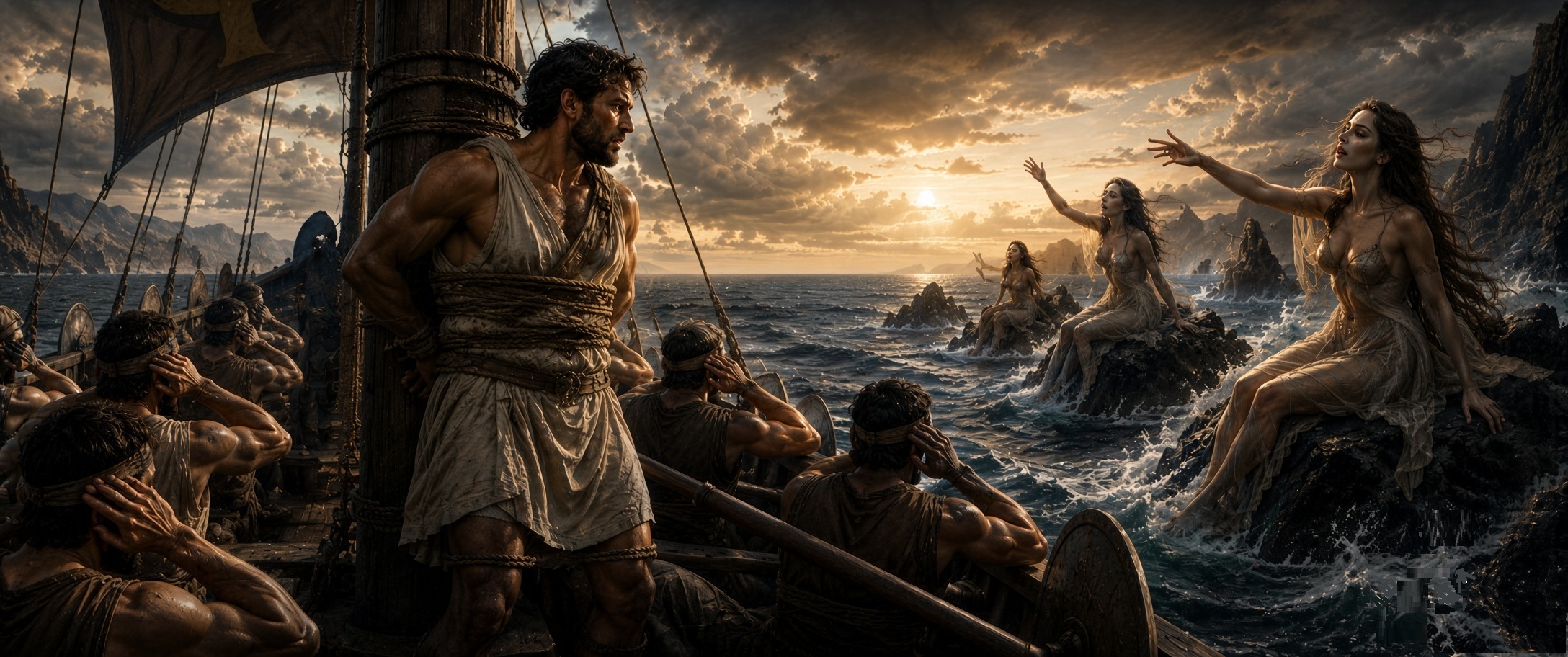
Odysseus asks his crew to tie him to the ship’s mast to avoid the Sirens’ lure
The true hero sees the temptress for what she is: not evil, but a test of commitment. He feels the pull toward comfort, acceptance, intimacy, and the restoration of familiar bonds, yet refuses to abandon his path merely to stop feeling alone. Passing this trial deepens his resolve. He learns that connection is worth having only when it can coexist with self-respect.
9. Atonement with the Father: Becoming One with the Masculine Principle
Joseph Campbell writes:
“For the ogre aspect of the father is a reflex of the victim’s own ego—derived from the sensational nursery scene that has been left behind, but projected before, … sealing the potentially adult spirit from a better balanced, more realistic view of the father, and therewith of the world… But this requires an abandonment of the attachment to ego itself; and that is what is difficult. One must have a faith that the father is merciful, and then a reliance on that mercy. Therewith, the center of belief is transferred outside of the bedeviling god’s tight scaly ring, and the dreadful ogres dissolve.”
Campbell’s language here can be dense, and some may find this passage difficult to unpack. Put more plainly, he is describing how a child’s early image of the father can continue to shape the adult man’s relationship with authority, masculinity, and the world itself.
When a child experiences the father as frightening, controlling, judgmental, or overwhelmingly powerful, that image can get stuck in his mind. Even after he grows up, he may keep projecting that childhood version of “the father” onto authority, morality, society, God, and even masculinity itself.
So the “ogre father” is not necessarily the actual father as he really is. It is partly an image created and preserved by the child’s own ego: the frightened, dependent part of the self that still sees authority through childhood eyes.
Campbell’s point is that a man cannot fully mature while he remains psychologically trapped in that old relationship. If he keeps seeing the father principle only as something oppressive that must be feared, resisted, pleased, or rebelled against, then he is still reacting like a child.
The difficult step is giving up some of that ego attachment. In other words, he has to stop making his whole identity revolve around his old fear, resentment, guilt, or rebellion.
When Campbell says a man must have faith that “the father is merciful,” we take him to mean that the deeper principle represented by the father—order, authority, reality, discipline, judgment—is not simply out to crush him. Once he can trust that and stop viewing it entirely through the lens of childhood fear, the monster disappears.
In the Manomyth, that Atonement with the Father marks a profound shift. The hero stops fighting the father principle as the tyrannical Ogre of nursery rhymes or the oppressive patriarch painted by gynocentric culture. He no longer sees traditional masculine authority, discipline, stoicism, and self-mastery as enemies to slay. Instead, he recognizes them as models to examine, refine, and integrate. The “father” is not an external monster but the archetypal force of ordered, sovereign manhood that he can now embody.
This atonement dissolves the false binary of rebellion versus submission. The hero abandons the ego-driven narrative that kept him trapped in perpetual boyhood or reactive anger. He drops the self-generated dragons of guilt and resentment. In their place comes a realistic embrace of masculine heritage—the lineage of teachers, protectors, builders, artists, and thinkers who came before him. He no longer needs either to imitate fathers blindly or reject them reflexively. He chooses what is worthy and makes the father principle his own.
The result of this hard-won integration is simple yet transformative. The hero can finally declare: “I and the father are one.” He stands at-one with the deep masculine. No longer at war with himself or dependent on the tribe’s permission to inhabit his own nature, he moves forward with clarity, strength, and unapologetic male authority.
This integration also ends his dependence on biology or inherited expectation alone to dictate his role. Instinct may still incline him toward protection, provision, competition, bonding, or sacrifice, and family tradition may still exert a powerful pull. But neither instinct nor tradition is sovereign. Consciousness now mediates the impulse. He can ask who benefits, what is reciprocal, what the cost will be, whether the bond is worthy of the sacrifice, and whether the act expresses his values or merely repeats his conditioning.
10. Apotheosis: The Hero Becomes the Realized Man
In Joseph Campbell’s monomyth, Apotheosis is the moment of profound transformation following Atonement with the Father. The hero undergoes a symbolic death and rebirth, transcending his former limited self. He achieves a divine-like state—an expansion of consciousness where the boundaries between human and transcendent dissolve. No longer bound by fear or ego, he recognizes his unity with the deeper powers of existence and gains the freedom that comes with it.
In the Manomyth, this stage marks the point where the male hero is increasingly unbound by former blue-pill fears. The terror of female disapproval, family disappointment, social ostracism, loneliness, and the need for external validation begins to lose its authority over him. This does not mean he has become indifferent to people. It means affection no longer requires obedience, and rejection no longer automatically sends him back into the old script. He now possesses the inner keys to authentic masculine freedom: unapologetic self-direction, emotional sovereignty, disciplined purpose, and the ability to remain himself in the presence of social pressure.
This mirrors Nietzsche’s ideal of the Übermensch—the God-man who creates his own values and stands beyond conventional slave morality. It also resonates with the Christian and Eastern Orthodox traditions of theosis or divinization: the process by which a person partakes in the divine nature through grace, becoming more fully what he was meant to be—not by becoming God in essence, but by reflecting and participating in divine qualities such as freedom, wisdom, strength, and creative power.
The hero does not float above humanity; he becomes the fullest expression of self-mastered manhood. Freed from illusion, he can stand among family, friends, colleagues, lovers, and strangers without needing any of them to certify his worth. He walks the earth with quiet authority—master of his domain, creator of his own meaning, and bearer of hard-won masculine light.
In practical terms, apotheosis is authorship. The man is no longer satisfied merely to tell the story of what happened to him. He begins to author and own the story of what happens next. His past may explain him, but it no longer commands him. He becomes capable of building a life in which work, friendship, family, solitude, love, service, and ambition are selected and ordered rather than inherited as demands. Some old relationships may survive in a healthier form. Others may fall away. Neither outcome determines his worth.
11. The Ultimate Boon: Absolute Freedom
Joseph Campbell illustrates this moment with the classic example of the Buddha:
“The Buddha’s victory beneath the Bo Tree is the classic Oriental example of this deed. With the sword of his mind he pierced the bubble of the universe—and it shattered into nought. The whole world of natural experience, as well as the continents, heavens, and hells of traditional religious belief, exploded—together with their gods and demons. But the miracle of miracles was that though all exploded, all was nevertheless thereby renewed, revivified, and made glorious with the effulgence of true being.”
In the Manomyth, the Ultimate Boon is the hard-won mindset of personal freedom. After enduring the trials, integrating the father principle, and transcending his former limitations, the hero pierces the bubble of gynocentric illusion. The entire edifice—the myths of female superiority, male disposability, mandatory providerhood, romantic salvation, compulsory sacrifice, and shame-based belonging—begins to shatter. What once seemed like an unquestionable social reality is revealed as a set of expectations he can evaluate rather than obey.
Yet, like the Buddha’s enlightenment, this is not nihilistic destruction. The world is renewed because his relationship to it has changed. The same society, laws, women, workplaces, families, friendships, and institutions still exist. He may participate in all of them. The difference is that none automatically owns him. He can love without worship, remain close to family without surrendering judgment, maintain friendships without performing an approved persona, and work without making employment the source of his identity. No longer driven by fear of loneliness, ostracism, or judgment, he lives from his own center. His time, energy, resources, loyalties, and purpose are his to direct. He has achieved the Ultimate Boon: the knowledge that his value is not contingent on being useful enough to earn a place in someone else’s life.
This is the liberated state that the journey prepared him for. He has not necessarily escaped society, abandoned work, or severed every bond. He has escaped the belief that acceptance must be purchased with self-erasure. He can remain in the world, and among the people he chooses, without surrendering authorship of his life.
RETURN
Having claimed the Ultimate Boon, the hero now faces the final challenge: bringing his hard-won wisdom back into the ordinary world. Whether reluctant or ready, he stands before the return threshold.
12. Refusal of Return: The Black Pill Cynicism
Joseph Campbell characterizes the Refusal of Return as follows:
“When the hero-quest has been accomplished, through penetration to the source, or through the grace of some male or female, human or animal, personification, the adventurer still must return with his life-transmuting trophy. The full round, the norm of the monomyth, requires that the hero shall now begin the labor of bringing the runes of wisdom, or the Golden Fleece, back into the kingdom of humanity, where the boon may redound to the renewing of the community, the nation, the planet, or the ten thousand worlds. But the responsibility has been frequently refused. Even the Buddha, after his triumph, doubted whether the message of realization could be communicated, and saints are reported to have passed away while in the supernal ecstasy. Numerous indeed are the heroes fabled to have taken up residence forever in the blessed isle of Immortal Being.”
In the Manomyth, this stage manifests as Black Pill cynicism: the refusal to return because withdrawal feels safer than risking the world again. And there is something here that deserves more compassion than condemnation. A man does not usually arrive at this place because nothing happened to him. He may have been betrayed by a wife or partner, separated from his children, financially gutted, falsely accused, humiliated, discarded after years of provision, or repeatedly shown that the institutions and relationships he trusted would not protect him. After enough injury, isolation can stop looking like defeat and begin to look like sanctuary.
That sanctuary can be profoundly attractive. In solitude there may be no family court, no romantic bargaining, no demand to prove his worth, no threat of being pulled back into an identity built around service and sacrifice. He can simplify his life, protect his resources, control his time, and reduce the number of people who have the power to hurt him. After years of chaos, predictability itself can feel like freedom. A man who has been burned badly enough can be forgiven for deciding that the safest fire is the one he never approaches again.

And some period of retreat may be exactly what he needs. There is nothing inherently pathological about solitude, caution, guardedness, or refusing relationships that no longer make sense. A man is not obligated to remarry, date, reconcile with people who mistreated him, become socially busy, or make himself available to a world that has already taken too much from him. The Manomyth does not require a return to the old bargain. It does not demand renewed vulnerability on somebody else’s terms.
But there is a difference between choosing solitude because it genuinely suits a self-directed life and choosing isolation because fear has been promoted into a philosophy. That is the danger of the Black Pill. Its conclusions can sound like wisdom because they are often built from real injuries and real observations. Yet when every future relationship is judged by the worst relationship in the past, when every woman becomes the woman who betrayed him, when every institution is assumed to be waiting to destroy him, and when every invitation to participate in life is interpreted as another trap, caution has hardened into fatalism.
Within the logic of the Manomyth, that is not the final form of sovereignty. It is more likely fear wearing the armor of certainty. The black-pilled man may insist that he has simply seen too much to be fooled again, but wisdom should enlarge his range of choices, not steadily reduce them. Autonomy means being able to approach or withdraw, trust or distrust, participate or decline according to the reality in front of him. Fear makes the decision in advance. It says no before the evidence arrives. It eliminates risk, but it also eliminates possibility.
This is why the black-pilled life can become highly insulated without becoming especially wise or happy. The man may be safer. He may be harder to exploit. He may have fewer conflicts, fewer obligations, and fewer opportunities for betrayal. Those are not trivial gains. But safety alone is not the same thing as flourishing. If the price of never being hurt again is never being surprised, challenged, loved, useful by choice, connected on reciprocal terms, or open to anything that cannot be completely controlled, then the walls that protect him may also define the limits of his life.
The point is not to shame the man behind those walls. Quite the opposite. His caution may have been purchased at extraordinary cost, and nobody who has not paid that bill should casually tell him to lower his defenses. The question is simply whether those defenses still serve him, or whether he now serves them. Has he built a life he actually wants, or only a life in which the things he fears have less access to him? Is he peaceful, curious, engaged, and self-directed, or merely unreachable? There is a meaningful difference between a man who prefers solitude and a man who is hiding inside it.
The Refusal of Return therefore marks a subtle failure of the journey. The hero has learned how not to be controlled by the old world, but he has not yet learned how to move through it without being governed by what it once did to him. He has escaped external captivity while remaining organized around the memory of injury. His bitterness may be understandable. His withdrawal may even be temporarily necessary. But if fear continues to determine the borders of his life, then the Black Pill is not the Ultimate Boon. It is a bunker built beside it.
The completed hero does not return because he has forgotten what happened, forgiven everyone, or decided the dangers were imaginary. He returns because those dangers no longer dictate the size of his world. He can keep his boundaries without turning them into walls. He can protect himself without making protection his highest purpose. He can remain solitary where solitude nourishes him and engage where engagement enriches him. Most importantly, he can choose either without fear making the choice for him. That is the distinction between insulation and sovereignty, and it is the distinction the Black Pill has not yet crossed.
13. The Magic Flight: The Otherworld Pursues Its Own
Joseph Campbell describes this stage:
“If the hero in his triumph wins the blessing of the goddess or the god, and is then explicitly commissioned to return to the world with some elixir for the restoration of society, the final stage of his adventure is supported by all the powers of his supernatural patron. On the other hand, if the trophy has been attained against the opposition of its guardian, or if the hero’s wish to return to the world has been resented by the gods or demons, then the last stage of the mythological round becomes a lively, often comical, pursuit. This flight may be complicated by marvels of magical obstruction and evasion.”
In the Manomyth, the Magic Flight is the awakened man’s attempt to re-enter ordinary society after his long sojourn in the Twilight Zone. He carries the ultimate boon yet discovers that the otherworld of initiation does not easily let him go. The red-pill communities, black-pill prophets, manosphere mentors, and digital brotherhoods that shaped him, may now resent his exit. They pursue him with accusations of betrayal, warnings that he is “leaking” or “going blue-pill,” and constant reminders that the ordinary world will destroy him. Some demand he remain forever on the fringes as a full-time warrior or monk. Yet the true hero possesses supernatural aids — inner clarity, strategic detachment, and hard-won wisdom. His flight becomes a skillful dance of evasion. He moves through both worlds lightly, revealing only what serves him and maintaining strong boundaries even with his former brothers. Sometimes comical, sometimes tense, this phase teaches him how to live in the world without being of it — and how to leave the otherworld of trials and initiations without rejecting the truths he gained there. He now lives his hard-won freedom on his own terms, deciding whether — and how much — to share his elixir with others.
14. Rescue from Without: The World Calls Him Back
Joseph Campbell writes:
“The hero may have to be brought back from his supernatural adventure by assistance from without. That is to say, the world may have to come and get him. For the bliss of the deep abode is not lightly abandoned in favor of the self-scattering of the wakened state. ‘Who having cast off the world,’ we read, ‘would desire to return again? He would be only there.’ And yet, in so far as one is alive, life will call. Society is jealous of those who remain away from it, and will come knocking at the door. If the hero is unwilling, the disturber suffers an ugly shock; but on the other hand, if the summoned one is only delayed—sealed in by the beatitude of the state of perfect being (which resembles death)—an apparent rescue is effected, and the adventurer returns.”
In the Manomyth, the Rescue from Without is the moment when ordinary society — friends, family, former colleagues, or even the rare perceptive woman — reaches out to draw the sovereign man back among them. After long immersion in the profound peace of absolute masculine independence, he may feel little urgency to re-engage. The bliss of minimal obligations, retained resources, and mental clarity is deeply seductive. Yet this call meets a man who is now willing to have a life among others again — not out of neediness or old gynocentric programming, but from the fullness of a life well lived. People around him begin to sense the depth of his newfound wisdom. They notice his calm confidence, unshakeable boundaries, and quiet authority. Old friends message him to “hang out again,” family urges him to be present for aging parents, or new opportunities appear. In today’s gender zeitgeist, this “rescue” often arrives in soft disguises — appeals to legacy, shared history, or mutual benefit — but the hero responds entirely on his own terms. The rescue, when accepted, becomes conscious integration. He steps back into the world selectively, carrying his boon openly. No longer its servant, he moves as its quiet master — engaging life richly while remaining fully sovereign.
15. Crossing the Return Threshold
Joseph Campbell captures the profound difficulty of this stage:
“The two worlds, the divine and the human, can be pictured only as distinct from each other. Nevertheless — and here is a great key to the understanding of myth and symbol — the two kingdoms are actually one. The realm of the gods is a forgotten dimension of the world we know… The first problem of the returning hero is to accept as real, after an experience of the soul-satisfying vision of fulfillment, the passing joys and sorrows, banalities and noisy obscenities of life… [T]he work of representing eternity in time, and perceiving in time eternity, cannot be avoided.”
In the Manomyth, Crossing the Return Threshold is the hero’s deliberate integration of his hard-won wisdom back into the ordinary world. He installs his new wisdom as a permanent operating system: calm boundaries, unapologetic self-priority, indifference to gynocentric shaming, and a life built on his own values. The Twilight Zone insights now shape how he works, relates, spends his time, and carries himself daily. If he chooses, compassion moves him to share this boon with other men still trapped in the matrix. As the old saying goes, if a wise man is not helping another man, he is harming another man. He may write, mentor, speak plainly, or simply live as a living example — not as a missionary or revolutionary, but as one who quietly refreshes the spoken word for those ready to hear it. He does this without illusion: he knows that most will rationalize his message into nonentity, yet he offers it anyway from a place of detached generosity. This crossing over is subtle and ongoing. The hero no longer lives in the gynocentric world as before, nor does he permanently hide from it. He walks between the two kingdoms — now revealed as one — translating the unspeakable freedom of the deep into the language of everyday masculine life.
16. Master of Two Worlds: Freedom Between Solitude and Society
Joseph Campbell writes:
“Freedom to pass back and forth across the world division, from the perspective of the apparitions of time to that of the causal deep and back—not contaminating the principles of the one with those of the other, yet permitting the mind to know the one by virtue of the other—is the talent of the master. The Cosmic Dancer, declares Nietzsche, does not rest heavily in a single spot, but gaily, lightly, turns and leaps from one position to another. It is possible to speak from only one point at a time, but that does not invalidate the insights of the rest.”
In the Manomyth, the Master of Two Worlds is the fully realized sovereign man who moves freely between two realities: the deep, enlightened solitude of masculine independence and the ordinary social world. Psychologically, he inhabits the calm, self-authored inner kingdom where gynocentric illusions hold no power. In the real world, he can step into society—work, family, friendships, even a selective pair-bond relationship—without becoming contaminated by its demands or losing his center. He is neither hermit nor participant; he is the Cosmic Dancer Nietzsche envisioned—moving lightly between worlds without resting heavily in either.
This mastery grants him immense practical freedom. He can enjoy deep solitude for renewal and clarity, then re-enter the social realm on his own terms — engaging warmly when it serves him, withdrawing instantly when it does not. He no longer contaminates his sovereign principles with blue-pill expectations, nor does he let worldly noise disturb his inner silence. The same man who sits content in peaceful aloneness can also laugh with friends, advance his career, or share time with a perceptive woman, all while remaining untouched at the core. He has become the true master: light-footed, unburdened, and whole. Solitude nourishes him; society no longer owns him. The fluid movement between worlds is the living expression of his completed journey.
17. Freedom to Live
Freedom to Live is not another form of mastery. It is what becomes possible after mastery is no longer something the hero must constantly demonstrate.
The man who reaches this stage is no longer organizing his life around resistance. He does not need to prove that he has escaped the gynocentric script, advertise his independence, win every argument, or remain permanently vigilant against manipulation. The old world has lost its authority over him, but it has also lost its ability to occupy his mind.
This is the final liberation: not merely freedom from institutions, expectations, or unhealthy relationships, but freedom from the internal compulsions those forces created. He is no longer driven by the need for female approval, social recognition, vindication, revenge, or ideological purity. He can remember what happened without living inside it.
His life is now directed by preference rather than reaction. He works because the work matters to him. He creates because something within him seeks expression. He enters relationships because they enrich his life, not because he fears solitude or needs validation. He may mentor, build, travel, love, withdraw, compete, rest, or begin again. None of these choices must justify his existence.
The past becomes instruction rather than identity. Betrayals, losses, humiliations, and wasted years remain part of his story, but they are no longer the author of it. The future also loses its power to terrorize him. He prepares where preparation is useful, but he no longer sacrifices the present to imagined catastrophes.
Freedom to Live is therefore the end of compulsory masculinity. The hero no longer exists chiefly as provider, protector, servant, combatant, or corrective force. He may perform any of those functions when he chooses, but none of them defines his worth.
He has reclaimed the most fundamental possession a man can have: authorship of his own life. Every breath is his own. Every commitment is chosen. Every day belongs to him.
Conclusion
The Manomyth is now complete. The hero who answered the Call now possesses the Freedom to Live.
Joseph Campbell reminds us of the deeper meaning of this path:
“But there is another way—in diametric opposition to that of social duty and the popular cult. From the standpoint of the way of duty, anyone in exile from the community is a nothing. From the other point of view, however, this exile is the first step of the quest. Each carries within himself the all; therefore it may be sought and discovered within. The differentiations of sex, age, and occupation are not essential to our character, but mere costumes which we wear for a time on the stage of the world… What is the core of us? What is the basic character of our being?”
This arduous journey exacts a heavy price: comfort, illusions, old relationships, and the warm anesthesia of the blue-pill script. Yet it pays dividends in a currency far more precious— the freedom to live by one’s own values as a man.
Campbell continues:
“The modern hero, the modern individual who dares to heed the call and seek the mansion of that presence with whom it is our whole destiny to be atoned, cannot, indeed must not, wait for his community to cast off its slough of pride, fear, rationalized avarice, and sanctified misunderstanding. ‘Live,’ Nietzsche says, ‘as though the day were here.’ It is not society that is to guide and save the creative hero, but precisely the reverse. And so every one of us shares the supreme ordeal—carries the cross of the redeemer—not in the bright moments of his tribe’s great victories, but in the silences of his personal despair.”
A growing number of men are finally recognizing the counterfeit roles that have been offered in place of a full masculine identity. To every man still hearing the Call: the path is real. The trials are severe. The reward is beyond what the ordinary world can ever promise. The Minotaur is not undefeatable, and the whale’s belly is not a tomb but a womb. And on the far side of the return threshold waits the life you were always meant to live — free, sovereign, and unmistakably your own.
The Manomyth is not legend. It is the living path of masculine awakening in our time. Walk it, and become the man the old world could never allow you to be.