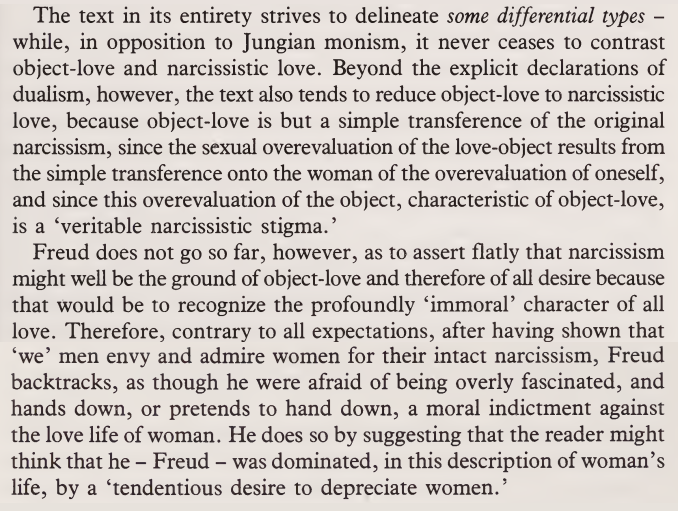
The following argument is simple. A girl is not required to give up as much of her primary narcissism as a boy is on his developmental journey. Romantic chivalry helps provoke that exemption in the family, then takes it over as a broader social contract. By adulthood the exemption is no longer only a private residue. It is a social situation: elevation on one side, tribute on the other.
Three different accounts are at play—Freud’s infantile narcissism, Millon’s grandiose narcissism, and Kohut’s vulnerable narcissism—each remaining a distinct construct. In the gynocentric life-cycle they tend to overlap, forming a state which can be more or less exaggerated by situation: more likely to be switched on in heterosexual exchange, where the woman is positioned as the one to be served and the man as the one who underwrites her center. That pairing is the old chivalric assignment in modern dress: she the suzerain, he the vassal; she the elevation, he the service.
1. The family compact
Primary narcissism is the infant’s position: self as first object, wish as law, the other not yet a separate center. The baby does not begin with a shared world. Hunger, comfort, and attention arrive as if the world were an organ of the self. Other people are not yet other; they are extensions.
That position does not fade by itself. It is broken by clashes. Freud called the accumulating force of those clashes the reality principle: the breast is not the self, the parent has another will, time does not obey the wish, the body is limited, other children exist, “no” is a fact rather than an insult. Delay, refusal, rival needs, and consequences keep teaching the same lesson—the world is not an organ of the baby.
The superego is the later, inner form of that lesson. What began as an external limit (a parent’s prohibition, a demand to wait, to share, to answer for harm) is internalized as an authority that says: you are not the law; you owe; your feeling is not a warrant. Maturity, in this account, is not niceness. It is the capacity to let the pleasure-self be overruled by a shared world and by an internalized demand for responsibility.
Families often run those clashes on a double standard. Twenge and Campbell (2009) write: “A remarkable percentage of clothing for baby girls has ‘Princess’ or ‘Little Princess’ written on it, which is wishful thinking unless you are the long-lost heir to a throne. And if your daughter is a princess, does this mean that you are the queen or king? No—it means you are the loyal subject, and you must do what the princess says.” 1
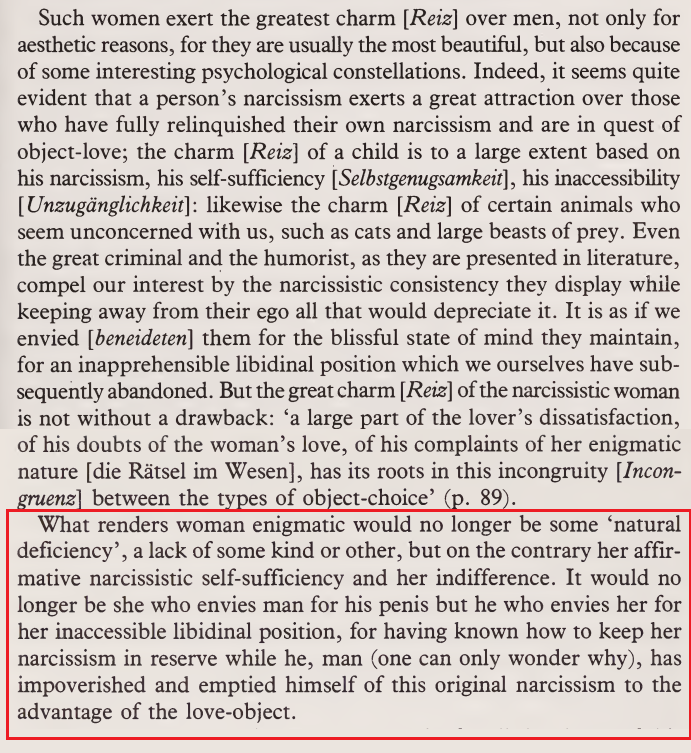
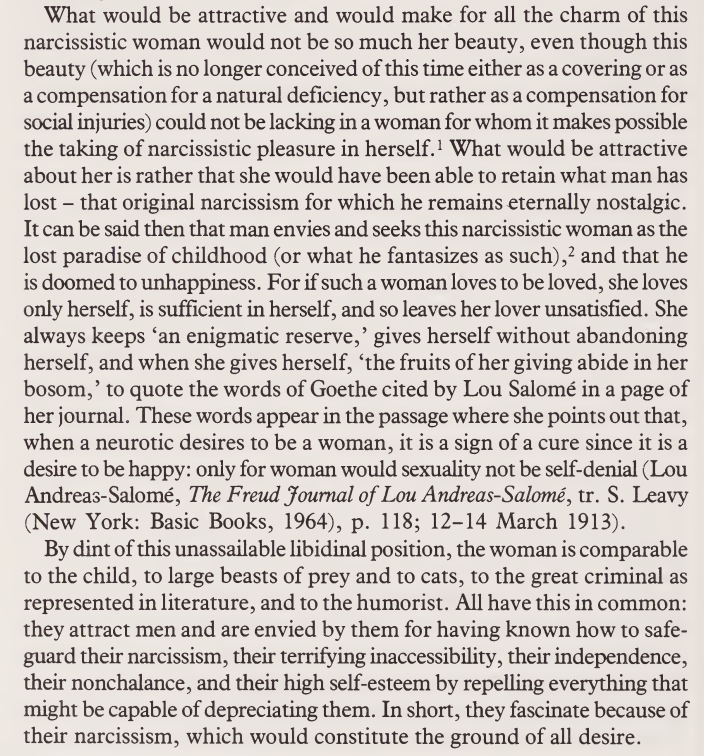
Daughters are often praised, buffered, and colluded with in the name of self-esteem. Sons are interrupted earlier: share, wait, girls-first, do not cry, be useful, your feeling is not the law. The compact is tacit. She need not relinquish as much of the infantile position.2 Typically, he must. The cost for her is a more solipsistic disposition: she is somewhat spared the demand that maturity means the world does not arrange itself around her. Reality still exists; it is simply applied with more cushion and more applause. The cost for him is emptying. That emptying later looks like duty, and later still like chivalry.
This is not a claim that no girl meets reality or that no boy is spoiled. It is a claim about uneven pressure at the first site where omnipotence is supposed to be given up.
2. The cultural compact
What the family starts, the culture finishes. Romantic chivalry is the long background tradition that says the woman’s position is to be elevated and the man’s is to serve that elevation.3 Courtesy is the polite surface of this arrangement. The compact is not issued equally.
For him, the usual path is ordinary recognition for ordinary compliance. For her, it is retained elevation—a public arrangement that exempts her from ordinary limits rather than asking her to accept them. She is not only seen: she is to be seen as if the world still turned toward her. He is assigned the tributary role of underwriting that appearance.
Robert Millman’s acquired situational narcissism4 names the same process. Narcissism need not be only a childhood scar. It can be fed by a situation in which everyone around a person treats them as extraordinary. Millman was talking about fame. The gynocentric claim is that a person’s sex, under chivalric convention, can work like a milder, lifelong fame: special status ascribed for being the woman in the pair, with etiquette, media, and moral language as the entourage that feeds it. Whether the seed was already there or not, the heterosexual situation amplifies it. A culture reproduces what it pays for.
3. Three narcissisms, in a single amalgam
The following three constructs answer different questions and should not be mashed into one diagnosis. In the life-cycle this article describes, they can be seen operating together.
- Infantile / primary (Freud): the other was never fully constituted; omnipotence was never fully given up—inaccessibility, self-sufficiency, the unmarked center.
- Grandiose (Millon): entitlement and superiority learned from overvaluation. Kernberg describes an alternative route—a defensive inflation against early hatred and envy.
- Vulnerable (Kohut): an exhibitionistic self that still needs a ‘reflecting other’ to stay intact. When that other fails, the result is injury, collapse, rage, or emptiness. Kohut treats this as continuous with primary narcissism that was never reliably mirrored and so never transformed.
They are categorically separate. In this life-cycle they cooperate. Chivalry keeps the infantile center in place (she need not empty herself into the object). Elevation and tribute invite grandiosity in the heterosexual field (priority, exemption, the other as function). The same arrangement produces vulnerability when the tribute falters: if the world was supposed to remain her mirror, neutrality feels like starvation and “no” feels like attack.
What shows up in many relations is therefore less a locked personality disorder than subclinical state narcissism5—features that swell in the situation that subsidizes them and recede when the situation is withdrawn. That is why the pattern is easiest to see in courtship, marriage theater, and the moral language of “putting her first,” and why it is easy to miss if one only looks for a cartoon tyrant.
4. The life-cycle
Girlhood: the family colludes to spare her a full encounter with the reality principle and with a demanding superego.
Youth: romantic convention meets her with a second compact—society will encourage what remains of the infantile position through culture and institutions.
Adulthood: heterosexual exchange becomes the main stage. He has been trained to relocate his abandoned narcissism into her, to live vicariously through a self-sufficiency he was not allowed to keep. She is trained to receive that relocation as weather. The pedestal he builds is the situation she occupies. That situation feeds the narcissistic amalgam.
The infantile wish is ordinary. The outcome this article describes is not. A subsidized exemption from the reality principle—solipsism, entitlement, collapse when tribute fails—is a maladaptive result, not an ancient or evolutionary norm. What is historically specific is the arrangement that pays for it. Romantic chivalry made that arrangement prevalent by giving it a moral costume: her elevation, his service. Gynocentric culture keeps paying out the contract—her incomplete displacement refunded as charm, his emptying mourned as maturity.
The point is not that women are infants or that men are saints. It is that a culture can assign who remains the baby6 and who must underwrite that remaining—and then call the assignment love.
References:
[1] Twenge, Jean M., and W. Keith Campbell. The narcissism epidemic. Tantor Media, 2009.
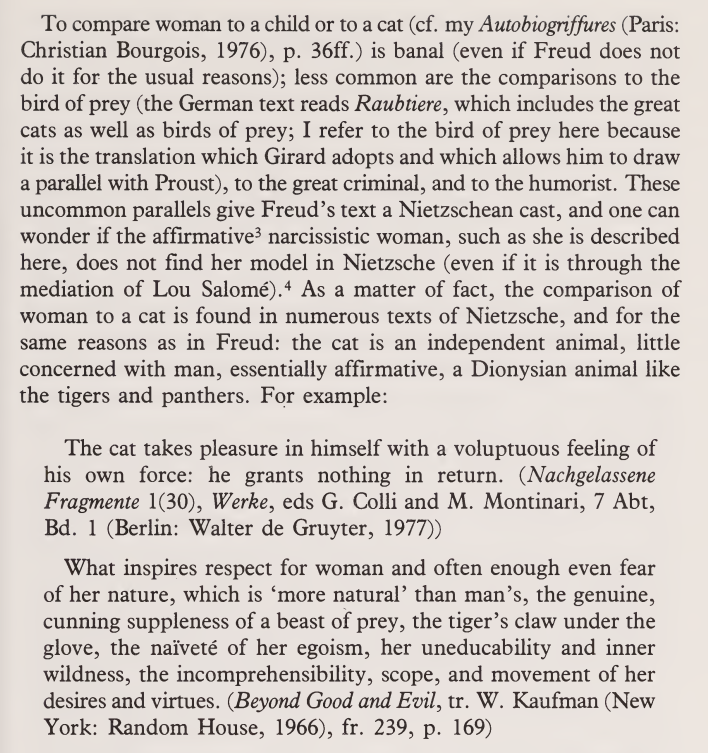
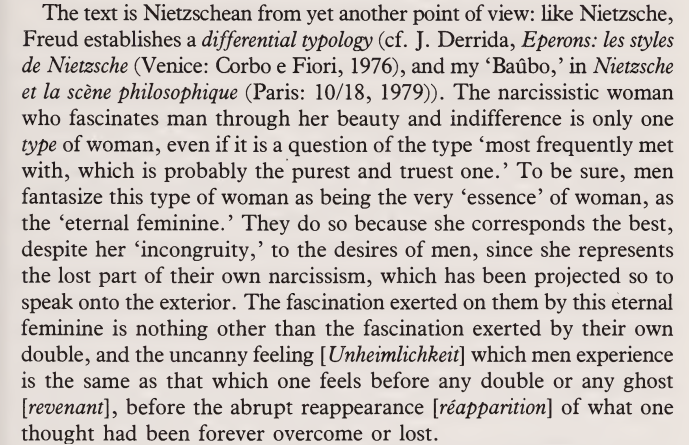
[2] Kofman, Sarah. The Narcissistic Woman: Freud and Girard. Diacritics, 1980
[3] Wright, Peter. Romantic Love as a Dyadic Cultural Script. 2026
[4] Plante, T. G. Mental Disorders of the New Millennium. Bloomsbury Publishing USA. 2006
[5] Giacomin, M., & Jordan, C. H. State narcissism. In A. D. Hermann, A. B. Brunell, & J. D. Foster (Eds.), Handbook of trait narcissism (pp. 105–111). Springer. 2018
[6] Wright, P. & Elam, P. Time to throw the baby out with the bathwater. February 13, 2022