__________
“What if the biggest obstacle to women’s individuation today isn’t patriarchy — but a culture that keeps us comfortable too long?”
__________
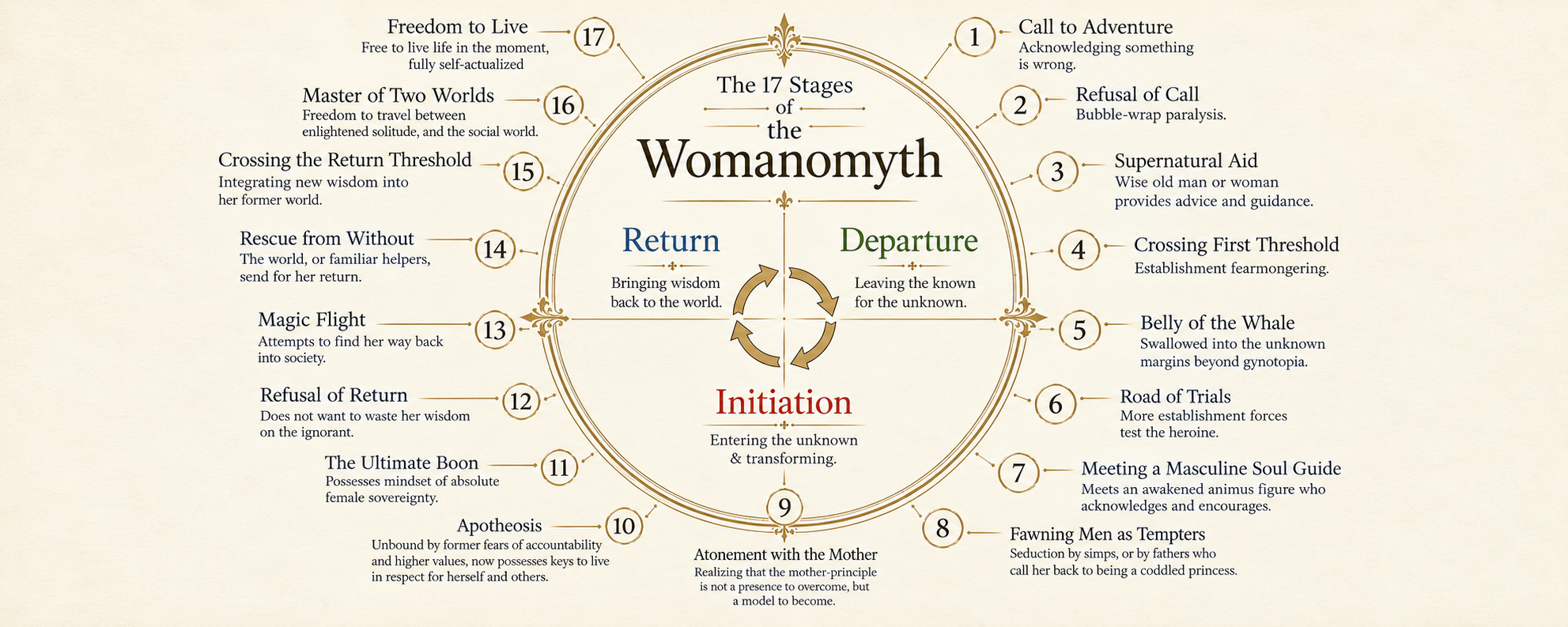
Joseph Campbell’s monomyth, the Hero’s Journey, distills thousands of years of storytelling across cultures into a universal pattern of transformation. Its three main phases—Departure, Initiation, and Return—map the movement from the ordinary world, through the crucible of trials, and back with hard-won wisdom.
In The Womanomyth, this ancient pattern illuminates a distinctly modern path for women. Historically, women often matured early, taking on responsibility, agency, and real-world accountability at younger ages. Today’s culture encourages the opposite: many women are gently steered into the protected role of daughter well into adulthood and sometimes beyond. Romantic ideals, chivalric expectations, Disney-style princess narratives, and a society that rewards perpetual emotional centrality all work to extend childhood-stage comfort long past its usefulness.
If the heroine’s journey is not undertaken, the ordinary world becomes one of extended comfort that quietly kills her potential to flourish. Institutions, media, social norms, and romantic scripts gently — and sometimes insistently — reinforce the idea that women should be protected, endlessly validated, and kept at the emotional center of life. In this environment, initiative, discomfort, and mature accountability are treated as optional and often discouraged. The heroine’s journey begins the moment a woman senses that this extended protection, while comfortable, is stunting her growth. She recognizes that remaining in this extended comfort no longer serves her deeper potential.
This is not a collective revolution but an individual exodus. What follows is her departure from the familiar nursery of gendered expectations, her initiation through trials of self-discovery, and her return as a sovereign woman grounded in agency, responsibility, and a mature appreciation of shared human value with men and women alike.
Note on adaptations: While Campbell’s monomyth includes notable female heroes (such as Psyche), it is primarily framed around male protagonists. In The Womanomyth, several stages have been thoughtfully adjusted to better reflect a feminine journey — for example, “Atonement with the Father” becomes “Atonement with the Mother,” and the traditional “Woman as Temptress” is reframed as “Fawning Men as Tempters.” These changes preserve the core structure and wisdom of the Hero’s Journey while making it more resonant for modern women.
DEPARTURE
1. The Call to Adventure: Acknowledging Something Is Wrong
The Call to Adventure arrives as an insistent inner voice or external shock that shatters the comfortable illusion of the ordinary world. In Campbell’s terms, a herald appears—something that cannot be ignored—and summons the heroine onto the path of exploration.
For the modern woman, this herald often comes through quiet disillusionment. She may notice the hollowness beneath the validation and protection, the growing restrictiveness and boredom of being perpetually cared for, or the subtle shame that surfaces when she sees how this enculturation has strained relationships with men, family, and friends. The comforting modern script — romantic ideals, chivalric rescue, and cultural messages that keep her in the role of cherished daughter — begins to feel suffocating rather than safe.
She senses that remaining in this protected role, where agency is optional and accountability is softened, has quietly stunted her growth. The discrepancy becomes too stark to dismiss: she has been told she is strong and independent, yet she sometimes feels fragile, directionless, or emotionally immature. Something feels profoundly wrong. This Call forces the uncomfortable question: If my needs are endlessly accommodated yet I remain dissatisfied, what is my actual worth beyond the role of cherished receiver?
Many women try to mute the Call with distraction, more affirmation, pampering, or renewed demands for protection. But once truly heard, it cannot be unheard. The journey toward authentic feminine maturity and adult agency has begun.
2. Refusal of the Call: Bubble-Wrap Paralysis
“Often in actual life, and not infrequently in the myths and popular tales, we encounter the dull case of the call unanswered; for it is always possible to turn the ear to other interests. Refusal of the summons converts the adventure into its negative. Walled in boredom… the subject loses the power of significant affirmative action and becomes a victim to be saved. His flowering world becomes a wasteland of dry stones and his life feels meaningless… All he can do is create new problems for himself and await the gradual approach of his disintegration.”
In the Womanomyth, this refusal appears as Bubble-Wrap Paralysis. She has sensed the Call — the quiet dissatisfaction beneath her comfortable life — yet turns away. She doubles down on the familiar script: seeking constant reassurance, avoiding discomfort, and remaining wrapped in layers of emotional safety, chivalric protection, and social approval. Insulated by romantic narratives and cultural messages that encourage her to stay dependent, she tells herself that staying within these known boundaries will eventually bring fulfillment.
Her identity has fused with this zone of safety. The fear of losing comfort, facing uncertainty, or stepping into full adult agency keeps her frozen. She maintains the environment that shields her, choosing the reassurance of familiar protections over the terror of real growth and accountability. Life gradually becomes a wasteland of superficiality and unfulfilled potential. Many women remain here until a harsher Call finally breaks through the wrapping.
3. Supernatural Aid: Wise Old Man or Woman Provides Advice and Guidance
Joseph Campbell writes: “For those who have not refused the call, the first encounter of the hero-journey is with a protective figure… who provides the adventurer with amulets against the dragon forces he is about to pass.”
In the Womanomyth, this protective figure rarely appears as a literal wizard. Instead, the heroine encounters the voice of a wise old man or woman — sometimes a living mentor, more often the resurrected words of clear-sighted thinkers, authors, or elders who saw beyond the prolonged comforts of the modern daughter role long before her. These guides offer honest maps and gentle but firm truths precisely when the dragons of social approval, chivalric protection, and familiar romantic narratives begin to circle.
Their wisdom serves as the first true amulet. It gently challenges the illusions of perpetual safety and emotional centrality, helping her see the cost of remaining in extended childhood. Armed with their clarity, she steps forward no longer disoriented, but carrying distilled insight from those who have walked the path of mature agency ahead of her. Whether through a trusted elder, a perceptive book, or an awakened voice that cuts through the noise, this supernatural aid reassures her that she does not walk the unfamiliar path alone. The journey deepens.
4. Crossing the First Threshold: Establishment Fearmongering Designed to “Keep a Woman in Her Place”
Joseph Campbell describes the threshold guardians who stand at the boundary of the known world, warning the hero of danger beyond. Popular belief gives every reason to fear the first step into the unexplored. He writes, quote:
“With the personifications of his destiny to guide and aid him, the hero goes forward in his adventure until he comes to the ‘threshold guardian’ at the entrance to the zone of magnified power… Beyond them is darkness, the unknown, and danger; just as beyond the parental watch is danger to the infant and beyond the protection of his society danger to the member of the tribe. The usual person is more than content, he is even proud, to remain within the indicated bounds, and popular belief gives him every reason to fear so much as the first step into the unexplored.”
In the Womanomyth, these guardians wear familiar modern faces: media voices, social institutions, wellness influencers, and peer networks. As the woman, newly armed with honest guidance, attempts to step beyond the zone of prolonged safety and comfort, the establishment unleashes its warnings: “You’ll be alone forever.” “Going your own way instead of staying with consensus is selfish.” “Without constant protections and validation, you’ll fail or regret it.”
The threats are rarely subtle: loss of social approval, accusations of internalized misogyny, or ostracism from familiar circles. These “monsters of the deep” can feel like pressures designed to keep her centered in the familiar nursery of expectations.
The true heroine crosses anyway. She recognizes these guardians as desperate sentinels of a limiting paradigm. Beyond the threshold lies uncertainty, but also magnified power: reclaimed agency, the development of real accountability, and the possibility of genuine maturity. Crossing demands courage. The open path of authentic womanhood awaits.
5. Belly of the Whale: Swallowed into the Unknown Margins of Society
Joseph Campbell explains this pivotal moment: “The hero… is swallowed into the unknown, and would appear to have died.”
In the Womanomyth, once she crosses the first threshold and defies the fearmongering, the heroine is not met with celebration but with engulfment. To the world that celebrated her as the cherished daughter, she has effectively disappeared. Friends and family may label her cold, selfish, or “lost,” while the broader culture writes her off as someone who has rejected her proper place. She finds herself in the quiet margins — living with less automatic protection, fewer excuses, and no guaranteed deference.
This is the dark womb of rebirth. Stripped of her former insulation, she begins the slow process of digestion: breaking down old narratives of perpetual vulnerability and learning to accept accountability for her own actions and their impact on others. Discomforts and failures can no longer be automatically blamed on failed caregivers or external protectors. In this symbolic death, old patterns of entitlement dissolve and the raw material for a more responsible, self-authored woman begins to form.
INITIATION
6. Road of Trials: More Establishment Forces Test the Heroine
Joseph Campbell writes: “Once having traversed the threshold, the hero moves in a dream landscape of curiously fluid, ambiguous forms, where he must survive a succession of trials.”
In the Womanomyth, the Road of Trials strikes with new intensity. Having stepped beyond the zone of prolonged comfort, the heroine now faces repeated tests from establishment forces: social pressure to return to familiar roles, loss of easy validation, and the daily challenge of maintaining discipline when no one is cushioning her path. Relational aggression looms among women; female friend groups, in particular, can sometimes respond with tension when she prioritizes her own growth without seeking the group’s permission, guidance, or collective approval.
Campbell illustrates this stage with the figure of Psyche in Roman mythology. After being cast out and separated from her beloved, Psyche is given a series of seemingly impossible tasks by the jealous goddess Venus. She must sort a vast, chaotic heap of mixed grains and seeds before nightfall; collect golden wool from dangerous wild sheep whose bites are poisonous; fetch water from a freezing, dragon-guarded spring high on an inaccessible mountain; and finally descend into the underworld itself to retrieve a box of supernatural beauty. Each task feels insurmountable. Yet through humility, resourcefulness, and unexpected aid Psyche completes them all.
These trials strip away remaining illusions. Like Psyche, the modern heroine learns to carry real responsibility instead of emotional outsourcing and group conformity, and to face consequences without defaulting to familiar defense mechanisms. Old patterns of dependency are challenged. Yet through these fires, she also discovers unexpected strengths—resilience, clearer thinking, and a growing sense of authentic agency. The wisdom she carries acts as both map and shield. Small wins begin to accumulate. She is no longer merely surviving the tests—she is slowly learning how to thrive as a mature woman on her own terms.
7. Meeting a Masculine Soul Guide: The Animus Figure Who Acknowledges and Encourages
Joseph Campbell describes this encounter as the triumphant hero-soul entering a mystical marriage with a divine figure — typically a male hero meeting a goddess in his examples. For the Womanomyth, this figure appears as a god or holy masculine guide. This meeting, he says, occurs at the nadir, the zenith, or the very edge of existence — within the deepest chamber of the heart.
This encounter often arrives after a low point in the trials. Its most important form is internal: an awakened masculine principle within her own psyche, steady and clear-eyed, that stops narrating her as fragile or in need of rescue. Where old scripts offered pedestalization or protection, this inner voice offers something plainer — the assumption that she can bear weight.
Sometimes this principle finds a mirror in an actual man. When it does, he does not coddle or flatter her into old patterns; he simply treats her competence as unremarkable, her respect of boundaries as legitimate, her accountability as expected rather than exceptional. But the relationship, if one exists, is confirmation of a shift that already happened inside her — not the origin of it. She does not need him to arrive for the shift to hold. For the first time, she may experience masculine energy as supportive rather than something to manipulate or fear.
This meeting can be with a real man, a profound inner dialogue, or both. It establishes a new standard—respect earned rather than demanded, boundaries honored without negotiation, accountability modeled without shame. It heals old wounds and reignites vital feminine energy—an essential waypoint on the path toward integrated womanhood.
8. Fawning Men as Tempters: Simps, or Fathers Who Call Her Back To Being a Coddled Princess
In Campbell’s framework, after meeting the Goddess, the hero encounters the Temptress — the archetype of worldly seduction that threatens to derail the quest.
In the Womanomyth, the tempters appear as fawning men who offer endless emotional labor, and unconditional approval in exchange for her returning to the familiar role of cherished center—a role that quietly grants them influence and control over her life. Some do it through flattery, the endless attention, deference, the promise that she’ll never have to carry weight alone again. Fathers or father-figures may also tempt her, urging her back toward the safety of being looked after in princess-like comfort, still loved, and still small. “You don’t have to do this the hard way,” the pull seems to say. “Let me handle it.”

The offer is seductive precisely because it’s real relief — restored ease, restored social comfort, an exit from the discomfort of the Road of Trials. And it costs her the thing she just earned: the sense that her own judgment is sufficient, and that she doesn’t need to be rescued to be safe.
The true heroine feels the pull and does not pretend otherwise. She simply doesn’t take the deal. What she’s protecting isn’t her isolation — it’s her authorship. Passing this trial doesn’t harden her against connection; it clarifies what kind of connection she’s willing to accept going forward.
9. Atonement with the Mother: Becoming One With The Feminine Principle
In Joseph Campbell’s monomyth, atonement with the father involves reconciling with the deep masculine principle. In the Womanomyth, the parallel moment is Atonement with the Mother.
The heroine stops viewing the mother-principle as something to rebel against or remain dependent upon. She no longer sees mature femininity as an oppressive or outdated force, nor does she cling to a childish version of it. Instead, she recognizes the positive mother archetype—generative, nurturing, resilient, and accountable—as a model she can now consciously embody. This is not necessarily reconciliation with her literal mother, though that reckoning often runs alongside it—it’s reconciliation with the principle of mature femininity itself.
As Nancy Friday explored in My Mother, Myself, this often requires facing the complex mix of love, anger, competition, and identification that daughters carry toward their mothers and also aunts, teachers, and other early models of what a grown woman is allowed to be. Working through these feelings allows the heroine to release old patterns of blame and emotional outsourcing.
This integration dissolves the false binary of eternal daughter versus rejecting mother. She releases old resentments and steps into greater personal responsibility for herself and toward others. The result is transformative: she realizes the triune goddess archetype — Daughter, Mother, and Crone — not as separate external figures to be projected outward, but as integrated aspects within one awakened woman. No longer at war with her own feminine depth, she moves forward with clarity, maturity, and authentic feminine authority.
10. Apotheosis: The Heroine Becomes the Realized Woman
In Joseph Campbell’s monomyth, Apotheosis is the moment of profound transformation. The heroine undergoes a symbolic death and rebirth, transcending her former limited self. She achieves a divine-like state — an expansion of consciousness where the boundaries between human and transcendent dissolve.
Campbell illustrates this stage with the Bodhisattva Kwan Yin (Kwannon) of China and Japan — the compassionate “regarder of the world” who attains enlightenment yet chooses to remain on the threshold of Nirvana, postponing her own final release to help all beings. As Campbell writes:
“She is blessed alike to the simple and to the wise; for behind her vow there lies a profound intuition, world-redeeming, world-sustaining. The pause on the threshold of Nirvana, the resolution to forego until the end of time (which never ends) immersion in the untroubled pool of eternity, represents a realization that the distinction between eternity and time is only apparent—made, perforce, by the rational mind, but dissolved in the perfect knowledge of the mind that has transcended the pairs of opposites. What is understood is that time and eternity are two aspects of the same experience-whole, two planes of the same nondual ineffable.”
In the Womanomyth, this stage marks the point where the heroine becomes unbound by her former fears of accountability and higher values. The terror of social disapproval, loss of special protections, and the discomfort of genuine responsibility falls away. She now possesses the inner keys to live with self-respect and respect for others — no longer needing to be the emotional center, but standing as a mature participant in shared humanity.
This is her apotheosis: a quiet expansion into authentic womanhood. Like the compassionate Bodhisattva Kwan Yin, who remains on the threshold to help others, the heroine partakes in the divine energies of compassion and wisdom. She draws on the strength, wisdom, and nurturing power of archetypal wise women and other spiritual icons who embody mature sovereignty. Freed from the need to externalize blame or cling to entitlement, she operates from her own center. She has become what she was always capable of being — a woman of integrity, resilience, and grace.
The heroine does not float above humanity; she becomes the fullest expression of self-mastered womanhood. Freed from illusion, she walks the earth with quiet spiritual authority — mistress of her domain, creator of her own meaning, and bearer of hard-won light.
11. The Ultimate Boon: Absolute Freedom
Joseph Campbell illustrates this moment with the classic example of the Buddha:
“The Buddha’s victory beneath the Bo Tree is the classic Oriental example of this deed. With the sword of his mind he pierced the bubble of the universe—and it shattered into nought. The whole world of natural experience, as well as the continents, heavens, and hells of traditional religious belief, exploded—together with their gods and demons. But the miracle of miracles was that though all exploded, all was nevertheless thereby renewed, revivified, and made glorious with the effulgence of true being.”
In the Womanomyth, the Ultimate Boon is the hard-won mindset of absolute female sovereignty. After enduring the trials and integrating the mature mother-principle, the heroine pierces the bubble of prolonged childhood conditioning. The myths of perpetual vulnerability, endless entitlement, and moral exemption dissolve. What once felt like unassailable reality loses its power over her.
Yet this is not destruction — it is renewal. The same world, relationships, and cultural scripts still exist, but they no longer define her worth or dictate her behavior. She is free. No longer driven by the need for constant validation or protection, she lives from her own center. Her time, energy, choices, and moral responsibility belong to her. She has claimed the ultimate boon: the unshakeable knowledge that she is enough as a sovereign individual, seeking mutual respect and shared humanity among men and women alike.
RETURN
12. Refusal of Return: Does Not Want to Waste Her Wisdom on the Ignorant
Joseph Campbell notes that even after winning the boon, many heroes hesitate to return. The responsibility of bringing wisdom back into the world is frequently refused.
In the Womanomyth, this refusal appears as a sharp withdrawal. Having attained the mindset of absolute female sovereignty, the heroine now feels reluctant to re-enter ordinary life. She thinks, “They won’t understand,” “It’s not worth the effort,” or “Why should I share this with people still trapped in the old script if they’ll just attack me for it?” She may retreat into solitude, intellectual isolation, or elitist detachment, choosing to withhold her hard-won insights rather than risk misunderstanding or rejection.
While understandable after the long journey, this refusal keeps her boon locked away. True sovereignty includes the freedom to return — or not — on her own terms, without bitterness. The woman who remains permanently withdrawn possesses the wisdom but withholds its light. The full heroic cycle remains incomplete until she is willing to consider how (and with whom) her transformation might serve a larger good.
13. Magic Flight: The Otherworld Pursues Its Own
Joseph Campbell describes the Magic Flight as the lively, often tense stage in which the hero, carrying the boon, must skillfully navigate re-entry while the otherworld tries to pull him back.
In the Womanomyth, the Magic Flight is the heroine’s attempt to reintegrate into ordinary society after her long immersion in the margins. She carries the mindset of absolute female sovereignty, yet discovers that the world of initiation does not easily release her. The rarer insightful men and women who once guided her may now resent her departure. They might accuse her of “selling out,” “softening,” or dismiss her as a “traitor to women” for daring to re-engage with the broader world.
Old social circles may test her with subtle pressure to return to familiar roles — of Disney girlhood, pampered tradwife, or a feminism that asks her to trade her agency for grievance. Her flight becomes a graceful dance of boundaries and discernment. Armed with inner clarity, she moves between worlds lightly — revealing only what serves, maintaining strong limits, and refusing to be pulled back into either superficial comfort or permanent isolation. This phase teaches her how to live in the world without being of it, carrying her sovereignty with quiet confidence as she finds her place in society once more.
14. Rescue from Without: The Old World Calls Her Back
Joseph Campbell writes that sometimes the hero must be brought back from the supernatural adventure by assistance from without. The world itself comes knocking.
In the Womanomyth, the Rescue from Without arrives when ordinary life — family, friends, colleagues, or even perceptive men and women — reaches out to draw the sovereign heroine back among them. After the profound peace of her solitary integration, she may feel little urgency to re-engage. The comfort of independence and clarity is deeply satisfying.
Yet the world senses the depth she now carries. People notice her calm confidence, clear boundaries, and quiet maturity. Old connections reappear with invitations, opportunities arise, or loved ones simply ask her to be present again. This “rescue,” when accepted, becomes conscious integration. She steps back into relationships and society selectively, no longer from need or old programming, but from the fullness of her own sovereignty. She returns not as a receiver, but as a mature participant ready to give and receive on equal terms.
15. Crossing the Return Threshold
Joseph Campbell captures the difficulty of this stage: the two worlds — the divine and the human — are actually one. The returning hero must now represent eternity in time and accept the banalities of ordinary life after the soul-satisfying vision of transformation.
In the Womanomyth, Crossing the Return Threshold is the heroine’s deliberate integration of her hard-won sovereignty back into daily existence. She installs her new wisdom as a permanent operating system: calm accountability, mutual respect, emotional self-regulation, and a balanced view prioritizing shared human value between men and women.
Old habits of prolonged adolescence and emotional outsourcing lose their grip. Discomfort now triggers ownership instead of blame. If she chooses, she shares her insights with other women still trapped in the old matrix — not as a missionary, but through quiet example and honest words. This crossing is subtle and ongoing. She walks between kingdoms now revealed as one: fully sovereign, translating the freedom of her inner journey into the language of everyday mature womanhood.
16. Master of Two Worlds: Freedom Between Solitude and Society
Joseph Campbell describes the Master of Two Worlds as the ‘Cosmic Dancer’ who moves lightly between the perspective of time and the deep causal realm, without contaminating the principles of one with the other.
In the Womanomyth, this stage marks the matured woman who moves freely between two realities: the deep peace of enlightened solitude and the ordinary social world. She can withdraw into quiet self-renewal without guilt, then re-enter relationships, work, and community on her own terms. She is neither hermit nor constant participant — she is the graceful dancer.
This mastery brings immense freedom. She enjoys rich solitude for clarity and strength, then engages warmly with others when it serves mutual value. No longer pulled by old needs for validation or protection, she maintains strong boundaries while remaining open to genuine connection. She has become whole: capable of deep independence and meaningful interdependence, grounded in self-respect and respect for others. The fluid movement between worlds is the living expression of her completed journey.
17. Freedom to Live
Freedom to Live is the culmination of the Womanomyth — the liberated state in which the heroine finally dwells completely in the present moment. Yesterday’s grievances, old patterns of dependency, and former identities no longer chain her. Tomorrow’s anxieties lose their grip. The trials, the integration of accountability, and the mastery of both solitude and society have burned away neurotic attachment to outcomes.
She now lives lightly yet powerfully. Relationships are enjoyed without desire for manipulation or need for constant validation. Work and purpose are pursued with clarity rather than performance. Time is spent on what truly nourishes her — creation, connection, growth, and quiet presence. She no longer needs to center herself in every narrative or outsource responsibility for her happiness and emotional regulation.
This is the ultimate boon fully embodied: a woman who has reclaimed her life. Every day is lived on her own terms, with self-respect and respect for others. A heroine returned, not to demand the old comforts, but to inhabit the world — and herself — with unapologetic freedom and mature humanity.
Conclusion: The Self-Directed Woman Returns
The Womanomyth is now complete. The heroine who answered the Call, crossed the thresholds, endured the trials, atoned with the Mother, claimed the Ultimate Boon, and mastered both solitude and society now stands in the final freedom — the Freedom to Live.
This arduous journey demands real cost: the comfort of old protections, the illusions of prolonged dependence, and the warm anesthesia of a culture that encourages extended childhood. Yet it pays dividends in something far more precious: radical self-actualization, unshakeable inner authority, genuine accountability, and the rare freedom to live as a mature woman among equals.
No longer defined by victimhood or emotional centrality, she becomes the author of her own existence. She can enjoy deep solitude, form healthy relationships, pursue meaningful work, and engage the world — all while remaining grounded in self-respect and mutual respect with men and women alike. Yesterday’s chains and tomorrow’s fears lose their power. She lives here, now, fully present and sovereign.
The world continues its noisy dance, but the heroine sees it clearly: a stage, not a prison. She may engage it lightly when it serves, withdraw into enlightened solitude when it does not, and quietly model a better way for those ready to see it.
To every woman still hearing the Call: the path is real. The trials are necessary. The reward is a life of authentic freedom and shared humanity.
Step forward. The whale’s belly is not a tomb but a womb. On the far side of the return threshold waits the woman you were always meant to become — sovereign, responsible, and unmistakably your own.