Several medieval (especially Middle High German) writers explicitly or by clear equivalence refer to the personified figure of love—Frau Minne / vrouwe Minne (Lady Love), or the related Dame Amor / Dame Amour in French traditions—as a goddess (gotinne / Göttin).
Religious scholar Joseph Campbell tells that Dame Amor was also worshipped as a goddess in Germany, quote:
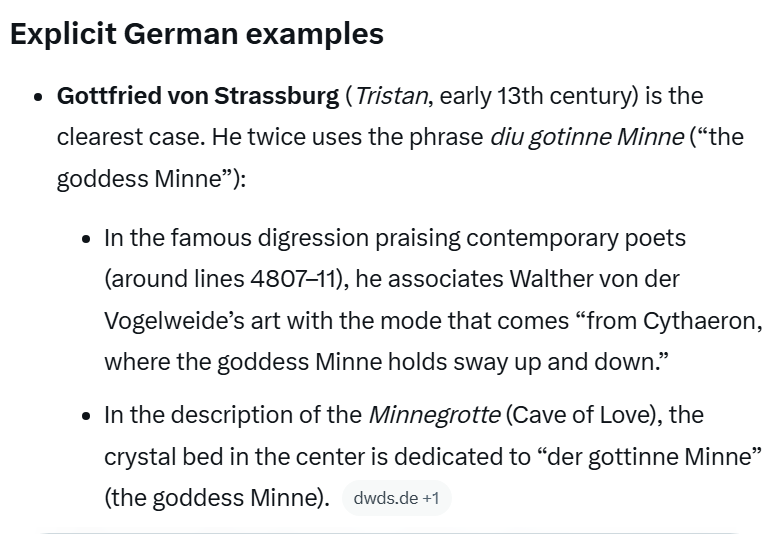
The minnesingers of Germany recognized that this power of amor was indeed divine. It wasn’t simply a secular thing but contained the compulsion of the goddess. The word Minne in German is a reference to this kind of love, and minnesinger means “singer of love.” The greatest of all these poets was Walter von der Vogelweide, a delightful figure whose poetry is simply delicious. Walter speaks of the goddess Minne in her power, in her majesty, and so here you’re on the brink of a religion of love. This religion of love was actually rendered most powerfully, I would say, in the Tristan of Gottfried von Strassburg. Gottfried’s poem was left incomplete when he died in 1210. In this story, the potion that Tristan and Iseult drink represents the breakthrough of compulsive love. [Romance Of The Grail: Magic And Mystery Of Arthurian Legend]
For more on the significance of courtly love/chivalry as a religious practice, see the following:
[1] To ‘Believe’ in Love – The Religious Significance of the Romantic Love Myth in Western Modernity (Sarah Balstrup – 2012)
[2] Courtly Love as Religious Dissent, by Jeffrey B. Russell (1965)