Childlikeness As Artificial Promotor of Gynocentrism: A Short Comment

The following brief exchange appeared in the comments under an article titled C.S. Lewis: The Feudalisation of Love. In it I give a brief comment about how women’s cultivation of childlikeness contributes to gynocentric attitudes, and how this appears to be a more forceful influence than sexual and reproductive pressures.

TEXT: 

2cyar wrote:

“The primary ‘something’ that was biologically there to leverage is the child archetype in women, an innocence and moral purity feigned with cosmetics, clothing, gestures and fragility and held up as a fetish for men to worship and protect. Sexual factors do come in but are secondary in strength.”

The next question is how do we turn it off? They certainly aren’t going to self regulate, so we have to figure out how to turn off the impulse within ourselves (and all men) to render it ineffective.
___________________________________

Peter Wright wrote: 

Turning it off can happen by no longer believing that women are children deserving indulgences at men’s expense – ie. seeing it as artificially manufactured and that in reality women are grown adults. It’s the same process as no longer viewing the Santa Claus in the shopping mall as real – he’s doing theatre.

The result of that awakening is that men find themselves saying “No” to every bit of theatrical childishness put before them, realising that it’s a supernormal bait and a grift. Such a man is no longer caught in the gynocentric machinery of his mind.

This is where I part ways with a few honeybadgers and men’s advocates who believe gynocentrism is more ‘natural’ than I do, even as they accept gynocentrism as sometimes extreme and unfair to men. The “gynocentrism is natural” stance is built mostly on belief in the power of women’s sexuality and reproductive functions, while omitting more powerful & more artificial ruses such as feigning childlikeness: i.e. women may have breasts and uteri, but they are not children. 

It’s self-defeating ideology to believe sexual politics is totally unfair for men, while simultaneously believing gynocentrism is “natural.” It results in a learned impotence. Most advocates of this theory end up promoting the familiar parental lifestyle for men under the nostalgic euphemism of “honouring masculinity.” That approach pretends to free men while ultimately keeping them trapped – compliments of an unexamined and unchallenged child archetype, combined with a cultural ideology that pedestalizes women as a higher, quasi-noble class

* * * 

*Note: For an illuminating treatment of this topic by Honeybadger Hanna Wallen, see ‘The Natural Gynocentrism Fallacy.‘ 

SEE ALSO:
Articles On Women’s Attraction to the Child Archetype
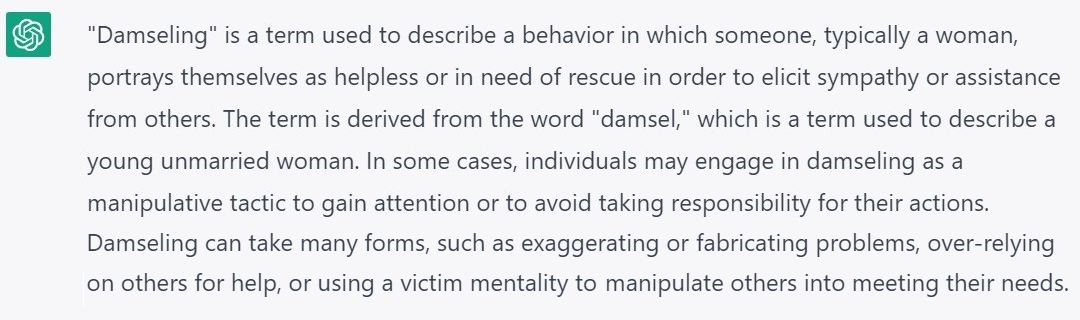
Articles Exploring The Nature of Damseling Behaviors
Fascinating Womanhood: How To Use Childlikeness to Manipulate Men (video)
Fascinating Womanhood: Women’s Introduction To Cultivating Childlikeness (pdf)

Gynæcocentric Theory (Articles & Essays 1888 to 1930)

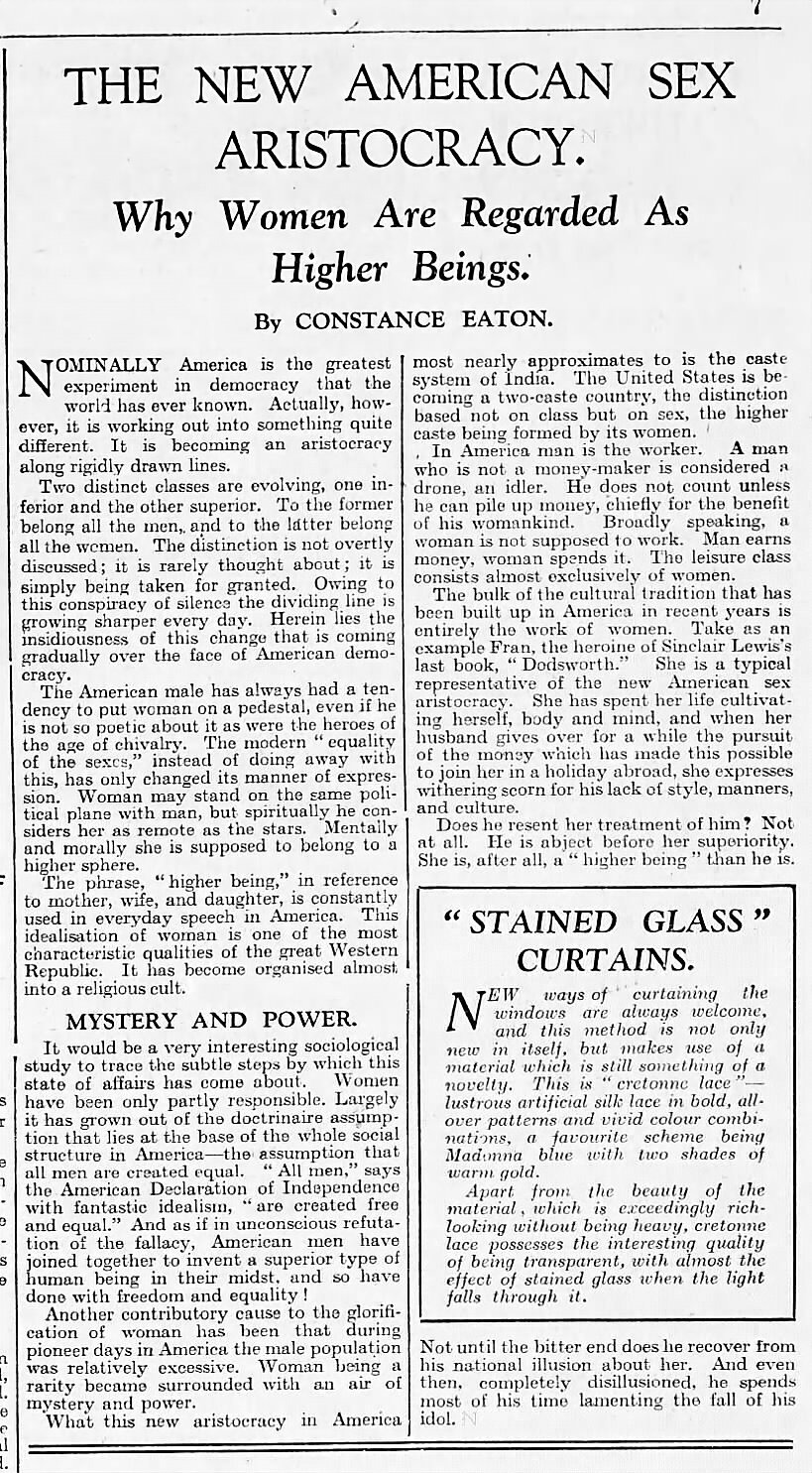
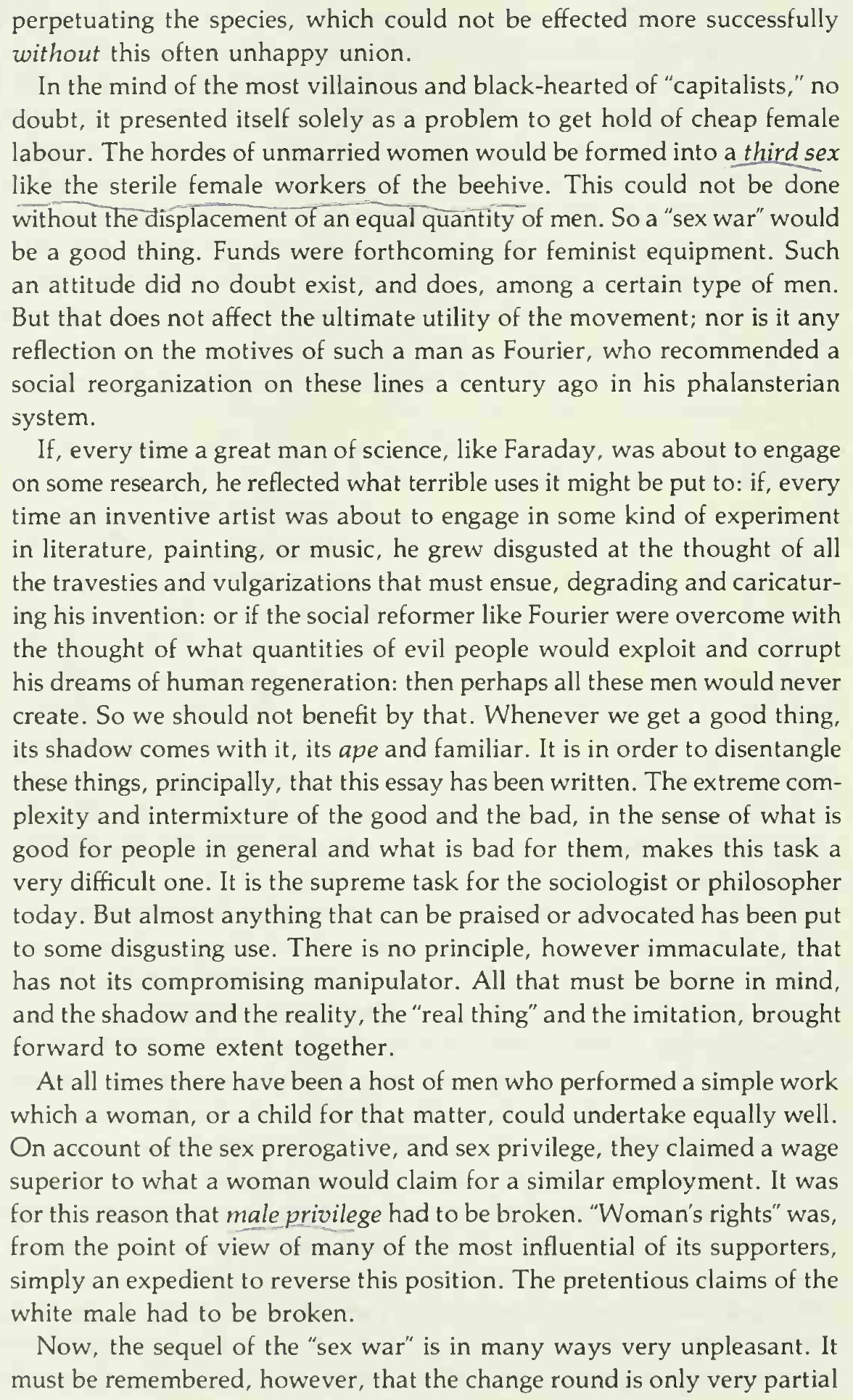
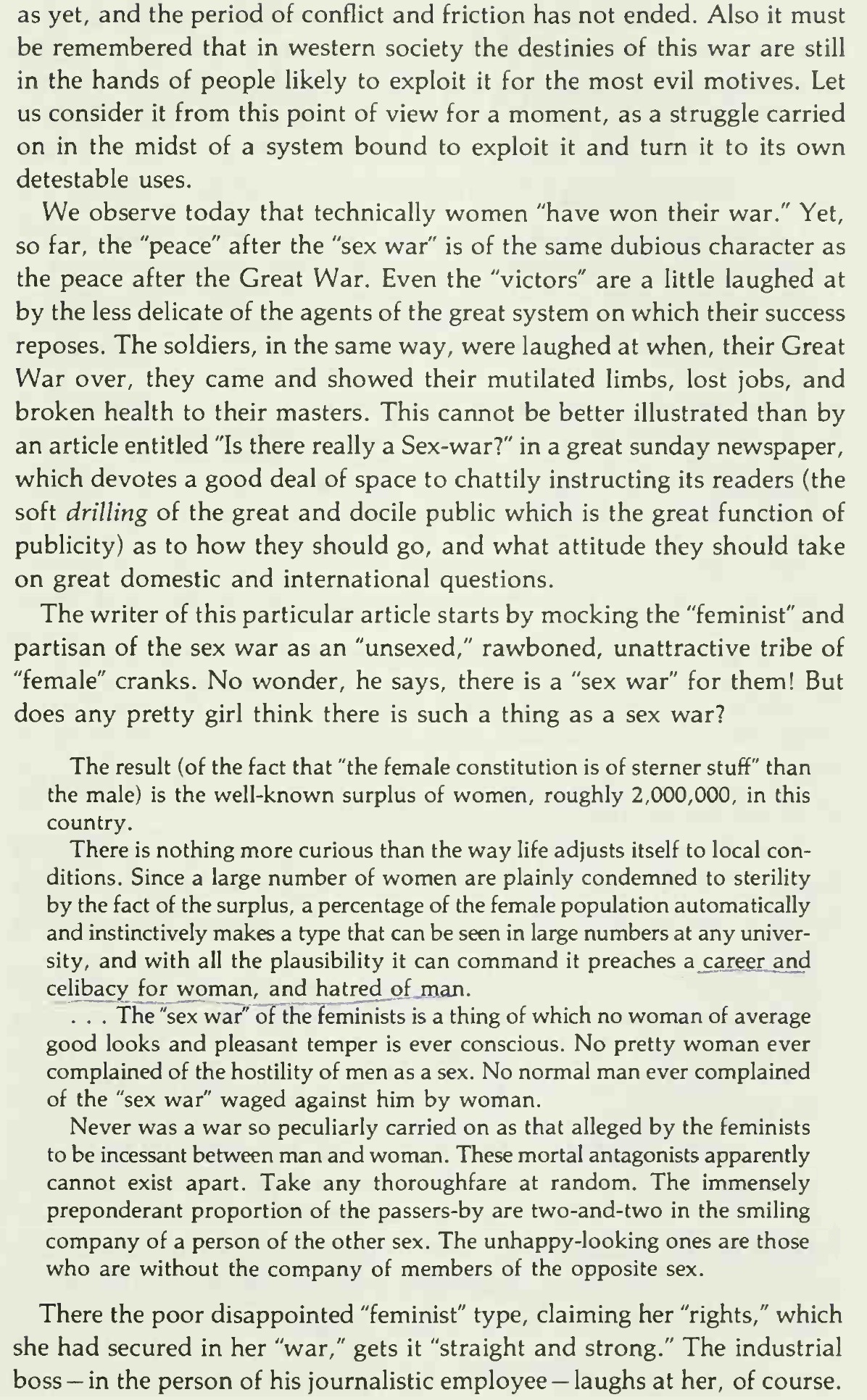
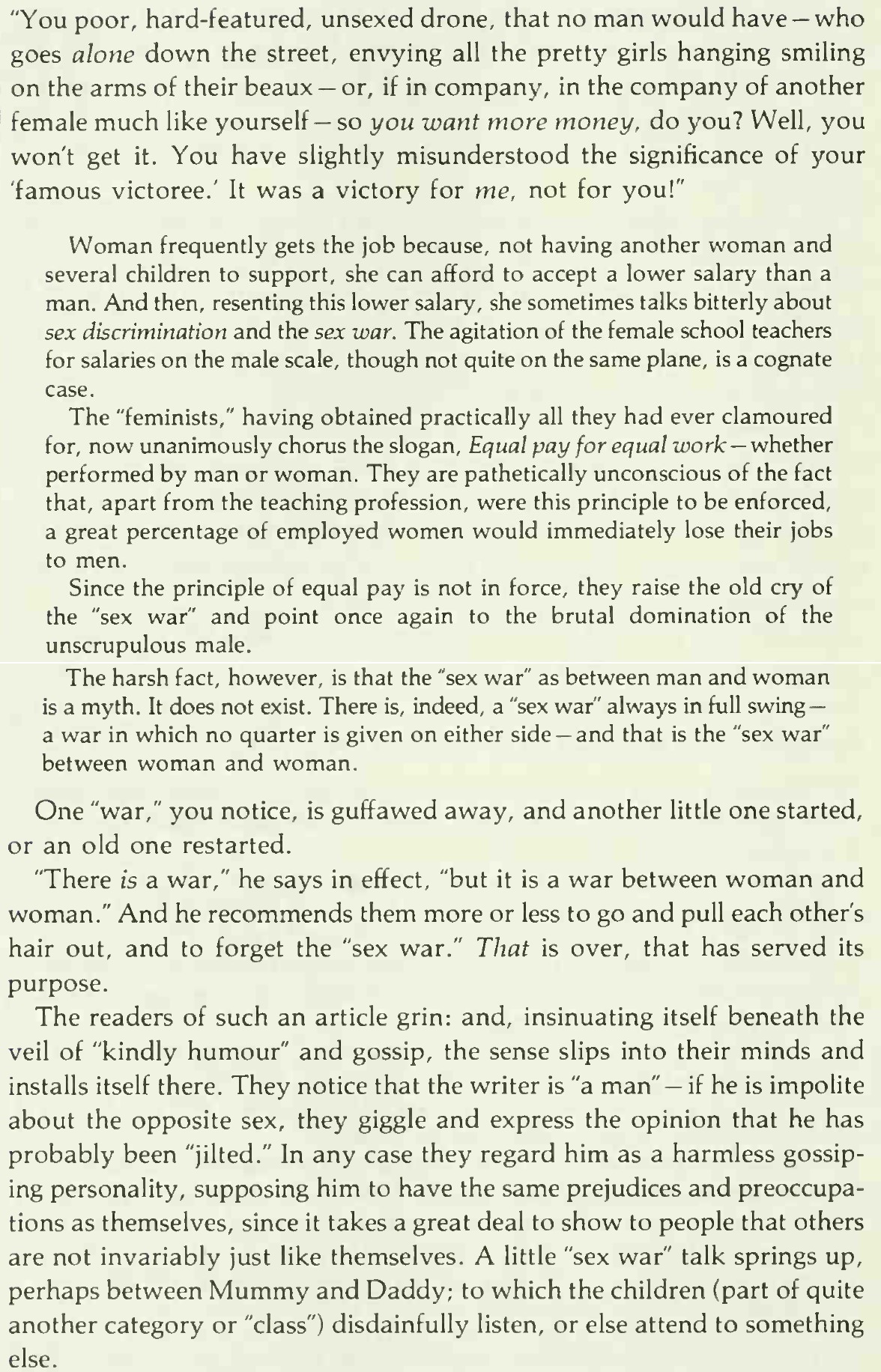
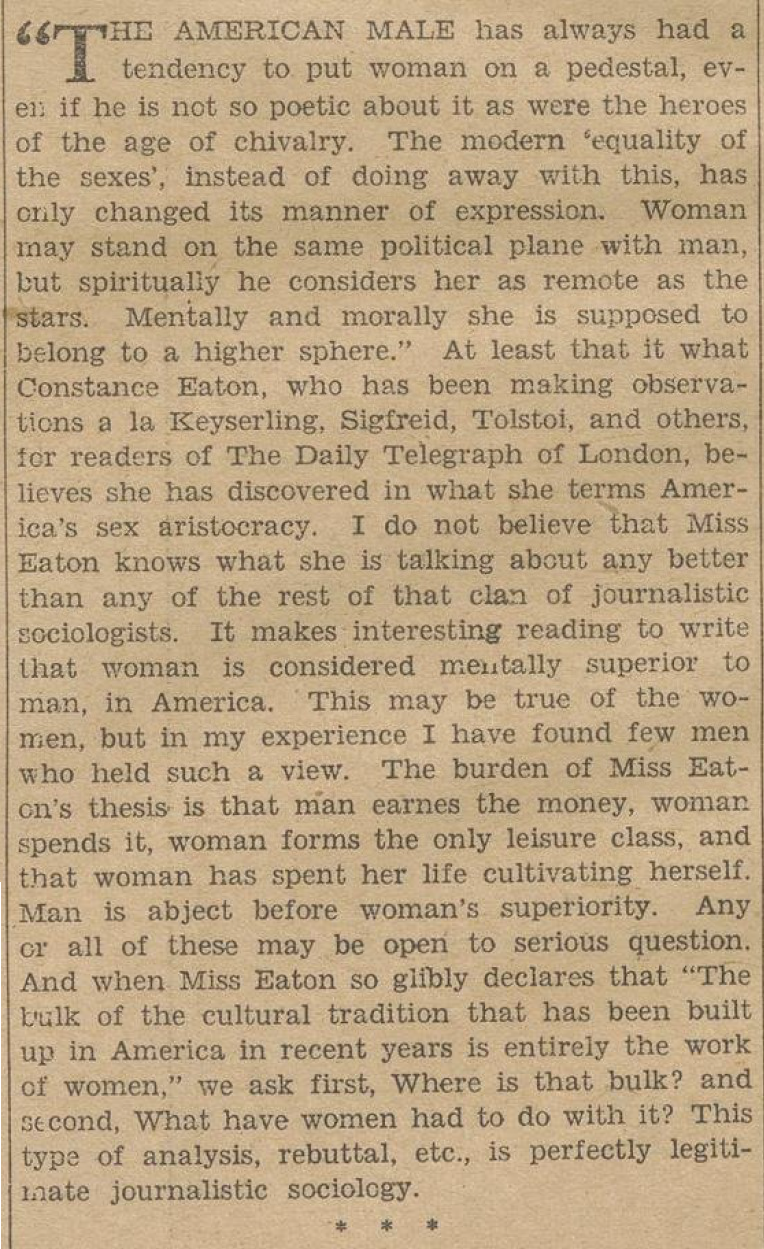
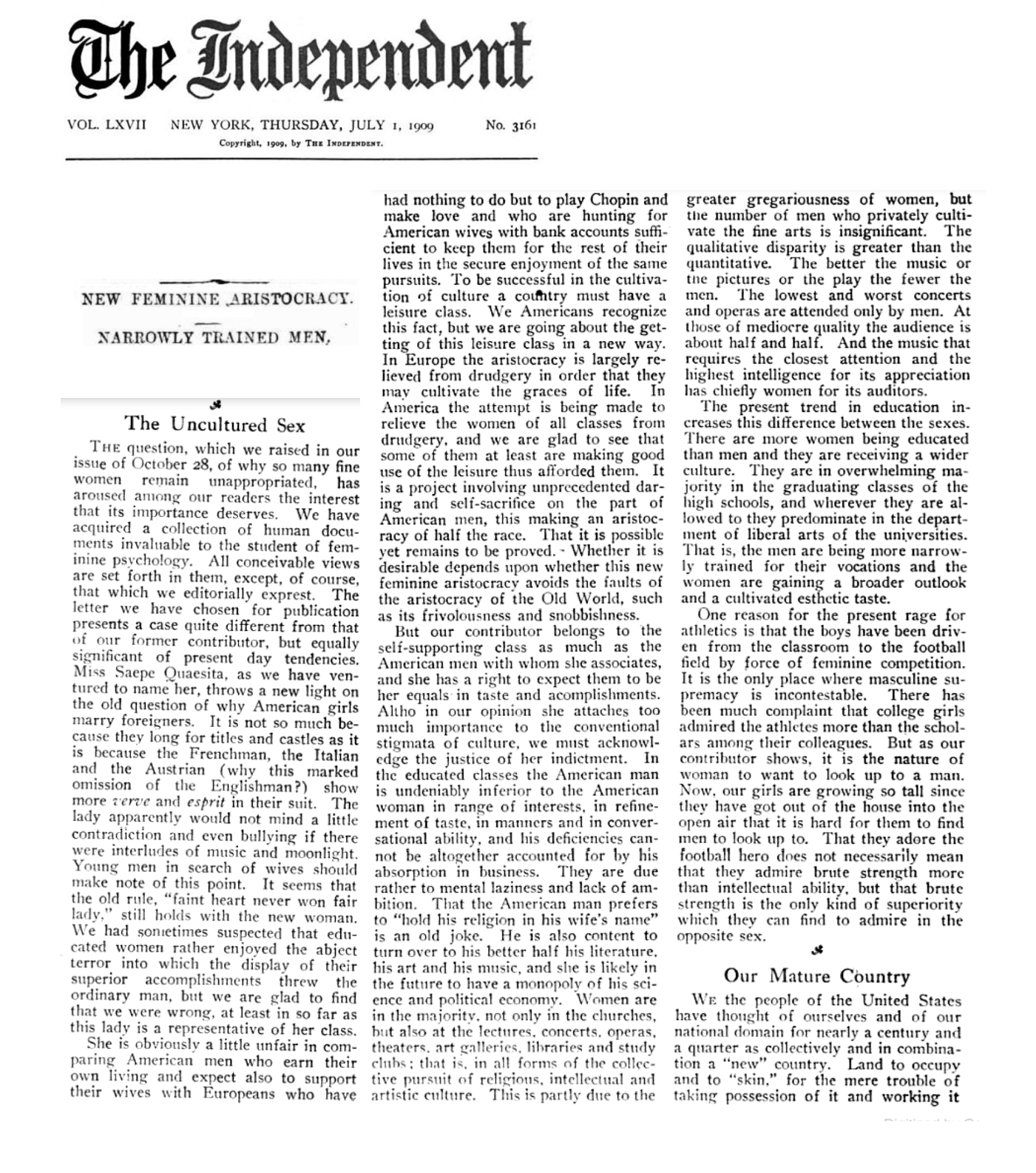
The importance of Lester F. Ward’s ‘Gynæcocentric Theory,’ presented first as a speech to a group of feminists in the year 1888, and subsequently as an essay in 1903, cannot be overstated. There were numerous writers promoting gynocentric ideology prior to Ward’s effort, however he was the first to use the term for a complex biological theory that has generated thousands of subsequent academic and newspaper articles promoting female superiority, and likewise many protests against the incoherence of his theory – including by early men’s human rights activist Ernest B. Bax (see below).

Ward’s gynocentric theory exerted a major influence on feminist thought, while also circulating in popular culture and in universities where, as one account from 1920 reveals:

“While a comparatively small number of people read this theory from the original source, it is still being scattered far and wide in the form of quotations, paraphrases, and interpretations by more popular writers… College reference shelves are still stocked with books on sex sociology which are totally oblivious of present-day biology. For example, Mrs. Gilman (Man-Made World), Mrs. Hartley (Truth About Woman) and the Nearings (Woman and Social Progress) adhere to Ward’s theory in substantially its primitive form, and not even sociologists like Professor Thomas (Sex and Society) have been able to entirely break away from it.”

The following selection of articles directly mention Ward and his gynæcocentric theory.

Our Better Halves, by Lester F. Ward (1888)
The Real Woman Problem: Raising Women Up (1888)
Lester Ward’s Call To Elevate Women (1888)
A New Defense Of Woman (1888)
Science and “Our Better Halves” (1888)
Lester Ward and Sex Supremacy (1888)
Professor Ward On Women’s Superiority (1889)
The Gynæcocentric Theory, by Lester F. Ward (1903)
‘Gynæcocentricity’ Poem from the London Punch (1903)
Lester Ward’s Gynæcocentrism Theory & Marxism (post 1903)
The Evolution of Sex According to Lester F. Ward (1909)
The Future of Women – by D. M. N. (1909)
Ernest B. Bax Responds to Lester Ward’s ‘Gynocentric Theory’ (1909)
“The Evolution of Sex” – A Protest Against Ward’s Gynæcocentric Theory (1909)
The Book of Women’s Power – edited by Ida M. Tarbell (1911)
Woman and Gynæcocentric Social Progress – by S. Nearing (1912)
Ernest B. Bax: Examines Lester Ward’s ‘Gynœcocentric Theory’ Fallacy (1913)
Some Biological Aspects of Feminism – by R.E. Ryan (1914)
The Influence of Gynaecocentric Theory On Feminism – by C. M. Walsh (1917)
Race Motherhood: Is Woman The Original Human Race? – by D. Montefiore (1920)
Book Review of D. Montefiore’s ‘Race Motherhood’ by D. M. N (1920)
‘Gynocentric Theory’ in Colleges and Popular Culture, by M. M. Knight et.al (1920)
The Foundations Of Feminism – by Avrom Barnett (1921)
A History Of Gynocentrism’s Journey Into China (1921-1922)
The Lure of Superiority: ‘Gynæcocentric Feminism’ by W.F. Vaughan (1928)

Contemporary articles deconstructing gynocentric theories:

Lester Ward’s Gynocentrism Theory in Chinese Literature – by Ping Zhu (2015)
A History Of Gynocentrism’s Journey Into China (1921-1922)
How Lester F. Ward Developed a “Patriarchy Theory” – by M. Muscolino (2019)
What’s in a suffix? reviewing the meaning of gyno–centrism – Peter Wright (2019)
Lester Ward’s Gynocentrism & The Deification of Women – by Peter Ryan (2020)
Gynocentrism – A Review by Aman Siddiqi (2021)
Briffault: Rules for the Rational Simp – by Peter Wright & Paul Elam (2021)
Eight Traits of the Bio-Gynocentrist – by Vernon Meigs (2022)
Is Gynocentrism Adaptive? – Peter Ryan (2022)
Bio-gynocentrism: Turning Science Into Goddess Worship – by Peter Ryan (2022)
The ‘Natural Gynocentrism Fallacy’ – critique by Hanna Wallen (2023)
Gynocentrism: A Beloved Feminist Fiction – by Peter Wright (2023)
Maladaptive Gynocentrism Is Not “Natural” – Peter Wright (2023)
Robert Briffault’s Law Doesn’t Apply to Humans – Peter Wright (2023)
Has the MRM Adopted a Gynocentric Ideology? – Peter Wright (2023)
Humans as a “Gynocentric Species” is Pure Myth – Peter Wright (2023)

Women’s attraction to the ‘child archetype’

ARTICLES ON WOMEN’S ATTRACTION TO THE CHILD ARCHETYPE


Archetypal Transsexuality (Rachel Pollack)

The following article first appeared in the journal TransSisters in 1995, and is reposted here with permission of the author.

Aphrodite: Transsexual Goddess of Passion (Rachel Pollack)

The following essay exploring archetypal transsexual archetypes appearing in traditional mythology was first published in Spring – A Journal Of Archetype And Culture, in the edition titled ‘Pink Madness’ (1995). The essay is republished below by permission of the author.


“Love Service”

Love service is a ritualized form of male love-devotion toward women, especially noble women, that was popularized in the Middle Ages.[1][2][3]

History

The practice of love service appeared first in Medieval Europe and was modeled on a combination of feudalistic class distinctions, courtly love tenets, and gendered aspects of the chivalric class code regarding respectful treatment of women.[4][5]

Love service had certain resemblances with vassalage, especially the concept of obedience. According to Sandra R. Alfonsi the entire concept of love-service was patterned after the vassal’s oath to serve his lord with loyalty, tenacity, and courage. These same virtues were demanded of the male supplicant. Like the liegeman vis-a-vis his sovereign, the male approached his lady with fear and respect, submitted obediently to her and awaited a fief or in this case an honor of reception as did the vassal.[6]

The vocabulary of love service borrowed some terminology from the vocabulary of feudalism indicative of the ties between a man to his lord. Examples are servitium (service), dominus (denoting the feudal Lord, or Lady), homo ligius (addressing the Lord’s liegeman or ‘my man’), homage (duty toward Lord), and honor (honoring gestures). The men were sometimes referred to as domnei or donnoi, meaning an attitude of chivalrous devotion of a knight to his Lady based in servitude and duty.[7]

References
  1. Margaret Schaus, Women and Gender in Medieval Europe: An Encyclopedia, Taylor & Francis, 2006
  2. Chivalry and Love Service, in Judith M. Bennett, Ruth Mazo Karras, The Oxford Handbook of Women and Gender in Medieval Europe, Oxford University Press, 2013
  3. Sandra R Alfonsi, Masculine Submission in Troubadour Lyric (American University Studies), Peter Lang Publishing, 1986
  4. James A. Schultz, Courtly Love, the Love of Courtliness, and the History of Sexuality, University of Chicago Press, 2006
  5. Chivalry and Love Service, in Judith M. Bennett, Ruth Mazo Karras, The Oxford Handbook of Women and Gender in Medieval Europe, Oxford University Press, 2013
  6. Sandra R Alfonsi, Masculine Submission in Troubadour Lyric (American University Studies), Peter Lang Publishing, 1986
  7. Sandra R Alfonsi, Masculine Submission in Troubadour Lyric (American University Studies), Peter Lang Publishing, 1986

Gender narratives

Narrative pic

Cultural Narratives

Mythologies of the men’s rights & feminist movements (Peter Wright)
Men Who Sit At The Screens (Peter Wright)
One True Masculinity (Peter Wright)
Feelings Don’t Care About Your Facts (Elizabeth Hobson & Peter Wright)
Where Do Stories Come From? (Richard Kearney)
Stories and The Christian Faith – Part 1 (Paul Elam)
Stories and The Christian Faith – Part 2 (Paul Elam)
The Men’s Rights Movement: Changing The Cultural Narrative (Peter Wright)

Personal Narratives for Men

Men Authoring Their Own Lives (Paul Elam & Peter Wright)
Narrative Therapy With Men (Paul Elam & Peter Wright)

Archetypes & Gender


Time to throw the baby out with the bathwater

By Peter Wright & Paul Elam (2017)


A wise man once suggested that when it comes to marital discord couples fight more over one issue: who is going to play the child in the relationship and who is going to play the responsible parent.

His comment rings true on its face, with men historically being the ones who take on the parental role in marriage. It’s witnessed in the centuries of men taking responsibility for the financial and other security concerns of wives, and also hinted at in the relationship age gap. Males marry younger females — not to control their sexuality (as we are frequently misled to believe) – but because women seek an older male to place in the responsible, paternal role, to enhance the child theme they intend to play out in the relationship.

Women collectively spend billions annually to neotenize their appearance, enhancing their efforts to assume the infantilized role.

We see the same theme appear in our language when men are shamed for being ‘Peter Pans’ or ‘man babies’ along with the injunction to ‘man-up’ — which has no counterpart for women; they are phrases intended to jolt men out of any inclination to regress to a childlike state of dependency. Never do we hear women being chastised as immature Wendys, woman babies, nor do we hit them with the demand to ‘woman-up.’

To be fair we may see the occasional man playing a full-time child to his female partner, and we can say that all men experience occasional moments of regression to boyishness in their relationships. However, society frowns upon men indulging too much of the child within. And such indulgence is roundly met with sexual rejection by women. The child role is reserved exclusively for women within the relationship context.

The stresses that this dynamic places on relationships and especially on men cannot be overstated; the catering to a child within an adult’s body is exhausting and ultimately demeaning to both the infantilized woman and the parentified man. Standardizing childishness in one partner and hyperagency in the other prohibits any sort of relationship between adult peers. Instead, it breeds contempt and conflict.

The structure of this type of arrangement ultimately results in an assured relationship killer. Hostile dependency. It is impossible for the infantilized partner to maintain respect for, or a healthy emotional connection to, her chief enabler. And it is impossible for the chief enabler to maintain respect or a healthy emotional connection to what amounts to a financial, emotional and familial parasite. Self-respect in both parties is also a casualty of this arrangement.

Before getting more into the dynamics posed by this dysfunctional relationship, we’d like to elaborate a bit more on the concept of the adult child which is something quite different from the literal child we look after when they are small. The ‘child’ is also one of the fundaments of the human psyche, operating equally in biologically mature adults and in children, thus the popular qualifier of ‘the inner child.’

The great 20th century psychologist Carl Jung wrote a paper on the inner child, or what he preferred to call the child archetype,1 where he outlined its main psychological features which include 1. growth toward independence, 2. vulnerability, and 3. a state of innocence.

1. Growth toward independence (but never reached)

This aspect of the child archetype is concerned with futurity, and is captured in the phrase ‘what I want to be when I grow up.’ It reflects the ongoing state of becoming without ever arriving at the destination – it remains an eternal child. In this respect the child archetype differs from the archetype of individuation, a more heroic path that does eventually culminate in mature autonomy and self-reliance.

The ambition for perpetuated childhood, as we commonly see in modern women (and enabled by men), is the inevitable outcome of the child archetype. As men and women collude to remove the destination of adult autonomy from the life-map, they effectively kill the archetype of mature individuation – the path of true potential for growth. And instead they give birth to the child of static permanency. Individuals dominated by the child archetype will always position themselves as eternally incapable of personal agency, even relying on the chief enabler to help fabricate a web of denial about their true nature.

This is reflected in the spiritual, financial, or relationship ‘growth’ workshops attended largely by women, who appear to pursue adult goals but who are in reality only participating in a charade. The true goal is more dependency and more childhood. These pursuits are often funded through the hard labor of the hopelessly paternalized male.

We also see this acted out in the psychodrama of the modern housewife, “taking charge” of such matters of household finances and other matters of home and hearth, without any responsibility for creating wealth, taking the risks that come with those efforts, or any other matter of real consequence. The perpetuated child chooses the colors but cannot buy the paint or climb the scaffold with brush in hand.

2. Vulnerability

Vulnerability is one of the main guises of the child, and so the woman dominated by this archetype is constantly signalling threats to herself from the surrounding environment. She is in danger of getting lost, hurt, abandoned and frightened, and just like the child of fairy tales she projects herself as lost in the woods with snarling bears and wolves, or afloat on the river Nile in a flimsy basket where she is in danger of getting lost or going under.

She is “at risk” at all times, including the risk of exposure to her chief enabler’s frustrations or his wishes for her to realize adulthood.

The vulnerable, permanent child, communicates with the wider world through these threat narratives2 which most everyone is familiar with through the archetypal damsel in distress — tied to the railway tracks, the locomotive of adult agency barreling down on her, or being held prisoner by a dragon from which she must be freed by your parental, sacrificial rescue.

3. Innocence

The child’s way of defending its perpetual dependency is to project its innocence: “I don’t know”, “I didn’t realize”, “I didn’t mean anything”, “It just happened”, “I got carried away by my feelings.” Yes, her own emotions can be the villain in her threat narrative. And the understanding of a hyper-responsible male is required to save her from it. Because she claims ignorance she divests herself of all responsibility for what happens, leaving others to pick up the tab – most likely her male partner if she has one.

We see this even in women’s general predisposition to gravitate toward victim politics, supporting male candidates who offer enabling paternalism from the state, and the vision of woman as perpetually in distress.

Moving on from Jung, perhaps the best conceptualization of the child archetype comes from Eric Berne, whose transactional analysis shows three possible relationship dynamics:

  1. A child relating to a parent
  2. A parent relating to a child
  3. An adult relating to another adult.

The first of these – child to parent – encompasses all that we’ve said so far about the child archetype and its exploitative style of relating with others. The second – parent to child – represents the parental relationship to a child. And the last one – adult to adult – represents a healthier mode of conducting relationships based on steering a middle path between the more extreme demands of both parent and child. This latter is where we might hope to be along with anyone we might choose for pair bonding.

TransactionalAnalysis

The perpetual child, however, demands that the default relationship setting be parent to child, an emotionally incestuous arrangement that affords some comfort to the irresponsible child, but that does so at the expense of a healthy adult connection.

Eventually, and we think invariably, this results in the parentified male viewing the infantilized female as inept, incapable and deserving of pity over respect. It can also breed a lot of anger that goes both ways, from the frustrated, overburdened male, and the dependent, irresponsible female whose life is a constant reminder of her lack of meaning.

The parental brain

Juvenile characteristics have long been known to evoke in caretakers a neurological state known as the ‘parental brain.’ Children’s faces and various other child gestures provoke hormonal changes that prime parents to be more sensitive towards infant cues and needs, resulting in nurturance, caretaking and protectiveness.

Adult women who learn to mimic child features through cosmetics, and the feigning of childlike behaviors of innocence and vulnerability, evoke in their male partners a very similar parental response. Like parents of literal infants men can be seen to respond with care-taking and protection, and if women are skilled at peppering the routine with threat-narratives she gains the ability to prompt him like a philharmonic concert conductor. Such is the obedient, reflexive state of readiness to rescue that defines the lives of so many men.

Listeners are probably familiar with this charade being played out between men and women, one which was not lost on Esther Vilar when she gave a sardonic description of it in her 1971 book The Manipulated Man. There she writes:

Woman’s greatest ideal is a life without work or responsibility – yet who leads such a life but a child? A child with appealing eyes, a funny little body with dimples and sweet layers of baby fat and clear, taut skin – that darling minature of an adult. It is a child that woman imitates – its easy laugh, its helplessness, its need for protection. A child must be cared for; it cannot look after itself. And what species does not, by natural instinct, look after its offspring? It must – or the species will die out.

With the aid of skillfully applied cosmetics, designed to preserve that precious baby look; with the aid of helpless exclamations such as ‘Ooh’ and ‘Ah’ to denote astonishment, surprise, and admiration; with inane little bursts of conversation, women have preserved this ‘baby look’ for as long as possible so as to make the world continue to believe in the darling, sweet little girl she once was, and she relies on the protective instinct in man to make him take care of her.”3

Vilar hits the nail right on the head; that many women have been taught they will be protected while having every whim catered for by simply playing the child.

This parent~child dynamic, perhaps more than any other theme, captures the dilemma most men are wrestling with – a theme more central than sexual attraction, more central than pair bonding, and more than romantic love and all the other social mandates. The biological urge to care for children is king, and it’s also an Achillies’ Heel for those who abide by it unconsciously.

The good news is that our vulnerability to abuse is corrected in one move: by men refusing to play parent, whether indulging or trying to correct women who are perpetual children. Instead we have to insist that female partners woman-up right alongside men, showing reciprocal responsibility between two adults. Or be prepared to show them the door once it’s apparent that the task is too much for them to take on.

Esther Vilar’s comment that a woman’s greatest ideal is ‘a life without work or responsibility’ requires someone to facilitate it, and that someone is almost always a man. But men need not play the role of parent and they do have the option to seek a relationship between adult peers: two responsible adults supporting each other in the walk through life. Such a woman may be a unicorn but unicorns do exist. And success, if you are lucky enough to get it, will be more likely tied to the women men reject than the woman they seek.

References:

[1] C.G. Jung, ‘The Psychology of the Child Archetype’ in The Archetypes and the Collective Unconscious, Princeton University Press (1969)
[2] Alison Tieman, Threat Narrative series
[3] Esther Vilar, The Manipulated Man (1971)

To Be a Better Man? The Revival of Courtly Values in Modern Film

By Raymond J. Cormier

While the influence of powerful troubadour motifs is undeniable, let us cite here one brief northern French text as a kind of shorthand, for emphasis. It is a brief narrative or lai that illustrates certain courtly values. Lanval, Marie de France’s eponymous hero, is a sad, forlorn Arthurian knight, abandoned, lonely, and helpless. An otherworldly sequence brings to him a wealthy and supremely stunning noblewoman (a fairy princess) with whom he becomes “well lodged.”

His liberation from the bonds of solitary abandonment lead to liberality (he now gives freely to all comers), the medieval ideal of generosity, “the queen of virtues.”9 Kindness and love rescue him, as they do several male characters in modern film.10 Northern French poets emphasized too the “chivalry topos,” that is, that love motivates the knight in love and he becomes a better person through his adventures, thus meriting his beloved all the more. Noble love ennobles; in this better world too (for Auerbach), the apolitical “feudal ethos” encompasses “self-realization” (116-117).

Courtly thinking existed in the Middle Ages and is manifested in the modern era.11 Each of the films we analyze here will of course not yield up every feature of the courtly mode, but still I sense that there is enough medieval residue and resonance in each to justify the argument, that, as some might put it succinctly, “courtly themes continue to generate artistic creation.” Along these lines, one wonders if the strong continuity of the Troubadour ethos—in particular that longing for a “far-away love”—is what underlies the resonances and residues. Love stories, requited or not, remain viable even in today’s hip-hop world.

It has been reasoned that the two principal and most admired modes of courtly behavior were generosity and joy. Aristocratic courtly culture held that “the lady” was lord, and the lover’s role was to serve her, to sing about her merits and qualities, and carry out all imaginable actions to remain or become worthy of her, in a word, to deserve her.12 

The function of love in this context was as dictated by the De amore of Andreas Capellanus (ca. 1185): “Love easily attained is of little value; difficulty in obtaining it makes it precious” and “Everything a lover does ends in the thought of the beloved.”13 

For Auerbach, the synthetic term corteisie embodied values like the “refinement of the laws of combat, courteous social intercourse, service of women” (117). In what is dubbed the long European twelfth century (1050-1250), French humanism predominated, a phenomenon already analyzed historiographically at length.

As Italianist Ronald Witt recently put it (2012: 317): “The term ‘humanism’ aptly describes French culture in the period […].” In this context, interior monologue and dialogue arose from a new awareness of the interior life (the unique individual is now consciously separate from the court), which was further linked to the chivalric adventure/quest whereby audiences yearned for the unusual and the marvelous—now stimulated especially by wondrous stories brought back from the East by returning Crusaders (in particular the First-ca. 1100, and Second-ca. 1150). In discussing this particular type of medieval love, Aldo Scaglione has written (559):

The radical interiorization of the love experience carried with it the impossibility of communicating with the love object (topos of ineffability). Not only did poets profess themselves incapable of communicating to the beloved the depth of their passion, but the very lack of communication was for them both a sign of its depth and a consequence of it, to the point of entailing the complete physical absence of the lady.

Transformation through kindness and love, the frequent quest motif, the rescue of the hero/heroine—such are the narrative innovations associated with these elements (even the ineffable moment can be noted in at least one film, Roxane). Allied terms include honesty and humility—for perfection of the knight depended on his courtly worth, manifested through continuous bravery and feats of arms, humbly accomplished so to enhance and vouchsafe his honor and his nobility.

Such aims for flawlessness were mirrored by the lady’s perfection, inspired too by her knight/liege. Of course, adultery occurs as co-incidental in this context, as does a “religion of love,” whereby mutual suffering and adoration are obligatory14. Let us see how all this plays out in the series of films selected for analysis.

As Good As It Gets

The romantic comedy As Good As It Gets, the Jack Nicholson and Helen Hunt masterpiece (with Greg Kinnear), has provided the main title of this essay. The iconic line, “You Make Me Want to Be A Better Man,” is spoken by the misanthropic Melvin Udall (Jack Nicholson), whose obsessive-compulsive behavior and pathological germophobia strangle all of his human interactions. In the penultimate sequence, after he affronts and insults Carol (played by Hunt), his apology, necessary to get back into her good wishes, is a confession that he wants to merit her and deserve her respect (enough so that he can have their relationship return to its prior arrangement).

One can say that all his motivations are selfish (arranging to care for Carol’s asthmatic son, putting up with his gay artist neighbor and then the neighbor’s dog), yet he is redeemed in the end, having moderated somewhat his odd manners.15 If not mere empathy, a kind of love is born in Melvin’s heart—even for his gay neighbor, for the dog, even for his neighbor’s African-American agent, and especially for Carol. For in the end, he is “a better man.”

Pretty Woman

Perhaps no genuinely touching and dreamlike modern film has captioned courtly features as much as Pretty Woman (1990), in which the Richard Gere character (Edward) undergoes a major personality shift, from ruthless business tycoon to generous shipbuilder, as a result of his experience of love for/with (an apparently) blonde streetwalker named Vivian (played by Julia Roberts).16 The wig disguises, as it were, her true personality. Over and above the film’s obvious Cinderella theme, it has been argued in fact, in a reversal of traditional gender roles, that it is she, Vivian, who, as the “Fair Unknown” (Scala 35), is transformed from “veiled” Hollywood Boulevard prostitute into a truly “noble character,” a change attributable to soul-sharing (with Edward—neither “wimp nor wild man”17), catalyzed by the experience of a San Francisco opera performance focused on the heroine Violetta (La Traviatta).

Vivian’s real character is revealed too in an early scene when she drives, like a NASCAR expert, Edward’s sports car, then again in the bathtub scene, where she sexually enfolds him in her extra-long legs. But, after their goodbyes, when Edward unexpectedly returns (in a white stretch limo) to Vivian’s apartment at the very end of the film, he scales the fire escape (in spite of his fear of heights) to “rescue the princess in the tower.” He has undergone a total conversion, from emotionless corporate raider to brave, forgiving and loving human.

Tellingly, he asks the now red-haired (and post-feminist) Vivian what happens after the knight rescues the princess, she replies that she saves the hero “right back,” another revelation of a “reversal of gender roles” (Scala 38).18 And, as Genz recently put the question of the “post-feminist woman” (PFW). The PFW wants to “have it all” as she refuses to dichotomize and choose between her public and private, feminist, and feminine identities. She rearticulates and blurs the binary distinctions between feminism and femininity, between professionalism and domesticity, refuting monolithic and homogeneous definitions of postfeminist subjectivity.19 

Reddy, in his analysis of this film posits it as a mirror of the sexual revolution of the 1960s and 1970s (380-381), whereby prostitution is permissible and sexual desire is destygmatized, but still stands in opposition to love, since both characters, now mutually devoted to each other, give up their life of “mere appetites.”20 Edward is thus a better man, Vivian a better woman.

Casablanca

Going back now to the World War II era, we will glance briefly at the great 1942 classic, Casablanca, in which, again surprisingly and ironically, the bitter and cynical refugee hero Rick Blaine (Humphrey Bogart) is transformed not by passionate love, but in this case through a self-effacing compassion. He just wants his beloved Ilsa (the woman between two men story), played famously by Ingrid Bergman) to be happy, for, as he remarks to her—“We’ll always have Paris.”

In the final sequence, Rick, his tough-guy veneer now gone, surrenders two objects, one tangible, the other human—i.e., the vital letters of transit for transport out of Morocco, along with his chance for love with Ilsa. In a meeting with her and her husband Lazlo (the Resistance-fighter) at the Casablanca airport, the now-noble Rick swallows his resentment toward her and yields himself to a new emotion, empathy mixed with admiration for both Ilsa’s devotion and Lazlo’s political cause. And he opines: “It doesn’t take much to see that the problems of three little people don’t amount to a hill of beans in this crazy world.” In a dramatic gesture of magnanimity, Rick turns Ilsa over to the freedom fighter. Generosity and self-sacrifice redeem the hero as it will the other protagonists, even in different ways.

Beauty and the Beast

At this point, we will turn to three animated films (one of which is inspired by a live-action archetypal film produced just a few years after Casablanca). I refer to Beauty and the Beast, known today mainly through the 1991 Disney version. The lesser-known account that inspired the modern and magical remake is the Jean Cocteau classic, a contemporary parable based on a seventeenth-century French tale.

The flawless Belle—to pay for her father’s transgression and obliged to dwell within the Beast’s castle—finds the beast repulsive, but, eventually, love is the potion that will transform both her and the Beast within; he is saved through Belle’s own generous change of heart as she responds to his kindness and favors. Similarly, Belle’s pity, patience, growing admiration and slowly-receding fear of the Beast, brings her to lower her guard and embrace the creature.

Once she does love him (as foretold), the enchantment magically evaporates, the Beast is tamed and everything is joyfully transformed—by their love and new-found respect for each other.21

Hercules

Redemption of a different sort rescues the mythological hero Hercules from the depths of weakened loss and despair. In this 1997 Disney film, the once-powerful and immortal youth attempts to save the life of Megara, his beloved (to provoke the hero, she was slain by Hercules’ nemesis Hades). His awesome powers had been taken from him by the villain but Hercules miraculously regains his strength through mutual love, and is on his way to become a “true hero”— just as (Samson-like) he lifts a huge column that had fallen on Meg. He is wholly and joyfully restored—by love—as a proper and divine hero, and elevated to Mt. Olympus.

Tangled

In Disney’s 2010 Tangled, the heroine Rapunzel undergoes a major personality shift as a result of her encounter with the hero Eugene. It is in fact he who is responsible for getting her out of the imprisoning tower (using a ruse along with the appeal of the mysterious tiara—it’s hers, it is discovered, and she’s the princess!).

In an interesting twist and role-reversal, Eugene tells Rapunzel that she was his new dream and Rapunzel says he was hers. Eugene dies in Rapunzel’s arms. In despair, Rapunzel sings the “Healing Incantation,” and begins to cry. Moved by her love and kindness, the last remnants of a magical flower’s enchantments condense in her tear, which heals Eugene. Later, the two return to the castle to meet her parents and eventually marry, living happily ever after. Rapunzel is redeemed through reciprocal love.

Excalibur

One must expect courtly themes in a medieval film like Excalibur (1981), set presumably in the late fourteenth or fifteenth century, bearing “mythical truth, not historical,” according to its director John Boorman.22 When the charismatic character of Lancelot first appears, he battles with Arthur’s knights, then with Arthur himself. Summoning such superhuman power that the sword Excalibur is cracked in half, Arthur overcomes Lancelot, though the new champion enigmatically but with great nobility bows to the king and offers him fealty.

With the twelve-year peace across Britain established, along with the Round Table and its famed fellowship, Arthur proclaims he will marry. The relationship between Lancelot and Guinevere at first encapsulates what Scaglione named (see above) the “impossibility of communicating with the love object (topos of ineffability).” But then, while escorting the bride Guinevere to the wedding (each, now love struck, having already undergone a coup de foudre), Lancelot is asked by her if he will find a soul mate to love and marry. His reply goes like this: I have found someone. It is you, Guinevere. I will love no other while you live. “I will love you always as queen and wife of my best friend.”

Several scenes later, the queen is charged with adultery and Lancelot (now aware of her unhappy marriage) is at once named her champion—to defend her honor. Such a scenario is familiar to scholars, but surely the millions of non-specialists who have seen the film must relate somehow to this courtly episode.

As if enacting a Occitan love lyric, each has been mightily unfaithful: Guinevere in her longing glances, Lancelot in his fixed staring. But finally they must surrender to their passion. Their shameful infidelity, a deep wound, paralleled by Arthur’s own (unwilling) incestuous coupling with his half-sister Morgana, brings on a terre gaste, a horrid, morbid and gross wasting of both Arthur’s body and the land. The courtly and anti-courtly elements here predominate: the lovers’ religion of love easily nullifies any idea of a stylized game of flirtation. No one is improved this time.

Roxanne

In the romantic comedy, Roxanne (1987), brilliantly adapted by Steve Martin from Rostand’s Cyrano de Bergerac, the astronomer heroine (Daryl Hannah) argues with the genuinely courtly hero (C. D. Bates, Martin’s tennis-playing fireman). In the final sequence (to this woman between two men story) the hero reveals himself as the epitome of generosity by interceding for another man and wooing the heroine on his behalf. Bates says in the end that all Roxanne wanted was the perfect man who was both physically beautiful, emotionally mature and verbally adept.

Finally, Bates (who loved her from the beginning, but direct communication with her was not possible—once more, the ineffable!) and Roxanne forgive one another as she confesses her love for him, in spite of his extraordinarily characteristic nose: it gives him uniqueness, she thinks, observing that flat-nosed people are boring and featureless. Feelings of compassion, admiration, tenderness and understanding change her point of view. The joyful humor and big-heartedness of the film charm the viewer.

The Matrix

We turn next to a blockbuster, the mysterious 1999 science fiction “cyberpunk-cyber thriller,” The Matrix. Amidst all the computer-generated graphics, amazing action scenes and visual effects, futuristic costumes, the enigmatic significance of The Matrix itself, and the secretive feelings Trinity (Carrie Ann Moss) experiences for the hero, Neo (Keanu Reeves), the story really embodies a simple and beautiful fairy-tale component. Trinity’s destiny was to fall in love with “the One” (prophesied as a savior-healer and super manipulator of The Matrix).

The romantic relationship of the two is not revealed until the very end of the film, but Trinity’s act of kissing Neo powerfully resuscitates him within the sentient world (his interfaced physical body) and within The Matrix as well, where his avatar has been active. It is a phenomenal moment when the obscure meaning of The Matrix, Trinity’s love (from afar!) for Neo and Neo’s resurrection and fate are revealed all at once. Trinity does not have to quest for Neo: his sentient body remained right there with her in the laboratory. One can argue that Neo’s life is saved (literally) through the efforts and love of a beloved: Trinity has loved Neo all along. One can also posit that Neo’s acceptance of his destiny as “the One” is augmented by his awareness of Trinity’s love for him.

At the very opening of the film’s sequel, The Matrix Reloaded, the two have now become lovers, and, in one of the film’s final sequences, Neo has a choice: save mankind from extinction (it would happen through a “system reboot”), resulting in the survival of the destructive machines (but not humanity), or choosing to save Trinity’s life: in a face-to-face battle with an Agent (humanoid robot of The Matrix), she crashes out of a window and a bullet pierces her heart. In his abbreviated and breathtaking quest, Neo catches her in mid-air, but she dies. Loath to allow Trinity’s death, Neo uses his superhuman abilities to remove the bullet and revive her. The balance of the two scenes is perfect: in The Matrix it is Trinity who rescues Neo, while in the sequel Neo the hero saves his beloved through love. These films do not illustrate every aspect of courtliness or court culture, but the revealing moment does transport the viewer to a realm of heightened emotion. As in Hercules, love reigns supreme.23

Slumdog Millionaire

Our final film is Slumdog Millionaire, billed as a kind of bildungsroman, a straightforward story about Jamal Malik, an eighteen-year old orphan from the slums of Mumbai. But the film has multiple strata, and underlying the story is Jamal’s search for his “far-away love”—a theme made legendary by twelfth-century Occitan poet Jaufre Rudel’s amor de lonh.24 As the film’s narrative revolves around “Kaun Banega Crorepati,” the Indian TV version of Who Wants To Be A Millionaire? each chapter of Jamal’s increasingly layered story reveals where he learned the responses to the show’s seemingly impossible questions.

To witness the unfolding of Jamal’s life journey—surviving as a street urchin/career thief, his many colorful adventures, gang encounters, his job serving tea in a call center—helps to explain several mysteries, like how and why he ended up as a featured contestant, but most especially how he knows the answers. His life story—in reality a quest—includes being orphaned at an early age; growing up with an older brother, who was both his guardian/protector and antagonist (a kind of rival and dark “other”); and having a relationship since childhood with another orphaned child, a girl named Latika.

A parallel plot line deals with the law—in the present-time episodes, the police grill him to determine how Jamal can be doing so well on the show when others who are brighter, more educated and wealthier fail. Is he cheating? Is it purely luck? But the fact is, the complex and interwoven story is simply a tale of love: every action of Jamal is motivated by his search for his lost childhood love, Latika.

The resplendent joy manifested in the final sequences—an emblem, we recall, of courtly life (Battais 135)—unlocks all the puzzles and enigmas of the film.25 With great generosity of character, Jamal, enduring and shaking off all sorts of suffering and pain, was searching endlessly for Latika: that is why he found a way to get himself recruited to be a contestant for the game show, for he knew she would be watching and that they would be able to meet together, finally, at a designated locale, and no doubt live “happily ever after” and in joy.26

Conclusion

As we have seen, in these selected films (and in many other contemporary ones) transformation through kindness and love frequently manifests itself as a part of the finale. The quest motif very often subsumes the conversion—not necessarily as dramatic as an Augustinian one—yet nevertheless resulting in the rescue of the hero/heroine, where rescue is a generic term including redemption, resuscitation and/or vindication. Melvin Udall, Edward and Vivian, Lancelot, Neo and even Rick Blaine—all are made over or made better by love. Beauty and the Beast, Hercules, Rapunzel and Eugene—these are characters transformed from within; Jamal Malik’s life quest, motivated by a far-away love, ends in a glorious epiphany. An explanatory rationale for the preceeding essay might suggest how faintly aware of these themes our readers might be, but the need remains to inform them of their exact correspondence with courtly love themes. However much it has been transplanted, the courtly legacy sustains. And “the better man” (or woman) survives today.

WORKS CITED

  • 10. Dir. Blake Edwards. Orion Pictures, 1979. Film.
  • Aberth, John. (2003). A Knight at the Movies: Medieval History on Film. New York: Routledge.
  • As Good As It Gets. Dir. James L. Brooks. Gracie Films, 1997. Film.
  • At First Sight. Dir. Irwin Winkler. Metro-Goldwyn-Mayer (MGM), 1999. Film.
  • Auerbach, Erich. (1957). Mimesis: The Representation of Reality in Western Literature. Trans. Willard Trask. Garden City, NY: Doubleday Anchor.
  • Battais, Lise“La Courtoisie de François d’Assise: Influence de la littérature épique et courtoise sur la premi?re génération franciscaine.” Mélanges de l’Ecole française de RomeMoyen-Age, Temps modernes 109 (1997): 131-160.
  • Beauty and The Beast (“La belle et la b?te”). Dir. Jean Cocteau. DisCina, 1946. Film.
  • Beauty and the Beast. Dir. Gary Trousdale and Kirk Wise. Walt Disney Pictures, 1991. Film.
  • Bernau, Anke, and Bettina Bildhauer. (2011). Medieval Film (Filming the Middle Ages). London, Reaktion Books Ltd.
  • Bogin, Magda. (1980). The Women Troubadours. New York and London: W. W. Norton.
  • Burns, E. Jane. “Courtly Love: Who Needs It? Recent Feminist Work in the Medieval French Tradition.” Signs, 27 (2001): 23-57.
  • Casablanca. Dir. Michael Curtiz. Warner Brothers Pictures, 1942. Film.
  • Deleyto, Celestino. “Between Friends: Love and Friendship in Contemporary Hollywood Romantic Comedy.” Screen 44, 2 (2003): 167-182.
  • Driver, Martha W., and Sid Ray. (2004). The Medieval Hero on Screen: Representations from Beowulf to Buffy. Jefferson, North Carolina: McFarland.
  • Duby, Georges. ”Le modèle courtois,” in Histoire des femmes en Occident, ed. G. Duby and M. Perrot (v. 2, Le Moyen Âge, ed. Ch. Klapisch-Zuber). Paris: Perrin, 1991.
  • Elliott, Andrew B. R. (2003). Remaking the Middle Ages: The Methods of Cinema and History in Portraying the Medieval World. Jefferson, North Carolina: McFarland.
  • Excalibur. Dir. John Boorman. Orion Pictures; distributed by Warner Bros., 1981. Film.
  • Fatal Attraction. Dir. Adrian Lyne. Paramount Pictures, 1987. Film.
  • Finke, Laurie A., and Martin B. Shichtman. (2003). Cinematic Illuminations: The Middle Ages on Film. Baltimore: Johns Hopkins UP.
  • Galician, Mary-Lou. (2002). Sex, Love, and Romance in the Mass Media Analysis and Criticism of Unrealistic Portrayals and Their Influence. Routledge Communication Series. New York and Oxford: Routledge.
  • Genz, Stephanie. “Singled Out: Postfeminism’s ‘New Woman’ and the Dilemma of Having It All.” The Journal of Popular Culture 43 (2010): 97–119.
  • Grossel, Marie-Geneviève. “Remarques sur le motif du ‘service d’amour’ chez quelques trouvères des cercles champenois.” Cahiers de Recherches Médiévales 15 (2008): 265-276.
  • Grice, Paul. (1989) Studies in the Way of Words. Cambridge, MA: Harvard University Press.
  • Hercules. Dir. Ron Clements and John Musker. Walt Disney Pictures, 1997. Film.
  • Hume, Kathryn. (1985) Fantasy and Mimesis: Responses to Reality in Western Literature. New York: Routledge.
  • Jeffers-McDonald, Tamar. (2007) Romantic Comedy: Boy Meets Girl Meets Genre. London and New York: Wallfower.
  • Johnson, Kimberly R., and Bjarne M. Holmes (2009) “Contradictory Messages: A Content Analysis of Hollywood-Produced Romantic Comedy Feature Films.” Communication Quarterly 57, 3 (2009): 352–373.
  • Kantor, Jodi. “Elite Women Put a New Spin on an Old Debate.” New York Times June 22, 2012. Consulted online: <http://www.nytimes.com/2012/06/22/us/elite-women-put-a-new-spin-on-work-life-debate.html?_r=1>.
  • Kelly, Douglas. “Courtly Love in Perspective: The Hierarchy of Love in Andreas Capellanus.” Traditio 24 (1968): 119-148.
  • Kim, Ji-hyun Philippa (2012). “Pour une littérature médiévale moderne: Gaston Paris, l’”amour courtois” et les enjeux de la modernité.” Coll. Essais sur le Moyen Age, n° 55. Paris: Honoré Champion.
  • Leithart, Peter J. Zizek and Courtly Love. 4.29.15. http://www.firstthings.com/blogs/leithart/2015/04/zizek-and-courtly-love. Retrieved 12 July 2015.
  • Lewis, C. S. (1936)The Allegory of Love: A Study in Medieval Tradition. Oxford: Oxford UP.
  • Marcabru. “L’autrier jost’una sebissa.” In The Medieval Pastourelle, vol. 1, edited and translated by William D. Paden, 36-41. New York: Garland, 1987.
  • Marie de France.(1954) Lais. Ed. A. Ewert. Oxford: Blackwell.
  • Monson, Don A. “The Troubadour’s Lady Reconsidered Again.” Speculum 70 (1995): 255-274.
  • Novak, Michael. The Myth of Romantic Love. 2.14.11. http://www.firstthings.com/web-exclusives/2011/02/the-myth-of-romantic-love. Retrieved 12 July 2015.
  • Peberdy, Donna. “From Wimps to Wild Men: Bipolar Masculinity and the Paradoxical Performances of Tom Cruise.” Men and Masculinities 13 (2010): 231-254.
  • Poètes et romanciers du Moyen Age, (1952) Ed. Albert Pauphilet. Pléiade. Paris: Gallimard.
  • Pretty Woman. Dir. Garry Marshall. Touchstone Pictures and Silver Screen Partners IV, 1990. Film.
  • Pugh, Tison, and Susan Aronstein, Eds. 2004. The Disney Middle Ages: A Fairy-Tale and Fantasy Past (New Middle Ages). New York: Palgrave Macmillan.
  • Raw, Laurence. “Imaginative History and Medieval Film.” Adaptation 5, 2 (2012): 262-267.
  • Reddy, William M. (2012) The Making of Romantic Love: Longing and Sexuality in Europe, South Asia, and Japan, 900-1200 CE (Chicago Studies in Practices of Meaning). Chicago: U Chicago P.
  • Robertson, D. W. (1968) “The Concept of Courtly Love as an Impediment to the Understanding of Medieval Texts.” in The Meaning of Courtly Love, ed. F. X. Newman. Albany, NY: State University of New York, 1-18.
  • Roxanne. Dir. Fred Schepisi. Columbia Pictures Industries, IndieProd Company Productions, L.A. Films, 1987. Film.
  • Saturday Night Fever. Dir. John Badham. Producer: Robert Stigwood Organization (RSO). Distributed by Paramount Pictures. 1977. Film.
  • Scaglione, Aldo. “Petrarchan Love and the Pleasures of Frustration.” Journal of the History of Ideas 58 (1997): 557-572.
  • Scala, Elizabeth. “Pretty Women: The Romance of the Fair Unknown, Feminism, and Contemporary Romantic Comedy.” Film & History 29 (1999): 34-45.
  • Schultz, James A. (2006) Courtly Love, the Love of Courtliness, and the History of Sexuality. Chicago: U Chicago P.
  • Slumdog Millionaire. Dir. Danny Boyle. Fox Searchlight Pictures and Warner Brothers Pictures, 2008. Film.
  • Tangled. Dir. Nathan Greno and Byron Howard. Walt Disney Pictures, 2010. Film.
  • The Matrix. Dir. Andy Wachowski and Larry Wachowski. Village Roadshow Pictures, Silver Pictures, Groucho II Film Partnership; distributed by Warner Bros. Pictures, 1999. Film.
  • The Matrix Reloaded. Dir. Andy Wachowski and Larry Wachowski. Village Roadshow Pictures, Silver Pictures; distributed by Warner Bros. Pictures, 2003. Film.
  • The Princess Bride. Dir. Rob Reiner. Act III Communications, Buttercup Films Ltd., The Princess Bride Ltd., 1987. Film.
  • The Wild One. Dir. Laslo Benedek. Columbia Pictures, 1953. Film.
  • Walsh, P. G., ed. and trans. (1982) Andreas Capellanus on Love. London: Duckworth.
  • Witt, Ronald G. (2012) The Two Latin Cultures and the Foundation of Renaissance Humanism in Medieval Italy. Cambridge: Cambridge UP.
  • Zipes, Jack. (2011) The Enchanted Screen: The Unknown History of Fair-Tale Films. New York: Routledge.

NOTES

1 William A. Reddy, The Making of Romantic Love, 14-16; on “desire as sexual appetite,” see 105-107, 220, 351-352; on romantic love and anthropology, 16-21. See as well James Schultz, Courtly Love, the Love of Courtliness…, xvi, xxi, 91-94 (on the courtly paragon)—another recent publication, more specifically on courtly love itself, that posits an eroticization of noble power arising from paradigmatic roles of refinement and social distinction.
Also topically of interest is Galician’s work, Sex, Love and Romance, more negatively-oriented self-help guide than scholarly analysis, deals with “rescue fantasies” (26), courtly love, 28-29, as well as more than a few films, including Coming to America (156), Ever After and Far and Away (169), Legally Blonde (199), Jerry Maguire (206) and What Women Want (138). ?

2 Reddy’s focus unfortunately occludes the influences on twelfth-century European verse and romance of, among others, antecedent Arabic poetry as well as Marian devotional lyrics. ?

3 Magda Bogin, The Women Troubadours, p. 56. ?

4 Celestino Deleyto, “Between Friends,” 169. ?

5 Selection was nowhere near as systematic as that found in the modern media study by Johnson and Holmes; their “RomCom” films all had implications for adolescents, containing in fact (they concluded) contradictory messages (366) with both desirable and undesirable outcomes to romantic relationships; only four of the forty films studied seemed familiar to me (You’ve Got MailRunaway BrideWhat Women Want, and Sabrina—all still non-courtly it would seem). ?

6 This essay is dedicated to a colleague and friend of over forty years, Deborah Nelson-Campbell of Rice University.
Regarding other films I might have selected for study here, or recent scholarship that I might have “engaged” with, lack of space obliges me to disregard a spate of references to medieval legacies in cinema: medieval scholar Kathryn Hume deals mainly with fantasy, not courtly matters; extreme and heavily theoretical works like Bernau and Bildhauer’s Filming the Middle Ages or Pugh and Aronstein’s The Disney Middle Ages (major recipe discovery: traditional gender roles are reinforced in Disney movies, and Tangled is labeled “racist, speciesist…”—204 ). In theme-based studies like A Knight at the Movies, Aberth is oriented more to epic than romance and to films like CamelotEl CidRobin HoodSeventh SealThe Navigator, or to Joan of Arc films, and he does not mention any potential aspects of courtly values; while comprehensive and definitive Finke and Shichtman’s Cinematic Illuminations focuses on historicism and film conventions and does not deal with courtly subjects, nor does Elliott’s more recent Remaking the Middle Ages whileoffering innovative semiotic and historiographical analyses. Driver and Ray’s The Medieval Hero glosses over chivalry and knighthood (12-13, 44-45, esp. 73-87) but does not confront courtly issues directly. Laurence Raw reviews several other recent books in this category. ?

7 See C. Stephen Jaeger, Ennobling Love: In Search of a Lost Sensibility. For D. W. Robertson, the medieval phenomenon never existed: “I have never been convinced that there was any such thing as what is usually called courtly love during the Middle Ages” (1). ?

8 On fin’amors see Reddy, 164-167; also, Burns, Kelly and Monson provide full details and background on the subject; see Kim for the term “amour courtois.” ?

9 On this work, Burns writes with urgency (47): “As courtly heroines resist, recast, and manipulate paradigms of femininity, the standard scenarios available for male lovers shift as well. The anomalous and highly courtly fairy heroine in Marie de France’s twelfth-century Lai de Lanval, for example, openly displays the stunning beauty and refined behavior of the classic, commodified courtly lady while riding heroically to defend her seemingly helpless lover in a legal suit. The effect of this woman’s uncharacteristic participation in the legal system at King Arthur’s court is to disrupt it substantially and to defy simultaneously our preconceived notions of gendered options in the courtly world […]. While this heroine plays both parts of lovely lady and heroic knight, her lover Lanval is cast as stunningly ‘beautiful’ but not effeminate. He is a courtly suitor propositioned atypically by the lady’s expression of desire and a lover not required to prove his chivalric mettle in deeds of prowess”—obviously a view of the text quite different from mine. ?

10 My methodology will not include reference to courtliness or to the pragmatics of politeness/impoliteness (see e.g., Grice, Studies in the Way of Words); nor will I deal with obsessive-compulsive, erotic and neurotic Tristan & Iseut-type passionate love, as demonstrated in the movie 10 (George fanatically pursues Jenny) and/or Fatal Attraction (psychopathic Alex hounds Dan endlessly). As Genz observes (119), “[t]he film’s villain, Alex Forrest (Glenn Close), is forcefully prevented from ‘having it all’ as her joint desires to succeed in her career and have a child with her lover are represented as equivalent to madness and ultimately resulting in death. Thus, the backlash reinforces the division between professional and domestic world […], maintaining that women have to opt between a typical existence as a woman and independence.” On the other hand, At First Sight features a generous female (another “gender-bending” role reversal) who attempts to “save” the blind hero (i.e., find a way to bring him sightedness) but complications thwart her success. ?

11 Contemporary relevance is found as well in the writings of theorist Slavoj Zizek who saw courtly love as masochistic; one reviewer wrote that Zizek “sees courtly love everywhere still. It’s not a medieval phenomenon only, but a contemporary one. The femme fatale is an heiress of the cruel lady of courtly love […].” (Leithart, “Zizek and Courtly Love”—a account of The Metastases of Enjoyment: On Women and Causalityby Zizek.) ?

12 Battais, 133-135. Cf. G. Duby, ”Le modèle courtois,” in Histoire des femmes en Occident, 261-276. Reddy, 108-109, 219-220, describes what he calls a “longing for association” in the context of romantic love. ?

13 De amore, ed. Walsh, 1.6.371 (146), 377 (148), 399 (156); 2.8.44 (282). ?

14 See C. S. Lewis, Allegory of Love. On “love service” to/for the Lady, see Grossel’s essay. ?

15 Surprisingly, the final scene of Saturday Night Fever in which Tony and Stephanie conclude the story, reveals a similar sentiment: Stephanie—“There were other reasons why I was hanging around you. / Tony—What do you mean? / St—You made me feel better. You gave me admiration, you know? Respect. Support. / T—Stephanie, maybe now, when I’m going to be in town, maybe we could see each other. I don’t mean like that. I know you’re thinking I’m promoting your pussy. I mean like friends. Like you said: we could help each other. / St—You want to be friends? / T—I’d like to be friends with you. / St—Do you think you know how? Do you think you could be friends with a girl? Could you stand that? / T—The truth? I don’t know. I could try. That’s all I can say. / St—OK.” < http://www.script-o-rama.com/movie_scripts/s/saturday-night-fever-script-transcript.html>. Accessed 12 Oct. 2015. ?

16 For Deleyto (170), this film curiously reveals a “postmodern aesthetic of ironic vampirization of traditional rituals.” ?

17 See Peberdy’s article. For Pretty Woman, Reddy, 176-179, 180, sees parallels with the Lancelot romance by Chrétien de Troyes ; for Lancelot and adultery, parallels with Casablanca?

18 Perhaps a stretch, but I see a parallel here with the famous pastorela of innovative Occitan troubadour Marcabru: the rhythm and tone of the dialogue, its frankness (the shepherdess, in the chilly wind, has admirable nipples; the knight wants to see her beneath him to do together the “sweet thing” (per far la cauza dousanna), etc.) remind me of the banter between Edward and Vivian, particularly during the first half of the film. ?

19 Genz, 98. The term today is the “higher-harder-faster school of female achievement” and, in the oracular proclamation of Ms. Sandberg (CEO of Facebook): “require your partner to do half the work at home, don’t underestimate your own abilities, and don’t cut back on ambition out of fear that you won’t be able to balance work and children.” (Kantor NYT) ?

20 In this regard, see Jeffers-McDonald on the sub-genre “radical romantic comedy” of the sixties (59-84), that interrogates romance’s ideology itself, a result of the profound social changes of the era; she perceives in such films a conspicuous self-reflexivity, self-consciousness and self-absorption—what one called narcissism back in the day. ?

21 Fairy-tale specialist Jack Zipes has this to say about the numerous Beauty and the Beast films: they are “self help films [that] basically [offer] variations on the same theme: how to help attractive, seemingly strong women realize that appearances are deceiving and that happiness in wedlock is within their grasp if they understand the goodness of good-hearted men” (239). ?

22 As for relevance and continuity of appeal, one may note the film’s total domestic gross: $35 million—a testament to its success with audiences. ?

23 Chaos, death and mayhem reign in yet another film worthy of mention in this context: The Wild One (1953): the motorcycle hooliganism cannot overshadow the eight-minute romantic and quiet interlude (the hero safely escorts the girl away from violence), during which a desperate Kathy (Mary Murphy) expresses to the brooding Johnny (Marlon Brando) her yearning for salvation by “someone” who will rescue her from small-town mediocrity. ?

24 See, for example, Jaufre Rudel, “Quan lo rius de la fontana…” (amors de terra lonhdana) and “Lanquan li jorn son lonc en may…” (l’amor de lonh) in Poètes et romanciers du Moyen Age, ed. Pauphilet, 780-784. ?

25 Channeling St. Francis of Assisi, Battais observes (136) that pain delights the courtly lover since it can no doubt lead to ultimate happiness. ?

26 Michael Novak observes, on the very subject of that “rarefied spiritual passion” in a “higher sphere” known only to romantic lovers:. “Romantic love is a transfiguring force, something beyond delight and pain, an ardent beatitude, purer, more spiritual, more uplifting than physical “hooking up.” It is not a sated appetite, but in fact quite the opposite. It loves the feeling of never being satisfied, of being always caught up in the longing, of dwelling in the sweetness of desire […]. This is why romantic love desperately needs obstacles […].” On this, Zizek would say that such impediments elevate the value of the beloved (see note 10). ?

*First published in 2015 in the Americana Journal. Creative Commons.