Infantriarchy

By Gordon Wadsworth

If our species were observed by an alien race for any length of time, two profound defects in the human condition would rapidly become apparent to them. One is a defect in the female character, and the other is a defect in the male character. Although they weren’t always defects, they have become such because they are fundamentally at odds with both legal equality and self-actualization.

The female defect is her desire to infantilize herself; to project a facade of weakness and victimhood. The female does this because part of her identity is contingent on compelling males to act on her behalf. This is a mechanism which allows the female to feel desirable, important, and powerful. The female often mistakes this behavior as personal empowerment, when in reality it is quite the opposite. Taking personal responsibility is something she will inherently resist, because as soon as she takes personal responsibility and stops infantilizing herself, her identity can no longer command others to act on her behalf. Thus, the female defect keeps her from assuming personal responsibility, which presents a barrier to her self-actualization.

This is why the self-actualized female finds playing the victim so repugnant; she is shunning part of her old identity.

The male defect is his desire to compensate for the infantilized female. He does this because part of his identity is contingent on earning female validation. He thus demonstrates his ability to protect, provision and inform. This is a mechanism for feeling useful, powerful, knowledgeable, and important. The male defect leads him to compete with other males to demonstrate his primacy to females, and it ultimately turns him into a guardian, which keeps him from relinquishing responsibility. This becomes his own barrier to self-actualization.

This is why the self-actualized male sees competing for female validation as idiotic; he is shunning part of his old identity.

These defects mean that the female path of self-actualization is one of taking responsibility, and the male path of self-actualization is one of relinquishing responsibility.

It is vitally important to recognize that the majority of males and females in our culture enjoy their dysfunction. The female has a puerile sexual identity validated by compelling a man to act on her behalf, and the male has a similarly puerile sexual identity validated by demonstrating his ability to act on her behalf. This is a drug that our species has been addicted to for millennia, and it is one we desperately need to cast aside. Moving past this behavior is the next step humanity must make to realize equality.

We already have a name for this drug. It’s the blue pill. Those in the blue pill paradigm aren’t conscious of this behavior, they’re merely stuck engaging in it. Consciously recognizing this defective behavior is, in my opinion, the source of red pill wisdom. Once this behavior is seen for what it is, the blue pill paradigm becomes observable, and the transition to the red pill paradigm is made.

An understanding of the male defect is vital for contextualizing feminist criticism of men. Our defect, for example, is why many feminists are partially correct when they point to demonstrating power as a male motivation. We display power to demonstrate our readiness to compensate for the infantilized female. Our defect is also the source of feminist complaints about “mansplaining.” Men engaging in “mansplaining” are largely attempting to demonstrate their knowledge and value in order to demonstrate their capability to compensate for the infantilized female. Additionally, the “fatherly” guardian status that results from our defect is why the feminists are superficially correct about patriarchy, but why they are also leaving out half the picture.

Where the feminist is completely wrong is where she believes that pre-feminist Western culture was in its totality a patriarchy. Since the traditional paradigm of pre-feminist Western culture was an expression of both the male and the female defects, patriarchy was only half the picture.

Let’s clarify what patriarchy means.

For the most part, patriarchy is simply a word to describe the male defect. On its own, however, patriarchy says exactly nothing about the female defect. If we’re to have a fair and balanced discussion on sex and gender, we need a word to address both defects. Let us therefore add the word infantriarchy to describe the female defect.

Patriarchy and infantriarchy are simple concepts that reflect a relationship of codependency between the male and female defects. If the male defect is over expressed in society, female infantilization is compelled, and patriarchy results. If the female defect is over expressed in society, male compensation is compelled, and infantriarchy results.

Thus, the traditional paradigm of pre-feminist Western culture wasn’t in its totality a patriarchy, because it was built around the expression of both the male and the female defects. The fact that there exist both males and females who wish to return to traditionalism proves this. The traditionalist female was thus perfectly happy to infantilize herself, and infantriarchy was a part of traditionalism that cannot be ignored.

The feminist response to this, of course, will be to claim that patriarchy infantilizes women and that the second concept is therefore unnecessary. To clarify this response, the feminist will essentially be claiming that the male defect is wholly to blame. This line of reasoning is problematic because it denies the existence of the female defect, and in doing so it assumes women are perfect and asserts that the defect necessarily exists solely within men.

This can only be described as hate.

Because feminism doesn’t acknowledge the existence of the female defect, it denies female complicity in traditionalism, and thus distorts the male defect of compensating into one of oppressing. Thus, feminists mistakenly believe that women were uniquely oppressed because they’re using half of a theoretical model to examine traditionalism.

The notion of female oppression becomes highly dubious when one considers the female defect. The female defect, for example, becomes apparent when a woman claims that women have always been the primary victims of war, despite the countless millions of men who have died. The female defect has led a woman to cry about being victimized over a t-shirt, and it has led a journalist to claim that MHRM efforts are based on “victim envy.” So it isn’t terribly surprising that the female defect might lead certain women to claim that human history was one long story of female oppression. It is simply an expression of the female defect. It is the female projecting her victimhood.

What then, is feminism?

To be fair, I have met a handful of feminists whose goals I thought were legitimate. To a significant extent, however, feminism is merely a sociopolitical platform for these defects, an arena for them to play in, and the cultural force which is expanding infantriarchy. Feminists claim their movement is about female equality, but I disagree. Being an expression of the female defect, feminism is merely a movement to express female victimhood; more specifically, it is an expression of female victimhood to compel sociopolitical male compensation with the humorous goal of preventing female victimhood.

This results in a merry-go-round to hell, wherein feminism actively entrenches the same value it seeks to fight.

Because feminism is essentially an expression of female victimhood working to end female victimhood, most feminists are stuck in the destructive convulsions of an individual fighting against a victim identity she has chosen for herself.

The nail in the coffin for our society is that the male defect supports and encourages this female behavior. The majority of feminists are fighting an identity they’ve chosen for themselves, one that makes them feel deeply unhappy and traumatized, and the majority of males, instead of criticizing them, are simply trying to compensate for them. The male’s drive to compensate for the infantilized female knows no bounds. If the female is expressing her oppression the male will seek to compensate. If the female is ruthlessly attacking the male’s identity and stripping him of his rights, the male will still seek to compensate.

It is important to understand that both defects must disappear, or neither one will. These two defects are codependent. Females must stop infantilizing themselves, and males must stop compensating for infantilized females. If the female defect isn’t addressed, then no matter how savagely the male defect is attacked, directly or indirectly, the problems with these defects will never be solved. One behavior compels the other, since men and women are and will always be two sides of the same coin. Men and women will evolve their consciousness together, or their consciousness will not evolve.

With this in mind, “patriarchal” expression of the male defect doesn’t disappear in an infantriarchy, it merely changes forms. Remember, in infantriarchy, male compensation is compelled. “White knights” and “manginas” are the expressions of patriarchy, because they are the expressions of the compelled male defect, and often this expression is so pathetic as to beggar belief.

This patriarchal behavior goes largely unnoticed by feminists because they don’t see the male defect directly for what it is. They arbitrarily define patriarchal behavior as authoritative, but they’re mistaken in this regard. Patriarchal behavior is any expression of the male defect. White knights and manginas are thus expressing patriarchal behavior because their behavior seeks to compensate for the female, and it thus encourages the female to continue expressing her victimhood and self-infantilization.

This is the reason some feminists are beginning to recognize and reject men like Hugo Schwyzer for what they are. Men like Schwyzer will never criticize women on any level, simply because men like Schwyzer aren’t remotely interested in equality. They are merely interested in validating their own puerile sexual identities by demonstrating their compensatory capacity. They are cowards, content to ignore real world suffering as they continue taking hits off the blue pill crack pipe. And they are ironically the very agents of patriarchy feminists denounce.

The profound irony of this is that feminism claims to oppose patriarchy while fiercely upholding it, and the MHRM hates the concept of patriarchy, but is currently the only cultural force actually fighting it.

Finally, an infantriarchy will be built around male blame. This is because the female defect leads her to project all authority on to the male, and this forms the basis for blaming him for all wrongdoing. In order to project victimhood, it is necessary for the female to cast the responsibility for her problems elsewhere. Thus, the more infantriarchal a society, the more male blame can be expected.

In our society, this blame is expressed in the feminist’s belief that equality can be achieved by examining “masculinities,” and by deconstructing “patriarchy.” It is also why the feminist believes men just need to shut up and listen to women in order for equality to happen; inequality, after all, was “men’s fault,” and men should shut up and let women fix it.

In late stage infantriarchy, men even become blamed for a woman’s feelings.

If a joke offends a woman, men are blamed. If a man says hello in an elevator in a way a woman dislikes, he is blamed for making her feel victimized. If a man approaches a woman in a bar and she doesn’t like it, he is blamed for making her feel bad, and society responds by prohibiting men from talking to women in this way. If a man looks at a woman who is half naked and it makes her feel bad, he is blamed for looking.

Since the purpose of feminism is largely to express victimhood, “victim blaming” becomes one of its tools. “Victim blaming” is simply another expression of male blame. It is a tool designed to protect female victimhood by savagely casting blame at any male who ever dares to question it.

Feminism does not seek to address either defect, it seeks to criticize male behavior while upholding the male defect and openly expressing the female one. Feminism thus upholds both patriarchy and infantriarchy. Since directly deconstructing and understanding both defects is a minimum prerequisite to promote equality between the sexes, feminism will never achieve equality on its own, however viciously it attacks men.

In my opinion, the MHRM sees these two defects for what they are, and criticizes both of them directly. The MHRM opposes feminism as an unrestrained expression of the female defect, and it opposes “white knights,” “manginas,” and the forces of chivalry as expressions of the male defect and enablers of the female defect. The MHRM opposes both patriarchy and infantriarchy.

For all its claims, feminism is not a progressive movement. Whatever its stated goals, feminism binds humanity to an archaic sexual identity. The MHRM is the socially progressive movement because it is spearheading a move toward greater self actualization for both men and women.
*This  article first published in 2013 at AVfM.

The birth of chivalric love

Love and war have always been opposed, as we see in our usual phrase ‘make love not war’ or in the rhetoric of pro and anti-war camps. That the two are mutually exclusive is obvious enough. However, in twelfth century Europe something peculiar happened that ushered in a melding of these two contrary principles. Here the military code of chivalry was mated with the fancies of courtly love to produce a bastard child which we will here call chivalric love (today we simply label it ‘chivalry’). Prior to this time chivalry always referred to the military code of behaviour –one that varied from country to country– but one which had absolutely nothing to do with romantic love.

What method did twelfth century society use to bring this about? In a word, shaming.

The medieval aristocracy began to ramp up the practice of shaming by choosing the worst behaviours of the most unruly males and extrapolating those behaviours to the entire gender. Sound familiar? Knights were particularly singled out –much like today’s sporting heroes who display some kind of faux pas– to be used as examples of bad male behaviour requiring the remedy of sweeping cultural reform.

During this time of (supposedly) unruly males, uneducated squires were said to ride mangy horses into mess halls, and rude young men diverted eyes from psalters in the very midst of mass. Among the knights and in the atmosphere of tournaments occasional brawls with grisly incidents occurred – a cracked skull, a gouged eye – as the betting progressed and the dice flew. Male attention to clothing and fashion was said to be appalling, with men happy to go about in sheep and fox skins instead of clothes fashioned of rich and precious stuffs, in colours to better suit them in the company of ladies. And perhaps worst of all were their lack of refinement and manners toward women which was considered offensive.

How and by whom was this unruly gender going to be reformed? One of the first solutions was posed by a French Countess named Marie. According to historian Amy Kelly, with her male reforming ideas;

“Marie organized the rabble of soldiers, fighting-cocks, jousters, springers, riding masters, troubadours, Poitevin nobles and debutantes, young chatelaines, adolescent princes, and infant princesses in the great hall of Poitiers. Of this pandemonium the countess fashioned a seemly and elegant society, the fame of which spread to the world. Here was a woman’s assize to draw men from the excitements of the tilt and the hunt, from dice and games, to feminine society, an assize to outlaw boorishness and compel the tribute of adulation to female majesty.”1

Countess Marie was one among a long line of reformers to help usher in a gynocentrism whose aim was to convince men of their shared flaws –essentially to shame them- and to prescribe romantic love and concomitant worship of females as the remedy. Via this program romantic love was welded onto the military code and introduced as a way to tame men’s rowdiness and brutality, something today’s traditionalists agree with in their call for men to adhere to these same male roles established first in medieval Europe. One of today’s authorities on this period describes the training of knights in her observation, “The rise of courtly love and its intersection with chivalry in the West are both events of the twelfth century. The idea that love is ennobling and necessary for the education of a knight comes out of the lyrics of this period, but also in the romances of knighthood. Here the truest lovers are now the best knights.”2

With romantic love firmly established within the chivalric code we begin to see the romantic behaviours of soldiers so familiar to us today; going to fight and die for his Lady, love letters from the front lines, a crumpled photo of his sweetheart in a uniform pocket. Rather than for man, king and country it is his love for “her” that now drives a man’s military sacrifice. This is also the reason why today’s movies portraying warzones and carnage always include a hero and his Lady/Damsel pausing for a passionate tongue kiss while the bombs explode around them, as if to suggest that all this carnage is for the sake of her and romantic love. Once accepted into the chivalric canon various love “rules” were enforced with military might –by white knights as we call them- and the resulting culture has been unstoppable. To try and stop it brings the wrath of all those white knights who will bury your ass into the ground for breaking this new military “goal” of romantic love.

Prior to the Middle Ages romantic love was usually considered with suspicion and even viewed as a sign of mental instability requiring removal from the source of trouble and perhaps a medical solution. In the context of universally arranged marriages, romantic love, if it was indulged at all, was done so in a discreet and often underground way without the sanction of polite society. This was the situation worldwide until the advent of the European revolution.

The cult of chivalric love took root first among the aristocratic classes and soon after reached the common classes through literature and storytelling. Romance literature in particular. Having germinated initially in Germany and France in the twelfth centuries, the cult spread on the wings of a burgeoning book production industry that would bring the gynocentric revolution to the entire European continent.

When one considers the subjects in these books – Lancelot and Guinevere, Tristan and Isolde, heroic male deeds for women, love scandals, courtship, upper-class weddings, adultery, and status – we are reminded immediately of today’s women’s magazines that spill out of the magazine racks of shops and waiting rooms.

Women’s magazines and the omnipresent romance novel –and women’s gluttony for them- can be traced back to this early period in which the term romance was actually coined. According to Jennifer Wollock, a professor of Literature at Texas University, such literature had a substantial female readership along with mothers reading to their daughters. Wollock states that the continuing popularity of chivalric love stories is also confirmed by the provenance of romance manuscripts and contents of women’s libraries of the late Middle Ages.2

The three behaviors of chivalric love-code

Keeping with the male side of the equation, the main behaviors prescribed by the code of chivalric love are the doing of romantic deeds, gallantry and vassalage.

Prior to its redeployment in romantic relationships gallantry referred to any courageous behaviour, especially in battle. The word can still mean that. However, under the rules of chivalric love it became, according to the Google dictionary definition, “Polite attention or respect given by men to women.” Can these two definitions of gallantry be any further apart? Like the contraries of military chivalry vs. chivalric love, these two definitions of gallantry stretch the definition to cover two completely different domains of behaviour. It appears then that women of the time successfully harnessed men’s greatest sacrificial behaviours –chivalry and gallantry- to indulge their narcissistic appetites.

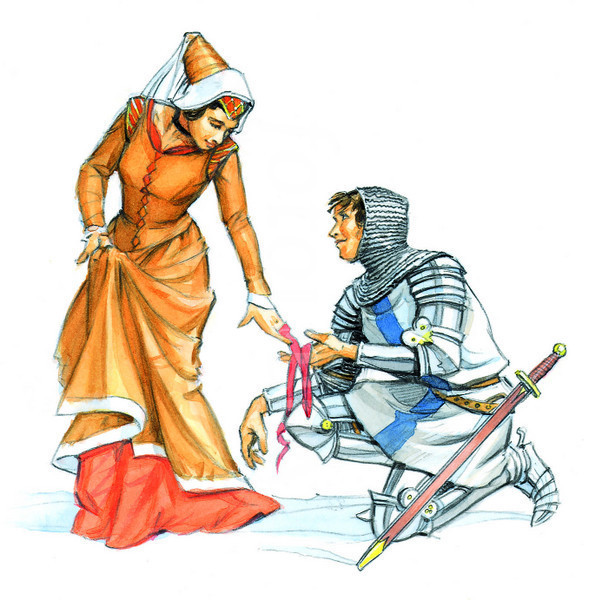
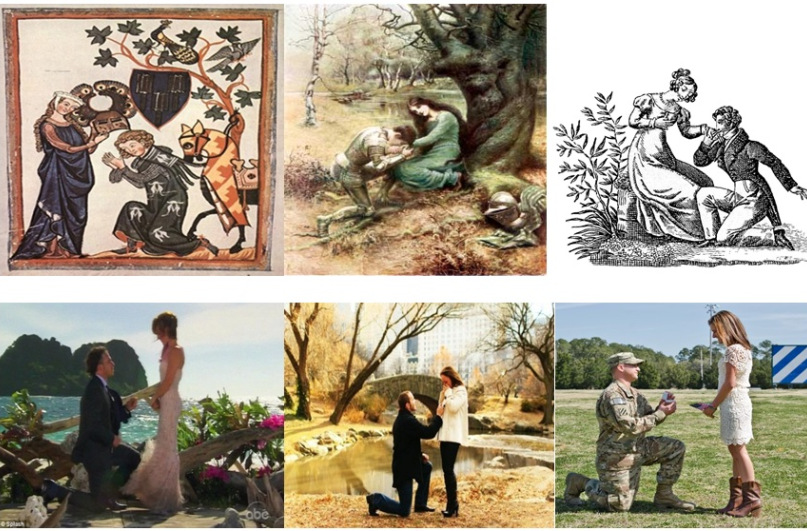
A vassal is defined as a bondman, a slave, a subordinate or dependent, or a person who entered into a mutual obligation to a lord or monarch in the context of the feudal system in medieval Europe. The obligations often included military support and mutual protection in exchange for certain privileges, usually including the grant of land held as a fiefdom. Vassalage was then utilized as a conceit that Maurice Valency called “the shaping principle of the whole design of courtly love.”3 Whether it was a knight, troubadour, or commoner the vassal-to-woman routine was the order of the day then, exactly as it is today.4 Poets adopted the terminology of feudalism, declaring themselves the vassal of the lady and addressing her as midons (my lord), which was taken as standard flattery of a woman. One particularly striking practice showing an adaption from the feudal model involved the man kneeling on one knee before the woman. By kneeling down in this way he assumes the posture of a vassal. He speaks, pledging his faith, promising, like a liege man, not to offer his services to anyone else. He goes even further: in the manner of a serf, he makes her a gift of his entire person.

Citing evidence of vassalism Amy Kelly writes, “As symbolized on shields and other illustrations that place the knight in the ritual attitude of commendation, kneeling before his lady with his hands folded between hers, homage signified male service, not domination or subordination of the lady, and it signified fidelity, constancy in that service.”5

Kneeling-pics
In short it was the lover’s feudal relationship between vassal and overlord which provided the lover with a model for his humble and servile conduct.2

_____

The lead actors – then and now
Imagine twelfth century Europe as a great stage performance enacting the themes of chivalric love, one that would become so popular its actors would continue to serve as role models for the global population 800 years later. The lead actors in this medieval play are as follows, accompanied (in brackets) with the titles we apply to those same actors today as they continue this ancient drama:

Courtly Ladies (= Feminists). Feminists today refer to courtly ladies of the late Middle Ages as the first feminists, or protofeminists, and as with modern feminists these women enjoyed considerable privilege and means. In the 12th – 14th centuries evidence shows that women began to agitate for increased authority over the ‘correct’ way for men and women to conduct relationships, with particular emphasis on what they felt were acceptable roles for males in a dignified and civil society. Not surprisingly this was precisely the time when powerful women were able to establish the female-headed ‘courts of love’ which acted in a comparable way to today’s Family Courts in that both arbitrated love disputes between conflicting couples.

Key literature from the period detailing proper etiquette expected in gender relations was commissioned for writing by powerful women (eg. ‘The Art of Courtly love’) and in some cases was written by women themselves (eg. Christine de Pizan’s writings or those of Marie de France). The emerging discourse acted like a drug that promised the introduction of a one-sided power for females over males, and through the dissemination of romance literature that promise rapidly spread to all social classes in the continent. We have been living with the consequences ever since, a revolution far more significant to the history gender relations than the introduction of the birth control pill and no-fault divorce combined- the latter being mere epiphenomena generated within a larger culture of chivalric love.

The archetypes introduced into society by these high-born ladies are instantly recognizable; the damsel in distress (women as innocent, woman as helpless, women as victim), the princess (women as beautiful, women as narcissistic subject requiring devotion, women as deserving of special privileges), and the high born Ladies (women as morally pure, women as precious, women as superior, women as entitled). These illusions ensured that the attentions of men would be spent attending to women, a program so successful that modern feminists continue to shape today’s cultural landscape with the program of their protofeminists forebears. And just like their forebears, feminists continue to use shaming narratives to facilitate their pedestalizing inheritance.

Fotor091415394White Knights (= White Knights). We retain this metaphor for such heroic individuals, men who are gallant in so many ways, but mostly the wrong ways such as showing-off to undeserving women and concomitantly delighting in competing with and hurting other men. More than any other player in this play, white knights specialize in gallant behaviour for the purpose of impressing and ultimately getting their egos stroked by women.

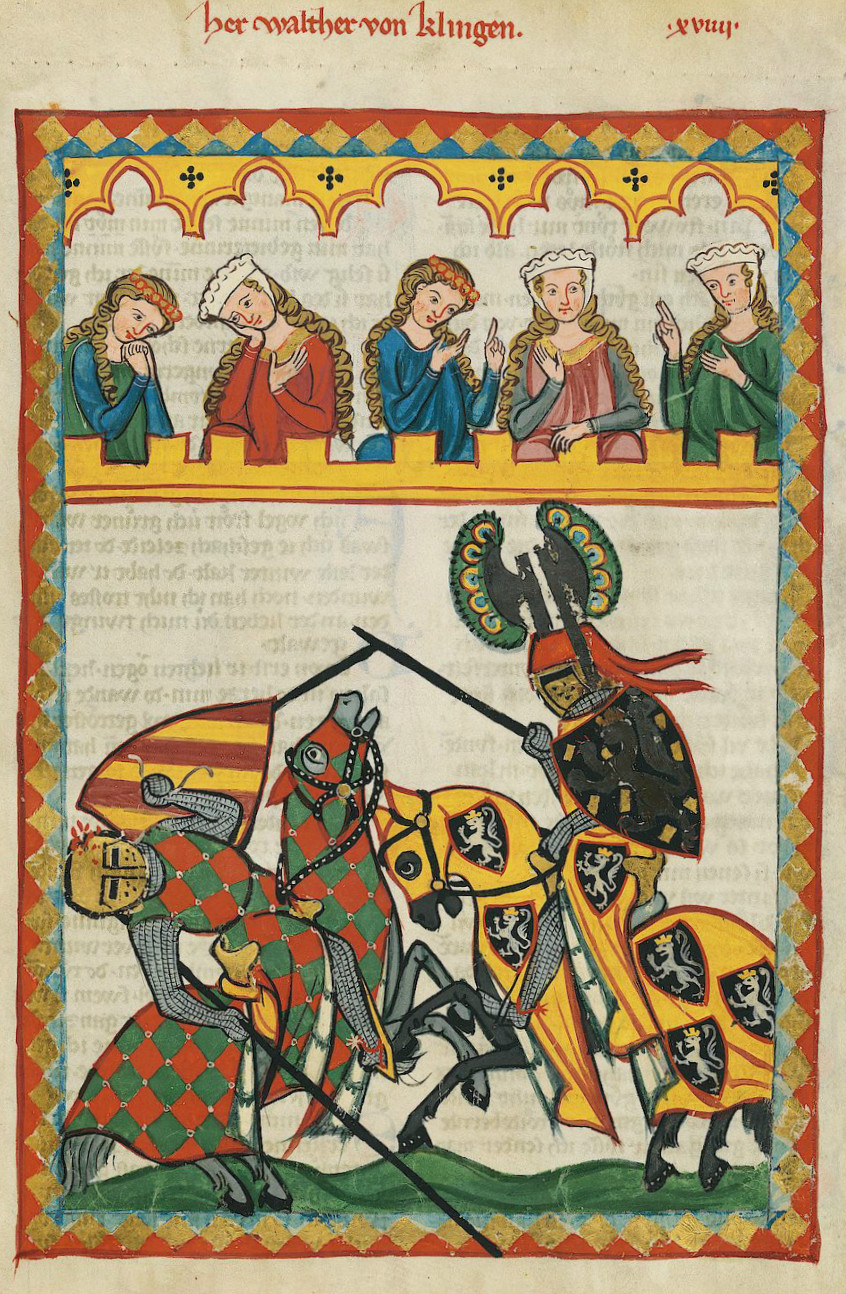
For these first white knights the tournament, the forerunner to modern sporting tournaments, consisted of chivalrous competitions or fights in the Middle Ages. In these fights knights were only too willing to hurt their fellow men to win the praise of female spectators. The competitors were observed doing battle by women who would throw their garments into the arena where the sportsmen would pick them up and wear pieces of women’s clothes -hence the male wearing a particular woman’s scarf would represent her in the tournament.

The men were basically fighting for “her” then, just as they did elsewhere on real battlefields for wife and mother. The gallant man who won his tournament was granted an opportunity to dally with the woman whom he represented in the ring. We retain this gynocentric tradition today as golf tournaments, football tournaments, martial arts tournaments and so on, all designed to show male prowess where the winning competitors get to dally with the best ladies.

MEDIEVAL KNIGHT & LADY BEFORE JOUST- ILLUSTRATIONOther activities of white knights include impressing women with big gestures of protection. For example, the ‘Enterprise of the Green Shield with the White Lady’ was a chivalric order founded by Jean Le Maingre and twelve knights in 1399 committing themselves to the protection of women. Inspired by the ideal of courtly love, the stated purpose of the order was to guard and defend the honour, estate, goods, reputation, fame and praise of all ladies and damsels, an undertaking that earned the praise of Christine de Pizan. Le Maingre, tired of receiving complaints from ladies, maidens, and widows claiming to be oppressed by powerful men bent on depriving them of the lands and honours, and finding no knight or squire willing to defend their just cause, founded an order of twelve knights sworn to carry “a shield of gold enamelled with green and a white lady inside”.

The twelve knights, after swearing this oath, affirmed a long letter explaining their purpose and disseminated it widely in France and beyond her borders. The letter explained that any lady young or old finding herself the victim of injustice could petition one or more or the knights for redress and that knight would respond promptly and leave whatever other task he was performing to fight the lady’s oppressor personally. The similarities of this Order with contemporary enterprises such as the White Ribbon Campaign in which male “ambassadors” pledge an oath to all of womanhood to never condone, excuse or remain silent about violence against women, and to intervene and take action against any man accused of wrongdoing against a woman. The similarities in these gallant missions make clear that the lineage of white knights has progressed seamlessly into the modern era.

Troubadours I (= PUA and Game promoters). The troubadours’ job was to spread the word about the virtues of chivalric love through music, song, poetry and storytelling. Aristocracy and commoner alike enjoyed hearing tales about bravery, and ladies were swept away with epic love poems as the troubadours practiced the rituals of chivalric love. Just like PUAs or Gamers today who write and speak in praise of pussy, troubadours too were composers and promoters of the ‘arts of love’ aimed at securing sexual fulfilment.

Like those troubadours, Roosh and Roissy (etc.) continue the tradition of prose-writing to illustrate the many ways to flatter women in order to get into their pants. Game is a very apt word for this 800 yr old tradition, with its proscription for rehearsed lines and lack of personal authenticity. It is a scripted game of women-worship aimed at a narrow goal. In essence this Casanova routine amounts to a feigning of chivalric love for the purposes of manipulation, usually to gain sex. When modern women call these men ‘players’ they may be very close to the mark. While Roosh et.al. outwardly claim to reject chivalry, they nevertheless embrace its tenets like consummate thespians.

Troubadours II (= Profeminist Men – sometimes derogatorily named ‘manginas’). Unlike the troubadours mentioned above who advocated for a love aimed at sexual fulfillment, Troubadour II advocated a more idealized love of longing that did not consummate in sexual fulfillment. In essence these men more resembled sycophantic Romeos than horny Casanovas. The guiding concept for them was called “fin’ amors,” which meant pure love. Such men were particularly prevalent in the north of France, whereas in the south we see that troubadours (type I mentioned up above) celebrated a love that was adulterous or carnal in which full sexual encounters were sought.

Another thing that distinguished type II troubadours from the former is authenticity. These men appeared to identify wholly with the role and were not merely players. The desire to serve women as their vassal, or perhaps as their masochistic slave, called upon their innermost character. Think of today’s version being the typical profeminist men who work slavishly to pass on the message of their feminist superiors, much as these troubadours slaved to advocate the narcissistic idiosyncrasies of their Ladies. The vassalage role applies here more than with any other character of the Middle Ages – not as a merely pretentious means-to-an-end routine to gain sex, but rather as a soul-affirming act.

_____

Which brings us to what the MHRM refers to as gynocentrism. It is clear from the foregoing that unless evidence of (broadspread) gynocentric culture can be found prior to the Middle Ages, then gynocentrism is precisely 800 years old. In order to determine if this thesis is valid we need first to define exactly what we mean by “gynocentrism”.

The term gynocentrism has been in circulation since the 1800’s, as far as I can tell, with the general definition being “focused on women; concerned with only women.”6 Adam Kostakis further qualifies gynocentrism as, “male sacrifice for the benefit of women” and “the deference of men to women,” and he concludes; “Gynocentrism, whether it went by the name honor, nobility, chivalry, or feminism, its essence has gone unchanged. It remains a peculiarly male duty to help the women onto the lifeboats, while the men themselves face a certain and icy death.”7

From these definitions we see that gynocentrism could refer to any one female-centered practice in an otherwise androcentric society, or to even a single gynocentric act carried out by one individual. With this broad usage in mind the phrase ‘gynocentric culture’ proves more precise for the purposes of this essay , which phrase I will define here as any culture instituting rules for gender relationships that benefit females at the expense of males across a broad range of measures.

At the base of our current form of gynocentrism lies the practice of enforced male sacrifice for the benefit of women. If we accept this definition we need to look back and ask the accompanying question of whether male sacrifices throughout history were always made for the sake of women, or alternatively for the sake of some other primary goal? For instance, when men went to die in vast numbers in wars, was it for women, or was it rather for Man, King and Country? If the latter we cannot then claim that this was a result of some intentional gynocentric culture, at least not in the way I have defined it here. If the sacrifice isn’t intended for the benefit women, even if women were occasional beneficiaries of male sacrifice, then we are not dealing with gynocentrism.

Male disposability strictly “for the benefit of women” comes in strongly only after the advent of the 12th century gender revolution in Europe – a revolution that delivered us terms like gallantry, chivalry, chivalric love, courtesy, romance and so on. From that period onward gynocentric practices grew exponentially, culminating in the demands of today’s feminism. In sum, gynocentrism was a patchy phenomenon at best before the middle ages, after which it became ubiquitous.

With all this in mind it makes little sense to talk of gynocentric culture starting with the industrial revolution a mere 200 years ago (or 100 or even 30 yrs ago), or of it being two million years old as some would argue. We are not simply fighting two million years of genetic programming; our culturally constructed enemy is much, much simpler to pinpoint and to potentially reverse. The historical evidence is strong. All we need do now is look at the circumstances under which gynocentrism first began to flourish and attempt to reverse those circumstances. Specifically, if gynocentric culture was brought about by the practice of shaming, then that is the enemy to target in order to reverse the entire enterprise. For me that process could begin by rejecting the fake moral purity to which women of the last millennia have pretended and against which the worst examples of men have been measured in order to shame the entire gender.

References

1. Amy Kelly, ‘Eleanor of Aquitaine and Her Courts of Love’ Source: Speculum, Vol. 12, No. 1 (Published by Medieval Academy of America, 1937)
2. Jennifer G. Wollock, Rethinking Chivalry and Courtly Love, (Published by Praeger, 2011)
3. Maurice Valency, In Praise of Love: An Introduction to the Love Poetry of the Renaissance, (Macmillan, 1961)
4. For an excellent article about vassaldom today see Gordon Wadsworth’s ‘The Western Butler and his Manhood’ which indicates an unbroken line between the romantic vassaldom of the Middle Ages and the “butler” role expected of males today. (Published on AVfM, 2013)
5. Amy Kelly, ‘Did Women Have a Renaissance?’ in Women, History, and Theory (Published by UCP Press, 1984)
6. Dictionary.com – Gynocentric
7. Adam Kostakis, Gynocentrism Theory – (Published online, 2011). Although Kostakis assumes gynocentrism has been around throughout recorded history, he singles out the Middle Ages for comment: “There is an enormous amount of continuity between the chivalric class code which arose in the Middle Ages and modern feminism… One could say that they are the same entity, which now exists in a more mature form – certainly, we are not dealing with two separate creatures.”

*This article first published at A Voice for Men on 25 March, 2013.

Gynocentrism Theory Lectures (Peter Wright)

The following selection of gynocentrism theory articles were published during 2012 – 2025 by Peter Wright. (For the full collection see Amazon title on right-hand sidebar).

Greek goddess

INTERVIEWS:

GYNOCENTRISM THEORY ARTICLE SERIES: 

1. Introduction to Gynocentrism
2. Gynocentric Culture
3. Gynocentric Culture Complex (GCC)
4. Timeline of Gynocentric Culture
5. The Sexual-Relations Contract
6. The Birth of Chivalric Love
7. How to tame men – gynocentrism style
8. What Ever Happened to Chivalry?
9. Gynocentric Marriage
10. Chasing The Dragon (video) | Chasing The Dragon (text)
11. Slaying The Dragon: Overcoming Sexual Superstimuli
12. Gynocentrism – why so hard to kill?
13. Damseling, Chivalry and Courtly Love (Part 1)
14. Damseling, Chivalry and Courtly Love (Part 2)
15. Sporting Tournaments: A Gynocentric Tradition
16. The Evolution of Gynocentrism Via Romance Writings – Part 1
17. The Evolution of Gynocentrism Via Romance Writings – Part 2
18. The Gynocentrism of Jordan Peterson
19. Jordan Peterson’s Map For Oedipal Men
20. Bastardized Chivalry: From Concern For Weakness to Sexual Exploitation
21. What’s In a Suffix? Taking a Closer Look At The Meaning of Gyno–centrism
22. A Sentimental Continuation of Coverture
23. Anti-Gynocentrism Is the Only Anti-Feminism That Matters
24. ‘Frau Minne’ The Goddess Who Steals Men’s Hearts
25. Mythologies of The Men’s Rights And Feminist Movements
26. Tradwives, Modwives and Feminists
27. Gynocentrism As A Narcissistic Pathology – Part 1
28. Gynocentrism As A Narcissistic Pathology – Part 2
29. Hera, Ancient Greek goddess of feminism
30. A New Aristocracy
31. Women of Color Feminists vs. White Feminist Tears
32. White Supremacy: A Euphemism For White Women Worship
33. Alison Phipps: White Men’s Ship Floats on White Women’s Tears
34. The Biological Origins of Damseling
35. Two Modes of Damseling
36. Unintended Effects Of Transgender Activism On Men’s Issues
37. Transphobia vs. Manphobia
38. C.S. Lewis: The Feudalisation of Love
39. Feminism’s Transgender Fruit — Process Philosophy in Action
40. Gamma Bias In The Maintenance of Gynocentrism
41. The Tradwife Revisited
42. ‘Biological Gynocentrism’ : Falling Into The Feminist Trap?
43. Maladaptive Gynocentrism Is Not “Natural”
44. Aggrieved Entitlement – women’s reaction to temporary loss of chivalry
45. Narcissism Exaggerates Baseline Hypergamy
46. Has the MRM Become a Gynocentric Ideology?
47. Robert Briffault’s ‘Law’ Doesn’t Apply to Humans
48. Four Dimensions Of Cultural Gynocentrism
49. Presumption Of Male Disposability Is Based On Flawed Hypothesis
50. Gynocentric Economies Eventually Lead To Low Birthrates
51. Gynocentric Misreading of Helen of Troy
52. Tradition Was Family-Centric, Not Gynocentric

Cornelius Castoriadis: Infantile Narcissism Replaced by a Narcissistic Social Contract

According to Freud, childhood omnipotence & narcissism undergo displacement via a series of clashes with the reality principle. For a special group of humans, however, culture offers to compensate them for that displacement by offering elevated status, a contract that restores the narcissistic bubble. Cornelius Castoriadis describes the situation:

‘The “narcissistic contract,” theorizes what the psyche expects from society as compensation for the abandonment of its “monadic ultranarcissism”. That’s the narcissistic contract: If you behave in this or that way, you’ll then have other people’s recognition; you will be cathected by the others, who will fill the narcissistic breach opened by the abandonment of originary omnipotence.’ [Figures Of The Thinkable, by Cornelius Castoriadis, Stanford University Press, 2007]