The Modcouple: A Strategic Model For the Modern World

The following Q&A took place on X and explores the concept of modwives and modhusbands (i.e., modcouples) as a strategic relationship option for the modern world. The exchange attempts to examine the broader implications of the idea.

____________________________________

Q.  Are there any examples of “modwife” societies functioning as claimed long term? [Illarion Bykov]

The concept of the modwife provides a strategic model for navigating the cultural, legal and institutional environment that prevails across much of the world today: a combination of affluence and personal freedoms undreamt of by many of our ancestors, alongside the ideological constraints and tyranny of feminism. It’s within this particular environment that the concepts of modwife and modhusband make sense. To make the obvious point, what sane man wants to lock himself into a provider role for a nonexistent tradwife #1, an entitled tradwife #2, or an entitled feminist? The modcouple is intended as an interim arrangement – a pragmatic placeholder for navigating relationships until a different, hopefully saner social environment emerges.

Some earlier societies exhibited elements of what might be recognized as the modcouple arrangement, particularly in their practical sharing of some roles and responsibilities. But these were only partial parallels at best. Those societies generally retained more rigid, sex-based divisions of labor and social expectations than the modcouple model allows. What distinguishes the modcouple idea is not simply the sharing of tasks, but the willingness to move beyond prescribed sex roles altogether, allowing couples (with particular emphasis on men) greater flexibility in determining how they organize their lives together.

Q. How do children fit into the modwife arrangement? Is there any fidelity expected between husband/wife? Paternity DNA tests mandatory? What happens when one side refuses to be reasonable? Is there a legal contract to enforce negotiated contributions?  [DH]

Most of the details are negotiated by the couple. If they don’t like the terms, they don’t proceed. If one breaks the agreement, the other has every right to walk. I should add that no one is under obligation to enter a relationship – being a bachelor is a perfectly reasonable path. “How do children fit into the modwife arrangement?” Having children is not mandatory to the model, and if course risky for any man today.

Q. So after a child is born either can walk away with no responsibility? [DH]

The concept refers only to pairbonding – a way to negotiate relationships in the modern era. Family formation is a different topic, and the prevailing legal frameworks don’t simply vanish under this approach. Modern laws don’t allow men to walk away with no responsibility.
Feminism and Traditionalism: the Two Great Gynocentrisms Of Our Time

In some ways confronting the feminist version of gynocentrism is easier than confronting its traditional counterpart, because feminists are more likely to admit to their plan of increasing the power of women — female empowerment as they like to call it.

Many traditionalists on the other hand tend to disguise their desire to grant women inflated status, but they work toward securing forms of gynocentric power no less than do feminists. In the traditionalist language that power is referred to as men ‘putting her on a pedestal’ – a phrase known by all, and an aim widely aspired to by traditionalists.
Both progressive and traditional gynocentrism aims to privilege women over men. Both are reliant on the damsel-in-distress narrative to harness chivalric supply, and the only thing that separates them is the typical list of privileges they aim to institute – ie. typically a pampered housewife for the traditionalist, or have-it-all lifestyle for the progressive feminist.

These two gynocentrisms are essentially at war with each other over who deserves priority access to male chivalry, that magic ingredient needed for realizing gynocentric power. To that end, traditional and progressive gynocentrists have cultivated different dog-whistles to provoke chivalric behaviour from males: the traditional woman plays the demure, weak damsel in need of saving by a knight in shining armour, while the feminist plays the same victim role but is far more aggressive in her demand for chivalric redress. We could say that the same ‘white knight’ caters to these two variants of damsel – the demure damsel, and the aggressive damsel respectively.

These two gynocentrisms have their taproots in the codified gender roles of medieval Europe, in which, to quote philosopher Julia Kristeva, “Roles were assigned to woman and man: suzerain and vassal, with the lady offering up a ‘distress’ and the man offering a ‘service.’”

So despite feminism positioning itself as a progressive new movement, its motive is remarkably traditional.

Circularity: Gamma Bias Informs The Very Theory of Gamma Bias

Gamma Bias is an excellent construct for explaining the gender bias we see today. A fatal flaw attached to the theory, however, is the claim that it is an evolved, hardwired species trait (as proposed in The Palgrave Handbook of Male Psychology and Mental Health).

Seager and Barry put the evolutionary claim this way:

It makes sense that women are more valuable than men, because of their importance in reproduction. A very basic way of understanding this is to think about the question of which hypothetical village would have the better chance of survival: the one with 100 women and one man or the village with 100 men and one woman? The answer to the question demonstrates the unquestionable value of women to human survival.

Why We Disfavour Men

On an evolutionary level, males can be seen as the providers of protection, not the recipients of protection (Seager et al. 2016). It makes sense that someone should have the role of protecting offspring, and also protect those who give birth to and nurture the offspring. Thus social attitudes would have been calibrated accordingly over many thousands of years to associate femininity with nurturing and vulnerability and masculinity with protection and strength. Because of this, it would be more difficult—both unconsciously and consciously—to feel the same level of emotional sympathy for a male than a female. For the man, it might also therefore be difficult to deviate from the script of the protector and seek help. By the same token, it might also be difficult for society to see men as victims rather than protectors.

[pp. 96-97 in The Palgrave Handbook of Male Psychology and Mental Health]

Evolutionary psychology “Just So stories” assume Victorian nuclear-family roles—man as sole protector/provider, woman as sole childminder/homemaker—that do not match most of human history. Humans lived and worked as cooperative teams (“all for one, and one for all”). Child survival depended on alloparental care and paternal investment; protection and provisioning came from every group member, not only men. When men were sick, injured, or dependent, the extended family filled the gap rather than discarding them according to any supposed hardwired gamma bias. Without that direct male investment in childcare and survival infrastructure, the offspring of many women paired with a single male, or even limited males, would almost certainly fail to survive.

The evolutionary-psychology component can therefore be discarded. Occam’s razor favors memetic drivers (Dawkins) over genetic ones; these are better grounded in the historical record, and it’s good to see an attempt to elaborate some of those memetic drivers in the same Palgrave handbook. Treating gamma bias as adaptive hardwiring simply perpetuates the maladaptive force it describes. Said differently, the appeal to genetics is part of the memetics of gamma bias.

Seager & Barry’s evolutionary account of the empathy gap and gamma-bias patterns treats the selective magnification and minimization as adaptive calibrations in the following way:

CELEBRATION (doing good):
-Female magnification (genetic/adaptive — higher reproductive value)
-Male minimization (genetic/adaptive)

PERPETRATION (doing harm):
-Male magnification (genetic/adaptive — disposable protector role)
-Female minimization (genetic/adaptive)

The selective pattern of magnifying female value while minimizing male vulnerability is the same pattern the theory itself applies when explaining the bias. The evolutionary gloss therefore accounts for gamma bias by invoking gamma bias itself. It treats the selective magnification of female value and minimization of male vulnerability as an already-established adaptive fact, then uses that pattern to explain why the bias exists. That is the circularity.

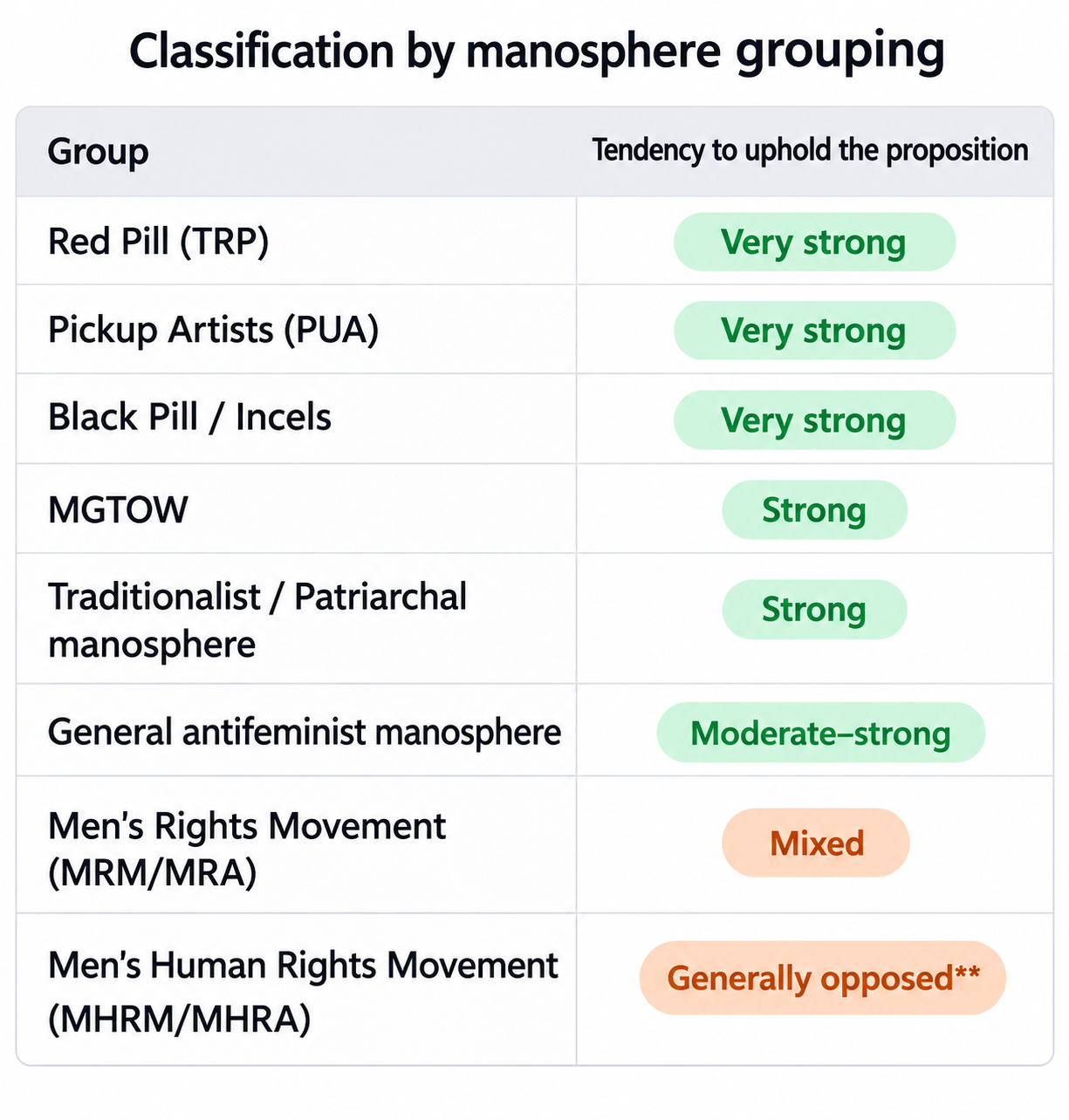
Chat GPT Ranks Manosphere Groups

Which Manosphere groups tend to uphold the following bio-gynocentric proposition: “Women are born inherently valuable, but men are not and so have to keep creating value”?

Chat GPT:

A longer response to this question from Chat GPT can be found here:

Men’s Human Rights Movement: A Snapshot

The Men’s Human Rights Movement (MHRM) is a distinct “second wave” of men’s advocacy that emerged in the internet era and was formally named in January 2013.

Its guiding philosophical principles include:

  • Rejection of gynocentrism as biologically hardwired or inevitable.
  • Prioritization of autonomy, self-determination, and expanded life choices for men.
  • Emphasis on changing cultural narratives rather than relying primarily on political lobbying.
  • Opposition to both feminist and traditional forms of male exploitation.
  • Advocacy of equal human worth, dignity, and consideration of men.
  • Focus on human rights rather than traditional gender roles or sex-based entitlements.

ORIGINS:

While the name and explicit second-wave framing date to 2013, elements of the underlying philosophy can be traced much earlier.

Ernest Belfort Bax’s The Legal Subjection of Men (1896) systematically enumerated cultural and legal disadvantages facing men, advocated for men’s human rights and freedom, and later challenged cultural narratives and biologically reductionist theories such as the bio-determinist views advanced by Lester Ward which proposed female biological superiority to men.

Bax engaged these ideas publicly through prominent newspapers and other media, challenging prevailing cultural narratives rather than relying solely on appeals to politicians. In this sense, he functions as an early precursor through his (1) rejection of bio-gynocentric theory, (2) focus on the human rights and dignity of men, (3) emphasis on changing the cultural narrative, and (4) opposition to both feminist and traditional forms of male exploitation.

Bax can therefore be regarded as an important nineteenth- and early twentieth-century intellectual precursor to the MHRM, anticipating several of its central concerns, although he did not establish or use the later movement’s terminology.

Over the following century, various writers and advocates continued to examine men’s legal and cultural disadvantages. The arrival of the internet in the 1990s provided an unprecedented means of exchanging ideas, networking, and developing a more comprehensive critique of established gender assumptions. By the late 2000s and early 2010s, much of this developing discourse had found a prominent platform through A Voice for Men, which helped consolidate a new approach to men’s advocacy.

It was within this environment that the ‘MHRM’ crystallized as a distinct philosophical orientation: the cumulative product of decades of discussion, rather than an entirely new set of ideas appearing overnight in 2013.

Relationship to the Men’s Rights Movement

Although the MHRM emerged partly from within discussions of the broader Men’s Rights Movement (MRM), the two labels are not philosophically interchangeable.

The MHRM distinguishes itself through its rejection of gynocentrism as an inevitable feature of human nature and its opposition to enforced traditional gender roles. Rather than seeking merely to improve men’s position within an assumed permanent system of female-centred social arrangements, it challenges the underlying assumptions of that system.

Its defining premise is that men are human beings entitled to equal rights, autonomy and self-determination in their own right—not merely individuals whose interests must be accommodated within traditional or gynocentric expectations.

Men’s Human Rights Movement – primary sources

Below is a collection of some primary sources and descriptions of the MHRM. ~ PW

– Welcome To The Second Wave (January 2013)
– Entering a New ERA (January 2013)
– Men’s Human Rights Movement (Wiki4Men – December 2013)
– A Voice For Choice (May 2014)
– Origin of the phrase ‘Men’s Human Rights Movement’ (2018)
– Is the MHRM a Tradcon Trojan horse? No  (2019)
– Has The MRM Become a Gynocentric Ideology? (2023)
– The Only Non-Gynocentric Approach in the Manosphere (2026)
– Men’s Human Rights Movement: A Snapshot (2026)
– Chat GPT Ranks Manosphere Groups (2026)