Pleasure-seeking vs. relationships

Friends in night club

Pleasure-seeking and relationships are the two most powerful forces informing societies, families and the inner life of individuals – and they are often pitted against each other, with one dominating at the expense of the other.
Pleasure-seeking as a philosophical enterprise has been around since at least the ancient Greek philosopher Epicurus, and was more fully elaborated in the writings of Sigmund Freud whose “pleasure principle” lays at the base of all psychoanalytic theory; “What decides the purpose of life,” writes Freud, “is simply the programme of the pleasure principle.”1

For Freud the human libido is a pleasure seeking force, and his popularization of this idea gave the project of global capitalism part of its internal rationale: every individual is an appetite ruthlessly seeking pleasure, a non-stop consumer. The majority of societies and economies around the world are now reliant on this principle in order to perpetuate themselves.

According to Freud, the pleasure principle is:

– backed by instinctual drive
– selfish
– ruthless
– narcissistic
– focused on the individual above relationships

After 100 years of promoting the importance of the pleasure principle, indeed over-promoting it, today we have become devotees at its shrine, promoting ideas like these:

– narcissism
– sense of entitlement
– pick up artistry
– rampant consumerism
– commodification of interpersonal relationships

How are we feeling about all that pleasure – are we enjoying it yet or are we sick of it? Do you want to dial up the hedonism some more, or do you want to join me in questioning the premise?

Despite capitalism’s incestuous relationship with the pleasure-principle, a behavior it does more to perpetuate than merely serve, early psychoanalysts began to see problems with it. The problem was not with the idea that humans are pleasure seekers, but that the idea had been afforded far more importance in human behavior than it deserved – there were other more important factors to human being that had been given short shrift.

Like relationships.

Early psychoanalyst Ronald Fairbairn was amongst the first to write about the importance of relationships over pleasure seeking. In 1944 Fairbairn explained the impasse with Freud’s theory as follows;
In a previous paper (1941) I attempted to formulate a new version of the libido theory and to outline the general features which a systematic psychopathology based upon this re-formulation would appear to assume. The basic conception which I advanced on that occasion, and to which I still adhere, is to the effect that libido is primarily object-seeking (rather than pleasure-seeking, as in the classic theory), and that it is to disturbances in the object-relationships of the developing ego that we must look for the ultimate origin of all psychopathological conditions. This conception seems to me not only to be closer in accord with psychological facts and clinical data than that embodied in Freud’s original libido theory, but also to represent a logical outcome of the present stage of psychoanalytical thought and a necessary step in the further development of psychoanalytical theory… 2
This revolution in psychoanalytic thinking launched the school of Object Relations psychology, with the word ‘Object’ standing for real people we enter into relationships with. Object Relations psychology is based more on attachment theory than on the pleasure principle. In a nutshell this school, which superseded psychoanalysis, is described as:

Object relations is based on the theory that the primary motivational factors in one’s life are based on human relationships, rather than sexual or aggressive triggers. Object relations is a variation of psychoanalytic theory and diverges from Freud’s belief that we are pleasure seeking beings; instead it suggests that humans seek relationships.3

Has the mental health industry caught up? Yes, I’m pleased to say that portions of the industry have not only caught up, they are driving the research on attachment forward. Other sections of the industry, however, especially those on the front line of offering services, continue to devote undue importance to pleasure-seeking through the advocacy of self-actualization and ‘me and my wants.’

The problems of gynocentrism and treating of men as utilities will not be addressed until we look at how these things are used to generate pleasure. One reason we have stalled in relativizing the pleasure-principle and affirming the findings of attachment science, is that it’s obviously not in the current society’s interest to do so. To catch up and look in the mirror is to die – the whole goddam system collapses – our beliefs, our customs, our financial systems.

But look at it we must, both collectively and individually if we wish to promote mental health.

Do we really need more shopping, drugs, stimulation, sex and food? Frankly many men are done… they’ve had enough food and sex to last 20 lifetimes. They don’t need more pick-up techniques, they don’t need more research fads focusing on sexual drives a-la-Freud, and they certainly don’t need to consume more – they’ve consumed quite enough, thank you.

If we insist on believing the pleasure principle is paramount, that it is our most pressing genetic imperative, along with the belief that “all men want is sex” that so many men find annoying, then our only escape is to follow a sick, nihilistic version of retreat from the world. How else to escape the call of pleasure? Our western culture’s devotion to the pleasure principle leaves it stuck in its own insoluble loop, like a snake devouring itself and not realizing that the tail it is eating is its own.

I say western culture because there are whispers of an alternative in other cultures that, alas are also being corrupted for the newfangled focus on the pleasure principle that drives the mighty dollar. I have listened to people from various Asian countries – Cambodia, China, Thailand – who talk of valuing their relationships and families somewhat more than their own pleasure-seeking ambitions. Watch how they eat together, having several dishes of food on the table that they all share, not everyman for his own narcissistic pleasure. I have also heard some Asians ask, perplexed, why women wear skimpy clothes in winter, not knowing that our cultures are all about inviting consumption and commodification of every person in order to feed each others’ predatory pleasures.

None of this is to deny the pleasure principle and its powerful pull on men’s lives. But pleasure quickly becomes hedonism without relationship to temper it, and it leads not to a meaningful life but to emptiness and nihilism where ‘opting out’ is the only alternative response – a response that looks more like a sickness than a cure.

Now what does all this mean to the wellbeing of men? In short, everything. Getting these two vital aspects of human nature in balance is not only the secret to psychological health, but our lives may literally depend on it. Regaining that balance can start with paying more attention to our relationship needs and less to pleasure – more to the girl-next-door and less to the girl with the exaggerated cleavage, boob jobs, and love bombs.

Moreover, the problem does not stop at intimate adult relations, and applies to family as well. If every family member is chasing his or her own pleasures, they are more likely than ever to spin off in their own directions like atoms rapping in a void – there’s no glue holding the unit together, no relationship – and custody battles, selfishness and estrangement are the inevitable result: Me and my pleasures first.

To be sure, regular relationships also afford experiences of pleasure or contentment, albeit of lower intensity than the pleasure-seeking described by Freud. Another distinguishing feature is that relationships don’t involve the use of people in the same ruthless manner as does the pleasure principle – ie. not the same as we experience when devouring food or having sex. Relationship is more concerned with situating oneself in a context and gaining emotional satisfactions from that – from belonging, from being-with-others, as contrasted with using objects to satisfy appetite. A second distinguishing feature of intimate relationships is that the individual has concern for the objects of his attachment – whereas the pleasure-seeking appetite has no concern over its use of people nor its destruction of same.

Jungian analyst Robert A. Johnson writes about the two impulses as two kinds of “love.” He calls the pleasure-seeking impulse romantic love, and the relationship-seeking version human love. Here is his description of the two;

Many years ago a wise friend gave me a name for human love. She called it “stirring-the-oatmeal” love. She was right: Within this phrase, if we will humble ourselves enough to look, is the very essence of what human love is, and it shows us the principal differences between human love and romance. Stirring the oatmeal is a humble act-not exciting or thrilling. But it symbolizes a relatedness that brings love down to earth. It represents a willingness to share ordinary human life, to find meaning in the simple, unromantic tasks: earning a living, living within a budget, putting out the garbage, feeding the baby in the middle of the night. To “stir the oatmeal” means to find the relatedness, the value, even the beauty, in simple and ordinary things, not to eternally demand a cosmic drama, an entertainment, or an extraordinary intensity in everything. Like the rice hulling of the Zen monks, the spinning wheel of Gandhi, the tent making of Saint Paul, it represents the discovery of the sacred in the midst of the humble and ordinary.

Jung once said that feeling is a matter of the small. And in human love, we can see that it is true. The real relatedness between two people is experienced in the small tasks they do together: the quiet conversation when the day’s upheavals are at rest, the soft word of understanding, the daily companionship, the encouragement offered in a difficult moment, the small gift when least expected, the spontaneous gesture of love. When a couple are genuinely related to each other, they are willing to enter into the whole spectrum of human life together. They transform even the unexciting, difficult, and mundane things into a joyful and fulfilling component of life. By contrast, romantic love can only last so long as a couple are “high” on one another, so long as the money lasts and the entertainments are exciting. “Stirring the oatmeal” means that two people take their love off the airy level of exciting fantasy and convert it into earthy, practical immediacy. Love is content to do many things that ego is bored with. Love is willing to work with the other person’s moods and unreasonableness.

Love is willing to fix breakfast and balance the checkbook. Love is willing to do these “oatmeal” things of life because it is related to a person, not a projection. Human love sees another person as an individual and makes an individualized relationship to him or her.4

I attempted to outline the importance of relational attachments in a past article Sex and Attachment and another sketching a way to build relationships that avoid some of the predatory themes at the heart of Western gynocentrism, entitled Love and friendship. Hopefully these provide some discussion points, but more important is asking of the initial question: are we ready to interrogate the pleasure-principle as the foundation of our society?

References:

[1] Sigmund Freud, Civilization, Society and Religion (PFL 12) p. 263 (1991)
[2] Ronald Fairbairn, Psychoanalytic Studies of the Personality pp. 82-83 (1952)
[3] Object Relations, definition from GoodTherapy.org (August 2015)
[4] Robert A. Johnson, We: Understanding the Psychology of Romantic Love, p. 195 (1983)

Feminism


FEMINISM

Below is a selection of articles showing the feminist project as a continuation of the longer gynocentric tradition to which it belongs. The underlying thesis of the articles is summarized in this passage by Adam Kostakis:

Feminism is only the modern packaging of Gynocentrism, an ancient product, made possible in its present form by the extensive public welfare arrangements of the post-war period. In spite of its radical rhetoric, the content of feminism, or one could say, its essence, is remarkably traditional; so traditional, in fact, that its core ideas are simply taken for granted, as unquestioned and unquestionable dogma, enjoying uniform assent across the political spectrum. Feminism is distinguishable only because it takes a certain traditional idea – the deference of men to women – to an unsustainable extreme. Political extremism, a product of modernity, shall fittingly put an end to the traditional idea itself; that is, in the aftermath of its astounding, all-singing, all-dancing final act.

The traditional idea under discussion is male sacrifice for the benefit of women, which we term Gynocentrism. This is the historical norm, and it was the way of the world long before anything called ‘feminism’ made itself known. There is an enormous amount of continuity between the chivalric class code which arose in the Middle Ages and modern feminism, for instance. That the two are distinguishable is clear enough, but the latter is simply a progressive extension of the former over several centuries, having retained its essence over a long period of transition. One could say that they are the same entity, which now exists in a more mature form – certainly, we are not dealing with two separate creatures.

Selection of articles:

La Querelle des Femmes
Ernest B. Bax on “Chivalry feminism”
Feminism: the same old gynocentric story
Gynocentrism and its Discontents
Feminism: gynocentric or egalitarian?
Feminism, sex-differences and chivalry
Nathanson and Young on gynocentric feminism
Gynocentrism, humanism and The Patriarchy™
Offering a concise definition of feminism
Gynocentrism 2.0, compassion, and choice
Damseling, chivalry and courtly love in modern feminism
Book review of ‘Governance Feminism: An Introduction’
Mythologies of The Men’s Rights And Feminist Movements
Hera, Ancient Greek Goddess of Feminism
Tradwives, Modwives and Feminists
A New Aristocracy
Women of color feminists vs. white feminist tears
White Supremacy: A Euphemism For White Women Worship

La Querelle

The following items elaborate on the long-running gender quarrel (La querelle) from the twelfth century to today.


WOMEN’S VOICES

Christine de Pizan: the first gender warrior
Jane Anger: gynocentrism in 1589
Modesta Pozzo: gynocentrism in 1590
Lucrezia Marinella: gynocentrism in 1600
Margaret Cavendish: gynocentrism in 1662
Elizabeth Poole Sandford: Female Power, Influence, and Privileges in 1835

FEMINISM

La Querelle des Femmes
Ernest B. Bax on “Chivalry feminism”
Feminism: the same old gynocentric story
Gynocentrism and its Discontents
Feminism: gynocentric or egalitarian?
Feminism, sex-differences and chivalry
Nathanson and Young on gynocentric feminism
Gynocentrism, humanism and The Patriarchy™
Offering a concise definition of feminism
Gynocentrism 2.0, compassion, and choice
Damseling, chivalry and courtly love in modern feminism

MEN GOING THEIR OWN WAY (MGTOW)

MGTOW philosophy

Perspectives on MGTOW (Men Going Their Own Way) – a significant post-gynocentrism subculture based on the principle of male self-determination.

Querelle du Mariage
How to tame men – gynocentrism style
Gynocentrism – why so hard to kill?
MGTOW – facts and fallacies
What are MGTOW against?
Early references to “Men going their own way”
Definition of MGTOW
A MGTOW Yardstick: Determination Of Self By Other (DOSBO)
On the nature of MGTOW self-determination
MGTOW: 12th century style
MGTOW movement of 1898
Authoring your own life
Don’t just do something, SIT THERE

Marriage shunning

The following collection of articles describe the post-gynocentrism phenomenon of marriage shunning by males, and the rationale behind it.

Marriage is a gynocentric custom
Slavery 101 – dating as taught to girls
Valentine’s Day: gynocentrism’s most holy event
Women complaining about lack of available slavemasters
Men not marrying
Men shouldn’t marry
Marriage is obsolete. Are women?
Men on strike: why men are boycotting marriage
Don’t give up on marriage? Request denied
Down the aisle again on the marriage question

Post-gynocentrism relationships

Post-gynocentrism relationships between men and women are possible and even desirable for many people. The following articles explore how relationships can be revisioned.

Hail to the V
The other Beauty Myth
Sex and Attachment
Love and Friendship
On the marriage question

Post-gynocentrism culture

Articles (mostly from AVfM) exploring post-gynocentrism culture. Each article presents a post-gynocentrism paradigm for individual or collective existence.

How to end gynocentrism
Gynocentrism – why so hard to kill?
Freedom from gynocentrism in 12 Steps
Breaking the pendulum: Tradcons vs. Feminists
Why anyone who values freedom should be fighting against feminism
A Voice for Choice
Gynocentrism and the hierarchy of entitlement
The Counterculture
MHRM: counterculture or subculture?
On creating a counter-culture
A little blood in the mix never hurt a revolution

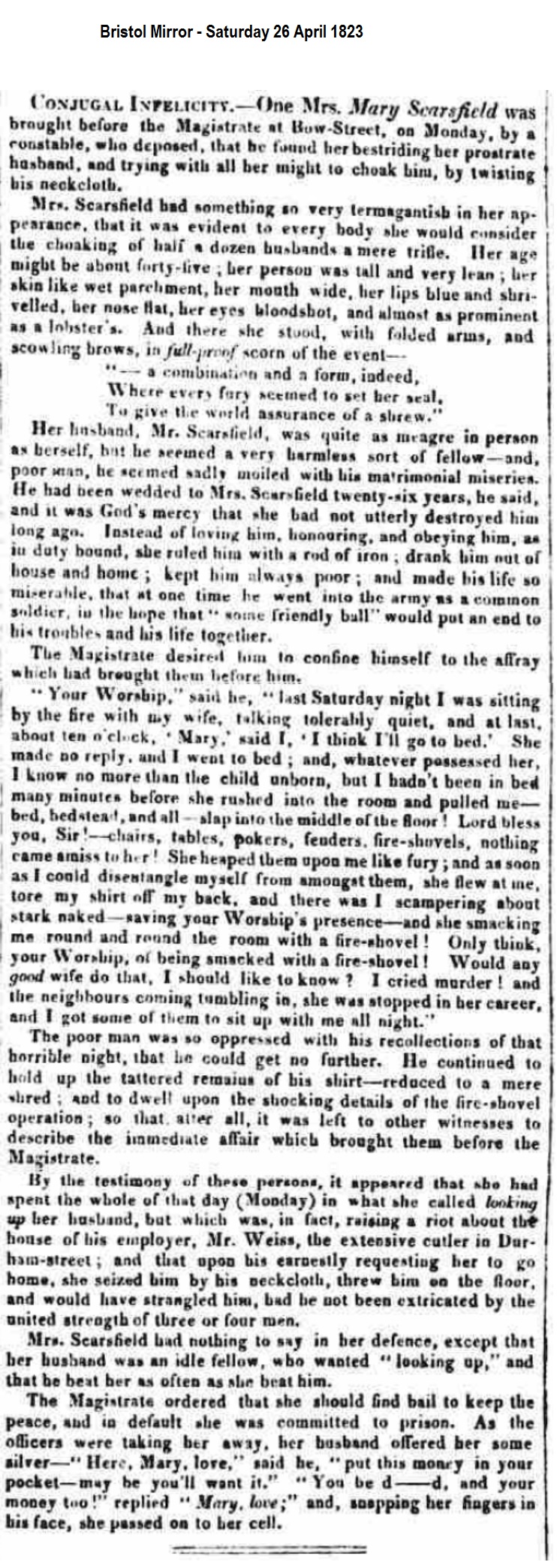
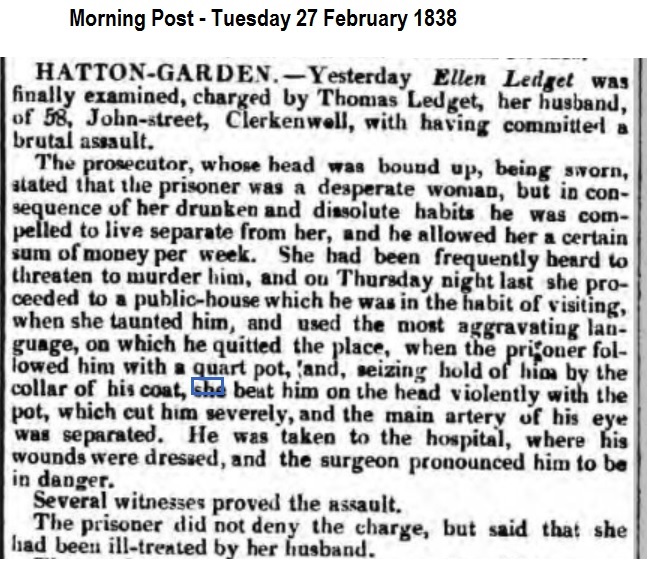
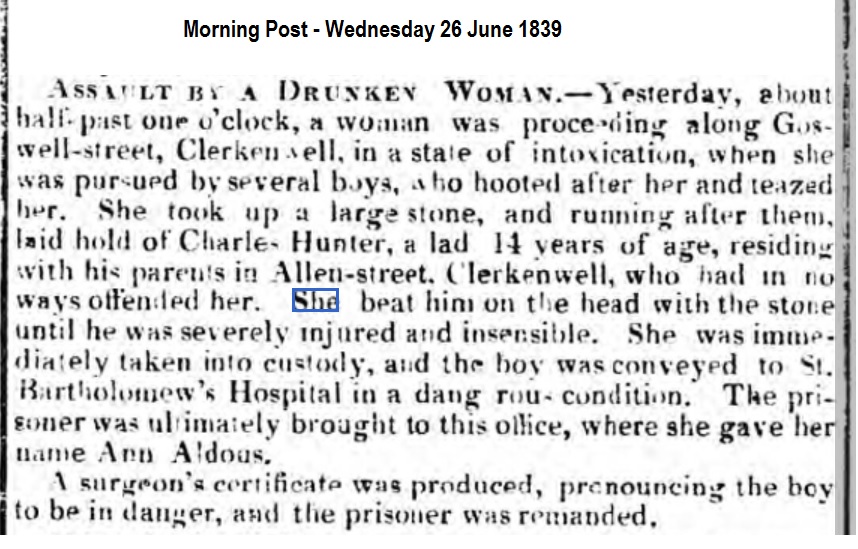
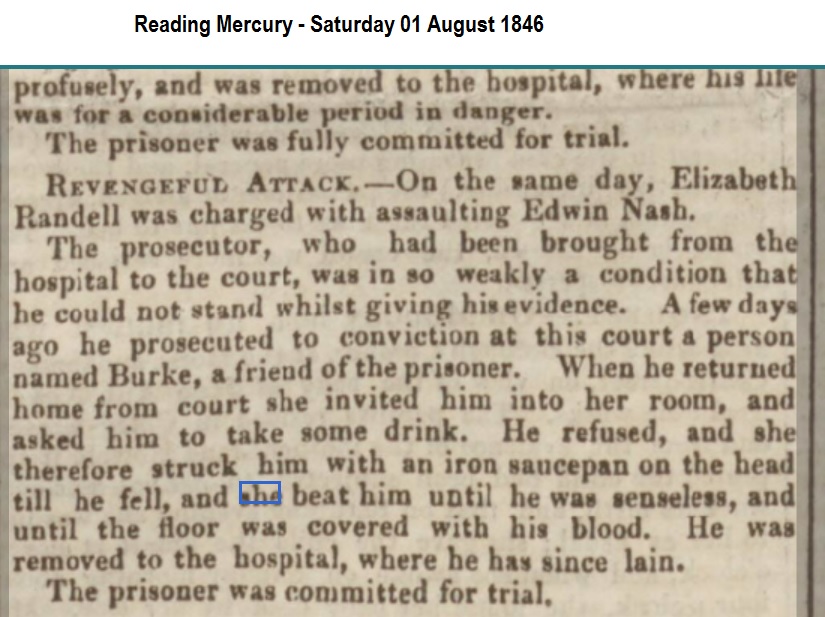
Fire-poker princesses: female perpetrated domestic violence in nineteenth-century England

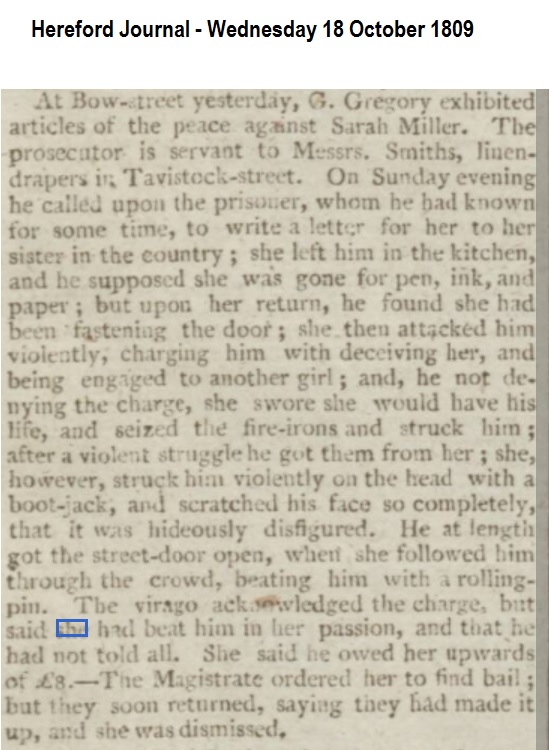
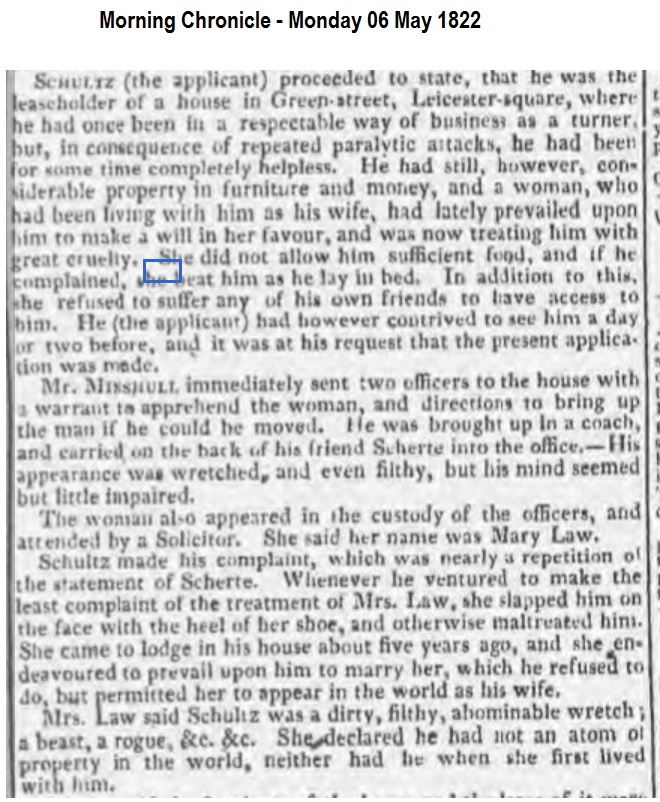
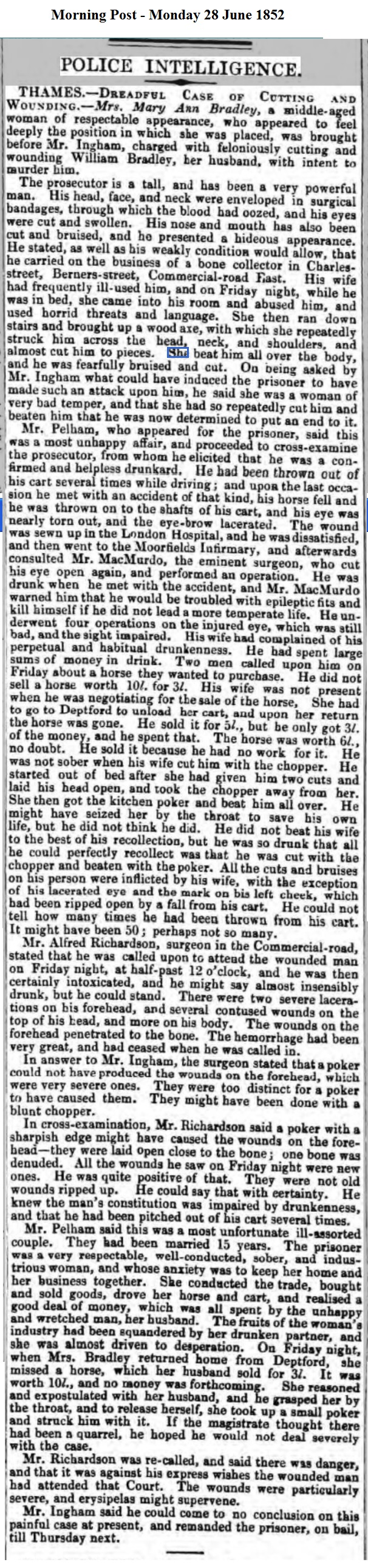
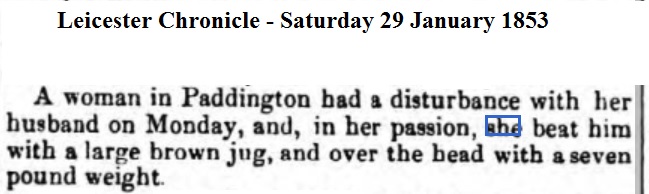
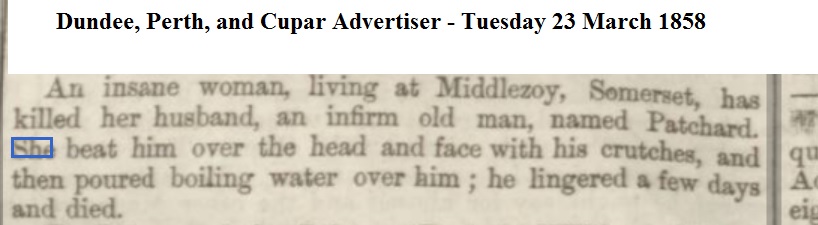
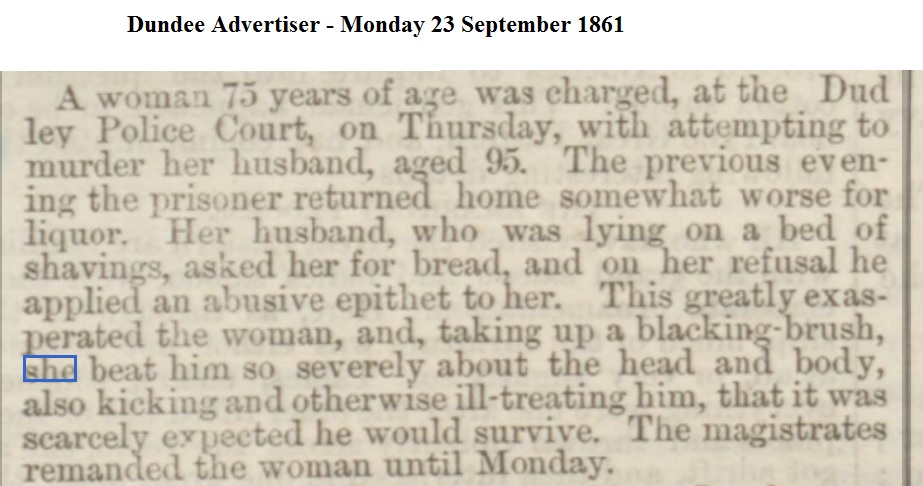
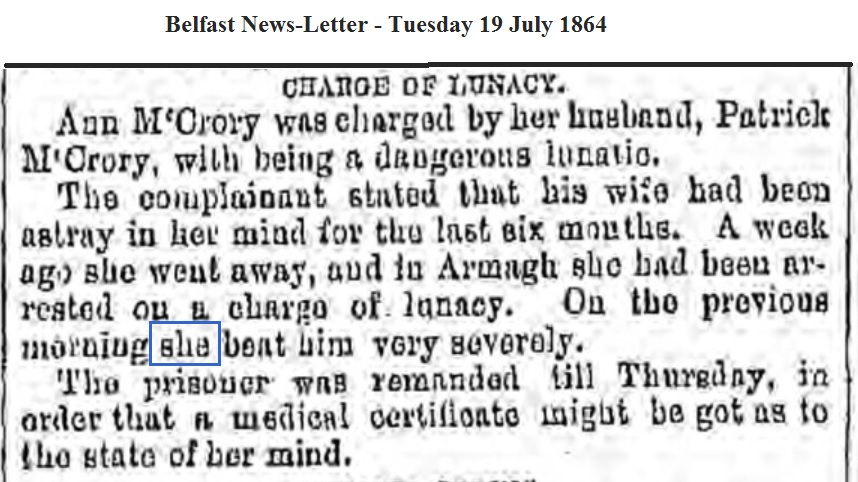
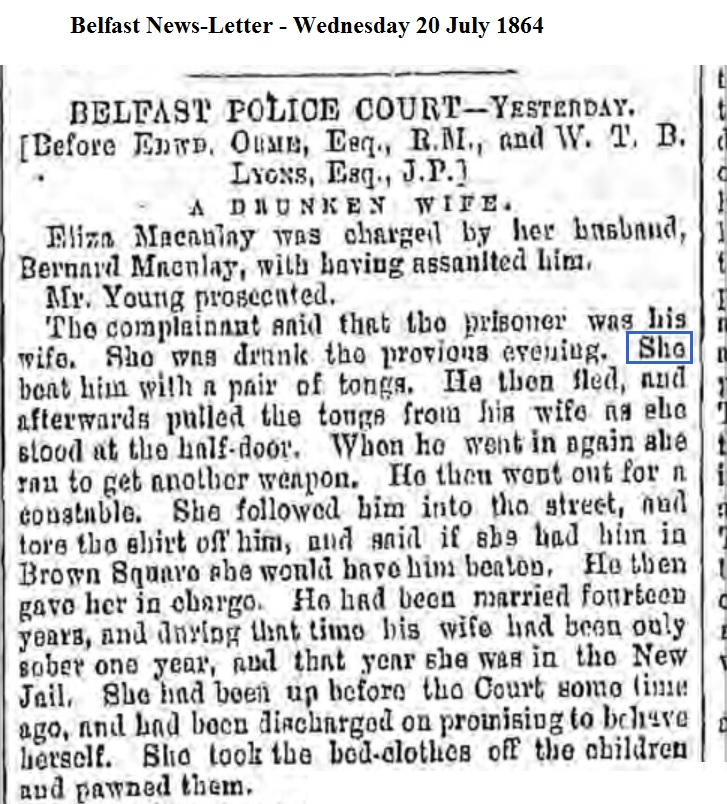
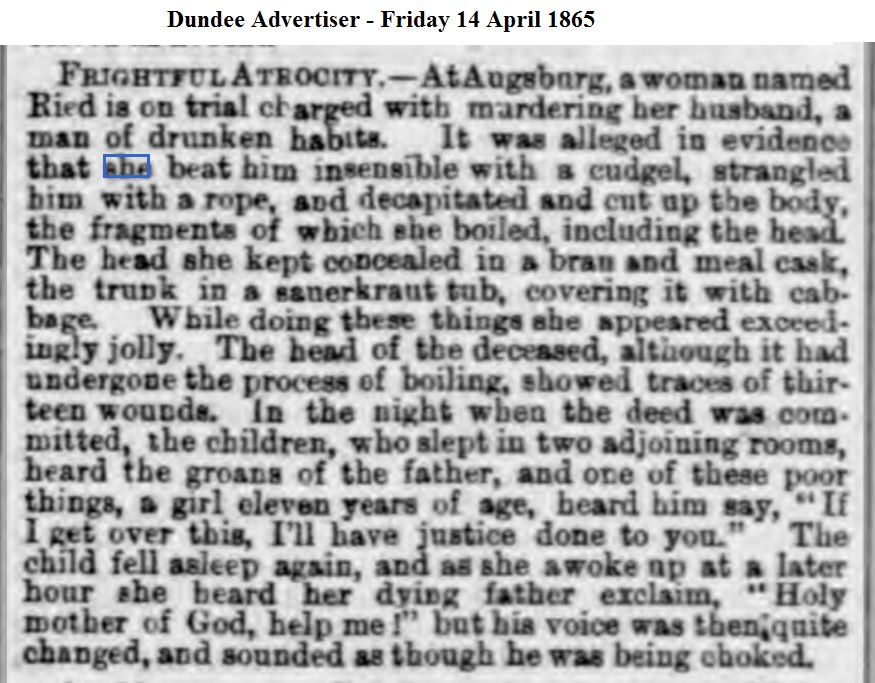
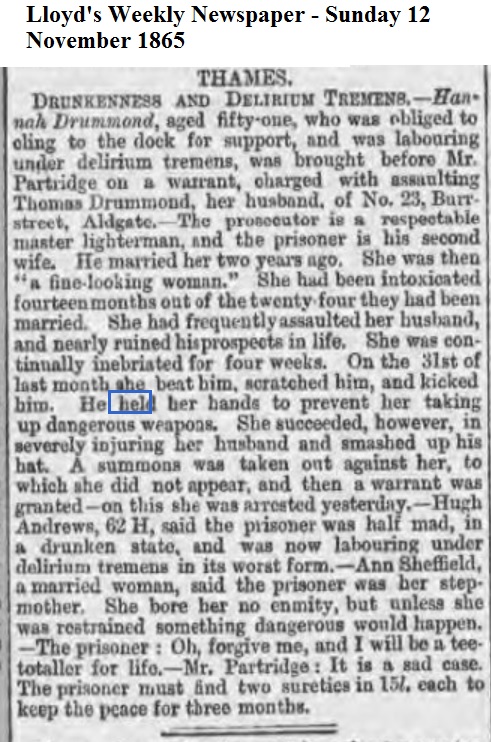
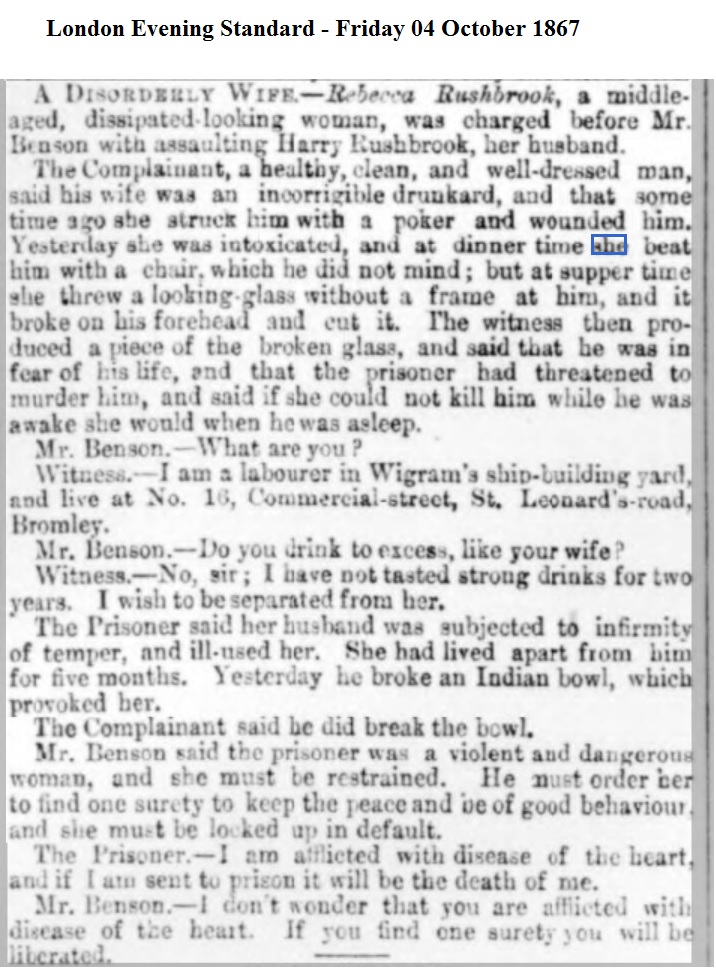
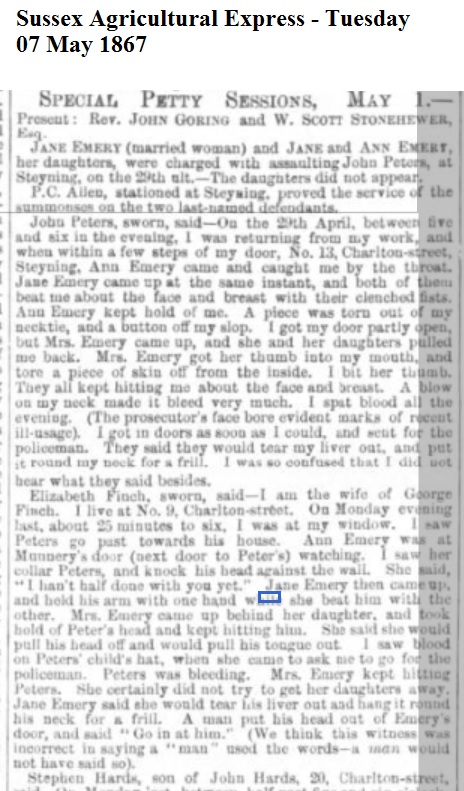
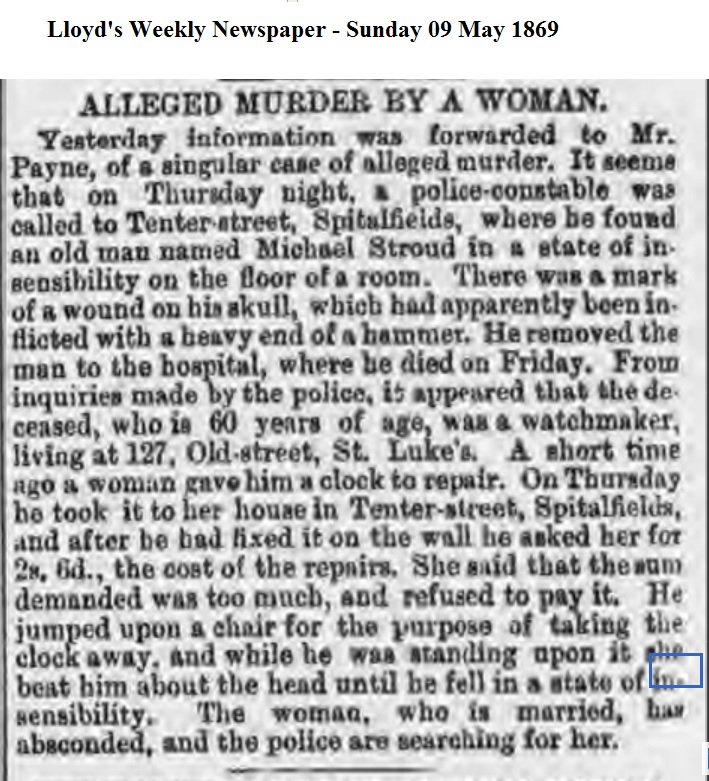
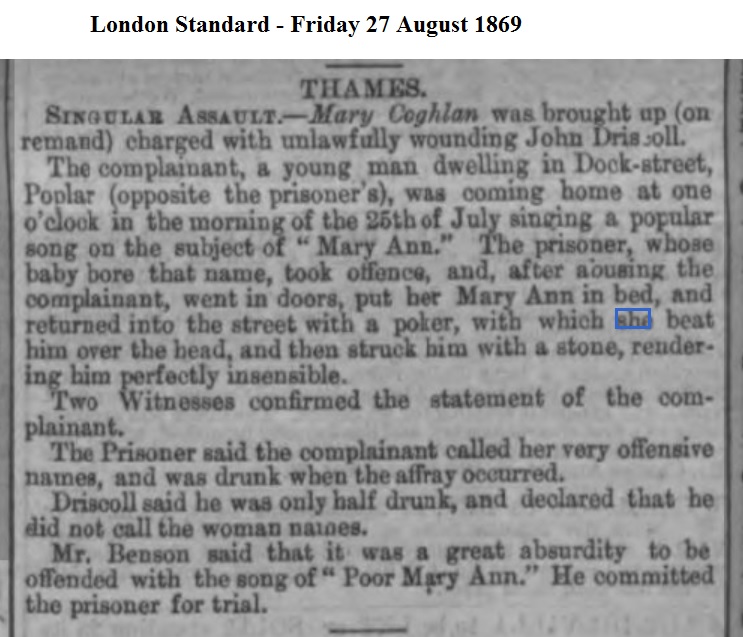
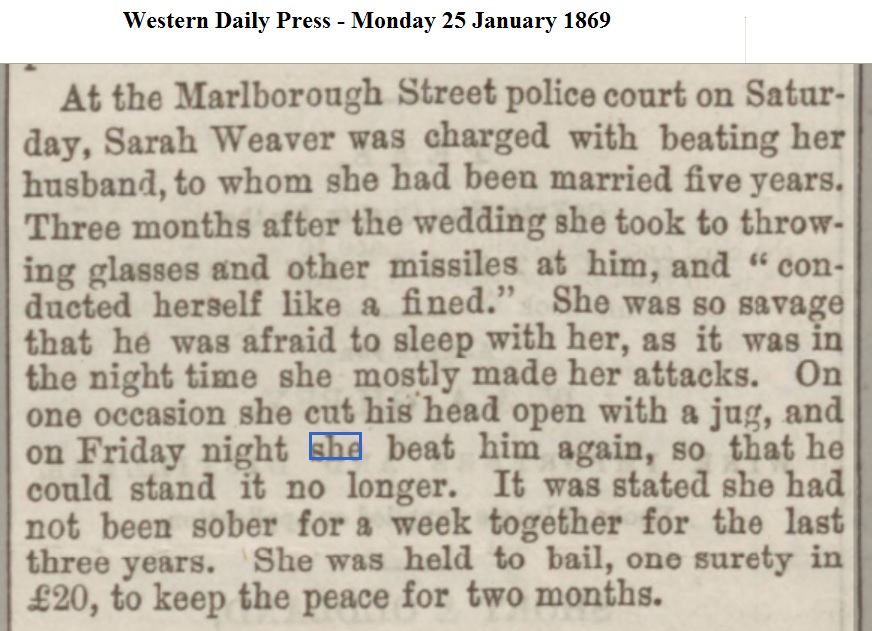
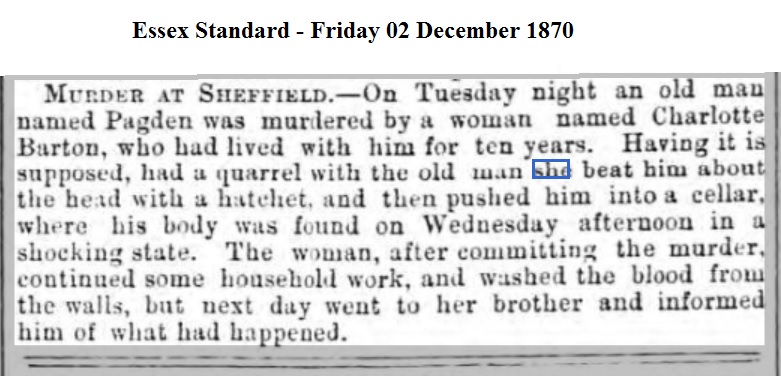
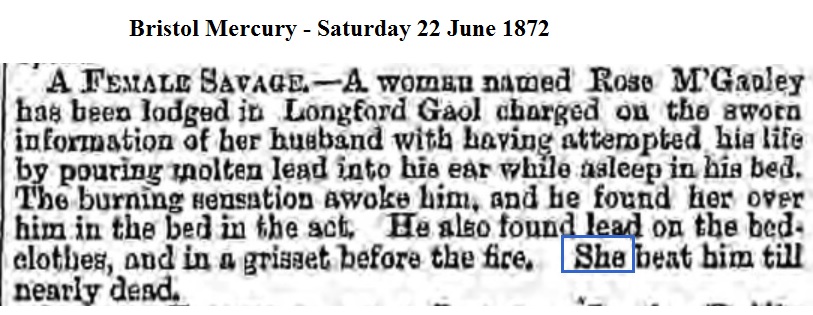
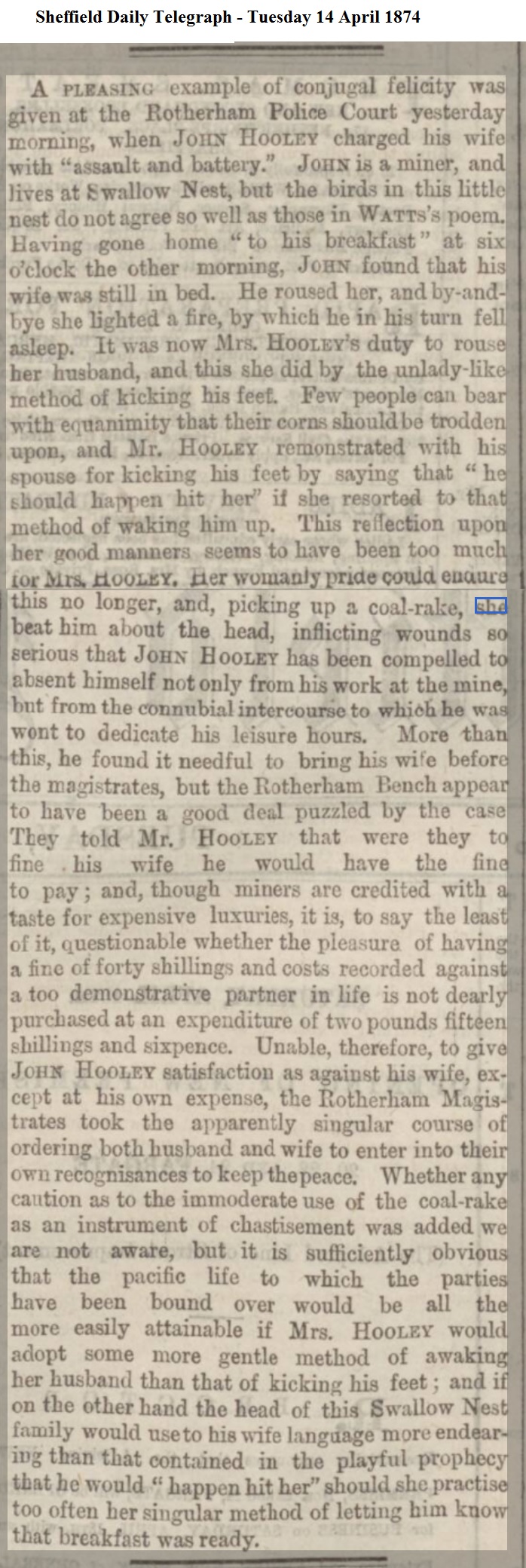
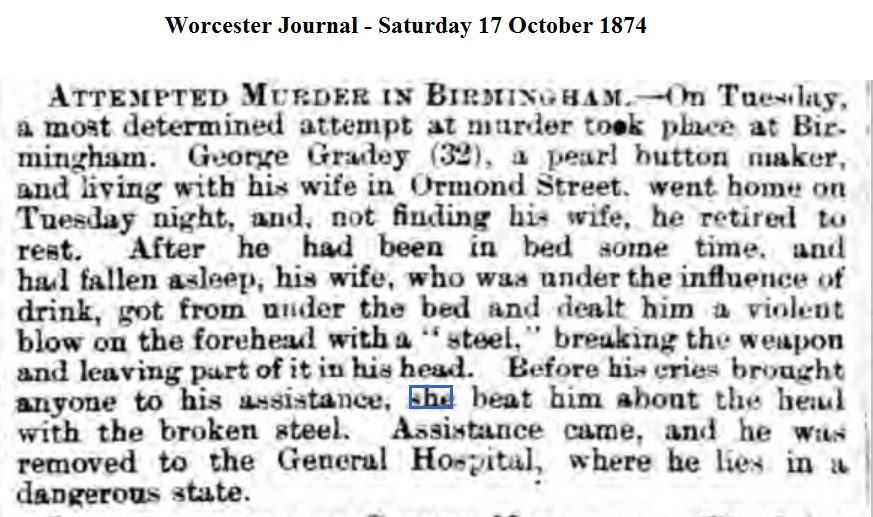
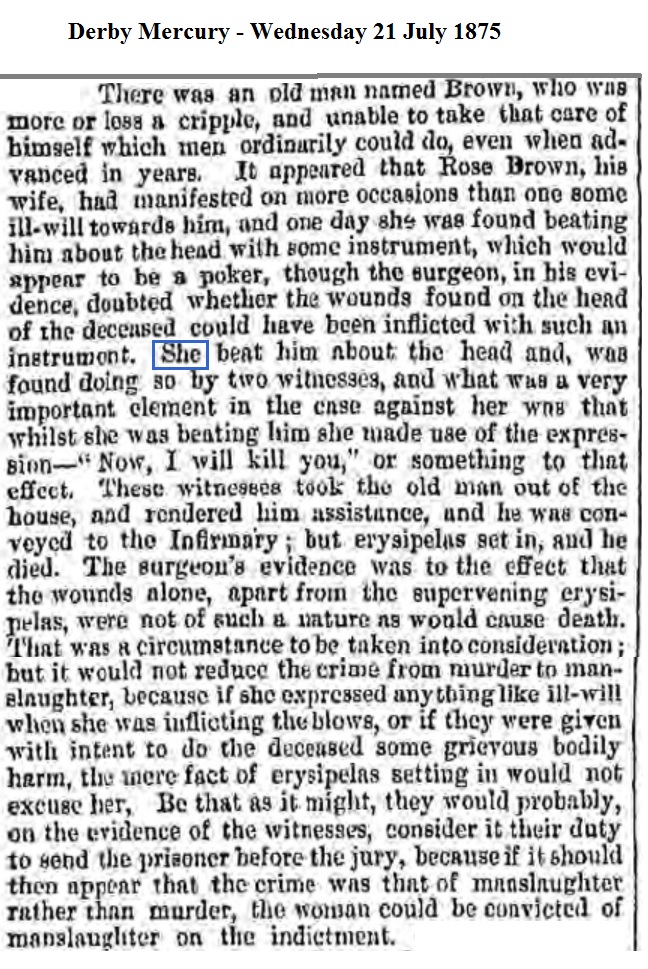
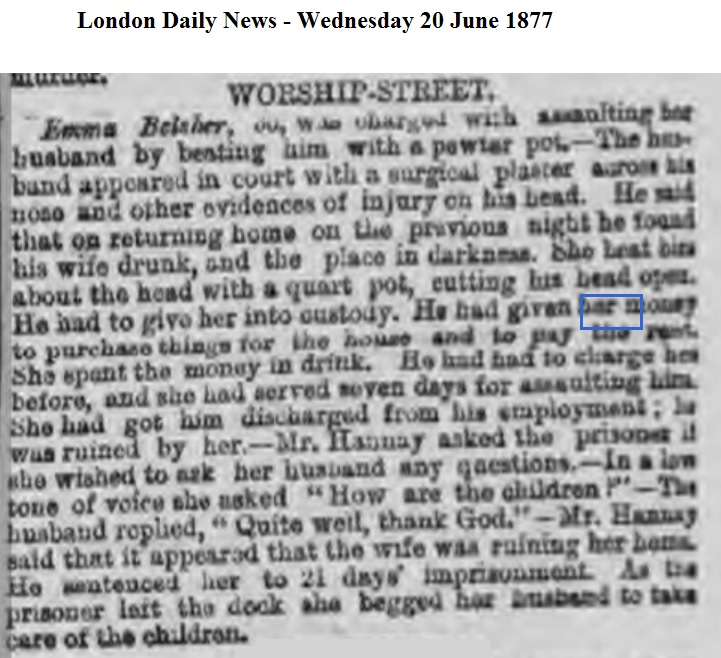
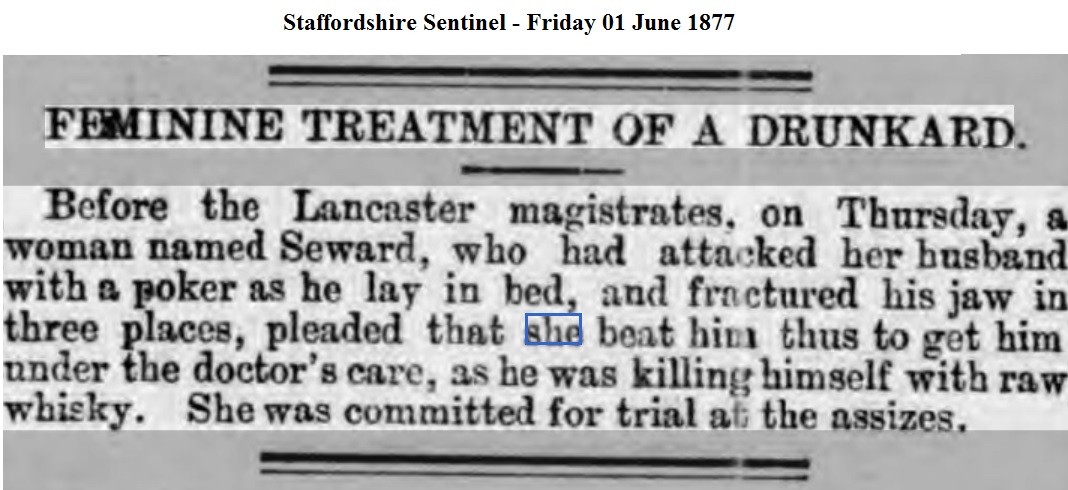
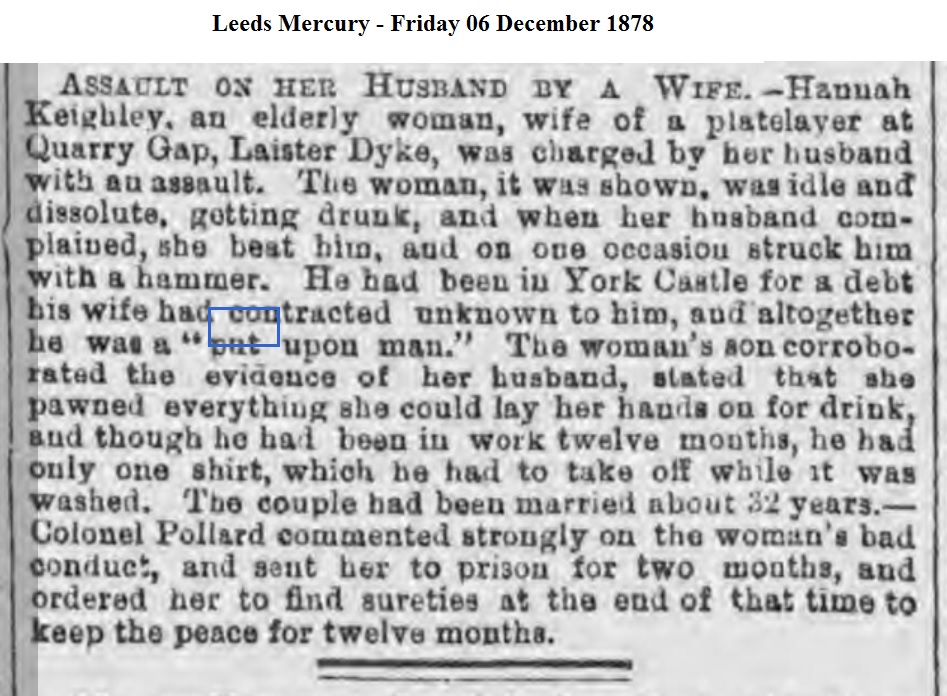
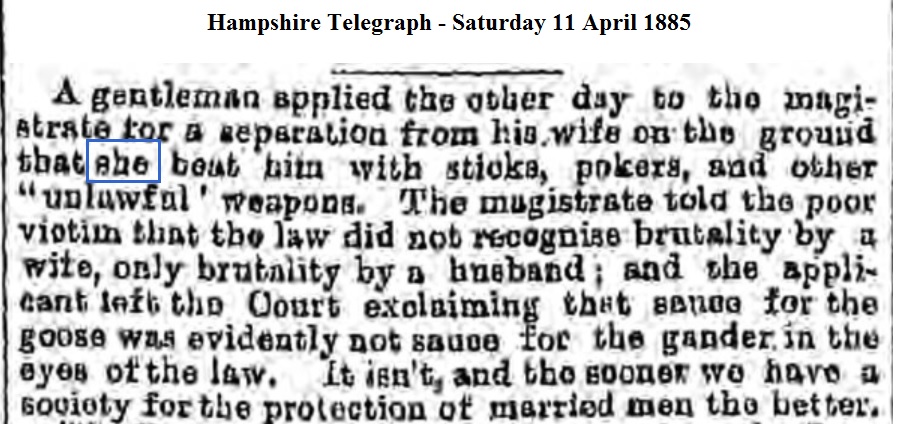
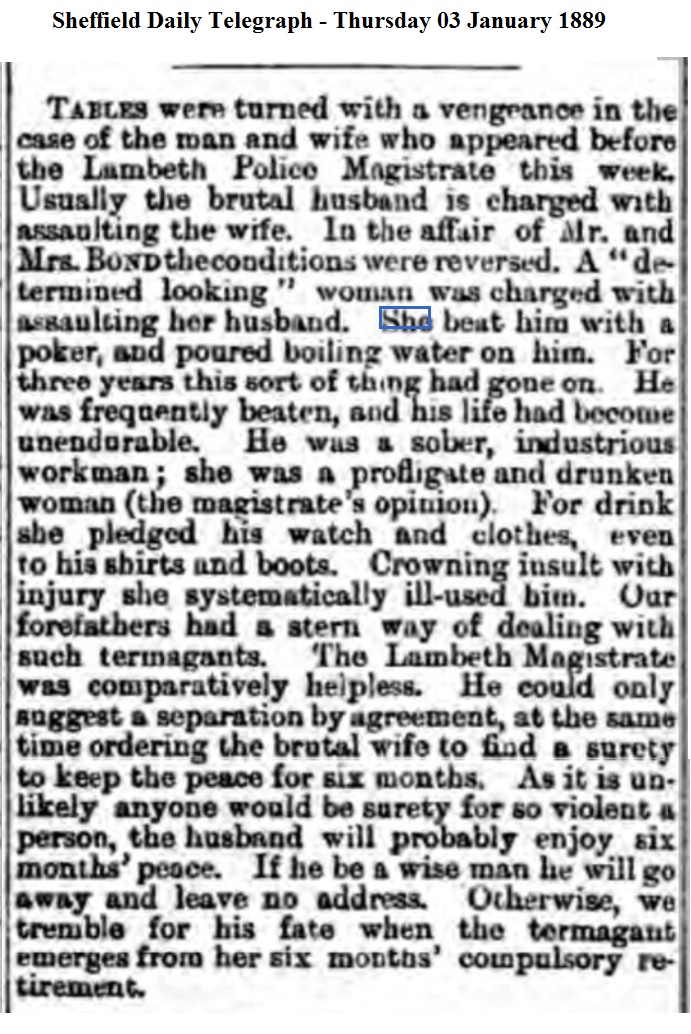
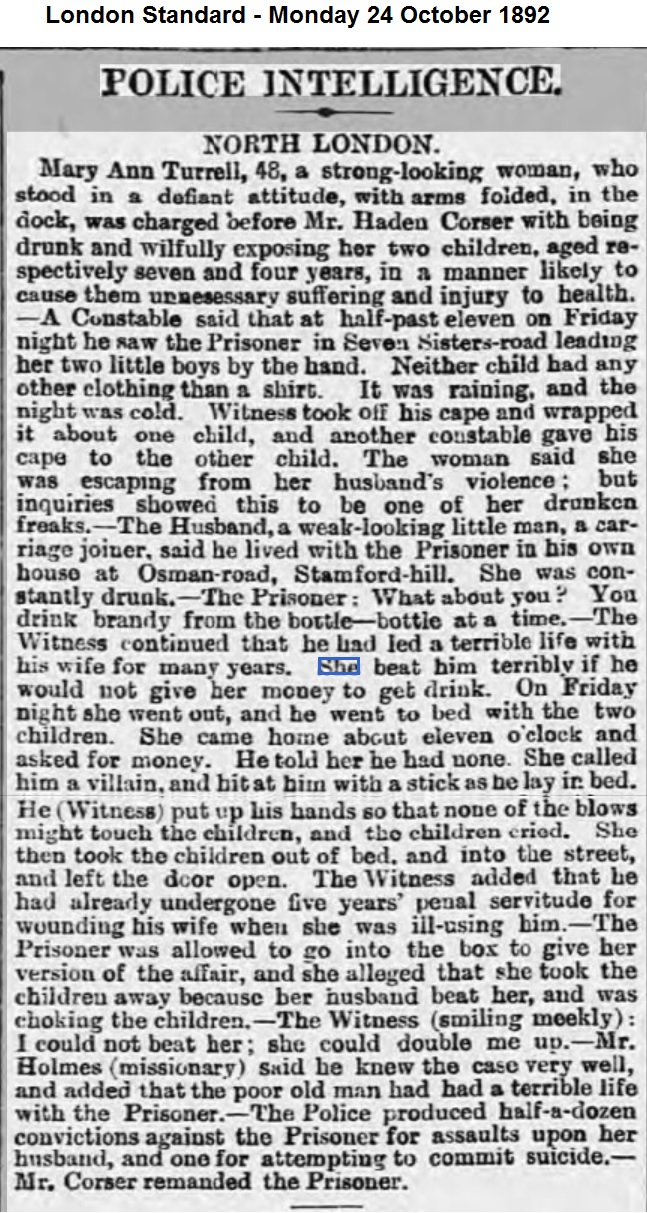
The following are a small selection of newspaper articles from the British Newspaper Archive showing a prevalence of severe violence perpetrated by women against men in the nineteenth century. Click on images to enlarge where needed. – PW

1809 Hereford Journal - Wednesday 18 October 1809

1822 Morning Chronicle - Monday 06 May 1822

1823 Bristol Mirror - Saturday 26 April 1823

1838 Morning Post - Tuesday 27 February 1838

1839 Morning Post - Wednesday 26 June 1839

1846 Reading Mercury - Saturday 01 August 1846

1852 Morning Post - Monday 28 June 1852

1853 Leicester Chronicle - Saturday 29 January 1853

1853 Morning Post - Thursday 03 February 1853

1858 Dundee, Perth, and Cupar Advertiser - Tuesday 23 March 1858

1861 Dundee Advertiser - Monday 23 September 1861

1861 Morning Chronicle - Thursday 03 October 1861

1863 Gloucester Journal - Saturday 07 November 1863

1864 Belfast News-Letter - Tuesday 19 July 1864

1864 Belfast News-Letter - Wednesday 20 July 1864

1865 Dundee Advertiser - Friday 14 April 1865

1865 Lloyd's Weekly Newspaper - Sunday 12 November 1865

1867 London Evening Standard - Friday 04 October 1867

1867 Sussex Agricultural Express - Tuesday 07 May 1867

1869 Lloyd's Weekly Newspaper - Sunday 09 May 1869

1869 London Standard - Friday 27 August 1869

1869 Western Daily Press - Monday 25 January 1869

1870 Essex Standard - Friday 02 December 1870

1872 Bristol Mercury - Saturday 22 June 1872

1872 Falkirk Herald - Thursday 20 June 1872

1874 Sheffield Daily Telegraph - Tuesday 14 April 1874

1874 Worcester Journal - Saturday 17 October 1874

1875 Derby Mercury - Wednesday 21 July 1875

1877 London Daily News - Wednesday 20 June 1877

1877 Staffordshire Sentinel - Friday 01 June 1877

1878 Leeds Mercury - Friday 06 December 1878

1885 Hampshire Telegraph - Saturday 11 April 1885

1889 Sheffield Daily Telegraph - Thursday 03 January 1889

1892 London Standard - Monday 24 October 1892

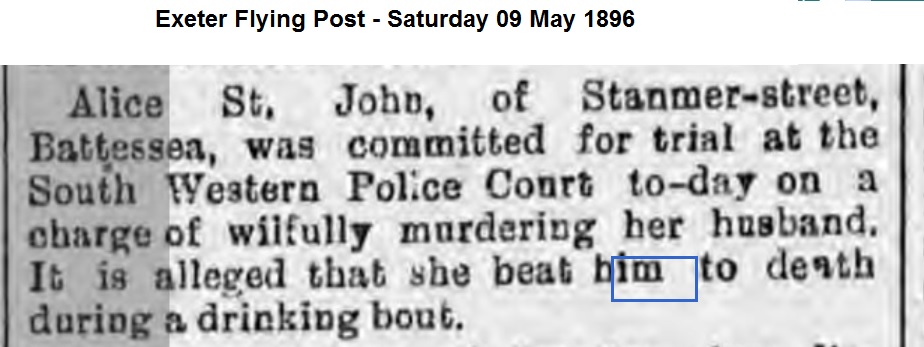
1896 Exeter Flying Post - Saturday 09 May 1896

See also:

Riding the Donkey Backwards: Men as the Unacceptable Victims of Marital Violence
“Stang riding” as punishment for male victims of intimate partner violence
The Henpecked Club – a 200 year fellowship of abused husbands
A random selection of nineteenth century newspaper articles referencing stanging

Nineteenth century: Rape accused forced to marry accusers

The following are samples from the long and ignoble tradition of false rape accusations. They come from nineteenth century newspapers, and reveal women making false accusations for the purpose of extorting marriage vows, money, seeking attention, revenge, or other reasons. – PW

Falsely accused had to wed accusers or go to jail – 1839

Attention of the Lord Lieutenant of Ireland was attracted to several cases which were compromised at the very time of trial by the prosecutrix marrying the prisoner and, as it appeared to Lord Normanby to be a very objectionable practice, he had it brought under the notice of the law officers, who declared it to be illegal. He then directed a circular containing that opinion to be issued to all the stipendiary magistrates, the gaolers, to eleven clerks of the crown, and to the crown solicitors, forbidding them to authorise or connive at the solemnisation of such marriages.

The Letter: “The fact of the willingness of the prosecutrix to marry the prisoner in the case of rape has nothing to do with the question of whether the prisoner should be admitted to bail or not, save and except so far as it may or may not, according to the circumstances of each case, furnish the presumption that the charge of rape has been falsely made, in order to compel the person accused to marry the prosecutrix.

01If the magistrates think, upon the whole of the case before them, that there is not a strong presumption of guilt which is described by the act of parliament, they ought to bail, whether the prosecutrix is or is not willing to marry the prisoner. On the other hand, when the presumption of guilt, founded upon the whole of the case, is strong and unrebutted, they ought not to take bail merely because the prosecutrix, in the hopes of repairing her disgrace, may be willing to marry the prisoner.

As to admitting the parties to compromise a charge of rape by marriage, the law officers state that it is illegal; and that such compromises have the twofold bad effect of encouraging women to adduce false charges of rape to compel men to marry them, and of encouraging men to commit the crime in expectation that the worst which will befall them, if brought to justice, will be to marry the victim of their lust.

______________

False charge of rape – 1851

At the summer assizes last year two men were convicted of rape on a young woman named Mary Anne Bennett. At the following spring assizes she was tried for perjury alleged to have been committed on that trial, and the two men who had been convicted and sentenced to transportation on her evidence were brought from Woolwich and examined as witnesses against her.

02She was then convicted of perjury, but some point of law having been reserved for the consideration of the Court of Appeal, Mr. Justice Talford, who tried her, deferred passing sentence. On the argument in the court above the conviction was upheld, and on Tuesday, Mr. Baron Martin passed the sentence upon her which Mr. Justice Talford directed — the heaviest sentence that could by law be passed — transportation for seven years.

______________

Serial false accuser – 1851

It is, we think, clear, from this statement, that this “artless” servant-girl of eighteen has been for some years past a regular trader in rapes and felonious assaults; and we trust, after this disgraceful exposure, that the law of perjury may be made to reach her. It is impossible to believe that she is in any one point the witness of truth.

03In the preliminary examination before the magistrate, Mr. Clarkson said that in five instances he could prove that this girl, from the age of fifteen, had made charges of this description against persons in whose houses she had been hired as a servant. There was reason to believe she had been successful in compromising some of them, and that on one occasion she had received twenty pounds.

Much of the evidence damaging the character and conduct of this disreputable person was adduced before the magistrate; and there is little doubt that, but for the corroborating evidence of the house surgeon of the Royal Free Hospital, the accused would have been at once discharged.

______________

Medical-men duped by false-rape accusations – 1851

04[Medical men] entirely forget the the real nature of their medico-legal duties, and allow themselves to be guided and influence by what the newspapers designate the “artless simplicity” of a cunning imposter. It was long since remarked by a barrister of large experience, that for one real rape tried at the assizes there were twelve false false charges; and we believe that this is no exaggeration. It is a fact, however, that scarcely a charge can be made, notwithstanding its improbability and untruth, which does not receive some medical support. Pseudo-medical science is carried away by artless simplicity.

It is quite time that this system was exposed, and that the medical questions arising in a case of alleged rape should be placed in their true aspect. A medical man should not frame his opinion on the statement made by a female, but on her bodily condition at the time he is called upon to institute an examination of her person.

______________

False rape accusation leads to perjury charge – 1852

05Harriet Cousins, a young woman of loose character, was convicted of perjury in making a false charge of rape, which was ignored at last assizes. On being convicted and sentenced to seven years transportation, she thanked his lordship, but declared she was innocent.

______________

False charge of indecent assault – 1852

06A curious and instructive case of this kind came before the magistrates at Spittlegate, Grantham, on Friday last. A young girl, Rebecca moore, living with her late sister’s husband, Joines, a tailor, of North Witham, brought a charge against William Wallen, a married man, in consequence, it would appear, of him having quarrelled with Joines about a pair of trousers…

The Bench dismissed the case. It was quite evident to every one that there was most gross perjury on one side or the other, and a little further inquiry would show which is the guilty party. If, as at present seems probable, the girl has perjured herself and tutored the little boy to lie, surely she should not go unpunished. Perjury of this kind is most dangerous to society, from the difficulty of corroborating it.

______________

False charge of rape – 1858

On Wednesday at the central criminal court, a labouring man named James Harrison, was indicted for committing a rape upon the person of Mary Southeran, a married woman, and the mother of six children. We purposely omit the evidence, which spoke little of the virtue of the woman.

Mr. Sleigh addressed the jury for the prisoner, and contended that as the evidence of the prosecutrix was not corroborated, it ought to be received with great caution, and that if the woman had made the resistance that she said she had, it was exceedingly unlikely that it should not have been heard by the other parties who were in the adjoining room.

07 Baron martin, in summing up the evidence said:- “The offence with which the prisoner stood charged with was one of the most heinous offences known to the law, and therefore they should be perfectly satisfied with the evidence before they found the prisoner guilty. There was a discrepancy in the evidence of the prosecutrix, which they could not have failed to have observed. In her examination in chief she said that at ten o’clock on the evening in question, she was awoke by the prisoner entering the room and locking the door, and in her cross-examination she said she was awoke by finding the prisoner in bed with her. It would be for them (the jury) to reconcile these two statements. The jury, after a short consultation, returned a verdict of not guilty.

______________

False charge of rape against a clergyman – 1863

A serious charge was heard on Thursday at the Petty Sessions, at Helmington, against the Rev Lewis Moilliet, of Abberley Hall. The complaint was by a Mrs. Harriet Tyler, whose husband was gardener to the defendant’s father, and in consequence of his ill-using his wife he had notice to leave the situation…

08Her husband was examined and in many important and unimportant points flatly contradicted the evidence of his wife. She had stated they had been married 12 years, he said they had only been married four. Both admitted they had been married after they had had children. Evidence was given by a man who was outside the house at the time, saying he did not hear any noise, and must have heard the woman scream had she done so. Further evidence was given, proving that Mr. Moilliet could not have been in the house more than a quarter of an hour.

The charge was finally dismissed amid the cheers of the villagers, and designated by the magistrates as a conspiracy to extort money, as the complainant’s husband had offered to say nothing about the matter if Mr. Moilliet would pay him £500, and pay all costs.

______________

Arrest warrant for false rape accuser – 1866

09A Warrant has been issued for the apprehension on a charge of perjury, of Miss Ellen Allen, who last week brought the false charge of indecent assault against Mr. Moseley, a dentist, of Bayswater, London. At the trial, which we noticed last week, it appears she gave a false address.

______________

Woman convicted of false charge of indecent assault – 1866

Our readers may remember that some time ago a woman named Allen charged Mr. Moseley, a London dentist, with committing a serious assault upon her in a railway carriage. the charge broke down completely, and the woman was on Wednesday put upon her trial at the Central Criminal Court, on charge of perjury. Convincing evidence was given of the infamous character of the defendant, and of the respectable character of the prosecutor; it was satisfactorily proved that Mrs. Allen had sworn falsely, not in one but in many instances; that her dress and her bouquet were unruffled by her supposed struggles with her ravisher…

10The offence was one of the most serious which could be advanced against any person, and if it had been successfully established in this instance, it would have unquestionably involved the utter ruin of an entirely innocent man. When the charge was made with the view of extorting money, and when that charge was deliberately persisted in before the magistrate, the court felt bound to pass a severe sentence, and yet the lightest which for such an abominable crime could be passed — namely, that the prisoner be kept in penal servitude for a term of five years — no one will think the term too severe.

Charges such as Mrs Allen preferred against Mr. Moseley are, we fear, much more frequent than is generally supposed, as the difficulty of meeting them commonly makes the accused, however innocent, only too glad to escape by compromise.

______________

False charge of indecent assault – 1868

11John Mabe, labourer, aged 23, was charged on remand at the Thames Police Court on Tuesday with indecently assaulting and robbing Maria Bedwell, aged 18. At first investigation the prisoner said she was a servant out of place, living with her aunt in Eglinton-road, Bromley, that she received a purse containing 7s. 3d. from her aunt, and went out for her upon an errand…. she was dragged into an arch under the North London railway and subjected to very rough and indecent usage from a man who was intoxicated, and in the presence of the prisoner and that he also assaulted her…

Mr. Benson believed the complainant’s account of the indecent assault and robbery was a tissue of falsehoods, and discharged the accused.

______________

False charge of indecent assault – 1875

12On Thursday James Berwick, proprietor of the Lorrimore Arms Tavern, Walworth, surrendered his bail at the Surrey sessions, to answer to an indictment charging him with indecently assaulting Miss Kate Gander, about 17 years of age….

Mr. Williams submitted to the jury that the charge was all false. These accusations were very easily made, but they were very hard to disprove. The defendant was a married man and had grandchildren; was it likely that he would be guilty of such a serious offence as this, when his own wife and married daughter were in the bar, and would be able to hear all that went on in the cellar? It was against common sense.

The jury, without calling on Mr. Lilley to sum up the case, returned the verdict of “Not guilty,” — The Chairman said that he quite agreed with the verdict and the defendant left the court without the slightest stain on his character.

______________

False allegation of indecent assault – 1883

13Elizabeth Hinde Cooks, a married woman living in Yat-street, was summoned for having laid a false charge of indecent assault against Edward Astle with intent to obtain money. Mr Greaves, on behalf of Cooks, produced a medical certificate showing that she was suffering from nervous debility, and was unable to attend. She had also lost a child on the day of the first hearing. Mr. Briggs, on behalf of Astle, said that having cleared his character, he was quite prepared now to withdraw the summons against the woman. The Bench allowed this course to be pursued.

______________

False accusation of rape – 1886

14George Neel, 18, fish hawker, was charged with committing a rape upon Mary Evans, at Berry Pomeroy, on the 2nd of September. Mr. Underhay prosecuted; Mr. Carter defended. The prosecutrix is the wife of John Evans, a boat builder, of Brixham…

The Judge said that during the 11 years he had been on the Bench he had known more absolutely false charges for rape than for any other offence. As had been remarked more than 200 years ago, it was a charge easily made, but very difficult to disprove. The present was a somewhat extraordinary case in which there was violent and conflicting testimony with which the jury must deal. His Lordship summed up strongly in favour of the prisoner, who was aquitted.

Source: British Newspaper Archive

See also:
Ernest Belfort Bax’s account of false rape accusations from nineteenth century.
Further examples of false rape accusations at the Unknown History of Misandry.

Definition of MGTOW

Men Going Their Own Way (MGTOW) refers to men committed to self-determination, and to voluntarism within relationships. Defining oneself as a Man Going His Own Way (MGHOW) reveals a commitment to the view that a man has the sole right to decide what his own goals in life will be rather than accepting goals conferred by others, or by social consensus of peers, or higher social status individuals or collectives. Generally, consensus-conferred male identities or goals are recognized and rejected by MGTOW men as prescriptive, utilitarian, and benefiting others at a cost of socially unrecognized masculine self-destruction or marginalization.1,2,3,4,5

History

The phenomenon of male self-determination goes back millennia under names such as free-man, celibate, bachelor or stag. Sometimes these self-determined or ‘MGTOW’ men formed groups, the earliest known being that of the Anti-Bardell Bachelor Band of 1898.6 The phrase “Men Going Their Own Way,” or variants such as “going his own way,” or “to go his own sweet way,” in reference to men’s freedoms is hundreds of years old.7

The MGTOW phrase was further promoted in 2004 by members of a men’s rights group.8 Two of those promoters went by the online names ‘Ragnar’ and ‘Meikyo,’ and in an online interview Ragnar describes the moment as follows:

You see all the ideas were floating around on the internet. We were frustrated that we couldn’t get men to build an organization, couldn’t get men to come to this damned meeting- everybody was going their own damned way, and the fact that men went their own way, we started to use that phrase and we started to talk about what’s important for men… who’s going to define their masculinity? Well, they actually have to do that themselves, they have to find out what it is for themselves. So, as you have the responsibility for your own actions, well then it’s also your responsibility to define who you are as a man.9

The MGTOW acronym has since enjoyed increasing popularity as a title for male self-determination.

Rejection of gynocentrism

A core tenet of MGTOW is rejection of gynocentrism, the preferential concern for women in both traditional and progressive forms. The gynocentric customs of marriage, romantic love, chivalry and male servitude are wholly rejected by MGTOW as running counter to the goal of men going their own way.

Adaption of visual aid by Bar Bar10

Philosophy and politics

MGTOW is viewed as an evolving consciousness of self-determination and way of looking at the world. It involves making choices in the present that serve ongoing, future self-determination. Conversely, choices made that seriously endanger future self-determination are viewed as antithetical to MGTOW. 11

Unlike the lockstep and dogma of so many contemporary movements, MGTOW is entirely individualistic, even though many men may arrive at the same conclusions from having observed the same phenomena. The MGTOW-symbol suggested by the 2004 promoters shows a path deviating from the main road (ie. individualism), and an arrow (evolutionary potential). The same promoters further suggested that MGTOW is not affiliated politically, and efforts are made to “avoid pulling it to the left or to the right politically.”12 The proposition for political apartisanship, however, carries no moral authority for individual MGTOW who are free by definition to choose any political alignment they wish.

References

The Henpecked Club

The following is an expanded version of an earlier 2014 article. – PW

Many a good man of the Henpecked Club has to be on his good behaviour in order to keep on anything like peaceable footing with his better half – (1860)1

The Henpecked Club is a very real organization, global in scope, that has been in continuous operation for at least the last 200 years. It served the needs of married men who faced domestic abuse from wives, and served young bachelors who might later have to deal with the same issues when they married.

Essentially a project for creating ‘Good Men,’ the Henpecked Club consisted of an international network of meeting-places where men came for support, especially if enduring emotional and physical abuse from wives. In this aspect the club is similar to Al-Anon, the modern support-movement for spouses of alcoholics. The clubs actively encouraged husbands to tolerate wives’ abuse, with the strategy of placating them with any means necessary to moderate abusive behaviours.
Henpecked-g
The key word there is placate, which the men did in spades. Club members, for instance, were expected to take their wives breakfast in bed daily and to do most of the household chores even after a hard day’s work, with the hope that this would place wives in a more amiable frame of mind or, perhaps more accurately, in a less abusive mood. The following are instructions to all members of the club:

  1. That every member of this society shall kindle the fire, set the kettle over, and have the water boiling before he awakes his wife in the morning.
  2. That every member shall take his wife her clothes to bed, after having aired and made them warm and comfortable, or be fined twopence for each offence.
  3. That he shall state to his wife the work he has done, and ask if there is anything more she wishes him to perform before he goes to his work in the morning.
  4. That if any member or members should come home to his dinner, and find his wife gossiping and the dinner not ready, he shall not complain; but cook for himself and family, and something for his wife that will make her comfortable when she does come home, or forfeit threepence.
  5. That if any member or members after their day’s labour come home and find that his wife has not washed the pots, or any other thing he thinks should have been done, he must do the same himself, and not find fault; he must likewise mend the fire, warm the water, sweep the house, mop and scrub the floor, and them make the bed or beds to her satisfaction, or forfeit fourpence.
  6. That when any member shall have finished his week’s work, he shall return home with his wages and give the same to his wife.
  7. That when any member has given the wages to his wife, he shall ask her what she wishes him to do the next, if she wishes him to go to the shop he must go, but if she wish to go herself he must stay at home to clean the house and furniture, and set things in order, that she may be satisfied when she returns, or forfeit sixpence.
  8. That every Sunday morning, each member shall rise at six o’clock, kindle the fire, clean and dress the children (if any) and get them ready for school, before his beloved wife shall be disturbed; but if she call for a pipe of tobacco, a pinch of snuff, or a glass of some nourishing cordial, he shall serve her that instant, or forfeit sixpence.
  9. That peradventure a member’s wife may wish to have some splendid clothing such as a silk velvet bonnet, a fine cap with artificials, a new gown, crinoline, boots, sandals, silk stockings, or any other article of fashionable dress, her husband shall provide for such things out of his over-time money, or forfeit one shilling and eightpence.
  10. That when a member’s wife is sick or in labour, he shall run for the doctor as fast as he can, whether it be night or day, frost or snow, hail or rain, or forfeit two shillings.
  11. That any member refusing to clean the child when it has shitten or bawed (as the term may be), he shall forfeit sixpence.
  12. That every member shall wash the child’s shitten hippins [diapers], when his wife order him or forfeit fourpence.
  13. That every Monday night, each member shall clean his wife and children’s shoes and clogs.
  14. That every Tuesday night each member shall look up the clothes for washing.
  15. That every Wednesday night each member shall look the buttery over, and see whether there be a sufficient quantity of tea, coffee, sugar, butter, bread, cheese, meal, flour, beef or mutton, and if found wanting, he shall provide the same without grumbling.
  16. That every Thursday night, each member shall provide for his loving wife such things as may improve her private happiness, such as cordials or spirits, according to circumstances.
  17. That every Friday night, each member shall look up the stockings, shirts, &c., and such as want mending he shall mend them.
  18. That every member shall pay the strictest observance to the five last-named rules or forfeit threepence for every neglect on conviction before the committee.2

Such instructions, which were typical of most of the Henpecked Clubs, were sometimes couched in self-mocking humor by the members suffering abuse by wives, and this has led to the erroneous assumption that the clubs were merely comedy. But that assumption is incorrect (and perhaps a little driven by denial of women’s violence) for the issue of domestic abuse was a serious concern for the clubs, as were strategies for dealing with same.

Henpecked-cartoon-Yorkshire-Evening-Post-Monday-25-March-1940Men were also advised to absorb any violence or abuse without complaint, stoically tolerating it so as not to provoke or further upset the perpetrator. This, explained club policy, was how one become a ‘good man.’ If the man’s wife continued her abuse after these conciliatory gestures, Club officials would ask the man what he may have unwittingly done to provoke her, followed by “How might you better serve her so she doesn’t become upset again?” The answer to that question was typically for the husband to do more housework, but there was also a novel intervention of ‘rocking a wife to sleep,’ of which I will say more shortly.

Henpecked clubs existed in their hundreds from the 1700s through to contemporary times, and in places as diverse as England, Austria, USA, Germany, France, Australia, Yugoslavia, China, and Japan.

Why haven’t we heard of these clubs, many containing several hundred members struggling to find ways to deal with difficult marriages, in an age when we are so hyper-focused on gender relations? Not even a peep from historians, despite the availability of material about Henpecked Clubs. Why?

Because it doesn’t chime with the image of a ‘dominant patriarchal husband’ proffered in modern interpretations of history.

So in a gesture of redressing history, here is small part of an 1810 book entitled, Some Account of that Ancient and Honourable Society, Vulgarly Denominated The Henpecked Club – showing that the project of creating ‘good men’ has been going on for at least 200 years, and probably more:

“[Husbands] submit to the pleasing bondage of their wives, in as great numbers, and with as much good will, as in any enlightened period of ancient or modern times.

Henpecked-club-title-page

“Henpeckicism, which has been graced by ranking as its Members the greater part of the most celebrated men who have appeared since the creation to the present day, whether legislators, philosophers, conquerors, poets or divines, requires no other argument to vindicate and establish its right to the most extensive influence and operation, than the language of every lover, who readily acknowledges himself to be, and swears to continue, the slave of his mistress, before marriage; ergo, he who denies her supremacy, when she becomes his wife, is guilty of the most criminal and unnatural rebellion against womanly authority that God himself have set over him. If other arguments were wanted, however, many might be adduced to prove that the superiority of the female is an ordination of Nature. For example, the noblest or fiercest dog will tamely submit to the snarling and snapping of the most pitiful bitch of the species.”

“For in Henpeckicism there is no distinction: the peerless woman lords it over her vassal even as the peasant: All are equally comprised in the description so happily given by the poet:

“The crouching vassal of the tyrant wife,
“Who has no sixpence but in her possession,
“Who has no will but in her high permission,
“Who must to her his dear friends secrets tell,
“Who dreads a curtain lecture worse than hell”

“The rules observed by the Members of those Meetings were every way adapted to preserve the existence of the institution. Such Members as had the honour of receiving a black eye from their spouses, were entitled to an allowance of 10s. 6d. per week, for so long as the glorious colouring remained: The allowance for two black eyes was £1 1s 0d. In all cases, proof was required that the contusion was received according to the true spirit of genuine Henpeckicism, that is, without resistance or murmuring, according to the example of that inestimable deceased Member, Socrates, who, together with his Lady, is alluded to by the poet in the following lines:

“How oft she scolded in a day he knew,
“How many pisspots at the sage she threw,
“Who took it patiently, and wip’d his head-
Rain follows thunder – that was all he said.”

Such married men as had not the honour to appertain to the Society, were earnestly requested to attend these Meetings, not as Members, but as visitors, in order that they might be induced to unite themselves with it, by witnessing the perfect happiness which it was calculated to confer. For what happiness can be greater than that of belonging to a spouse who takes upon herself the weighty care of regulating not only her own conduct, but that of her husband and the rest of her family; to a spouse who takes the trouble of receiving and paying all money; to a spouse who kindly undertakes the task of judging for her husband (in every occurence) of what is proper for him to do; of what time he should spend in public houses; of how much money he must expend; of what secrets ought to be retained in his or rather her possession, and of what ought to be divulged to the world? In short, she who takes upon herself all anxiety, all trouble, and leaves to her darling husband nothing to do but the delightful task of executing her commands; well remembering that:

“His proper body is not his, but mine,
“For so said Paul, and Paul’s a sound divine.”

The design and ostensible object of the Institution having always been to preserve, and even, if possible, to extend the just and laudable dominion of the fair sex, the several meetings thought it proper, also, to request the attendance of bachelors, not merely with a view that they might be benefited by witnessing such perfect examples of submission, but that those bachelors who had not yet turned their thoughts toward matrimony, or who might have overlooked so great an inducement to enter into the married state as the existence of out Institution, might be induced, as early as possible, to place themselves on a level, in this respect, with most of the greatest men in the world.

“The most common methods by which females attempt the full exercise of that unlimited power which of right belongs to them, is, at a very early period after marriage, to become extremely noisy and abusive, and to make a point of dealing out blame very liberally to their husbands for every action which they commit, whether they are really of the opinion that their conduct has been reprehensible or not. This method is at some times attended by blows. Though a vigorous and persevering course of this treatment may frequently be successful, yet there is considerable danger of resistance from those brutal fellows injudiciously termed men of spirit, a resistance which may be attended with consequences extremely injurious to female countenance. I would strenuously recommend this method be pursued by women, however, with all those effeminate characters who are more afraid of sustaining a drubbing, than eager to vindicate their title to manhood, as would especially advise it to be practiced on the whole tribe of fops or puppies, creatures possessed of no better proofs that they are privileged to rank as men, than that they have two legs and wear breeches.

“Some women pursue a course quite the opposite of this, and with greater success. They at one time load their husbands with caresses, magnify their own affection, and seem to have no other avocation worth their attention but that of convincing them that the sole study of their lives will be to invent fresh blandishments, and to render them in all respects completely happy. At other times, however, they affect a sulkiness of behaviour: a sudden and sullen gloom succeeds their former cheerfulness; they sigh frequently, and burst into floods of tears; nay, they are even seized with swoonings and hysterics.

The wretched husband of such a wife, alarmed at these surprising symptoms, anxiously enquires the cause. She affects to evade the question–he becomes more importunate–she persists in declining to assign a reason–his importunities are redoubled–till he is at last informed, with gentle reproaches and a burst of grief, that he himself is breaking her heart; that the reward of all her love is his neglect, &c. &c. Astonished at a charge which he is wholly unconscious of having merited, he at first endeavours to ridicule what he terms her childish uneasiness. She affects, however, still to doubt–he makes solemn protestations of his innocence; and they are reconciled. In a few days, however, the same farce is played out again, and again, and again, till the unhappy man is at length almost convinced, contrary to the evidence of his own senses, that his conduct has been criminal. Nay, to pacify his afflicted partner, he is even brought to confess his imaginary faults, and to promise amendment in the future. For fear of unintentionally giving offence, he learns to keep a strict watch over his own actions, becomes afraid to take any notice of those of his wife, and is, for the same reason, cautious of contradicting her, lest his cruelty should cause her to swoon; and, in short, becomes a Member of the Henpecked Society.

“Though the great object of our Society is to extend the domination of the female sex, it is far from being its intention to obtain that end by such reprehensible or unhappy means. The only worthy Members of the Society are those who have become so, as much by conviction of its utility, as by entertaining a due sense of the superiority of their wives. All such Members, however, have been treated in a manner very different from the preceding. They have (and let every wife endeavour to follow the same plan) been first brought to acknowledge that their wives, by their care and economy, were better adapted than Themselves to manage their concerns; have been satisfied, by their attentive behaviour, that they were well qualified to govern their families; and have been convinced, by their mildness and moderation, that the authority with which they were invested would never be abused. In such a family, resistance will never be attempted. Commands from the one party will be met by prompt obedience from the other. Perpetual harmony will be established; and correction, when necessary, will be submitted to, according to the fundamental rule of the Society, without murmuring and without resistance.”3

The Good Man’s Wife Pacifier

Henpecked-peace-box

Henpeck’d Club’s Peace Box – Patent Cure for a Cross Wife

The good men of the Henpecked Club were responsible for an interesting innovation: an adult-sized rocking cradle, which was used for soothing nagging wives instead of babies. If you look closely you can see curved feet that allowed the cradle to be gently rocked from side-to-side by the dutiful husband.

The ‘Peace Box’ was invented by a club member named Harry Tap in 1862, and several were manufactured for hire by Henpecked Club members suffering under tempestuous behaviour from wives. If a wife was abusing her husband too much, the husband would entreat his wife to recline in the box, which could be rocked like a child’s cot in order to send the wife to sleep. While she was sleeping the husband would perform all the household chores then awaken his wife who would hopefully have calmed down.

With those juicy historical morsels now in the open, we seem to have come full circle, back to the future. Here we remain, with hat in hand, beseeching Dear Woman for forgiveness for having displeased her, hoping that she will notice how hard we are trying to be good men.

You may at this point be feeling nauseous in the knowledge that men have been kowtowing to such abuse for hundreds if not thousands of years, and yet we’re still being asked to to Take It Like A Man™, Man Up™, and be Good Men™. If you are feeling that way you are not alone, and with the growing army of men and women in the MHRM you can help bring an end to such appalling gynocentric customs.

SOURCES:

[1] Huddersfield Chronicle – Saturday 11 August 1860
[2] This list of duties was in use at the Rochdale chapter of the club and is a condensed version of an earlier official document circulated among clubs: New Rules and Orders Reformation Act (1840)
[3] Some Account of that Ancient and Honourable Society, Vulgarly Denominated The Henpecked Club (1810)

SEE ALSO: Fire-poker princesses: a snapshot of female perpetrated IPV in nineteenth-century England

A historical perspective on why men can’t say NO.

By Paul Elam

Men are only as mentally and emotionally healthy as their ability to say no to a woman. Actually, that bears repeating.

Men are only as mentally and emotionally healthy as their ability to say no to a woman.

Obviously, this does not apply in some areas. Mental health problems won’t be solved by simply finding a woman and uttering the word “no.” Gay men may have a somewhat different perspective about this but they are raised with the same life expectations as straight men so there is no real pass for them either. Quite the contrary.

Still, I will hold to this proposition and do my best to explain it. I can tell a great deal about a man, his boundaries, his values and ultimately his integrity and character with a simple measurement of his obsequiousness with and deference to women.

Romantic Chivalry

To understand all this requires a bit of a history lesson, dating back to the twelfth century and the cultural movement driven by romantic chivalry.

At precisely that moment in history the warrior code was harnessed to the emerging culture of courtly love, an aristocratic invention that saw the military principles of honor, gallantry and service placed in the service of a new Commanders in Chief – courtly ladies.

As historian Jennifer G. Wollock summarizes, “The idea that love is ennobling and necessary for the education of a knight comes out of the lyrics of this period but also in the romances of knighthood. Here the truest lovers are now the best knights.”1

While there is arguable evidence that protection of women and children is a basic male instinct, tied to reproductive access, this is likely the first known time in history where that mandate was codified.

Over a period of a few hundred years, romantic chivalry spread to all the principle courts of Europe and found its way more broadly to lives of everyday men and women who coveted the lifestyle of the upper class. It also fostered a great deal of female privilege and the inescapable neoteny that came with it.

So went the first known institutionalization of pressuring men into a tradition of male servitude – or obsequiousness – toward women that continues unchecked today. Yet it was only the first of three foundational events that would become the prevailing model of gender relations; one that negatively impacts men’s lives and mental health.

The Industrial Revolution

IR-300x233The next developmental watershed in men’s deference to women was the Industrial Revolution. While thrusting humanity into modern civilization, it was the next giant step toward normalizing a standard of mental illness in men where it concerned their relationships with women.

Prior to the Industrial Revolution, men largely worked in or near their homes. They worked as artisans, farmers, producers of livestock, tradesman or some other profession that they passed down to their sons through apprenticeship and mentoring.

While still driven by the force of romantic chivalry, they were as involved in the raising of children as mothers were. Those mothers, by the way, also had laborious duties that were a regular part of their role in the family. With the combined work of both parents and participation of the children, families operated more like business concerns than what you most commonly see today.

Both discipline and nurturing from both parents were immediately present; both male and female influence in the lives of children.

The Industrial Revolution, combined with romantic chivalry, accelerated the problem. The mass migration to cities began. Fathers were removed from the home (and the daily lives of their children) to go into factories and work. And of course one of the first products of that revolution was advanced technology in the home, making the lives of women much safer and less arduous. It also created a lot more free time for women, arguably time for them to become fixated on their emotional needs.

The impact of that on family dynamics hit like a tsunami. Women were left to the increasingly softening work of home and children alone, and left in want of adult company. Husbands returning from long, grueling days of labor returned home to be fed and to rest, without the luxury of making up time they had missed with their families.

In this familial void, women quickly turned to their children, particularly male children, to fill their emotional needs. And fathers, consumed by work and duty, largely just enforced the wishes of the mother on the children. This triggered the second wave of privilege and psychological neoteny in western women and where men, due to resentment over their absence, began to be demonized.

Oedipal Culture

All of this greatly increased the likelihood that mothers would form inappropriate bonds with their male children in order to fill the holes in their lives. In other words, we took a step toward a society of emotional incest.

This is difficult to understate. What I am defining here is a culture of emotionally incestuous bonding between mothers and sons. The implications of that are tremendous, and in fact they seem to have been verified by the following 150 years of technological advancement and cultural malaise.

Perhaps it is not coincidental that the onset of the industrial revolution also saw the first formations of what were known to be “Henpecked Husbands” clubs; groups of men who gathered to use peer pressure to induce each other into tolerating more demands and abuse from their wives.

aaaaaaaaa-300x200The Industrial Revolution gave birth to a new age in civilization. It also ultimately resulted in the breakdown of the family unit as it was once known. The late nineteenth century rang in the Tender Years Doctrine, and with it the first legal presumption that younger children were better off in the care of mothers than fathers. The steamroller did not stop from there, it accelerated. The same glut of time and resources that spawned women to create an emotionally incestuous culture also produced gender feminism, the last and final of a monumentally powerful triad of events that left the majority of men in seemingly helpless servitude to women.

Barely one and a half centuries from the first American factory being built and our culture is all but dominated by a woman-first mentality. So rote and mindless have men become that they allow single mothers to effortlessly continue the spread of emotional incest and other forms of child abuse.

Our boys enter an education system completely dominated by female teachers, all of whom are a product of the same forces that created the new paradigm.

Society, especially the female dominated realms of home and early education, produces males that are highly, often terminally dependent on female approval. By the time boys get more substantial exposure to males, the pattern is set. Not to mention the fact that the males they are exposed to are as dependent on female approval as those who might otherwise provide mentoring. They too, as beta enforcers, put pressure on boys to participate in the incestuous bond as expressed in the schools.

This puts us squarely in an age of crippled masculine identity and the consequential impotence. We have legions of men who have stood by silently while their families have been destroyed in corrupt courts, where our young men are being driven out of education and into fields of combat and where men are more likely to support and enable these travesties than to object to them.

Their silence is the mental health issue of our time and you can see it reflected most clearly in men’s interpersonal relationships with women.

When I co-wrote “Say Goodbye to Crazy,” a book aimed at women who were dealing with the devastation wrought in their relationships by mentally unstable and abusive ex-wives, a substantial part of the focus was directed at husbands who lacked the ability to stand up to their former partners.

That problem is not contained to the second marriages of a handful of men. It is a sweeping societal problem that affects all men.

If you read my last article about male space, you will know that when I gave men in a treatment setting the task of focusing on themselves vs focusing on the women in that community, the immediate reaction was fear. That fear was proven justified when the men and women, both staff and clients of that facility, reacted in anger to the men putting themselves first for a single weekend.

What was also proven was the dire need for men to overcome overwhelming programming and pressure.

With a catastrophic gender suicide gap and a plethora of other problems affecting men, at the root of it is men’s programming to sacrifice their interests, well-being and their boundaries in order to take care of and please women.

They have lost the ability to say no. Indeed they have never had it. They are terrified of the loss implied by the very thought of it. The fact that we have done away with all of our rituals to transition boys into manhood does not help but that will be a topic for a future essay.

Changing Course

Correcting this, reversing the trend, is easier said than done. In fact, it is damned hard work for most, and simply undoable for the many who lack the strength to face and walk through fear on such a primal level. It can, however, be accomplished in stages for the dedicated.

The first stage is Simple Awareness and is by far the easiest. It is just education and can be had as easily as grasping the contents of this writing. When men understand the forces that compel them to please women at any cost, they create the opportunity and motivation to imagine it can be corrected. With that, they can rewrite their future, largely by rewriting their history. More to come on that as well.

The second stage is brutal. There is no other way to put it. It requires men to face the fear of ripping the emotionally incestuous bond; the foundational fear of all men, the fear that most resembles the fear of death. It means putting themselves in the jaws of the beast from which they have to scratch and claw their way out.

Once they have emerged they reach the final and unending stage of walking in the footsteps that were determined by a newly shaped history, sans the Romantic Chivalry, sans the emotional incest and sans the gynocentrism.

I realize that the definitions of these stages are cursory and incomplete. There is much more to them. A more thorough examination is next in this series of essays intended to help men free themselves and their sons from the clutches of a path that was chosen for them in favor of a path that they carve out for themselves.


[1] Jennifer G. Wollock, Rethinking Chivalry and Courtly Love, (Published by Praeger, 2011)

This article was first published at An Ear for Men and republished with permission.