Eleanor of Aquitaine and her ‘Courts of Love’

By Amy Kelly (1937)

ANDREAS CAPELLANUS furnishes in his Tractatus2 the principal source of our notions, which are scanty enough, of the institution known as the ‘courts of love’ in the twelfth century. In his work we come as near as possible to the original character of the courts before their ideas and practices became a stereotyped element in the chivalric convention, a part of a shaping influence in the social customs and the literary traditions of the Renaissance. The Tractatus (published 1190 AD) is based closely in theme and substance on Ovid’s Ars Amatoria (published 1 BC). In both works the conception of love is that of illicit passion; but there is a significant difference. Whereas in Ovid man is the master employing his arts to seduce women for his pleasure, in Andreas woman is the mistress, man her pupil in homage, her vassal in service.

What operated to change men’s attitude toward women from one of gross cynicism in Ovid to one of homage and deference in Andreas? What was the significance of the cult of women propounded in the Tractatus to the society in which it flourished? Furthermore there are internal evidences that Andreas, in spite of being ‘sapientissimus’ (wisest) was unable, in his redaction of Ovid, to make the free doctrines of the classical poet lie down comfortably in his clerical mind.

The Tractatus, in dealing with the theme of love, is so full of this conflict between pagan naturalism and Christian restraint, that one is tempted to imagine that Andreas did his redacting under some compelling influence. What was that influence? To recapture at this date the quality the court of love had for those who elaborated it, is doubtless impossible. There are, however, such puzzling incongruities between the bald erotic precepts of Ovid and the mystical transformation of these precepts in Andreas that curiosity reverts again and again to attempts to divine what, in the twelfth century, gave impetus to those alterations of doctrine before they passed into the social and literary conventions of the chivalric order.

Andreas reports, where lovers actually brought dilemmas before highborn ladies for judgment, but have been disposed to see in accounts of them mere literary redactions of the sophistical discussions of coteries of precieux, or attempts to reduce such discussions to juridical form. Some reflections of contemporary life – dramatized elements of feudal relationships, the hairspun scholasticism of the day, the formalism of ritual – are indeed discovered in the chivalric code as set forth by Andreas and as elaborated in the chivalric romances following the middle of the century. But the actual enactment of the little drama of the court of love in the feudal castle has seemed too fantastic to be taken literally. Without for the moment questioning these interpretations, it is suggestive to approach the inquiry as to what was the early character and significance of the courts and their code by studying in other connections the personages alleged to have presided in them, the circumstances affecting these personages in the third quarter of the twelfth century, and the atmosphere in which they lived. The contemporary materials for such study are fragmentary, but such bits as can be pieced together lead to speculation as to whether there are not other important elements than those suggested above in the grand assizes of the ladies known as the courts of love.

What we think of the actual courts of love depends ultimately upon what we make of the background of the work of Andreas Capellanus, recently assigned to the period between 1174 and 1182, and in modern studies attributed to Andreas, a chaplain of Louis vii associated at some time with the court of Louis’s daughter, Marie, Countess of Champagne. The Tractatus, which purports to be a guide to one Walter, a young man seeking to equip himself for admission to elect society, discourses with the precision of dialectic on the science of love in all its branches, defines the principles of love, its effect upon lovers, its disciplines, its code, its etiquette. It records twenty-one cases in which lovers (as litigants might appear at a feudal assize) present their dilemmas for judgment by a court of ladies. In these courts preside as judges Eleanor of Aquitaine, her daughter Marie of Champagne, her niece Isabelle of Flanders, and Ermengarde, Countess of Narbonne.

The only specific clue in the Tractatus to the date of the assemblies is the dating of a letter by Marie de Champagne to two petitioners, as of May, 1174. This date, as an approximation for establishing the period in which the courts flourished, is supported by historical circumstances which will presently be related. Presumably, though Andreas does not so state, the place of assembly is Poitiers, where from about 1170-74 Eleanor of Aquitaine was maintaining her independent court in the interests of her son, the youthful Coeur de Lion, who was in 1169 recognized by the treaty of Montmirail as hereditary Count of Poitou and Duke of Aquitaine. That Marie and Eleanor presided together in the same court is intimated by the fact that they are associated as judges in the Tractatus, at least once in one and the same case. Nothing that we know of Marie’s life precludes the assumption that she was in Poitiers in the period in question. Though in the work of Andreas, Marie de Champagne appears more conspicuously than Eleanor as presiding genius of the courts of love, the queen herself is certainly the more dominant figure in Poitiers, the sustainer and patron of the society which gave substance to the chivalric ideal.

And as Andreas mentions the queen’s juries as including as many as sixty ladies upon occasion, it may be presumed that the revival of the ducal court brought to Poitiers the negotiable heirs and heiresses of the great counts’ fiefs of the south. The heirs of Poitou and Aquitaine who came to the queen’s high place for their vassals’ homage, their squires’ training, and their courtiers’ service were truculent youths, boisterous young men from the baronial strongholds of the South, without the Norman or Frankish sense of nationality, bred on feuds and violence, men with rich fiefs and proud lineage, but with little solidarity and no business but guerilla warfare and daredevil escapade. These wild young men were a deep anxiety not only to the heads of their houses, but to the kings of France and England and to the Pope in Rome. They were the stuff of which rebellion and schism are made. For two generations the church had done what it could with the problem of their unemployment, marching hordes out of Europe on crusade and rounding other hordes into the cloister.

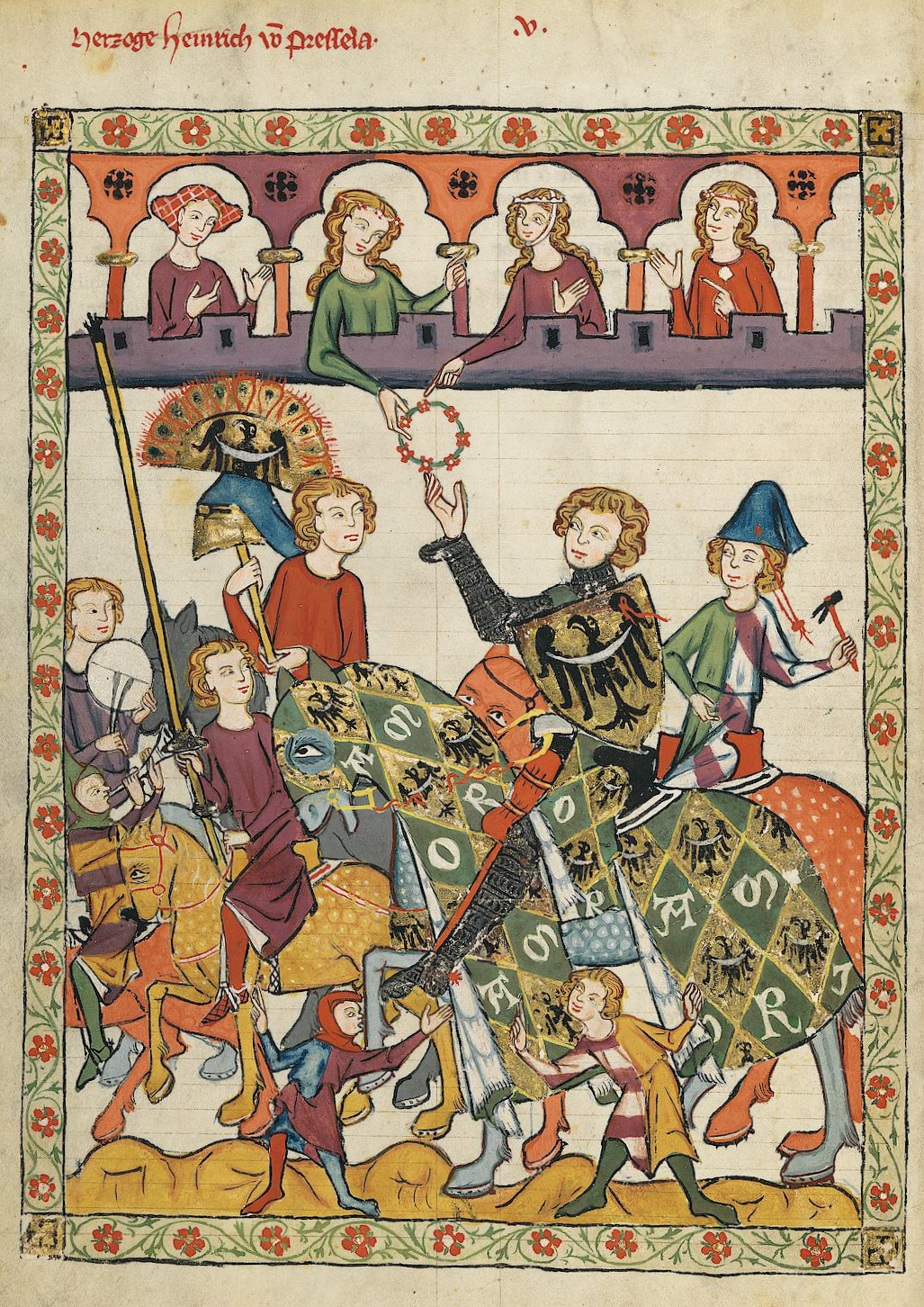
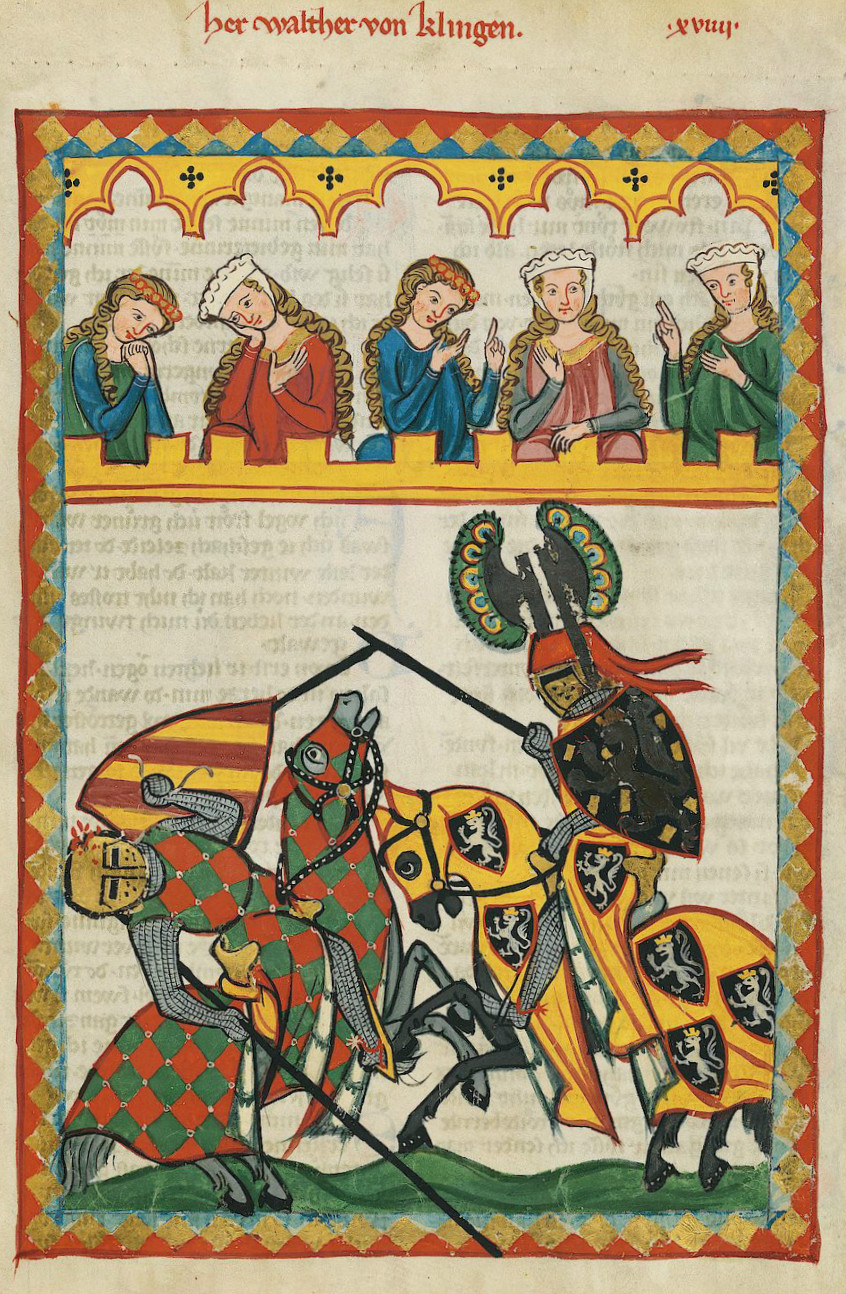
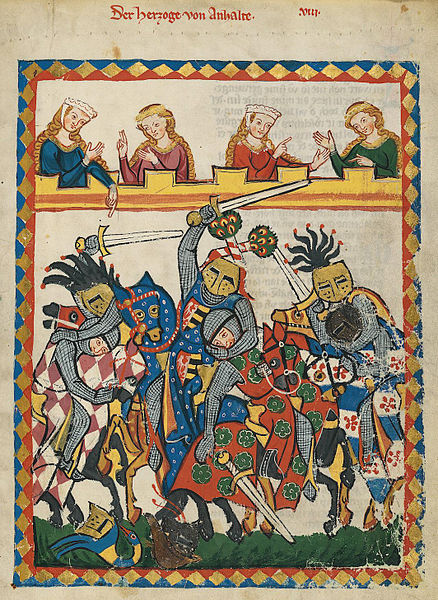
The biographer of Guillaume le Marechal gives an idea of how this rabble of courtly routiers amused itself on the jousting fields of western Europe. To the tournaments, occurring in a brisk season about twice a month from Pentecost to the feast of St John, flocked the young bloods, sometimes three thousand strong, taking possession of the nearest town. Thither also flocked horse dealers from Lombardy and Spain, from Brittany and the Low Countries, as well as armorers, haberdashers for man and beast, usurers, mimes and story-tellers, acrobats, necromancers, and other gentlemen of the lists, the field, the road. Entertainers of every stripe found liberal patronage; troubadours singing of love and war and the ‘bel saison’ in the south country, story tellers out of Brittany, goliards from the Paris streets. The gossip of palace and fief and school, of shrine and cloister, of synod and assize, flew in the street. There were feasts in upper chambers, and forges rang in the smithies all night long. Brawls with grisly incidents – a cracked skull, a gouged eye – occurred as the betting progressed and the dice flew. To cry up their champions in the field came ladies of fair name and others of no name at all. There was dancing below the pavilions on the greensward, with heralds and knights clapping the measures and calling out the changes.
We do not suspect either Queen Eleanor or the Countess Marie of having invented the courts of love. But it seems possible that Marie, who knew not only her Ovid, but the poetical traditions of her Provengal forebears as well, appropriated its little drama, so apt for her purpose of dramatizing the disciplines of the renascent court of Poitiers. She made this familiar framework the vehicle for her woman’s doctrine of civility, and in converting it, she transformed the gross and cynical pagan doctrines of Ovid to something more ideal, the woman’s canon, the chivalric code of manners. For manners, she plainly saw, are after all the fine residuum of philosophies, the very flower of ethics.

So Marie began her academic program in the queen’s palace not with philosophies, but with a theory of conduct developing the ultimate refinements of the mind and heart. The lesson, if formal, was not dry. With Ovid for a model, she drew up, and her chaplain Andreas recorded for her, then or subsequently, the constitution of a society to be impelled not by force nor by casual impulse, but by an inner disciplined sense of propriety. What progress could be made in dialectic by untutored squires who rode hacks into mess halls, and by hoydens who diverted eyes from psalters in the very midst of mass? And upon what could one ground a code of chivalry save on the classic and universal theme of love?

‘How passing wonderful is love,’ exclaims Andreas, ‘which makes men to be effulgent in virtue, and teaches everyone to abound in good manners.’ And finally, to support the rather threadbare dicta of Ovid, who was after all in that court the passion of the elder generation, Marie’s code professed to derive from the authentic practice of chivalry in the court of King Arthur in Caerleon on Usk, than which nothing could afford a more unexceptionable pattern for chivalry. It elucidated for aspiring knights the true inwardness of Gawain, the sustaining principles of Arthur himself.

There is something ghoulish in exposing Andreas’s book, which is also Marie’s, to the callous scrutiny of an age hostile to sentiment. A faint odor of cloistral mould and feudal decay clings to it. But the soil in which it grew was valiant. The ideal of l’amour courtois which grew up in Poitiers had, as Mr Loomis has suggested, more than a little to do with freeing woman from the millstone which the church in the first millenium hung about her neck as the author of man’s fall and the facile instrument of the devil in the world. The court of Poitiers gave its high sanction to ideals which spread so rapidly throughout Europe that ‘the doctrine of the inferiority of woman has never had the same standing since.’

The code of Andreas gives glimpses of a woman’s notions of a society different in essential respects from the prevailing feudal scheme, which was certainly man-made. In the Poitevin code, man is the property, the very thing of woman; whereas a precisely contrary state of things existed in the adjacent realms of the two kings from whom the reigning duchess of Aquitaine was estranged. Incidentally, there is something to explain the puzzling conflict in the Tractatus between the secular and the ecclesiastical views of love in the fact that the clerk whom Marie employed to organize her code was earning his living by flattering feminine majesty.

There is reason to think that Andreas, sensing the perversive nature of the document upon which he was engaged, made good Latin of it only under a certain pressure from his sovereign ladies; and the Countess’s other servant, Chretien de Troyes, quite openly revolted from the too liberal implications of her scheme. As critics we may make what we please of this upside-down philosophy of women. There it is in the first two books of Andreas. There have always been two schools of thought about it.

With this anatomy of the whole corpus of love in hand, Marie organized the rabble of soldiers, fighting-cocks, jousters, springers, riding masters, troubadours, Poitevin nobles and debutantes, young chatelaines, adolescent princes, and infant princesses in the great hall of Poitiers. Of this pandemonium the countess fashioned a seemly and elegant society, the fame of which spread to the world. Here was a woman’s assize to draw men from the excitements of the tilt and the hunt, from dice and games, to feminine society, an assize to outlaw boorishness and compel the tribute of adulation to female majesty. The book, together with the poetry of the troubadours, enables us to catch a glimpse of those famous assemblies in the queen’s new hall to which lovers brought their complaints for the judgment of the ladies.

The female portion of the academy, disciplined by the fashionable example of the countess and the queen to a noble grace of bearing, a flattering condescension, mount the dais, an areopagus something sixty strong. They gather round the queen, and among them shine, besides Marie, Isabelle Countess of Flanders, who is the queen’s niece; Ermengarde Countess of Narbonne, doubtless familiar with some such proceedings in the South; probably also Henry’s sister, the lovely Emma of Anjou, perhaps also, if she was actually another sister of the king, Marie de France – all except Ermengarde, who was more nearly the queen’s contemporary, women from twenty-five to thirty, the notable high priestesses of art and beauty in the day.

The chronicle of Geoffrey of Vigeois leads us to conclude that the standards of the court impressed themselves upon Poitou and the Limousin. ‘Time was,’ he says, ‘when even the Bishop of Limoges and the Viscount of Comborn were content to go in sheep and fox skins. But today [the queen’s day] the humblest would blush to be seen in such poor things. Now they have clothes fashioned of rich and precious stuffs, in colors to suit their humor. They snip out the cloth in rings and longish slashes to show the lining through, so that they look like the devils that we see in paintings. They slash their mantles, and their sleeves flow like those of hermits. Youths affect long hair and shoes with pointed toes.’ As for women, he adds, ‘You might think them adders, if you judged by the tails they drag after them.’ The price of fur and cloth had doubled within the period of the chronicler’s observation.

While the ladies, well-accoutred, sit above, the sterner portion of society, purged (according to the code) of the odors of the kennels and the road, and free for a time from spurs and falcons, range themselves about the stone benches that line the walls, stirring the fragrant rushes with neatly pointed shoe. There are doubtless preludes of music luring the last reluctant knight from the gaming table, tensons or pastourelles, the plucking of rotes, the ‘voicing of a fair song and sweet,’ perhaps even some of the more complicated musical harmonies so ill-received by the clerical critics of London; a Breton lai adding an episode to Arthurian romance, or a chapter in the tale of sad-man Tristan, bringing a gush of tears from the tender audience clustered about the queen and the countess of Champagne.

After the romance of the evening in the queen’s court, the jury comes to attention upon petition of a young knight in the hall. He bespeaks the judgment of the queen and her ladies upon a point of conduct, through an advocate of course, so that he may remain anonymous. A certain knight, so the advocate deposes, has sworn to his lady, as the hard condition of obtaining her love, that he will upon no provocation boast of her merits in company. But one day he overhears detractors heaping his mistress with calumnies. Forgetting his vow in the heat of his passion, he warms to eloquence in defence of his lady. This coming to her ear, she repudiates her champion. Does the lover, who admits he has broken his pledge to his mistress, deserve in this instance to be driven from her presence?

The Countess of Champagne, subduing suggestions from the floor and the buzz of conference upon the dais, renders the judgment of the areopagus. The lady in the case, anonymous of course, is at fault, declares the Countess Marie. She has laid upon her lover a vow too impossibly difficult. The lover has been remiss, no doubt, in neglecting his vow to his mistress, no matter what cruel hardship it involves; but he deserves leniency for the merit of his ardor and his constancy. The jury recommends that the stern lady reinstate the plaintiff. The court takes down the judgment. It constitutes a precedent. Does anyone guess the identity of the young pair whose estrangement is thus delicately knit up by the countess? As a bit of suspense it is delicious. As a theme for talk, how loosening to the tongue!

A disappointed petitioner brings forward a case, through an advocate of course, involving the question as to whether love survives marriage. The countess applying her mind to the code, which says that marriage is no proper obstacle to lovers (‘Causa coniugii ab amore non est excusatio recta’) and after gravely deliberating with her ladies, creates a sensation in her court by expressing doubt whether love in the ideal sense can exist between spouses. This is so arresting a proposition that the observations of the countess are referred to the queen for corroboration, and all bend upon the opinion of this deeply experienced judge.

The queen with dignity affirms that she cannot gainsay the Countess of Champagne, though she finds it admirable that a wife should find love and marriage consonant. Eleanor, queen of France and then of England, had learned at fifty-two that, as another mediaeval lady put it, ‘mortal love is but the licking of honey from thorns.’ Of course they rationalize a conduct that has outburst the rigid feudal scheme for women; but disillusion speaks also in these noble ladies, who, though they divine some unattainable ideal value in life, know that actually they remain feudal property, but part and parcel of their fiefs. It is plain that each and every one of the judgments in the queen’s court is an arrant feudal heresy. Taken together they undermine all the primary sanctions, and are subversive of the social order.

REFERENCES:
1. Amy Kelly, ‘Eleanor of Aquitaine and Her Courts of Love’ Source: Speculum, Vol. 12, No. 1 (Jan., 1937), pp. 3-19 Published by: Medieval Academy of America

2. Title Tractatus de Amore et de Amoris Remedio referred to in English as ‘The Art of Courtly Love’

Infantriarchy

By Gordon Wadsworth

If our species were observed by an alien race for any length of time, two profound defects in the human condition would rapidly become apparent to them. One is a defect in the female character, and the other is a defect in the male character. Although they weren’t always defects, they have become such because they are fundamentally at odds with both legal equality and self-actualization.

The female defect is her desire to infantilize herself; to project a facade of weakness and victimhood. The female does this because part of her identity is contingent on compelling males to act on her behalf. This is a mechanism which allows the female to feel desirable, important, and powerful. The female often mistakes this behavior as personal empowerment, when in reality it is quite the opposite. Taking personal responsibility is something she will inherently resist, because as soon as she takes personal responsibility and stops infantilizing herself, her identity can no longer command others to act on her behalf. Thus, the female defect keeps her from assuming personal responsibility, which presents a barrier to her self-actualization.

This is why the self-actualized female finds playing the victim so repugnant; she is shunning part of her old identity.

The male defect is his desire to compensate for the infantilized female. He does this because part of his identity is contingent on earning female validation. He thus demonstrates his ability to protect, provision and inform. This is a mechanism for feeling useful, powerful, knowledgeable, and important. The male defect leads him to compete with other males to demonstrate his primacy to females, and it ultimately turns him into a guardian, which keeps him from relinquishing responsibility. This becomes his own barrier to self-actualization.

This is why the self-actualized male sees competing for female validation as idiotic; he is shunning part of his old identity.

These defects mean that the female path of self-actualization is one of taking responsibility, and the male path of self-actualization is one of relinquishing responsibility.

It is vitally important to recognize that the majority of males and females in our culture enjoy their dysfunction. The female has a puerile sexual identity validated by compelling a man to act on her behalf, and the male has a similarly puerile sexual identity validated by demonstrating his ability to act on her behalf. This is a drug that our species has been addicted to for millennia, and it is one we desperately need to cast aside. Moving past this behavior is the next step humanity must make to realize equality.

We already have a name for this drug. It’s the blue pill. Those in the blue pill paradigm aren’t conscious of this behavior, they’re merely stuck engaging in it. Consciously recognizing this defective behavior is, in my opinion, the source of red pill wisdom. Once this behavior is seen for what it is, the blue pill paradigm becomes observable, and the transition to the red pill paradigm is made.

An understanding of the male defect is vital for contextualizing feminist criticism of men. Our defect, for example, is why many feminists are partially correct when they point to demonstrating power as a male motivation. We display power to demonstrate our readiness to compensate for the infantilized female. Our defect is also the source of feminist complaints about “mansplaining.” Men engaging in “mansplaining” are largely attempting to demonstrate their knowledge and value in order to demonstrate their capability to compensate for the infantilized female. Additionally, the “fatherly” guardian status that results from our defect is why the feminists are superficially correct about patriarchy, but why they are also leaving out half the picture.

Where the feminist is completely wrong is where she believes that pre-feminist Western culture was in its totality a patriarchy. Since the traditional paradigm of pre-feminist Western culture was an expression of both the male and the female defects, patriarchy was only half the picture.

Let’s clarify what patriarchy means.

For the most part, patriarchy is simply a word to describe the male defect. On its own, however, patriarchy says exactly nothing about the female defect. If we’re to have a fair and balanced discussion on sex and gender, we need a word to address both defects. Let us therefore add the word infantriarchy to describe the female defect.

Patriarchy and infantriarchy are simple concepts that reflect a relationship of codependency between the male and female defects. If the male defect is over expressed in society, female infantilization is compelled, and patriarchy results. If the female defect is over expressed in society, male compensation is compelled, and infantriarchy results.

Thus, the traditional paradigm of pre-feminist Western culture wasn’t in its totality a patriarchy, because it was built around the expression of both the male and the female defects. The fact that there exist both males and females who wish to return to traditionalism proves this. The traditionalist female was thus perfectly happy to infantilize herself, and infantriarchy was a part of traditionalism that cannot be ignored.

The feminist response to this, of course, will be to claim that patriarchy infantilizes women and that the second concept is therefore unnecessary. To clarify this response, the feminist will essentially be claiming that the male defect is wholly to blame. This line of reasoning is problematic because it denies the existence of the female defect, and in doing so it assumes women are perfect and asserts that the defect necessarily exists solely within men.

This can only be described as hate.

Because feminism doesn’t acknowledge the existence of the female defect, it denies female complicity in traditionalism, and thus distorts the male defect of compensating into one of oppressing. Thus, feminists mistakenly believe that women were uniquely oppressed because they’re using half of a theoretical model to examine traditionalism.

The notion of female oppression becomes highly dubious when one considers the female defect. The female defect, for example, becomes apparent when a woman claims that women have always been the primary victims of war, despite the countless millions of men who have died. The female defect has led a woman to cry about being victimized over a t-shirt, and it has led a journalist to claim that MHRM efforts are based on “victim envy.” So it isn’t terribly surprising that the female defect might lead certain women to claim that human history was one long story of female oppression. It is simply an expression of the female defect. It is the female projecting her victimhood.

What then, is feminism?

To be fair, I have met a handful of feminists whose goals I thought were legitimate. To a significant extent, however, feminism is merely a sociopolitical platform for these defects, an arena for them to play in, and the cultural force which is expanding infantriarchy. Feminists claim their movement is about female equality, but I disagree. Being an expression of the female defect, feminism is merely a movement to express female victimhood; more specifically, it is an expression of female victimhood to compel sociopolitical male compensation with the humorous goal of preventing female victimhood.

This results in a merry-go-round to hell, wherein feminism actively entrenches the same value it seeks to fight.

Because feminism is essentially an expression of female victimhood working to end female victimhood, most feminists are stuck in the destructive convulsions of an individual fighting against a victim identity she has chosen for herself.

The nail in the coffin for our society is that the male defect supports and encourages this female behavior. The majority of feminists are fighting an identity they’ve chosen for themselves, one that makes them feel deeply unhappy and traumatized, and the majority of males, instead of criticizing them, are simply trying to compensate for them. The male’s drive to compensate for the infantilized female knows no bounds. If the female is expressing her oppression the male will seek to compensate. If the female is ruthlessly attacking the male’s identity and stripping him of his rights, the male will still seek to compensate.

It is important to understand that both defects must disappear, or neither one will. These two defects are codependent. Females must stop infantilizing themselves, and males must stop compensating for infantilized females. If the female defect isn’t addressed, then no matter how savagely the male defect is attacked, directly or indirectly, the problems with these defects will never be solved. One behavior compels the other, since men and women are and will always be two sides of the same coin. Men and women will evolve their consciousness together, or their consciousness will not evolve.

With this in mind, “patriarchal” expression of the male defect doesn’t disappear in an infantriarchy, it merely changes forms. Remember, in infantriarchy, male compensation is compelled. “White knights” and “manginas” are the expressions of patriarchy, because they are the expressions of the compelled male defect, and often this expression is so pathetic as to beggar belief.

This patriarchal behavior goes largely unnoticed by feminists because they don’t see the male defect directly for what it is. They arbitrarily define patriarchal behavior as authoritative, but they’re mistaken in this regard. Patriarchal behavior is any expression of the male defect. White knights and manginas are thus expressing patriarchal behavior because their behavior seeks to compensate for the female, and it thus encourages the female to continue expressing her victimhood and self-infantilization.

This is the reason some feminists are beginning to recognize and reject men like Hugo Schwyzer for what they are. Men like Schwyzer will never criticize women on any level, simply because men like Schwyzer aren’t remotely interested in equality. They are merely interested in validating their own puerile sexual identities by demonstrating their compensatory capacity. They are cowards, content to ignore real world suffering as they continue taking hits off the blue pill crack pipe. And they are ironically the very agents of patriarchy feminists denounce.

The profound irony of this is that feminism claims to oppose patriarchy while fiercely upholding it, and the MHRM hates the concept of patriarchy, but is currently the only cultural force actually fighting it.

Finally, an infantriarchy will be built around male blame. This is because the female defect leads her to project all authority on to the male, and this forms the basis for blaming him for all wrongdoing. In order to project victimhood, it is necessary for the female to cast the responsibility for her problems elsewhere. Thus, the more infantriarchal a society, the more male blame can be expected.

In our society, this blame is expressed in the feminist’s belief that equality can be achieved by examining “masculinities,” and by deconstructing “patriarchy.” It is also why the feminist believes men just need to shut up and listen to women in order for equality to happen; inequality, after all, was “men’s fault,” and men should shut up and let women fix it.

In late stage infantriarchy, men even become blamed for a woman’s feelings.

If a joke offends a woman, men are blamed. If a man says hello in an elevator in a way a woman dislikes, he is blamed for making her feel victimized. If a man approaches a woman in a bar and she doesn’t like it, he is blamed for making her feel bad, and society responds by prohibiting men from talking to women in this way. If a man looks at a woman who is half naked and it makes her feel bad, he is blamed for looking.

Since the purpose of feminism is largely to express victimhood, “victim blaming” becomes one of its tools. “Victim blaming” is simply another expression of male blame. It is a tool designed to protect female victimhood by savagely casting blame at any male who ever dares to question it.

Feminism does not seek to address either defect, it seeks to criticize male behavior while upholding the male defect and openly expressing the female one. Feminism thus upholds both patriarchy and infantriarchy. Since directly deconstructing and understanding both defects is a minimum prerequisite to promote equality between the sexes, feminism will never achieve equality on its own, however viciously it attacks men.

In my opinion, the MHRM sees these two defects for what they are, and criticizes both of them directly. The MHRM opposes feminism as an unrestrained expression of the female defect, and it opposes “white knights,” “manginas,” and the forces of chivalry as expressions of the male defect and enablers of the female defect. The MHRM opposes both patriarchy and infantriarchy.

For all its claims, feminism is not a progressive movement. Whatever its stated goals, feminism binds humanity to an archaic sexual identity. The MHRM is the socially progressive movement because it is spearheading a move toward greater self actualization for both men and women.

*This  article first published in 2013 at AVfM.

Cornelius Castoriadis: Infantile Narcissism Replaced by a Narcissistic Social Contract

According to Freud, childhood omnipotence & narcissism undergo displacement via a series of clashes with the reality principle. For a special group of humans, however, culture offers to compensate them for that displacement by offering elevated status, a contract that restores the narcissistic bubble. Cornelius Castoriadis describes the situation:

‘The “narcissistic contract,” theorizes what the psyche expects from society as compensation for the abandonment of its “monadic ultranarcissism”. That’s the narcissistic contract: If you behave in this or that way, you’ll then have other people’s recognition; you will be cathected by the others, who will fill the narcissistic breach opened by the abandonment of originary omnipotence.’ [Figures Of The Thinkable, by Cornelius Castoriadis, Stanford University Press, 2007]