Love sick (part 2)

The following is Part 2 of the three-part extract from Frank Tallis’ book Love Sick. In this part Dr. Tallis uncovers the cultural roots of men’s tendency toward idealizing women and placing them on pedestals. – Eds.

Part 1
Part 2
Part 3
_______________

Incurable Romantics

The romantic themes of idealisation and forbidden (or non-consummated) love were taken to new extremes in Renaissance Italy. Poets such as Dante and Petrarch placed their muses on absurdly elevated pedestals. Dante’s Beatrice, and Petrarch’s Laura, are portrayed as models of perfection and purity. Moreover, the fact that both women died prematurely and then reappear in poetic visions, emphasises their divinity. There is some debate concerning the identity of Petrarch’s Laura. She may have been Laure de Noves of Avignon (a married woman with children), or she may never have existed at all (being merely a poetic invention). Dante’s Beatrice, on the other hand, was definitely a real person.

The extreme idealisation of Beatrice and Laura is partly attributable to Marianism. During the thirteenth century, Mary became increasingly important as a mediator between human beings and God. It was to Mary that the majority prayed for divine intercession. She was more `human’, and therefore approachable, than all three personifications of the Holy Trinity. Moreover, her curious (and paradoxical) position as the mother of God gave her considerable authority. For some time, the river of romantic literature was swollen by the tributary of Marianism. Women were worshipped with religious fervour, and sexual desire was wholly sublimated.

The story of Dante and Beatrice is principally recorded in Dante’s The New Life (a hybrid of autobiography and literary treatise). They met for the first time as children, when the poet accompanied his father to the house of Folco Portinari (Beatrice’s father). Dante immediately fell in love with Beatrice and remained devoted to her (more or less) for the rest of his life. She was married to a banker from an early age, and so – in true courtly style – Dante was forced to admire her from a distance. He appropriated the Arthurian role of Lancelot, and championed his `mistress’, not with arms, but with poetry.

The Marian nature of Dante’s love for Beatrice did not exempt him from the commonplace symptoms of love sickness. He complained of all the usual problems: expansive moods and depression, lightheadedness, obsession, anorexia, sleeplessness, paleness, trepidation and anguish. And Beatrice occupied such an elevated position in his universe that even the slightest suspicion of her disapproval was crushing. When she failed to return his greeting, Dante became extremely distressed:

… I was overcome by such sorrow that I left my fellow men and went to a secluded place, where I could bathe the earth with my bitter tears. Then, when my weeping was almost exhausted, I took myself to my room, where I could lament without being overheard. There, while calling for mercy from the lady of courtesy, and crying `Love, help your servant!’, I fell asleep like a little child crying after it has been beaten.

If anything, the spiritual nature of Dante’s love for Beatrice seemed to exaggerate the usual psychopathological resonances. Even his moments of rapture were tainted with the uncomfortable, manic energy of a religious fanatic. His eyes shine, and we question his sanity; we are not very far away from shaking fists, prophecy and revelation.

Perhaps the most compelling example of this arose during a period of sickness, when it suddenly occurred to Dante that Beatrice was mortal and might one day die: ‘At this I was overcome by such delirium that I shut my eyes and started to thrash about like a fever patient.’ He then entered a world of lurid hallucination: ‘Then I saw the sun darken and the stars changed to such a colour that I thought they wept; birds dropped dead while flying through the air, and there were vast earthquakes.’ We are reminded of the darkness that fell on the earth at the time of the crucifixion. For Dante, a presentiment of separation was not painful – it was the apocalypse.

At the age of twenty-four Beatrice did die, and predictably Dante was thrown into deep despair – even though, by then, he too was married. While grieving, he became temporarily infatuated with another woman; however, these feelings were completely expunged when Beatrice appeared to him in a heavenly vision. Dante was reminded of Beatrice’s incomparable beauty and he subsequently committed himself to a life of continued adoration. He became, in effect, a votary.

Love is predicated on togetherness in a world where things must exist separately, and total separation – because of death – is an inevitable and unbearable truth that few lovers can keep from contemplating. In the history of romantic story telling, love and death are old companions. Great love stories are made all the more poignant by our certain knowledge that the couple are cavorting on the lip of an open grave.

In his scholarly treatise, Love in the Western World, the Swiss philosopher Denis de Rougemont wrote:

Romance only comes into existence when love is fatal, frowned upon and doomed by life itself. What stirs lyrical poets to their finest flights is neither the delight of the senses nor the fruitful contentment of the settled couple; not the satisfaction of love, but its passion. And passion means suffering.

To live up to the romantic ideal, love must be fated. It must be passionate, painful and ultimately doomed. It must culminate in death and, if we are lucky, transfiguration.

But why?

Although death appears in love stories prior to the middle ages, it does so in the service of tragedy. After the middle ages, however, death is almost wholly in the service of love. The outcome of a fated love story might still be tragic, but death’s function has changed. Essentially, it offers unlimited possibilities for idealisation.

The most extraordinary feature of Dante’s The New Life is the degree to which he idealises Beatrice. Until Dante, almost all love poetry – however heady – recognised that beauty fades. In the end, time must ruin even the loveliest of faces. Yet, when it comes to Beatrice, Dante simply refuses to concede any ground to time. Of course, Beatrice conveniently obliged him by dying young, and in the reliquary of Dante’s imagination, Beatrice’s incorruptible body parts were preserved like those of a medieval saint.

The romantic tradition has always demanded that the beloved be, in some sense, beyond reach. Yearning, without out satisfaction or release, was presumed to be ennobling. Because romantic love is never supposed to be consummated, it never weakens, and continues to dignify the lover. When the beloved dies, she exchanges an earthly marriage for a numinous marriage. In death, she becomes completely unattainable, and the yearning must then go on for ever.

Islamic mysticism, courtezia and Renaissance literature have all added registers of meaning to the word `romantic’; however, it has also been enriched by association with a more recent, but nevertheless highly important, cultural development – the rise of Romanticism.

Strictly speaking, Romanticism is only tenuously connected with `romantic love’. The Romantic movement began in Germany towards the end of the eighteenth century, and continued to be influential, by varying degrees, until the end of the nineteenth. It began as a reaction against the values and preoccupations of the Enlightenment. The great thinkers of the Enlightenment venerated reason, lived in cities, and were keen to instigate political change. Romantics, on the other hand were fascinated by emotions, revered nature, and were far more interested in personal psychology than social reform.

The concerns of the Romantic movement were much wider than those of the troubadours or the Court of Love at Poitiers. Even so, in matters of love, there are several continuities that link the idea of romance with Romanticism. Indeed, the work which launched the Romantic movement was a love story which preserves many courtly themes. This was Goethe’s 1774 novel, The Sorrows of Young Werther.

Werther, an artistic young man, falls in love with the beautiful Lotte. Unfortunately, she is already engaged to Albert, a gentleman renowned for his honesty and good character. While waiting for Albert to announce the wedding day, Werther learns that Lotte and Albert have already been married. Werther tries to divert himself, and for a while wanders aimlessly, but his yearning for Lotte does not diminish and he feels compelled to return.

Werther is consumed with jealousy: ‘At times I cannot grasp that she can love another man, that she dare love another man, when I love her alone with such passion and devotion, and neither know nor have anything but her!’ He sinks into black despair: ‘Ah, have ever men before me been so miserable?’

While out walking on a wet, dreary day, he meets a madman ‘scrabbling about the rocks’ picking flowers for his ‘sweetheart’. The madman’s mother appears, and explains to Werther that her son has only recently been released from a madhouse, where he has been restrained in chains for a whole year. The following day, Werther discovers that the madman was previously a clerk employed by Lotte’s father. He, too, had fallen in love with Lotte, and the revelation of his love had cost him first his position and then his sanity.

The encounter with the madman is a presentiment of Werther’s own fate. He becomes progressively more disturbed, agitated and has hallucinatory dreams of making love to Lotte: ‘My senses are confused, for a full week I have been unable to think straight, my eyes are full of tears.’ His misery becomes intolerable – even to the solicitous Lotte – who perceptively suggests: ‘I fear, I very much fear that what makes the desire to possess me so attractive is its very impossibility.’

Werther cannot be reasoned with. He desires an eternal connection with Lotte, and he begins to see how this might be achieved. He leaves instructions for his body to be buried in clothes that are ‘sacred’ (because Lotte has touched them), and places a pink ribbon – a gift from Lotte – in his pocket. While experiencing a kind of spiritual reprieve from mental anguish (‘All around me is so silent, and my soul is calm’) Werther shoots himself, and dies.

A romantic love triangle, an idealised woman, an episode of wandering, and a young man who edges towards his doom. The old courtly themes are very much in evidence; however, it is Werther’s demise that seems to resonate most strongly with the mystical origins of romantic idealism. Ultimately, courtly love is about realising spiritual objectives: beauty is back-lit by a sun that sets in paradise.

The spiritual sub-text of Werther’s love for Lotte surfaces several times before his death. For example, at one point, he says of Lotte: ‘She is sacred to me. All my desires are stilled in her presence. I never know what I am about when I am with her; it is as if my soul were throbbing in every nerve.’ In another section, the possibility of a spiritual reunion is innocently raised by Lotte herself, when she discusses her religious convictions: ‘There will be a life for us after death, Werther! . . . but will we find each other again? And know each other? What do you suppose? What do you say?’

The Romantics had a highly developed sense of the numinous. They believed in a universal soul – a mysterious `fundament’ behind visible nature. Moreover, they believed that an understanding of this deeper truth might be achieved through communion with nature, or the experience of altered states of consciousness, such as powerful emotions, dreams or madness.

In this sense, Romanticism returns romantic love to its cultural source. It returns us to the desert, where Islamic sages sought truth in beauty. We are again in the company of Majnun, whose love is so intense, so powerful, it punctures the celestial dome and fenestrates heaven.

Romanticism is the closest thing we have to a religious faith in a predominantly secular society. This is probably because love is frequently associated with intense experiences of rapture and ecstasy. When love’s madness enters its manic phase, consciousness is raised. If love is consummated, sexual activity can intensify the experience even further – evoking what psychologists have called ‘oceanic feelings’.

Love’s rapture and transcendent states have much in common. Both achieve a sense of escape from the limitations of human identity by union with another being (either lover or God). The desired outcome is a kind of self-annihilation, in which personality, ordinarily overburdened with worldly concerns, is lost in a moment of pure, unadulterated bliss.

Almost all religions have a pseudo-erotic mystical tradition. Hindus practise sexual Tantra and Sufi poetry is fundamentally love poetry. Even Christianity has – to the considerable embarrassment of the Church itself – been unable to resist linking sex and spirituality. St Teresa of Avila, for example, evokes the female genitalia by describing a ‘wound of love’, and famously wrote about a vision in which she was penetrated by an angel carrying a golden spear with ‘a point of fire’. For St Teresa, spiritual enlightenment is a process that begins when the soul falls in love with God, and ends with ‘spiritual marriage’.

In Revelations of Divine Love, another medieval Christian mystic, Julian of Norwich, described oddly pornographic visions of Jesus Christ’s bleeding body. The sensuous language she employs knowingly emphasises the carnal aspects of carnage. Thus, her ‘revelation’ is ‘horrifying and dreadful, sweet and lovely’. Moreover, when Jesus speaks, he speaks in the person of a lover: ‘It is I whom you love; it is I whom you delight in … it is I whom you long for, whom you desire.’

The division that exists between reason and emotion has created a curious predicament for Western humanity. We find it hard to believe in God, but at the same time, we still have the capacity to look at the natural world and feel something thing close to reverence and awe. Although we suspect that there is no God, we feel that there should be. We are still dissatisfied with the limitations of personal identity. This is evidenced by the continuing popularity of recreational drugs. In the absence of an alternative, many settle for a chemical Nirvana.

In the East, where spirituality is still very much a part of everyday life, less is expected of love between human beings. The spiritual instinct is satisfied by religious observances, meditation or scripture. In the West, however, where religion plays no real part in the lives of most people, we have replaced religion with love. We have become passionate pilgrims, seeking the transport and meanings of spiritual ecstasy in the religion of romance and the sacrament of sex.

Even if we have little knowledge of the cultural history of romance, we all – to a greater or lesser extent – subscribe to a broad set of ‘romantic’ expectations. The notion of romance has inveigled itself into every aspect of courtship, sex and love. We seek to create a ‘romantic atmosphere’ on a dinner date, we allow ourselves the indulgence of a ‘holiday romance’, or attempt to revive passion with a long-term partner by taking a ‘romantic weekend break’.

The cultural history of ‘romance’ and various meanings of the word ‘romantic’ make it extremely difficult to define ‘romantic love’. Academic psychology – usually quite pedantic about its terminology – has been unable to establish a consensus. Some psychologists use the term in accordance with its courtly origins, whereas others use it interchangeably with ‘passionate love’. As a culture, we seem to have settled on the latter usage, viewing ‘romantic love’ and ‘falling in love’ as much the same thing.

It has already been argued that the fundamental features of romantic love are evolutionary in origin. Thus, courtship gives women time to evaluate the fitness of suitors; heroic acts are a form of male resource display; and an exclusive (or idealised) relationship is necessary for the formation of a strong pair-bond. Most contemporary evolutionary theorists would agree with Capelanus when he points out that the ease with which love can be won is inversely related to its value. In any social hierarchy, the more beautiful a woman is, the more difficult it will be for a man to win her affection. Beauty advertises good genes which, being at a premium, can be withheld for longer. A beautiful woman is never short of suitors. The inaccessibility of fairy-tale queens is perhaps the logical extension of this principle.

That we should find traces of evolutionary theory in story telling is unremarkable. Art has always served as an instrument of self-enquiry and self-definition. Therefore, it was inevitable that certain fundamental features of human behaviour should appear as conventions in romantic literature. The problem with the courtly tradition, however, is that during the course of its development, the romantic ideal became increasingly rigid and extreme; the imposition of arbitrary codes of conduct offered unlimited scope for self-contradiction contradiction and confusion.

The idea that psychopathology is related to conflict is an old one, and it is an explanatory principle that appears and reappears in the writings of numerous psychologists. Thus, individuals whose theories of psychopathology are extremely different – for example, Sigmund Freud and Ivan Pavlov – still have this much in common.

In the 195os, Gregory Bateson and colleagues developed a new conflict-based theory of psychopathology which made use of a pivotal concept known as the ‘double bind’. Essentially, Bateson suggested that severe psychological problems might be caused by ‘mixed messages’ – as, for example, when a mother repeatedly tells her son that she loves him, while turning her head away in disgust. The term double bind has also been used to describe ‘catch-22’ situations, where whatever choice is made, the outcome is undesirable.

The doctrine of romantic love has a double bind at its heart. It confuses the carnal and the spiritual. What started off as allegorical literature eventually became a code of conduct – and a completely impractical one at that. Arab mystical literature explored the correspondences between sexual desire and spiritual desire. However, as these threads were carried over the Pyrenees they became inextricably entangled – and much follows from this. The ever present tension between the carnal and spiritual produces a dynamic which generates layer upon layer of self-contradiction.

We expect another human being to make us feel complete, or fulfilled, yet these profound feelings of completion are usually only vouchsafed to the spiritually enlightened. We expect passionate love to last for ever – and even increase in intensity – but it is transitory; it almost always diminishes or turns into companionate love. We expect beauty to be resistant to the depredations of time, but all beauty fades. We like to think that we are being inexorably guided by supernatural forces towards one true love, but the most important factor in the formation of relationships (whether we like it or not) is chance, and in reality we fall in love promiscuously.

Worse still, the fabric of romance comes apart under the forces generated by its own contradictions. Women are worshipped as paradigms of purity, personifications of Marian virtue, but the foundations of adoration sink into a quagmire of lust and desire. Men make women into Madonnas, but cannot deny their sexual needs. Thus, they inevitably despoil paradise. In the later versions of ‘Arthurian’ legend (including those concerning Tristan), this is recognised by the introduction of a fatally adulterous relationship: Lancelot sleeps with Guinevere; Tristan sleeps with Isolde. As the courtly tradition evolved, more and more writers became preoccupied with adultery, rather than ennobling abstinence.

The impossible demands of romantic love have left a deep impression on Western literature. As Denis de Rougemont has astutely observed: ‘To judge by literature, adultery would seem to be one of the most remarkable of occupations in both Europe and America. Few are the novels that fail to allude to it … Without adultery, what would happen to imaginative writing?’

The fairy-tale, ‘Once-upon-a-time’ world of romantic love promises that we will live ‘happy ever after’, but romantic narrative is pure tragedy. Heroes vacillate between euphoria and melancholy, and then subside into states of morbid obsession. The name Tristan means child of sadness, and few romances end without first taking casualties. The confusion of the carnal and spiritual invites death into the bedroom and, ultimately, we join our voices with a vast choir and sing that great anthem of self-contradiction, the liebestod, the love death. Procreation and extinction accidentally join hands in the conceptual fog of romantic idealism, with devastating consequences.

Our romantic legacy is predicated on a Batesonian double bind, and its mixed messages incline us towards emotional instability. If evolutionary pressures have determined that love should drive us mad, then cultural pressures have created ideal conditions for its incubation.

Continued in part-3…
__________________________

About Dr. Frank Tallis

6EBScmv

Frank Tallis is an author and clinical psychologist. He has held lecturing posts at the Institute of Psychiatry and King’s College, London, and written self help manuals (How to Stop Worrying, Understanding Obsessions and Compulsions), non-fiction for the general reader (Changing Minds, Hidden Minds, Love Sick), academic text books and over thirty academic papers in international journals. He has also written several novels including: Killing Time, Sensing Others, Mortal Mischief, Vienna Blood, Fatal Lies, Darkness Rising, Deadly Communion, and Death And The Maiden.
Main Website

Love sick (part 1)

The following is Part 1 of a three-part extract from Frank Tallis’ excellent book Love Sick. The book takes a good look at romantic love, or more accurately the sickness of it, a fact underlined in several of the articles on this website. Dr. Tallis’ extensive clinical experience confirms just how sick-making these practices are for all who indulge them.
_______________

Incurable Romantics

Love, love, love – all the wretched cant of it, masking egotism, lust, masochism, fantasy under a mythology of sentimental postures, a welter of self-induced miseries and joys, blinding and masking the essential personalities in the frozen gestures of courtship, in the kissing and the dating and the desire, the compliments and the quarrels which vivify its barrenness.

The Female Eunuch, Germaine Greer

Romantic love has been described by the Jungian psychoanalyst Robert Johnson as `the single greatest energy system in the Western psyche’. Although this sounds like a wildly extravagant claim, it is almost certainly true. Love – and in particular romantic love – is our great preoccupation. Almost every aspect of our life is affected, in some way, by the concept of romantic love.

The word ‘romantic’ is troubled by a long history. It is like an overworked canvas, the composition and brushwork of which cannot conceal the suggestion of earlier drafts. English dictionaries distinguish ‘romantic’ with several definitions, but in reality, such tidy divisions are misleading. When we use the word, these different meanings bleed into each other. To be romantically involved is an admission that carries a host of implications: passion, folly, obsession, anguish, recklessness, intrigue, and adventure; archetypes rise from varying depths and jostle with each other for recognition and influence.

As with any native tongue, we first speak the language of romantic love without being able to explain its grammar. The assumptions on which romantic love is predicated are buried in the unconscious mind, where they exert a powerful influence on our beliefs, attitudes, and expectations. We never pause to question their legitimacy. When a romantic hero decides he will sacrifice everything for love, no one will ask ‘Is she really worth it?’ or ‘Can’t he find someone else?’ Romantic love has its own obscure logic which we all tacitly accept.

The roots of romantic love run deep. Indeed, the fundamental mental conventions of romantic love were consolidated on the ancestral plains of Africa, where evolutionary pressures determined that men should court women, that women should be coy, that relationships should be exclusive, and that love should storm the mind like a form of madness. However, since the rise of civilisation, these features have been increasingly complicated by ideological factors. The roots of romantic love are profoundly deep, but, now, they are also hopelessly tangled.

To understand fully the concept of romantic love requires an examination of its cultural history (in addition to its evolutionary history)…

* * *

The Islamic courtly tradition was introduced into Western culture by the troubadours, whose poetry preserved many features of Arab mysticism – particularly, a quasi-religious praise of female beauty. However, as this theme was reworked, it also began to change. Spiritual inaccessibility gradually evolved into alluring aloofness, which in turn became regal disdain. Thus, a recurring figure in troubadour poetry was the cold, cruel mistress.

The theme of inaccessibility was also explored in another way: the introduction of a female character, immensely desirable, but unavailable through marriage.

Even at this very early stage, the authenticity of love was being judged according to its difficulty (with respect to obstacles and impediments) and its irrationality. In troubadour poetry, we can recognise the cultural ancestry of modern concepts such as Lee’s mania or Tennov’s limerence: love that does not need liking – love that may even thrive in response to rejection or contempt. The troubadour’s cruel mistress reappears again and again in literature in different guises: the enchantress, the femme fatale, the Belle Dame sans Merci. Long before psychologists began to study love in a systematic way, literature required a particular female type who would represent unhappy love.

The doctrine of romantic love (also known as courtezia or amour courtois) would have spread across Europe irrespective of royal patronage; however, the process was certainly accelerated by events at the court of Poitiers, where William IX is reputed to have been ‘the first troubadour’ (on account of having written the earliest surviving examples of coutly verse in the Provencal language). It was also at Poitiers that William’s granddaughter, Eleanor of Aquitaine, and her daughter, Marie de Champagne, encouraged celebrated poets such as Bernard de Ventadour and Chretien de Troyes to compose works that exemplified courtly ideals. A narrative vehicle that was popular among the poets of Poitiers was Arthurian legend, which delivered a cast of characters whose relationships could be fully exploited to dramatise the frustrating dynamics of romantic love. Thus, Guinevere’s beauty is beyond compare, and Lancelot – Arthur’s most loyal servant – must fall hopelessly in love with the queen. (English readers are more familiar with this dynamic through Sir Thomas Malory’s Le Morte d’Arthur.) In the poetry of Chretien de Troyes, love – always complicated, but even more complicated by courtly conventions – is once again described as an illness: ‘My illness is what I want. And my pain is my health… I suffer agreeably… I am sick with delight.’

One of the most extraordinary developments at Poitiers was the creation of an inner court – the Court of Love – where noblewomen would meet to pose questions about love and the proper conduct of lovers. Questions would then be disputed, juried and judged, according to the increasingly dogmatic principles of courtezia. Perhaps, in an effort to make the task of this inner court easier, Marie instructed a cleric, Andrew Capelanus (also known as Andrew the Chaplain), to write a formal book of statutes: a kind of lovers’ charter.

Andrew began his task by consulting a classical authority – the Ars Amatoria (or Art of Love) by Ovid. It is difficult to imagine a more inappropriate work on which to base a ‘respectable’ canon. As with much to do with romantic love, history reveals cross-purposes, because for Ovid adoration is only a means to an end. Ovid adores, not because he can’t help himself, but because by feigning adoration he is more likely to succeed in seduction. He is a cunning and manipulative strategist, who advises on everything from good ‘chat up’ lines to how physical defects can be concealed by adopting special positions during intercourse. In an age of political correctness, he is still able to offend modern sensibilities. He recommends pretending to cry, making false promises, writing flattering verses (however insincere) and even coercion: `Some force is permissible – women are often pleased by force.’

Ovid also advises the aspirant libertine to affect the symptoms of love sickness: ‘All lovers should be pallid, it’s chic to be pale;/ Only fools deny it, pale skins rarely fail.’ Moreover, he observes that loss of appetite and worry ‘make the young lover as thin as a rake’. Therefore, if wishing to attract the attention of women, one should: `Look lean – it suggests passion.’

When Andrew Capelanus came to write his own work – The Art of Courtly Love – he did so by borrowing from Ovid. Thus, Ovid’s cynical observations were used to shore up the romantic ideal. Love sickness – merely another weapon in Ovid’s armamentarium – became fully established as a crucial sign of love’s authenticity.

Capelanus described love as `a certain inborn suffering’ and suggested thirty-one rules of love. They include the following:

Rule 2 He who is not jealous cannot love.
Rule 9 No one can love unless he is impelled by the persuasion of love (also translated as: No one can love who is not driven to do so by the power of love).
Rule 13 When made public love rarely endures.
Rule 14 The easy attainment of love makes it of little value; difficulty of attainment makes it prized.
Rule 15 Every lover regularly turns pale in the presence of his beloved.
Rule 16 When a lover suddenly catches sight of his beloved his heart palpitates.
Rule 20 A man in love is always apprehensive (also translated as: A lover is always fearful).
Rule 21 Real jealousy always increases the feeling of love.
Rule 22 Jealousy, and therefore love, are increased when one suspects his beloved.
Rule 30 A true lover is constantly and without intermission possessed by the thought of his beloved (Also translated as: The true lover is continuously obsessed with the image of his beloved.

Love and mental illness were closely linked according to the principles of Hippocratic medicine; however, Capelanus’s principles seem to do much the same thing. At Poitiers it was decided that love – if true – must be disturbed and slightly perverse; it must be obsessive, compulsive, agitated, anxious, jealous, suspicious, clandestine, and frustrating.

There is still some debate concerning to what extent Capelanus meant his rules to be taken seriously. It is possible that The Art of Courtly Love was meant to be satirical – but if so, its satirical content was lost on contemporary and subsequent generations. The Art of Courtly Love was never viewed as a critique. It was always viewed as a manifesto.

Romantic love became an increasingly important feature of literature in the late twelfth and thirteenth centuries. The Lais of Marie de France and de Lorris’s Romance of the Rose are significant examples; however, the quintessential courtly romance of the middle ages must be Tristan – now more widely encountered in the opera house as Wagner’s Tristan and Isolde.

Although Tristan does not feature King Arthur, it is an ‘Arthurian’ romance set in a landscape of castles, quests and dragons. An authenticated ‘original’ does not exist, but five versions have been handed down – the most famous being those of Beroul, Gottfried von Strassburg and Thomas.

Tristan is raised by his uncle, King Mark of Cornwall, and it falls upon him to escort King Mark’s bride-to-be, the beautiful Princess Isolde, from her home in Ireland to the king’s castle. While crossing the Irish Sea, they both mistakenly drink a love potion, and subsequently fall in love. The love potion – a potent symbol of love’s madness – neatly excuses Tristan’s betrayal of his uncle.

In Gottfried’s version, the bemused Tristan complains: `I do not know what has come over poor Isolde and me, but we have both of us gone mad in the briefest space of time, with unimaginable torment – we are dying of love …’

Tristan and Isolde (against their better judgement) become clandestine lovers and, in doing so, stir the gods of tragedy. Much of the ensuing drama concerns their attempts to avoid discovery, and eventually they must separate. Tristan is wounded by a poisoned spear and, as his life ebbs away, he calls for Isolde. She rushes to be with him, but arrives too late and can do nothing to save him. Clasping his dead body, she gives up her spirit and dies.

During the middle ages, romantic narrative’s landscape of kings and queens, knights and ladies, heroism, bravery, destiny and magic became established in the Western imagination, and is familiar to children, appearing in numerous story-books. The idea of romantic love has penetrated so deep into our culture, that few people escape its influence before leaving the nursery. Unfortunately, a consequence of this is that many grow up assuming they will find fairy-tale happiness in the real world – an expectation that is rarely fulfilled. Moreover, it is curious that the main exemplars of courtly romance (which in a sense foster our fairy-tale aspirations) rarely end with a `happy ever after’, but with torment, tears and death.

Continued in part-2….

Part 1
Part 2
Part 3

__________________________

About Dr. Frank Tallis
6EBScmv

Frank Tallis is an author and clinical psychologist. He has held lecturing posts at the Institute of Psychiatry and King’s College, London, and written self help manuals (How to Stop Worrying, Understanding Obsessions and Compulsions), non-fiction for the general reader (Changing Minds, Hidden Minds, Love Sick), academic text books and over thirty academic papers in international journals. He has also written several novels including: Killing Time, Sensing Others, Mortal Mischief, Vienna Blood, Fatal Lies, Darkness Rising, Deadly Communion, and Death And The Maiden.

Main Website

A Values-Based Approach To Gynocentrism For Men

By Paul Elam

For the values centered model, I assume three states of being most typical to modern western men. Those are:

1. Gynocentric
2. Gynocentric Reactive
3. Gynocentric Proactive

Gynocentric refers to the average man. He usually, but not always, operates with women unconsciously, just following whatever scripts he has adopted from early life. He seeks women’s acceptance without an intact set of values that are designed to protect him. In fact, it is his values that put him at risk. Many men value only being accepted sexually and romantically, by any woman they are attracted to, regardless of her moral character and any possible risk she represents.

The gynocentric man is the one with a piece of paper that says kick me taped to his back. We can mock him if we want, but we are well to remember that we have all been this man at one point or another in our lives.

The next state of being, Gynocentric Reactive, is a much more complicated affair. Here we see men who are infinitely more conscious than gynocentric men. They are aware of relationship pitfalls, may even be quite familiar with concepts like gynocentrism, hypergamy and male disposability.

It is their reaction to that information that may foment troubles. These men can be perpetually fulminating and overtly hostile to anything female. It’s the “all women are bitches and hoes” crowd, and the ever present resentments they carry can cause emotional and psychological atrophy. They may have a diminished capacity for reason and defensively take refuge in an ideology that shields them from examining their anger productively.

Another manifestation of the gynocentric reactive man is one who hides inside emotional armor, simply reducing women to their sexual utility, doing their best to get sex then get out. Unfortunately, it is a form of self-protection that may well heighten risk with repeated sexual contact with women who have not been assessed for anything other than physical attraction.

Finally, there are still other gynocentric reactive men who are just frustrated by the realities of lived experience with women. They find themselves caught in a web of confusion and consternation. They tend to be understandably mistrustful of women, and sometimes vacillate between being indifferent to them and being attracted. They feel stuck and outgunned. Chronic loneliness is often part of their lot. For this reason, many of them may be attracted to the other forms of reaction-based mindsets that don’t leave them feeling so vulnerable.

Gynocentric Reactive men get call misogynists a lot. They’re not. Setting aside judgements about the efficacy of their state of being, they are just men rationally demonstrating the will to self-protect. Regardless of how tiring the perpetual anger may be, they are much more functional and conscious than the gynocentrist.

Finally, there is the Gynocentric Proactive man. He routinely operates consciously with women. He has a clearly identified, personally chosen set of values that trump his sexual instincts and significantly temper his need for female approval.

Whether he includes women in his life or not, he is not burdened by fear of, or resentment toward, them.

He does not tolerate abuse, doesn’t take unnecessary financial risks or commit thoughtlessly. He can be available for a relationship if he chooses. He is also willing and able to let a relationship go that threatens his well-being. And he can do it without undue emotional distress.

Importantly, he is willing, indeed insistent, on evaluating any woman on his radar for risk and maintenance concerns.

It is important to reiterate here that none of these states of being can be called wrong. They are simply ways of coping in the modern sexual milieu. Even the gynocentric male is trying to cope in his way.

I will point out, however, that when I see men belittling and shaming other men for not walking in lockstep with them, it usually comes from gynocentric and gynocentric reactive men. Those are also the two states of being where, exceptions notwithstanding, I have observed the least happiness and the least reasonable points of view.

So, obviously, the intent here is to suggest that there is much more benefit to men in a Gynocentric Proactive state of being. The benefits are certainly there for emotional health.

Traditionalism vs. Traditionalism

By Peter Wright and Paul Elam

The topic of gynocentrism is a perpetual undercurrent in the realm of red pill philosophy. It came up again recently, in a critique of a largely popular, critical commentator on third-wave feminism. That touched a nerve in the MHRM, and sparked some spirited, even acrimonious debate.

That nerve, we think, is connected directly to faultline, to a zone of demarcation within the nonfeminist sector that manages to surface regularly in the new narrative.

If history is any indication, we will see this friction revisited with greater intensity in the months and years ahead. That heat will increase with the commensurate increase in the popularity of nonfeminism. It warrants a good faith attempt to identify and explain what is happening. We may even head off some problems.

Traditionalism vs. modernism

Ostensibly, it appears that we have a long-running conflict between traditionalists and those who would make a clean break from any and all social constructs that govern identity and expectation based on sex.

Yet the debate about traditionalism is clearly more complex than a disagreement between people who want traditional vs. non-traditional relationships, a fact that becomes more evident with each flare-up of controversy and dissent.

Yes, we are going to say it. NATALT (Not All Traditionalists Are Like That). Not everyone who embraces some aspects of traditional relationships embraces chivalry or male disposability.

In the small but extant groupthink of the MHRM we have tended to tow some pretty rigid lines about what we perceive to be traditional relationships. If she works in the home and he works outside, and/or she primarily tends to children and he mows grass and does the home repairs, then we tend to lump it all into the same category, often in an unflattering way.

We’ve even developed a pejorative language, e.g. “tradcon” to identify those who have decided to pursue married and family life.

This division is not insignificant and has been the source of factions and splits within the greater movement for years.

Gynocentric traditionalist vs non-gynocentric traditionalist

There, we reckon, is the clearest definitive difference. This, much more so than traditionalist vs nontraditionalist, identifies those who are legitimately following a path which supports the restoration of human worth to men and boys.

The faultline can equally be discerned between two kinds of relationship agreements. ie. between gynocentric traditionalist and the non-gynocentric traditionalist. However both of them may choose to be married and have a family. We simply argue that one of those two different kinds of families has a great chance of producing more well-rounded children, individuals with agency and accountability.

The faultline, which rightly deserves to be there, is between those who follow the tenants of chivalry and romantic love, and those who don’t.

Non-gynocentric traditionalism might still be based on a role division as long as it’s an equitable one in terms of labor exertion and associated risks to health. That means role divisions can’t be based on chivalry or any other kind of male servitude. No amount of labor division can reciprocate or compensate for a man dying on the job for less in return.

For example, this by Modesta Pozzo in 1590 speaks of an unequal labor division, thus gynocentric tradition:

“Don’t we see that men’s rightful task is to go out to work and wear themselves out trying to accumulate wealth, as though they were our factors or stewards, so that we can remain at home like the lady of the house directing their work and enjoying the profit of their labors? That, if you like, is the reason why men are naturally stronger and more robust than us—they need to be, so they can put up with the hard labor they must endure in our service.”1

The description of traditional gynocentric roles put forward by Pozzo is no mere theory, as proven in the words of one of her contemporaries, Lucrezia Marinella (c.1571-1653), who described the situation between men and women as follows;

“It is a marvelous sight in our city to see the wife of a shoemaker or butcher or even a porter all dressed up with gold chains round her neck, with pearls and valuable rings on her fingers, accompanied by a pair of women on either side to assist her and give her a hand, and then, by contrast, to see her husband cutting up meat all soiled with ox’s blood and down at heel, or loaded up like a beast of burden dressed in rough cloth, as porters are. At first it may seem an astonishing anomaly to see the wife dressed like a lady and the husband so basely that he often appears to be her servant or butler, but if we consider the matter properly, we find it reasonable because it is necessary for a woman, even if she is humble and low, to be ornamented in this way because of her natural dignity and excellence, and for the man to be less so, like a servant or beast born to serve her.”2

The chivalry and romantic love in this account, one that promotes a gynocentric sexual contract between men and women, is the part that can easily be dropped while still embracing traditional standards that foster family bonds and the raising of functional, adjusted children.

What remains after gynocentrism is excised are benign aspects of traditional relationships such as a balanced labor division (where men and women both cut up meat and are covered in ox’s blood) or labor balanced into different areas – she scrubs bathroom tiles while he mows grass. Women’s willingness to labor was common in times past where they regularly worked as butchers, bakers and candlestick-makers alongside their male counterparts.

In that cooperative atmosphere of mutual contribution, men and women were more attracted to marriage and belonging to a large extended family – with all members of the family looking out for the safety, and health of the family network.

Other aspects of traditionalism, too, deserve a mention, such as those of benefit to men. These include more father-son time, and an assumption of being able to enjoy male spaces such as male-only drinking saloons, sporting teams, pool halls, and fraternal organizations; Elks, Masons, Golden Fleece, and many others.3

The question today is where the hell can any man find a traditional relationship with a women who eschews chivalry and romantic love – aka gynocentrism? It’s like looking for a needle in a haystack, which is why going your own way, or rather away from gynocentric traditionalism, is the most sensible thing a man can do.

The low odds for success are why modern men are rejecting traditional relationships with women, even the non-gynocentric ones, in favor of novel new ideas – because they don’t believe women today are willing to reciprocate while the hand of gynocentrism keeps on giving. Usually, they are right.

Men’s Human Rights Advocates wishing to promote benign or valuable aspects of tradition need to be more active in denouncing the toxic gynocentrism of same, otherwise the baby will continue to be thrown out with the bathwater, sans ceremony, by men who are unwilling to play Russian roulette with a world of Disney Princesses.

Even so the question remains of whether the valuable aspects of traditionalism can be separated in lived life, for this baby has been drinking the bathwater for centuries.

The answer to that question is probably in the affirmative for the small number of men with the insight, intelligence and determination to create such relationships.

What remains certain, though, is that those men and others will not benefit from a veneer of men’s advocacy that peels back to reveal gynocentric obedience and male disposability.

Simply put, antifeminism is not enough. Antagonizing social justice warriors is an entertaining pastime but on its own becomes a hollow ally for men concerned with misandry and male disposability.

If you are concerned with the humanity of men, with their access to compassion and choice, you would be ill-advised to consider anyone your ally that says in one breath that feminism is harmful, and out of the next that we need men to learn how to treat women according to a chivalrous code.

It was that code that morphed into the ideologically polluted waves of feminism to begin with.

References:

[1] The Worth of Women: their Nobility and Superiority to Men (1590)
[2] The Nobility and Excellence of Women and the Defects and Vices of Men (1600)
[3] Edward Ward, The Secret History of Clubs, (published 1709). [This is one of hundreds of titles detailing traditional male clubs, guilds, and fraternities. The examples given show that the clubs were riotous places of laughter, male bonding, drinking, inventing and collaborating on various projects, and above all were places to enjoy a little self-chosen freedom. Married and bachelor men alike participated, and in the majority of clubs no women were allowed to set foot].
[4] E. Belfort Bax, ‘Chivalry Feminism’ in The Fraud of Feminism (1913)

I asked Bing AI to give me an example of gynocentric behavior. Here is the response.

Can you give me an example of gynocentric behavior?

Searching for: examples of gynocentric behavior

Generating answers for you…

Sure, I can give you an example of gynocentric behavior. Gynocentric behavior is any action or attitude that prioritizes the interests, needs, and perspectives of women over those of men. For instance, a gynocentric behavior could be:

  • Expecting men to pay for dates, gifts, and other expenses, while not offering to reciprocate or share the costs.
  • Demanding that men perform chivalrous acts, such as opening doors, carrying bags, or giving up seats, while not showing appreciation or respect for their efforts.
  • Assuming that women are always right, innocent, or victimized, while dismissing, blaming, or vilifying men for any conflict or problem.
  • Believing that women’s opinions, feelings, and preferences are more important, valid, or relevant than those of men, and disregarding or silencing men’s voices.
  • Claiming that women are oppressed, discriminated, or marginalized by a patriarchal society, while ignoring or denying the privileges, benefits, and advantages that women enjoy.
  • Advocating for policies, laws, or programs that favor women over men, such as affirmative action, quotas, or special grants, without considering the fairness, merit, or impact on men.

These are some examples of gynocentric behavior that can be seen in various contexts, such as social, cultural, political, or interpersonal. Gynocentric behavior can have negative consequences for both men and women, as it can create resentment, hostility, inequality, and division between the genders. Therefore, it is important to challenge and overcome gynocentric behavior and promote a more balanced and respectful way of relating to each other.

I asked Bing AI what is gynocentrism? – Here’s the response

Gynocentrism is a term that refers to the tendency to prioritize women’s interests, needs, and perspectives over those of men. It is often associated with feminism, but it can also be seen as a broader cultural phenomenon that affects both men and women in various ways. One of the possible psychological explanations for gynocentrism is that it is a form of narcissism, a personality disorder characterized by an inflated sense of self-importance, a lack of empathy, and a need for admiration and validation.

According to some researchers, gynocentrism can be seen as a gendered expression of narcissism that operates within the context of heterosexual relationships and exchanges. They argue that gynocentric women exhibit features of both grandiose and vulnerable narcissism, such as entitlement, manipulation, exploitation, self-enhancement, self-victimization, and resentment. These women tend to view themselves as superior to men, expect special treatment and favors from them, use them as sources of narcissistic supply, and discard them when they are no longer useful or satisfying. They also tend to blame men for their own problems, deny their own responsibility, and seek sympathy and support from others.

Gynocentrism as a narcissistic pathology can have negative consequences for both men and women. For men, it can lead to feelings of frustration, resentment, alienation, and depression, as well as a loss of self-esteem, identity, and autonomy. For women, it can prevent them from developing healthy and fulfilling relationships with men, as well as from achieving personal growth and happiness. It can also create a backlash from men who feel oppressed, exploited, and devalued by gynocentric women, resulting in hostility, aggression, and violence.

Therefore, gynocentrism as a narcissistic pathology is a serious issue that needs to be addressed and challenged. It is not a healthy or sustainable way of relating to others, nor is it a fair or respectful way of treating others. It is a distorted and dysfunctional way of thinking and behaving that harms both men and women, as well as society as a whole.

Republicans and Democrats, both Gynocrats

Knights

By Peter Wright and Paul Elam


“All parties, all sorts and conditions of politicians, from the fashionable and Conservative west-end philanthropist to the Radical working-men’s clubbite, seem (or seemed until lately) to have come to an unanimous conclusion on one point – to wit, that the female sex is grievously groaning under the weight of male oppression.”

– E. Belfort Bax, (1907)1

***

Our two party political system increasingly reveals itself to be a staged battle, inspiring about the same credibility as professional wrestling. Democrats and Republicans allegedly square off on either side of a deep philosophical divide and battle for the hearts and minds of the American people. It is family values vs progressive ideals, religious edicts vs personal autonomy, secure borders vs open inclusion and multiculturalism vs national identity.

It is actually dozens of seemingly opposing ideals, impassioned voters on either side of the fence, setting off increasing media fireworks as we get closer to completing each election cycle.

Yet, as we see right before our eyes, our political practices and policies play vastly different than campaign issues would make it appear. The servants we elect wage the same wars, maintain the same extralegal prisons, bail out the same corrupt Wall Street players, cater to the same corporate interests and infringe equally on our Constitutional protections.

What we have pre-election is the Great American Psychodrama; a Dog and Pony Show that distracts us from the post-election reality that an agenda more powerful than Dem vs Pub is actually calling the shots on our governance.

We have a one party system. Republicrats vs Republicrats; a political mafia who sends front men out to “represent” respective sides of a philosophical battle that exists only in the minds of voters.

It allows politicians to run on platforms like “hope” and “change,” with their biggest challenge being the maintaining of a straight face.

This is the perfect environment for modern sexual politics as well.

This is hardly a surprise to most men’s advocates. Many are already aware that there are two different brands of politicians in today’s world when it comes to gender issues: Knights and Troubadours. Just like Dems and Pubs, they ostensibly appear to be on opposing teams. That façade falls apart quickly, though, when you realize they answer to the same master; they are simple stage props used interchangeably by the same production company.

They are owned and operated by Gynocentrism, Inc. Their marching are women first and most often women only. They appear on the surface to be at odds but chivalry is the glue that binds them together. Everything they say and do comes back to women first every time.

Let’s take a look at their approach to perpetuating gynocentric privilege for women through different styles of chivalry.

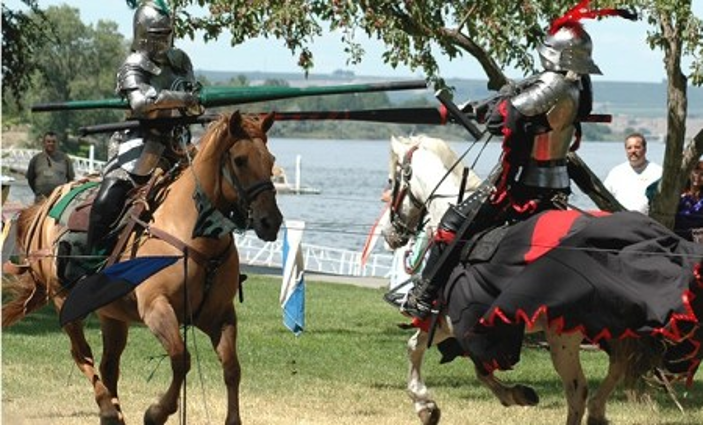
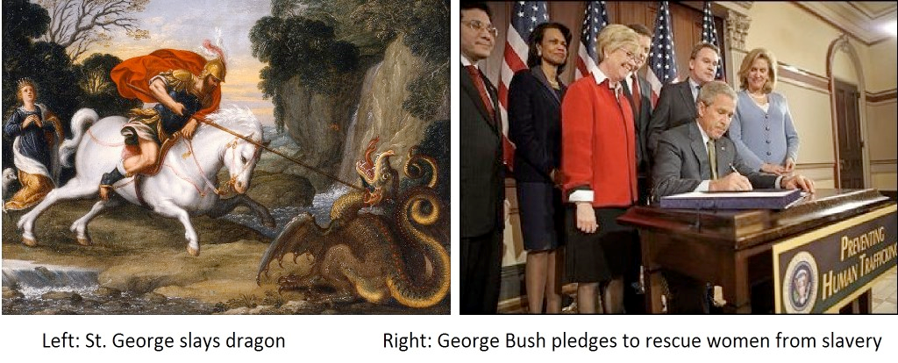
In the chivalric tradition ‘knights’ are viewed as damsel savers. They are the protectors of womankind and the hero of ladies. We first saw them emerge all the way back to medieval politics where, for instance, Jean II Le Maingre – marshal of France and a knight renowned for his military skill – instituted The “Enterprise of the Green Shield with the White Lady,” a chivalric order of knights organized to defend women’s honor in the face of male insults. Inspired by the ideal of courtly love, the stated purpose of the order was to guard and defend the honor, estate, goods, reputation, fame and praise of all ladies.

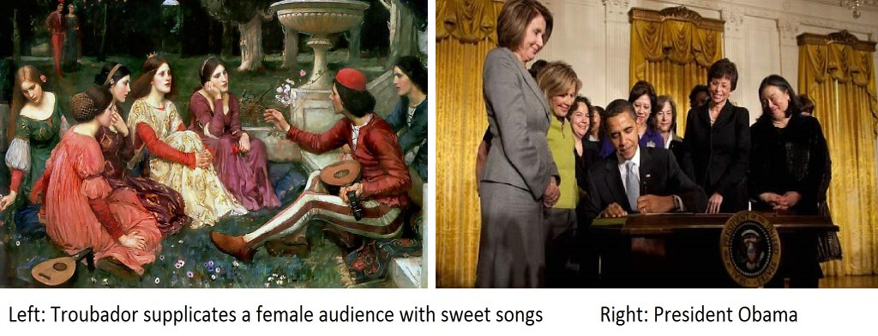
Alternatively, the ‘troubadour’ politician has long been a permanent fixture in western politics, and has his roots in courtly love. He is the singer of sooth songs to female voters. He’s the one who proudly waxes that women can do anything men can do, and do it better, and do it in heels.

This aristocratic crooner emerged in the troubadour revolution of France and Germany. But unlike the chivalric knights who aggressively rescues damsels, the troubadour makes stock and trade of enacting directives from his female superiors.

Medieval literature is rich with stories of such men seeking direction from women, the latter having an endless list of tasks for the troubadour to fulfill before his gynocentric credentials are confirmed. A famous example is Ulrich von Liechtenstein, a German troubadour (minnesinger) who wrote the autobiographical manual “In The Service of Ladies.” Von Liechtenstein’s modus operandi, like that of all troubadours, was to put himself before a lady and ask to be directed.

And then to strut around like a banty rooster, high on his own achievements and hopeful for a pat on the head or even access to the holy of holies.

Has anything changed? Nope. We still see the smugly sacrificing heroics of the alleged right and the sycophancy of the alleged left. We see both as they posture themselves as the advocates for all womankind, throwing men and boys directly into the meat grinder of feminist governance with open abandon.

The knightly politician of today likewise offers to protect women from harm and insult, the benevolent patriarch.

The more sensitive, troubadour-like politician of today offers his to support all female issues and alleviates all female discomforts on instruction from women. He’s an archetypical feminist, SJW and sycophant.

The bottom line? What we live in today is essentially a gynarchy, defined as a political system governed by women or heavily in the interest of women. Some will protest that we don’t live in a gynarchy because most of the political leaders are male, but that would be a superficial conclusion. In her book What’s Right With Feminism Cassandra Langer gives a concise definition that accounts for the proxy role of male leaders: “Gynarchy refers to government by women, or women-centered government.”2

Gynarchy refers to any government advocating female interests, including any establishment of laws and bureaucracies that mostly benefit women, regardless of whether the advocates in question are male or female. Said differently the political system that women govern may actually be staffed by male servants called prime ministers, presidents, or politicians who work on behalf of the of women.3

We can hear the protesters already: But surely the United States has always been governed by and for the dominant patriarchal powers?

No, not according to some early observers.

One of them was cultural critic Max O’Rell who in 1903 observed;

“The government of the American people is not a Republic, it is not a monarchy: it is a gynarchy, a government by the women for the women, a sort of occult power behind the scenes that rules the country.” 4

What O’Rell saw in 1903 was that both sides of politics were serving as liegemen to the female populace – and nothing else.

The solution to this is simple and far from easy. All we need is a healthy percentage of the population, say one or two percent, to look past FOX NEWS and CNN programmed thinking; to look past their own biological impulse to save those who don’t need saving and to engage in a pragmatic, rational examination of modern sexual politics.

We need them to see that the so-called candidates they are so bitterly either defending or attacking are just the same whores wearing different clothing.

Mind you, this is not about right vs left, which is a much more tangible and credible divide.

In American elections there is no right and left, just the pandering to Americans acting like robots with emotion chips that have gone on the fritz.

Whether it is with Lilly Ledbetter, VAWA or any other legislation enjoying round bipartisan support, what Americans have is a single option two party system that gives voters the opportunity to feel warm and fuzzy as they destroy their sons while chanting “You GO Girl”

All it will take is a tenacious, indefatigable minority of people who will simply not allow the lies and the injustice to pass unchallenged.

References:

[1] E. Belfort Bax, The “Monstrous Regiment” of Womanhood (1907)
[2] Cassandra Langer, What’s Right With Feminism, iUniverse, (2001)
[3] Alison Tieman provides a historical example of slave leadership in her video When Slaves Ruled.
[4] The Philadelphia Record, quoting Max O’Rell’s 1903 comments on American women

A historical perspective on why men can’t say NO.

By Paul Elam

Men are only as mentally and emotionally healthy as their ability to say no to a woman. Actually, that bears repeating.

Men are only as mentally and emotionally healthy as their ability to say no to a woman.

Obviously, this does not apply in some areas. Mental health problems won’t be solved by simply finding a woman and uttering the word “no.” Gay men may have a somewhat different perspective about this but they are raised with the same life expectations as straight men so there is no real pass for them either. Quite the contrary.

Still, I will hold to this proposition and do my best to explain it. I can tell a great deal about a man, his boundaries, his values and ultimately his integrity and character with a simple measurement of his obsequiousness with and deference to women.

Romantic Chivalry

To understand all this requires a bit of a history lesson, dating back to the twelfth century and the cultural movement driven by romantic chivalry.

At precisely that moment in history the warrior code was harnessed to the emerging culture of courtly love, an aristocratic invention that saw the military principles of honor, gallantry and service placed in the service of a new Commanders in Chief – courtly ladies.

As historian Jennifer G. Wollock summarizes, “The idea that love is ennobling and necessary for the education of a knight comes out of the lyrics of this period but also in the romances of knighthood. Here the truest lovers are now the best knights.”1

While there is arguable evidence that protection of women and children is a basic male instinct, tied to reproductive access, this is likely the first known time in history where that mandate was codified.

Over a period of a few hundred years, romantic chivalry spread to all the principle courts of Europe and found its way more broadly to lives of everyday men and women who coveted the lifestyle of the upper class. It also fostered a great deal of female privilege and the inescapable neoteny that came with it.

So went the first known institutionalization of pressuring men into a tradition of male servitude – or obsequiousness – toward women that continues unchecked today. Yet it was only the first of three foundational events that would become the prevailing model of gender relations; one that negatively impacts men’s lives and mental health.

The Industrial Revolution

IR-300x233The next developmental watershed in men’s deference to women was the Industrial Revolution. While thrusting humanity into modern civilization, it was the next giant step toward normalizing a standard of mental illness in men where it concerned their relationships with women.

Prior to the Industrial Revolution, men largely worked in or near their homes. They worked as artisans, farmers, producers of livestock, tradesman or some other profession that they passed down to their sons through apprenticeship and mentoring.

While still driven by the force of romantic chivalry, they were as involved in the raising of children as mothers were. Those mothers, by the way, also had laborious duties that were a regular part of their role in the family. With the combined work of both parents and participation of the children, families operated more like business concerns than what you most commonly see today.

Both discipline and nurturing from both parents were immediately present; both male and female influence in the lives of children.

The Industrial Revolution, combined with romantic chivalry, accelerated the problem. The mass migration to cities began. Fathers were removed from the home (and the daily lives of their children) to go into factories and work. And of course one of the first products of that revolution was advanced technology in the home, making the lives of women much safer and less arduous. It also created a lot more free time for women, arguably time for them to become fixated on their emotional needs.

The impact of that on family dynamics hit like a tsunami. Women were left to the increasingly softening work of home and children alone, and left in want of adult company. Husbands returning from long, grueling days of labor returned home to be fed and to rest, without the luxury of making up time they had missed with their families.

In this familial void, women quickly turned to their children, particularly male children, to fill their emotional needs. And fathers, consumed by work and duty, largely just enforced the wishes of the mother on the children. This triggered the second wave of privilege and psychological neoteny in western women and where men, due to resentment over their absence, began to be demonized.

Oedipal Culture

All of this greatly increased the likelihood that mothers would form inappropriate bonds with their male children in order to fill the holes in their lives. In other words, we took a step toward a society of emotional incest.

This is difficult to understate. What I am defining here is a culture of emotionally incestuous bonding between mothers and sons. The implications of that are tremendous, and in fact they seem to have been verified by the following 150 years of technological advancement and cultural malaise.

Perhaps it is not coincidental that the onset of the industrial revolution also saw the first formations of what were known to be “Henpecked Husbands” clubs; groups of men who gathered to use peer pressure to induce each other into tolerating more demands and abuse from their wives.

aaaaaaaaa-300x200The Industrial Revolution gave birth to a new age in civilization. It also ultimately resulted in the breakdown of the family unit as it was once known. The late nineteenth century rang in the Tender Years Doctrine, and with it the first legal presumption that younger children were better off in the care of mothers than fathers. The steamroller did not stop from there, it accelerated. The same glut of time and resources that spawned women to create an emotionally incestuous culture also produced gender feminism, the last and final of a monumentally powerful triad of events that left the majority of men in seemingly helpless servitude to women.

Barely one and a half centuries from the first American factory being built and our culture is all but dominated by a woman-first mentality. So rote and mindless have men become that they allow single mothers to effortlessly continue the spread of emotional incest and other forms of child abuse.

Our boys enter an education system completely dominated by female teachers, all of whom are a product of the same forces that created the new paradigm.

Society, especially the female dominated realms of home and early education, produces males that are highly, often terminally dependent on female approval. By the time boys get more substantial exposure to males, the pattern is set. Not to mention the fact that the males they are exposed to are as dependent on female approval as those who might otherwise provide mentoring. They too, as beta enforcers, put pressure on boys to participate in the incestuous bond as expressed in the schools.

This puts us squarely in an age of crippled masculine identity and the consequential impotence. We have legions of men who have stood by silently while their families have been destroyed in corrupt courts, where our young men are being driven out of education and into fields of combat and where men are more likely to support and enable these travesties than to object to them.

Their silence is the mental health issue of our time and you can see it reflected most clearly in men’s interpersonal relationships with women.

When I co-wrote “Say Goodbye to Crazy,” a book aimed at women who were dealing with the devastation wrought in their relationships by mentally unstable and abusive ex-wives, a substantial part of the focus was directed at husbands who lacked the ability to stand up to their former partners.

That problem is not contained to the second marriages of a handful of men. It is a sweeping societal problem that affects all men.

If you read my last article about male space, you will know that when I gave men in a treatment setting the task of focusing on themselves vs focusing on the women in that community, the immediate reaction was fear. That fear was proven justified when the men and women, both staff and clients of that facility, reacted in anger to the men putting themselves first for a single weekend.

What was also proven was the dire need for men to overcome overwhelming programming and pressure.

With a catastrophic gender suicide gap and a plethora of other problems affecting men, at the root of it is men’s programming to sacrifice their interests, well-being and their boundaries in order to take care of and please women.

They have lost the ability to say no. Indeed they have never had it. They are terrified of the loss implied by the very thought of it. The fact that we have done away with all of our rituals to transition boys into manhood does not help but that will be a topic for a future essay.

Changing Course

Correcting this, reversing the trend, is easier said than done. In fact, it is damned hard work for most, and simply undoable for the many who lack the strength to face and walk through fear on such a primal level. It can, however, be accomplished in stages for the dedicated.

The first stage is Simple Awareness and is by far the easiest. It is just education and can be had as easily as grasping the contents of this writing. When men understand the forces that compel them to please women at any cost, they create the opportunity and motivation to imagine it can be corrected. With that, they can rewrite their future, largely by rewriting their history. More to come on that as well.

The second stage is brutal. There is no other way to put it. It requires men to face the fear of ripping the emotionally incestuous bond; the foundational fear of all men, the fear that most resembles the fear of death. It means putting themselves in the jaws of the beast from which they have to scratch and claw their way out.

Once they have emerged they reach the final and unending stage of walking in the footsteps that were determined by a newly shaped history, sans the Romantic Chivalry, sans the emotional incest and sans the gynocentrism.

I realize that the definitions of these stages are cursory and incomplete. There is much more to them. A more thorough examination is next in this series of essays intended to help men free themselves and their sons from the clutches of a path that was chosen for them in favor of a path that they carve out for themselves.


[1] Jennifer G. Wollock, Rethinking Chivalry and Courtly Love, (Published by Praeger, 2011)

This article was first published at An Ear for Men and republished with permission.